


惯性聚合 高效追踪和阅读你感兴趣的博客、新闻、科技资讯
阅读原文 在惯性聚合中打开

推荐订阅源

Threat Intelligence Blog | Flashpoint
W
WeLiveSecurity
O
OpenAI News
N
News and Events Feed by Topic
K
KPMG report finds enterprise disconnect between AI and its ROI | CIO
cs.CV updates on arXiv.org
Webroot Blog
Webroot Blog
Google Online Security Blog
云风的 BLOG
云风的 BLOG
N
News | PayPal Newsroom
H
Hacker News: Front Page
博客园_首页
Exploit-DB.com RSS Feed
The Last Watchdog
The Last Watchdog
钛媒体:引领未来商业与生活新知
钛媒体:引领未来商业与生活新知
H
Heimdal Security Blog
cs.AI updates on arXiv.org
S
Schneier on Security
宝玉的分享
宝玉的分享
H
Hackread – Cybersecurity News, Data Breaches, AI and More
Recent Commits to openclaw:main
Y
Y Combinator Blog
Cyberwarzone
Cyberwarzone
Microsoft Security Blog
C
CXSECURITY Database RSS Feed - CXSecurity.com
GbyAI
GbyAI
Cloudbric
Cloudbric
TaoSecurity Blog
TaoSecurity Blog
人人都是产品经理
人人都是产品经理
P
Palo Alto Networks Blog
M
MIT News - Artificial intelligence
G
GRAHAM CLULEY
C
Check Point Blog
Apple Machine Learning Research
Last Week in AI
Last Week in AI
T
Troy Hunt's Blog
L
Lohrmann on Cybersecurity
www.infosecurity-magazine.com
P
Proofpoint News Feed
Blog — PlanetScale
Blog — PlanetScale
量子位
博客园 - 聂微东
S
Securelist
博客园 - 三生石上(FineUI控件)
F
Full Disclosure
G
Google Developers Blog
L
LINUX DO - 热门话题
P
Proofpoint News Feed
AI
AI
PCI Perspectives
PCI Perspectives

THP Feed -- all premium articles

Intel Micron commits $500 million to GlobalWafers Anthropic says it can read Claude While the U.S. flip-flops on chip sanctions, China is building its own chip supply market — export controls are creating conditions for a Sino-Russian chip trade alliance Elon Musk receives FTC greenlight to buy Mesh Optical as interconnects emerge as AI Rapidus fab roadmap examined — first new leading-edge chipmaker in decades has one Hokkaido fab, a 2027 deadline, and 60 potential customers SiPearl South Korea Nvidia and Intel tout homegrown American chip supply chain prowess as country bolsters local production, but gaps remain — crucial Blackwell packaging steps remain offshore as projects grow in scope and scale Steam Machine interview full transcript: Valve engineers discuss $1,049 pricing, compact design, component shortages, and Windows support Inside the history of DRAM price-fixing lawsuits — how HBM allocations could make a difference after two decades of failed cases U.S. PC shipments drop 7%, market isn The bifurcated laptop landscape of Computex 2026 – MacBook Neo competitors with 8GB of RAM, and expensive Nvidia laptops promising an agentic-focused future of Windows on Arm Chinese Z.ai Imec Solidigm VP talks PCIe 6.0 SSDs, next-gen floating gate NAND, liquid cooled storage and more — Avi Shetty, VP of AI, Solutions & Market Enablement discusses the future of enterprise storage tech The AI tokenmaxxing party is crashing over spiraling costs — leaked consulting firm audio suggests no one is sure how to measure AI effectiveness US Secures Netherlands for Pax Silica Alliance in key win for strategic chip alliance — tension remains over MATCH Act restrictions China tops the list of fastest supercomputers with a CPU-only behemoth, ending US champion El Capitan Arm servers capture over 45% of data center market revenue — GPU clusters and high-end AI infrastructure fuel a tectonic shift away from x86 Post-silicon era gets closer as industry giants crack the 2D transistor scaling bottleneck with breakthrough tech — imec, ASML, and TSMC fab complementary 2D-material transistors at 50nm pitch on a 300mm wafer Ditching the cloud for local AI — how I use two mini PCs to process millions of tokens a day and save money on costly API fees Intel US pulls the Intel AMD’s massive SP7 socket for EPYC Venice and Intel’s gargantuan 9,324-pin socket for Diamond Rapids appear at Computex — SP7 and LGA9324-1 sockets will power the next generation of AI servers Marvell details vision of optically-interconnected data centers spanning across thousands of kilometers — new interconnects sampling later this year would allow CSPs to pool resources based on workload Nvidia's high-speed AI data center storage servers break cover, touting 2.9 petabytes of storage and extreme PCIe 6.0 performance — Wiwynn shows off SCADA server with GPU-accelerated storage AI is set to consume up to 600 billion gallons of water by 2030 — rising energy consumption primarily to blame as… Google reportedly books Intel for packaging more than 3 million TPUs in 2028 — SK hynix is testing Intel's… Analyzing TSMC's fab expansion roadmap — multi-fab N2 ramp, CoWoS, SoIC, and uncorking bottlenecks Anthropic's warning over AI self-improvement has a hidden message — accelerating development requires more compute before companies ever risk losing control of frontier AI models Demand for data center CPUs has surged, and AI agents are responsible – why the CPU to GPU ratio is more important… Executives are cutting jobs for an AI future that hasn't fully arrived yet, even as productivity gains remain difficult to prove — data neither confirms nor refutes an AI unemployment apocalypse Tom's Hardware Unfiltered: Computex 2026, Day 4 — the B2B shift, and we say farewell to Taipei Qualcomm Roundtable Interview transcript — SVP of Compute and Gaming talks Snapdragon C, RTX Spark, and the… AMD's Helios MI455X AI platform breaks cover, initial systems use UALink-over-Ethernet interconnects — AMD's Vera Rubin rival surfaces, but the downsides of Ethernet could hamstring performance Frore shows off LiquidJet Nexus coldplate for Nvidia Vera Rubin, other AI accelerators — offers up claimed 10% token generation boost over rival liquid-cooling solutions Tom's Hardware Unfiltered: Computex 2026, Day 3 — the heat bites as our team races across Taipei Tom's Hardware Unfiltered: Computex 2026, Day 2 — Interviews, roundtables, and the first day at the Nanggang… The rise of local agentic computing faces a brutal reality: rising DRAM prices —  RTX Spark, Gorgon Halo chips subject to 63% DRAM contract price hike this quarter Astera Labs showcases 320-lane PCIe 6.0 switch for vendor-agnostic scaling in data centers — up to 80 accelerators… Intel Xeon 6+ Computex roundtable interview transcript — Kira Boyko and Tim Wilson on 18A wafer allocation, Clearwater Forest, and dropping hyper-threading Tom's Hardware Unfiltered: Computex 2026, Day 1 — night markets, taking the MRT train, and a slew of demos Intel Arc G3 interview transcript — Intel's Senior Product Director talks new handheld chips, Arrow Lake… Qualcomm aims Snapdragon C laptop chip at the budget laptop segment, as manufacturers feel the DRAM squeeze —  analysts warn sub $500 laptop market may disappear before 2028 Access Tom’s Hardware Premium’s Computex 2026 coverage for free — sign up for an account to read… Tom's Hardware Unfiltered: Computex 2026, Day 0 — peek behind the curtain to see how we're covering the… Trailing-edge foundry roadmaps for GlobalFoundries, UMC, and SMIC — mature node chipmakers each pursue differing… AI costs begin to bite as agents may increase token demand by 24 times, says Goldman Sachs report — Uber and Microsoft among companies feeling the bite of tokenized billing IBM spins off America's first quantum chip foundry with $2 billion in federal and private funding — newly-minted 'Anderon' foundry to offer 300mm quantum wafer fab and manufacturing services Imec builds world's first High-NA EUV-fabricated quantum dot qubit device — breakthrough could pull quantum computing onto the same manufacturing roadmap as next-gen AI processors, compressing timelines Analyst says Nvidia poised to capture two-thirds of the x86 server CPU market from Intel and AMD with expected $20 billion in revenue — 'Nvidia is already on track' to deliver 4 million Vera CPUs in FY2027 AI is starting to out-design chip engineers in narrow areas as LLMs accelerate software chip design tool development — "There is still a lot of human guidance" says Berkley researcher The custom AI ASIC state of play (May 2026) — Broadcom deals, Google TPUs, Meta MTIA & beyond Memory makers brace for hydrogen fluoride pricing shock as Hormuz blockade impacts supply chain — key etching and cleaning material faces sharp cost increase amid trade disruption SMIC founder and AMEC CEO urge Chinese fabs to test domestic chipmaking tools on active production lines — equipment makers post record revenue but falling margins Why now is the best time to jump on the OLED monitor bandwagon — breaking down new-gen panel tech and our top… Musk's Colossus 1 AI supercomputer's inefficient mixed-architecture design couldn't be used to train Grok, so Anthropic's using it for inference instead — Musk readies unified Blackwell-only Colossus 2 for frontier training and potential IPO Leading-edge foundry roadmaps for TSMC, Intel and Samsung — outlining the path to 1.4nm nodes and beyond Japanese chemical giant JSR expands to Taiwan for EUV photoresist production near TSMC — plant to fill missing… Why building a quiet PC is harder than you think — what to know, and how to make your rig quieter The tech industry is moving faster than ever. Keep up with Tom’s Hardware Premium, available from just $7 per… Arm's $2 billion in AGI CPU sales are still not enough to penetrate 5% of overall market share, analyst reveals — at least $90 million worth of CPUs to be shipped before FY2027 The Middle East had everything data center builders and hyperscalers could wish for — then the Iran war happened White House reportedly considers mandatory government vetting of AI models before release — executive order under… High-capacity HDD roadmap: the race to 100TB and zettabyte-scale storage — Toshiba, Seagate and WD outline three… Survey shows that nearly half of Americans don't want new data centers built near their homes — 47% oppose… Huawei braces for $12 billion in AI chip revenue driven by homegrown AI model demand —  Chinese fabs can barely keep up as Nvidia's market share craters within the region Steam Controller interview full transcript — Valve programmer and engineer discuss design, latency, prototyping, and the joys of not having a kernel driver Skyrocketing component prices push Big Tech capex to record $725 billion — Microsoft alone attributes $25 billion of AI budget to increased memory and chip costs ASML's roadmap for chipmaking lithography tools examined — from DUV to Low-NA, High-NA, Hyper-NA, and beyond Talent over tokens: AI models are becoming more expensive to run, and productivity gains are limited — efficient workers might be the solution to strained budgets Meta's multi-billion-dollar Graviton deal highlights intensifying CPU shortages in AI infrastructure — the industry signals a shift to Agentic inference workloads, pushing demand TSMC SoIC 3D stacking roadmap outlines path from 6-micron pitches today to 4.5-micron in 2029 — Fujitsu's… OpenAI and Microsoft The GeForce RTX 30-series upgrade matrix — does your Ampere GPU need an upgrade in 2026? Inside Google TSMC How a cavalcade of blunders gave unauthorized users access to Claude Mythos — restricted model accessed by third parties, thanks to knowledge from data breach Congress moves to strip the DoC of chip-export discretion with the MATCH Act — DUV lithography machines among those targeted in chipmaking tool crackdown Showstopper Build: Greyscale — building a custom-looped ITX PC that pushes the form factor to its limits Testing PC games using FEX on a high-end Android tablet can yield playable results — but the early tech is still… Chinese chipmakers made record profit in 2025, despite slipping margins — U.S shipments fall 34% as Beijing shores up local chipmaking efforts Local political revolts threaten to derail US data center projects — mounting delays are already costing AI hyperscalers billions Quantum photonics roadmap — how Xanadu and PsiQuantum are looking to transfer qubits through beams of light YMTC Anthropic Our experts review your astonishing PC builds and setups in Rig Rundown — from wall-mounted setups to a system… Why we spent 50+ hours retesting Intel’s Core Ultra 270K Plus and 250K Plus Anthropic's Claude Mythos isn't a sentient super-hacker, it's a sales pitch — claims of 'thousands' of severe zero-days rely on just 198 manual reviews Intel's EMIB-T packaging technology set for fab rollout this year — as TSMC CoWoS capacity remains limited, EMIB-T is preparing for advanced AI accelerator designs A brief history of Denuvo DRM and the new hypervisor bypass — inside the cat-and-mouse game between Denuvo and the… PCI Express roadmap: The path to 1TB/s with PCI 8.0, the challenges of integration, and beyond Why TSMC grew four times faster than its foundry rivals in 2025 — price hikes, vertical integration, and commanding technology lead pay dividends WD Innovation Day 2026 press Q&A transcript: roadmap plans to reach 60TB with ePMR and 100TB via HAMR by 2029 — 'at some point, the laws of physics will require us to transition to HAMR' America’s AI chip rules keep changing — and the rest of the world is paying the price Here’s what the FCC ban on foreign-manufactured routers actually means for consumers China's homegrown silicon suppliers gain traction as Nvidia struggles to get its chips into the market — Huawei, Cambricon and more step up to fill crucial market gap Why Nvidia just poured $2 billion into AI ASIC competitor Marvell — NVLink Fusion turns into soft ecosystem…
Nvidia's RTX Spark could caplitalize where Qualcomm's Arm-based efforts have not —  following the expiration of Qualcomm's Windows on Arm deal, Nvidia stands poised to pick up the slack
Luke James · 2026-06-02 · via THP Feed -- all premium articles
Nvidia RTX Spark
(Image credit: Getty / I-Hwa Cheng)

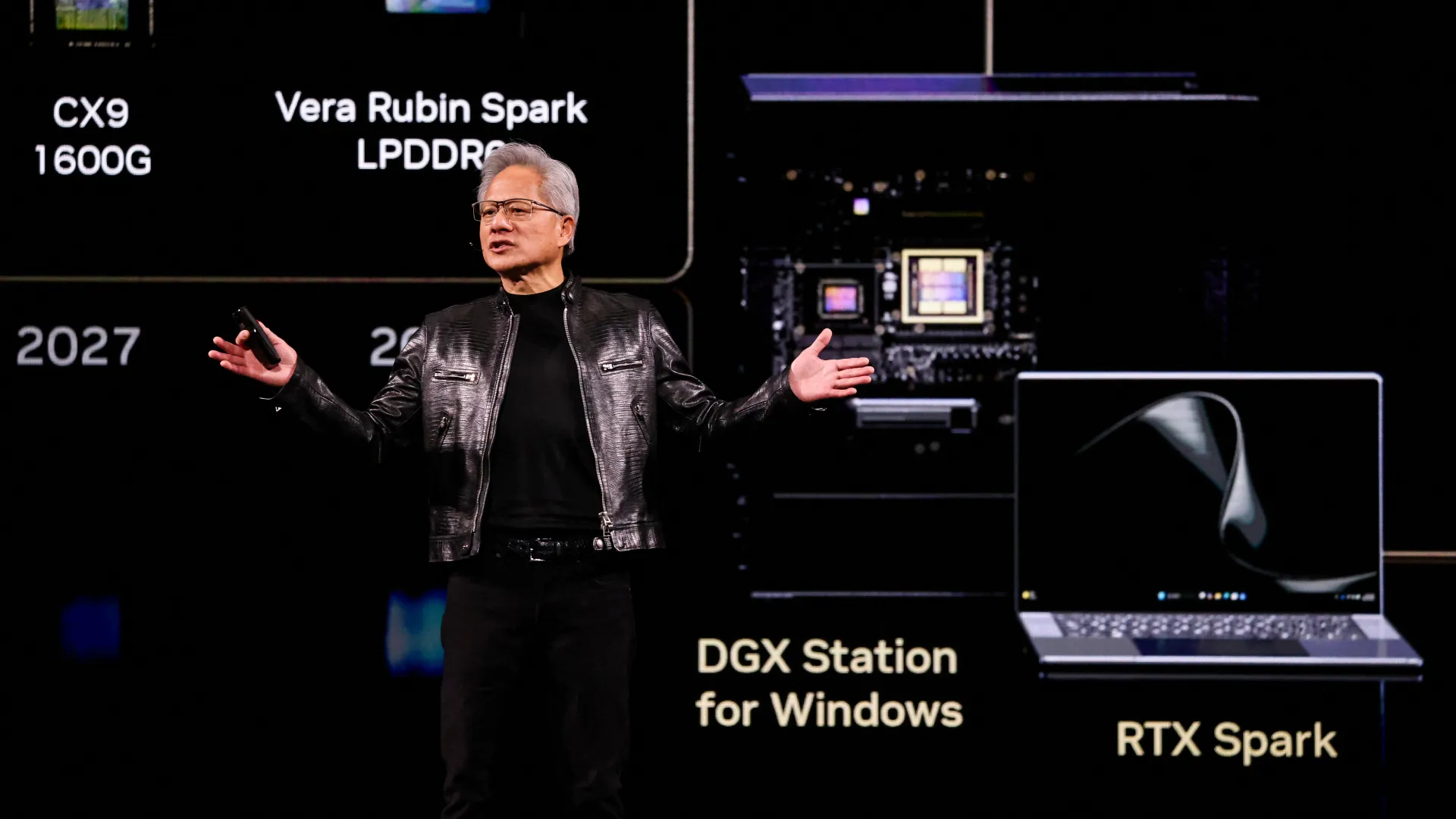
Nvidia unveiled the RTX Spark superchip on May 31st ahead of its GTC Taipei event, and right before Computex 2026. The device packs a 20-core Arm-based Grace CPU and a Blackwell RTX GPU on a single package and points it at the one corner of computing where the company has never had a foothold: the Windows PC.

The chip carries up to 128GB of unified memory, a claimed 1 petaflop of AI compute, and 6,144 CUDA cores, and it ships this fall in laptops and compact desktops from ASUS, Dell, HP, Lenovo, Microsoft Surface, and MSI, with Acer and GIGABYTE to follow. Microsoft is named as a co-developer, not just an OS supplier, having built new Windows security primitives to run on-device AI agents alongside Nvidia's OpenShell runtime. Branded as RTX Spark, it’s the chip the industry has spent three years calling N1X.

"For forty years, you launched apps. Click. Type. With RTX Spark and Microsoft Windows, you ask, and the PC does the work," said CEO Jensen Huang. Running 120-billion-parameter LLMs with up to 1 million tokens of context, RTX Spark can render 90GB 3D scenes and play AAA games at 1440p above 100 frames per second, all on a chip whose CPU was half engineered by smartphone SoC vendor MediaTek.

‘A new era of PC’

RTX Spark hasn’t come out of nowhere; it’s the consumer-oriented sibling of the GB10 Grace Blackwell superchip already shipping inside the Linux-based DGX Spark mini-PC, which carries a price tag currently approaching $5,000 due to memory shortage-related pricing pressure. The GB10 pairs a MediaTek-produced Arm CPU complex with a Blackwell GPU on a TSMC 3nm-class node, joined by Nvidia's coherent NVLink-C2C interconnect and fed by a shared 128GB pool of LPDDR5X. RTX Spark takes that architecture and repurposes it for Windows.

We first began to hear about the RTX Spark under its N1X codename back in 2023, when it was reported that Nvidia was developing Arm CPUs capable of running Windows. The chip appeared repeatedly through 2024 and 2025 via the rumor mill, with various delays attributed to factors including Microsoft’s slow next-gen work on Arm and soft notebook demand, pushing a planned second-half-2025 debut into this year.

For eight years, Microsoft's Windows on Arm program ran exclusively on Qualcomm silicon under a partnership that locked out every other chipmaker. Microsoft chose Qualcomm in 2016, and until the deal lapsed, no rival could ship an Arm chip in a Windows PC. Arm CEO Rene Haas confirmed in an interview in January 2024 that Qualcomm's exclusivity with Microsoft would lapse that year, the first on-record acknowledgment from a principal after years of the deal being treated as an open secret. Reuters had reported in 2024 that MediaTek, Nvidia, and AMD were all building Arm Windows chips to enter once the window opened.

Microsoft's role in RTX Spark goes deeper than the Copilot+ certification program it handed Qualcomm, however. The two companies built the agent security stack together at the operating-system level: identity, containment, and policy primitives in Windows, paired with OpenShell's ability to route queries to local models based on a user's privacy rules and to mask personal information in queries sent to the cloud.

Satya Nadella, chairman and CEO of Microsoft, said the launch will deliver "unmetered intelligence to every home and every desk with Windows,” an outwardly materially closer integration than the Snapdragon X program ever received.

Windows on Arm

Qualcomm spent its eight years of exclusivity demonstrating that Windows on Arm could work, but failing to make it sell. Snapdragon X laptops moved roughly 720,000 units in the third quarter of 2024, their first full quarter on sale, which Canalys data put at about 0.8% of PC shipments that quarter. ABI Research projected Arm wouldn’t clear 13% of the PC market in 2025. Qualcomm's own counter-figures were heavily conditioned: CEO Cristiano Amon's "more than 10%" share claim, made on the company's Q1 2025 earnings call, covered only U.S. retail Windows laptops priced above $800 in a single quarter.

A big factor behind this lacklustre performance was software issues. Microsoft’s Prism runs x86 apps on Arm, but in our own analysis of Snapdragon X2 Elite Extreme, we found that professional tools like AutoCAD were unsupported, and games crashed or rendered incorrectly under emulation. The original Snapdragon X pitch leaned heavily on battery life as a huge differentiator, but then Intel's Lunar Lake matched that efficiency, giving buyers long battery life on x86 chips that run every Windows app natively, with no emulation and none of the slowdowns or crashes that came with it. Ultimately, Arm's share of Windows never reached the 50% within five years that Arm and Qualcomm had floated back in 2024.

Two familiar problems

Unlike Qualcomm, Nvidia isn’t selling battery life. RTX Spark's USP is the GPU, CUDA, and the 128GB unified memory pool, hardware aimed at local AI, agents, creators, and gamers rather than all-day portability. Adobe is rearchitecting Photoshop and Premiere for the platform with a claimed two-times uplift in AI and editing workflows, and over 100 Windows software vendors, plus game developers including KRAFTON, NetEase, Remedy Entertainment, Riot Games, and Microsoft Xbox are listed as backing the platform.

Two problems dogged Windows on Arm for nearly a decade that won’t simply disappear with a faster chip, though. First: x86 emulation. Any application without a native Arm build still runs via Prism, and that has meant performance penalties and outright failures across the Snapdragon era.

Nvidia's full CUDA and RTX stack is native, which helps AI and graphics workloads, but says nothing about the long tail of legacy Windows software and peripheral drivers. The second problem is Microsoft itself: its slow progress on the next-gen Windows on Arm platform was cited as a primary cause of the N1X delays, and developers won’t be getting the full picture of the Windows agent features until Microsoft's Build keynote on June 2nd and 3rd, days after the chip was announced.

As for pricing, we’ve got nothing on that yet. The only reference point is the DGX Spark's $3,999 desktop baseline, a figure that’s now approaching $5,000 but also heavily inflated by enterprise networking hardware that consumer-grade devices will omit. That said, LPDDR5X memory costs and TSMC 3nm manufacturing both point toward premium pricing rather than the sub-$700 bracket Qualcomm targeted to broaden Arm's reach.

With the RTX Spark, Nvidia is opening a door that Qualcomm could only pry at, carrying the one asset it never had, and inheriting compatibility and OS dependencies that no amount of compute can resolve on its own.

Luke James is a freelance writer and journalist.  Although his background is in legal, he has a personal interest in all things tech, especially hardware and microelectronics, and anything regulatory.