



惯性聚合 高效追踪和阅读你感兴趣的博客、新闻、科技资讯
阅读原文 在惯性聚合中打开

推荐订阅源

爱范儿
爱范儿
Y
Y Combinator Blog
博客园 - Franky
D
Docker
B
Blog RSS Feed
M
MIT News - Artificial intelligence
雷峰网
雷峰网
博客园 - 司徒正美
人人都是产品经理
人人都是产品经理
宝玉的分享
宝玉的分享
S
SegmentFault 最新的问题
GbyAI
GbyAI
Recent Announcements
Martin Fowler
Martin Fowler
H
Hackread – Cybersecurity News, Data Breaches, AI and More
MyScale Blog
MyScale Blog
B
Blog
H
Help Net Security
Microsoft Security Blog
WordPress大学
WordPress大学
Vercel News
Vercel News
The Cloudflare Blog
OSCHINA 社区最新新闻
OSCHINA 社区最新新闻
Google DeepMind News

Latest from Tom's Hardware in Artificial-intelligence

Microsoft says 'Transformation Paradox' holding back AI adoption in the workplace — 45% of respondents say it's safer to focus on current goals, rather than AI innovation Palantir co-founder Peter Thiel backs $140M wave-powered AI data center startup — Panthalassa aims to run offshore… Google, Microsoft, and xAI agree to let US government test AI models before public release — OpenAI and Anthropic also on board after renegotiating deals with Washington Nvidia CEO Jensen Huang says China should not have Blackwell or Rubin AI GPUs — firmly states US should have 'the first, the most, and the best' when it comes to AI hardware China pushes for 70% homegrown silicon wafer use as domestic firm ramps up 12-inch production — government seeking to localize critical chip supply chain amid AI boom and export restrictions Intel swipes Qualcomm veteran of 25 years to lead client computing — Alex Katouzian jumps ship to oversee consumer… Trump administration considers mandatory pre-release vetting of AI models — Anthropic's Mythos cited as… Nvidia's exposure to Asian supply chains for components hits 90% of its production costs — marked increase from 65% could intensify as physical AI adds even more exposure Anthropic in early talks to buy DRAM-less AI inference chips from UK startup — Fractile's SRAM architecture reduces need for pricey memory during extreme pricing and shortage crunch Chinese court rules companies can't fire workers just because AI is cheaper — ruling says automation alone… Jensen says Nvidia now has 'zero percent' market share in China — says US export policy 'has… US Navy signs deal with AI firm for training underwater drones to detect mines in Strait of Hormuz — $100 million would allow drone minesweepers to update their detection algorithms in days instead of months The Pentagon announces AI deals with OpenAI, Google, Microsoft, Amazon, Nvidia, and more — LLMs to be deployed on classified Department of War networks ‘for lawful operational use’ SoftBank plans robotics and AI firm in the US to build data centers — aims for $100 billion valuation and an IPO… Huawei could seize China’s AI chip crown in 2026 as Nvidia's H200 shipments stall in regulatory limbo — Beijing pushes homegrown AI hardware dominance in a market projected to hit $67 billion by 2030 Talent over tokens: AI models are becoming more expensive to run, and productivity gains are limited — efficient workers might be the solution to strained budgets Samsung and SK hynix warn AI-driven memory shortages could last until 2027 and beyond, as HBM demand explodes — customers already reserving supply years ahead, while the wider DRAM market begins to tighten Victim of AI agent that deleted company's entire database gets their data back — cloud provider recovers critical files and broadens its 48-hour delayed delete policy Exploding number of AI data center build-outs delay Texas housing projects — data centers' high demand for electricians prices out contractors, homes now take two months longer to complete Meta's multi-billion-dollar Graviton deal highlights intensifying CPU shortages in AI infrastructure — the industry signals a shift to Agentic inference workloads, pushing demand OpenAI has effectively abandoned first-party Stargate data centers in favor of more flexible deals — company now prefers to lease compute and says Stargate is an umbrella term Google signs classified Pentagon AI deal but exits $100 million drone swarm program — report claims employees revolted over ethical fears, delivered letter to CEO Pichai Nvidia exec says AI is more expensive than actual workers — yet some companies don't see the extra costs as a… Meta will beam sunlight from space to power AI data centers, solar-collecting satellites will orbit 22,000 miles above Earth — firm reserves 1 Gigawatt of orbital solar energy and 100 Gigawatt-hours of long-duration storage Market slumps as OpenAI reportedly misses internal targets for active users and revenue — Nvidia, Oracle, AMD, and CoreWeave shares all tremble on the news OpenAI and Microsoft News site linked to OpenAI super PAC sent bots posing as journalists to interview real people — site has published nearly 100 articles with real quotes gathered by fake writers Claude-powered AI coding agent deletes entire company database in 9 seconds — backups zapped, after Cursor tool… DeepSeek launches 1.6 trillion parameter V4 on Huawei chips as U.S. escalates AI theft accusations — U.S. gov't alleges IP theft by DeepSeek and other Chinese AI firms NEO Semiconductor's revolutionary 3D X-DRAM for AI processors has passed proof-of-concept validation — company secures funding to develop next-gen memory HBM alternative
AI cryptomining network's 320,000 RTX 3090-class GPUs all...
Etiido Uko · 2026-06-14 · via Latest from Tom's Hardware in Artificial-intelligence
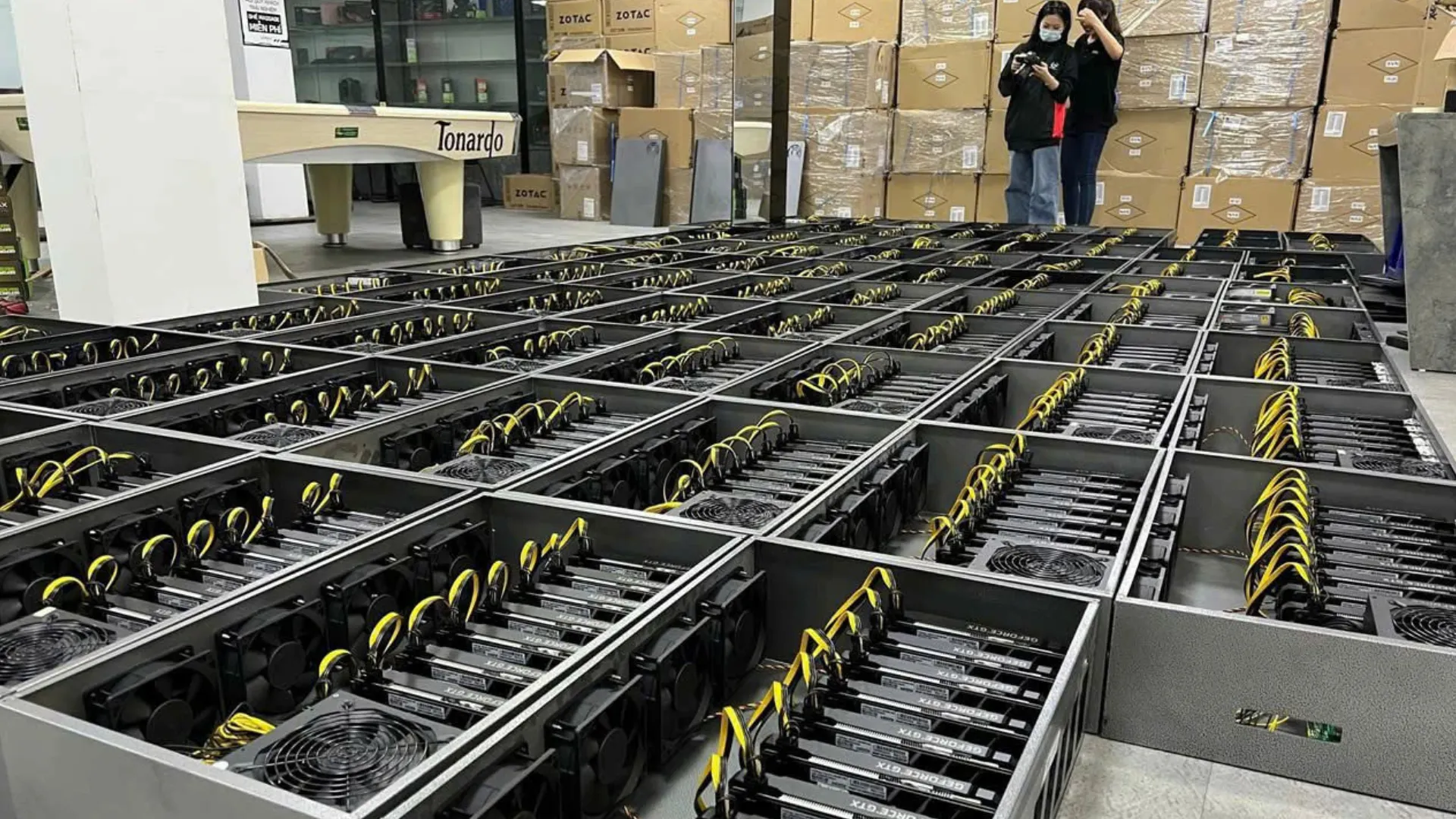
Crypto mining rigs for the cryptocurrency Pearl
(Image credit: @I_Leak_VN via X.com)

A new research preprint claims that Pearl, a Layer-1 blockchain marketed as turning cryptocurrency mining into useful artificial intelligence (AI) computation, is doing nothing of the sort, despite having recently triggered a GPU mining rush. The study estimates Pearl's network runs at roughly 24 exahashes per second (EH/s) — the equivalent of about 320,000 RTX 3090-class GPUs drawing an estimated 112 megawatts (MW) — all while producing "zero useful AI computation." Researchers saw a roughly 38% jump in budget GPU rental prices on the marketplace vast.ai go to Pearl mining, with utilization climbing from 57% to 94% after the mining software went public in May.

Instead of performing real inference or training, the paper, titled The Usefulness Gap in Proof-of-Useful-Work, says the network grinds through random matrix multiplications that merely take the shape of AI math. The self-billed “first empirical measurement of a deployed Proof-of-Useful-Work (PoUW) system” study argues that Pearl’s mining protocol verifies that miners performed matrix multiplication correctly, but does not verify whether that work came from real AI training or inference workloads.

Pearl swaps Bitcoin's SHA-256 hashing for a scheme it calls cuPOW, which asks miners to compute noised integer matrix multiplications and prove they did so correctly. That operation is the same arithmetic that underpins neural network inference and training, which is the foundation of Pearl's pitch that mining and AI compute can be one and the same job. The problem, according to the study, is that the protocol's verification step only confirms that the multiplication was performed correctly. It never checks whether the input matrices came from a real model, a paying customer, or any AI workload at all.

To demonstrate that gap, the researcher, Abhinaba Basu, built a miner that feeds the network uniformly random matrices with no inference attached, then submitted the output to a mining pool. The paper reports 44 pool-accepted shares on Nvidia and AMD hardware, with the same miner also benchmarked on a CPU and Apple Silicon, plus an on-chain payout earned by running the standard mining software unmodified. If random numbers collect rewards as readily as genuine AI work, the argument runs, then the network cannot tell the two apart, and miners have every incentive to skip the AI part entirely.

Basu also analyzed 8,012 workers in a single pool, representing about 21% of Pearl's hashrate, and found that all of them ran hardware capable of AI inference. Yet, the dominant mining binary contained no identifiable code for any machine-learning framework. That binary analysis relies on string inspection, which the paper notes can be defeated by stripped or obfuscated code, so the finding is offered as strong evidence rather than outright proof. Runtime profiling pointed the same way, with the miners showing heavy compute use and light memory-bandwidth use, a signature consistent with pure matrix math and inconsistent with the memory-hungry behavior of transformer inference.

For GPU buyers, the resource angle is the part that stings. The study attributes a roughly 38% jump in budget GPU rental prices on the marketplace vast.ai to Pearl mining, with utilization climbing from 57% to 94% after the mining software went public in May. Using a difference-in-differences comparison against pricier datacenter cards, Basu estimates around $600,000 per year in additional rental costs borne by independent researchers who compete for the same cheap hardware. However, he cautions that the figure depends on assumptions about how stable prices were beforehand. At PRL's recent price near $0.76, the paper calculates that mining is marginally profitable on budget cards such as the RTX 3060 Ti and roughly breakeven on an RTX 3090.

The work also chips away at the assumption that Pearl mining is an Nvidia-only affair. Basu reports the first Pearl shares ever mined on non-Nvidia hardware, driving an AMD Instinct MI300X at 10.6 million tiles per second, faster than the closed-source Nvidia miner managed on an RTX 3090, and benchmarking the same workload on a server CPU and on an Apple M2 through Metal compute shaders. Because the computation is commodity integer arithmetic, the paper argues there is no vendor lock-in and no technical reason for the work to remain on any one company's silicon.

Get Tom's Hardware's best news and in-depth reviews, straight to your inbox.

Pearl may have a ready response, but the study takes it on directly. Together AI, which announced an exclusive partnership in May, framed the deal as letting "every GPU cycle powering AI training and inference" also mint the PRL token, and it now offers a discounted Gemma-4-31B-it-pearl inference endpoint subsidized by mining proceeds. Basu counters that this is financial arbitrage rather than useful mining, because Together AI's own GPUs perform that inference separately from the mining network, with PRL revenue used to trim the endpoint's price. The 8,012 mining workers he measured, he says, produced none of that inference themselves.

The study’s conclusion is not that Proof-of-Useful-Work is impossible, but that Pearl’s current design leaves a major enforcement gap. The protocol enables useful work in theory, but it does not require it in practice. That leaves Pearl in an uncomfortable middle ground — it performs real computation, but according to the paper, the network currently has no way to prove that the computation is useful AI work rather than cryptomining with AI-shaped math.

Google Preferred Source

Follow Tom's Hardware on Google News, or add us as a preferred source, to get our latest news, analysis, & reviews in your feeds.

Etiido Uko is a news contributor for Tom's Hardware covering the latest updates in big tech and the PC industry. He is a mechanical engineer and senior technical writer with over nine years of experience in documentation and reporting. He is deeply passionate about all things engineering and technology, and is an expert in gadgets, manufacturing, robotics, automotive, and aerospace.