

惯性聚合 高效追踪和阅读你感兴趣的博客、新闻、科技资讯
阅读原文 在惯性聚合中打开

推荐订阅源

让小产品的独立变现更简单 - ezindie.com
WordPress大学
WordPress大学
人人都是产品经理
人人都是产品经理
Engineering at Meta
Engineering at Meta
小众软件
小众软件
I
InfoQ
有赞技术团队
有赞技术团队
Cyber Security Advisories - MS-ISAC
Martin Fowler
Martin Fowler
月光博客
月光博客
雷峰网
雷峰网
aimingoo的专栏
aimingoo的专栏
云风的 BLOG
云风的 BLOG
Last Week in AI
Last Week in AI
OSCHINA 社区最新新闻
OSCHINA 社区最新新闻
S
SegmentFault 最新的问题
The GitHub Blog
The GitHub Blog
Y
Y Combinator Blog
V
Visual Studio Blog
博客园 - 叶小钗
钛媒体:引领未来商业与生活新知
钛媒体:引领未来商业与生活新知
GbyAI
GbyAI
P
Proofpoint News Feed
Apple Machine Learning Research

Latest from Tom's Hardware in Artificial-intelligence

Microsoft says 'Transformation Paradox' holding back AI adoption in the workplace — 45% of respondents say it's safer to focus on current goals, rather than AI innovation Palantir co-founder Peter Thiel backs $140M wave-powered AI data center startup — Panthalassa aims to run offshore… Google, Microsoft, and xAI agree to let US government test AI models before public release — OpenAI and Anthropic also on board after renegotiating deals with Washington Nvidia CEO Jensen Huang says China should not have Blackwell or Rubin AI GPUs — firmly states US should have 'the first, the most, and the best' when it comes to AI hardware China pushes for 70% homegrown silicon wafer use as domestic firm ramps up 12-inch production — government seeking to localize critical chip supply chain amid AI boom and export restrictions Intel swipes Qualcomm veteran of 25 years to lead client computing — Alex Katouzian jumps ship to oversee consumer… Trump administration considers mandatory pre-release vetting of AI models — Anthropic's Mythos cited as… Nvidia's exposure to Asian supply chains for components hits 90% of its production costs — marked increase from 65% could intensify as physical AI adds even more exposure Anthropic in early talks to buy DRAM-less AI inference chips from UK startup — Fractile's SRAM architecture reduces need for pricey memory during extreme pricing and shortage crunch Chinese court rules companies can't fire workers just because AI is cheaper — ruling says automation alone… Jensen says Nvidia now has 'zero percent' market share in China — says US export policy 'has… US Navy signs deal with AI firm for training underwater drones to detect mines in Strait of Hormuz — $100 million would allow drone minesweepers to update their detection algorithms in days instead of months The Pentagon announces AI deals with OpenAI, Google, Microsoft, Amazon, Nvidia, and more — LLMs to be deployed on classified Department of War networks ‘for lawful operational use’ SoftBank plans robotics and AI firm in the US to build data centers — aims for $100 billion valuation and an IPO… Huawei could seize China’s AI chip crown in 2026 as Nvidia's H200 shipments stall in regulatory limbo — Beijing pushes homegrown AI hardware dominance in a market projected to hit $67 billion by 2030 Talent over tokens: AI models are becoming more expensive to run, and productivity gains are limited — efficient workers might be the solution to strained budgets Samsung and SK hynix warn AI-driven memory shortages could last until 2027 and beyond, as HBM demand explodes — customers already reserving supply years ahead, while the wider DRAM market begins to tighten Victim of AI agent that deleted company's entire database gets their data back — cloud provider recovers critical files and broadens its 48-hour delayed delete policy Exploding number of AI data center build-outs delay Texas housing projects — data centers' high demand for electricians prices out contractors, homes now take two months longer to complete Meta's multi-billion-dollar Graviton deal highlights intensifying CPU shortages in AI infrastructure — the industry signals a shift to Agentic inference workloads, pushing demand OpenAI has effectively abandoned first-party Stargate data centers in favor of more flexible deals — company now prefers to lease compute and says Stargate is an umbrella term Google signs classified Pentagon AI deal but exits $100 million drone swarm program — report claims employees revolted over ethical fears, delivered letter to CEO Pichai Nvidia exec says AI is more expensive than actual workers — yet some companies don't see the extra costs as a… Meta will beam sunlight from space to power AI data centers, solar-collecting satellites will orbit 22,000 miles above Earth — firm reserves 1 Gigawatt of orbital solar energy and 100 Gigawatt-hours of long-duration storage Market slumps as OpenAI reportedly misses internal targets for active users and revenue — Nvidia, Oracle, AMD, and CoreWeave shares all tremble on the news OpenAI and Microsoft News site linked to OpenAI super PAC sent bots posing as journalists to interview real people — site has published nearly 100 articles with real quotes gathered by fake writers Claude-powered AI coding agent deletes entire company database in 9 seconds — backups zapped, after Cursor tool… DeepSeek launches 1.6 trillion parameter V4 on Huawei chips as U.S. escalates AI theft accusations — U.S. gov't alleges IP theft by DeepSeek and other Chinese AI firms NEO Semiconductor's revolutionary 3D X-DRAM for AI processors has passed proof-of-concept validation — company secures funding to develop next-gen memory HBM alternative
SpaceX unveils 11-million-square-foot Gigasat factory, a ...
Etiido Uko · 2026-06-09 · via Latest from Tom's Hardware in Artificial-intelligence
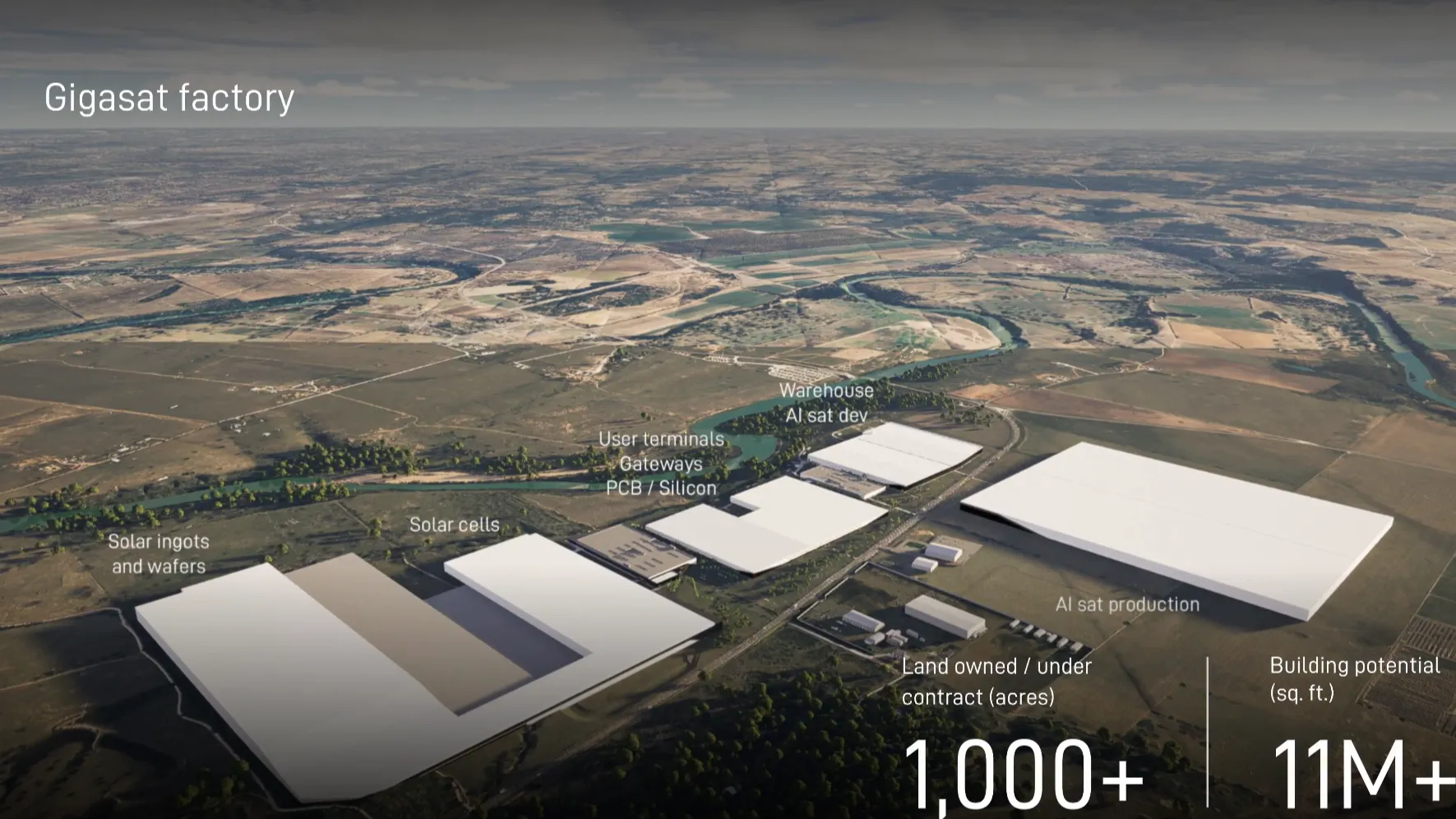
SpaceX Gigasat factory
SpaceX Gigasat factory (Image credit: SpaceX)

SpaceX has announced a new 11-million-square-foot Gigasat factory in Bastrop, Texas, dedicated to building the infrastructure needed to achieve the company's orbital data center goal. In an internally conducted interview posted on X on June 8, SpaceX CEO Elon Musk confirmed that the facility is expected to begin producing complete "AI satellites" by 2027. The company is targeting 1 gigawatt (GW) of orbital AI compute capacity by the end of next year, with plans to scale that figure by an order of magnitude annually thereafter.

Go deeper with TH Premium: AI and data centers

During the interview, Musk unveiled the build and specs of the proposed AI1 satellite, the company’s take on orbital data centers. The satellite will span roughly 70 meters (229.66 feet), with a massive solar array — generating power at a density of 250 W/m² — making up the bulk of the structure. AI1 will also feature vertically oriented, double-sided radiators for cooling, with the 150-kilowatt (kW) peak compute payload positioned right in the middle of the structure.

The massive 11-million-square-foot Gigasat facility — more than ten times larger than Starfactory, SpaceX's current largest spacecraft manufacturing complex — will vertically integrate much of the AI1 satellite supply chain on a single campus. The facility will manufacture solar ingots and wafers, solar cells, printed circuit boards (PCBs), silicon-based electronic components, user terminals, gateways, and the AI1 satellites themselves. The 1,000-acre site will also include dedicated satellite development and testing facilities, warehousing and logistics infrastructure, and a large-scale AI satellite production line.

According to Musk, the solar manufacturing facilities are already under construction, while the AI satellite production building is about to break ground. SpaceX expects to be producing a "reasonable volume" of these orbital data centers by the end of 2027. While each satellite will carry 150 kW of compute power, the company aims to achieve 1 GW per year of space AI compute in that same time. That would mean launching on the order of more than 6,000 AI1 satellites in a single year. For context, Starlink has about 10,500 active satellites as of June 2026.

Musk hopes to scale to 100 GW per year by 2030 and even has eyes on Terrawatt-level computing, completely solar-powered in space. "This is what we are going to try to do and think we probably can do, which is to get to roughly an annualized rate of a gigawatt per year by the end of next year at Space AI compute. And then aspirationally, scale that by an order of magnitude per year. So in two and a half years, hitting an annualized rate of 10 gigawatts a year at Space. And three and a half years, maybe 100 gigawatts," he said, while also expressing a desire to one day scale to a terawatt per year, depending on progress in chip making.

The largest AI data center anyone has actually announced is Meta's Hyperion in Louisiana, designed to scale up to 5 GW and house roughly 2 million GPUs at full buildout, at over $100 billion — and even that only reaches its first 2 GW phase by 2030. xAI's own Colossus 2 in Memphis just expanded to nearly 2 GW of capacity, with 555,000 GPUs, for about $18 billion, making it the world's largest single-site AI installation. So 100 GW/year is approximately 20 Hyperions or 50 Colossus-2s per year.

Achieving this will take an unprecedented volume of chips, and Musk's answer is Terafab — a SpaceX/Tesla/xAI venture in Austin aiming to fab 1 terawatt of compute a year, roughly 100 to 200 million advanced chips, in a 100-million-square-foot plant. However, the project itself is being met with widespread skepticism. For starters, none of the three companies has ever made a chip, yet they're starting at the bleeding-edge 2nm node. Our in-depth Terafab industry analysis explores various other reasons why this skepticism is valid.

Get Tom's Hardware's best news and in-depth reviews, straight to your inbox.

Multi-Gigawatt ambitions aside, Gigastat is a significant step towards orbital data center goals that are increasingly seen as a potential viable solution to the extreme power consumption of on-ground data centers. Not unexpectedly, SpaceX is leading the race. Manufacturing solar arrays, wiring, and satellite bodies at volume is largely conventional work — much of it built on technology SpaceX already produces for its Starlink V3 satellites, just at far greater scale — which is part of why a 2027 production start is credible.

Google Preferred Source

Follow Tom's Hardware on Google News, or add us as a preferred source, to get our latest news, analysis, & reviews in your feeds.

Etiido Uko is a news contributor for Tom's Hardware covering the latest updates in big tech and the PC industry. He is a mechanical engineer and senior technical writer with over nine years of experience in documentation and reporting. He is deeply passionate about all things engineering and technology, and is an expert in gadgets, manufacturing, robotics, automotive, and aerospace.