









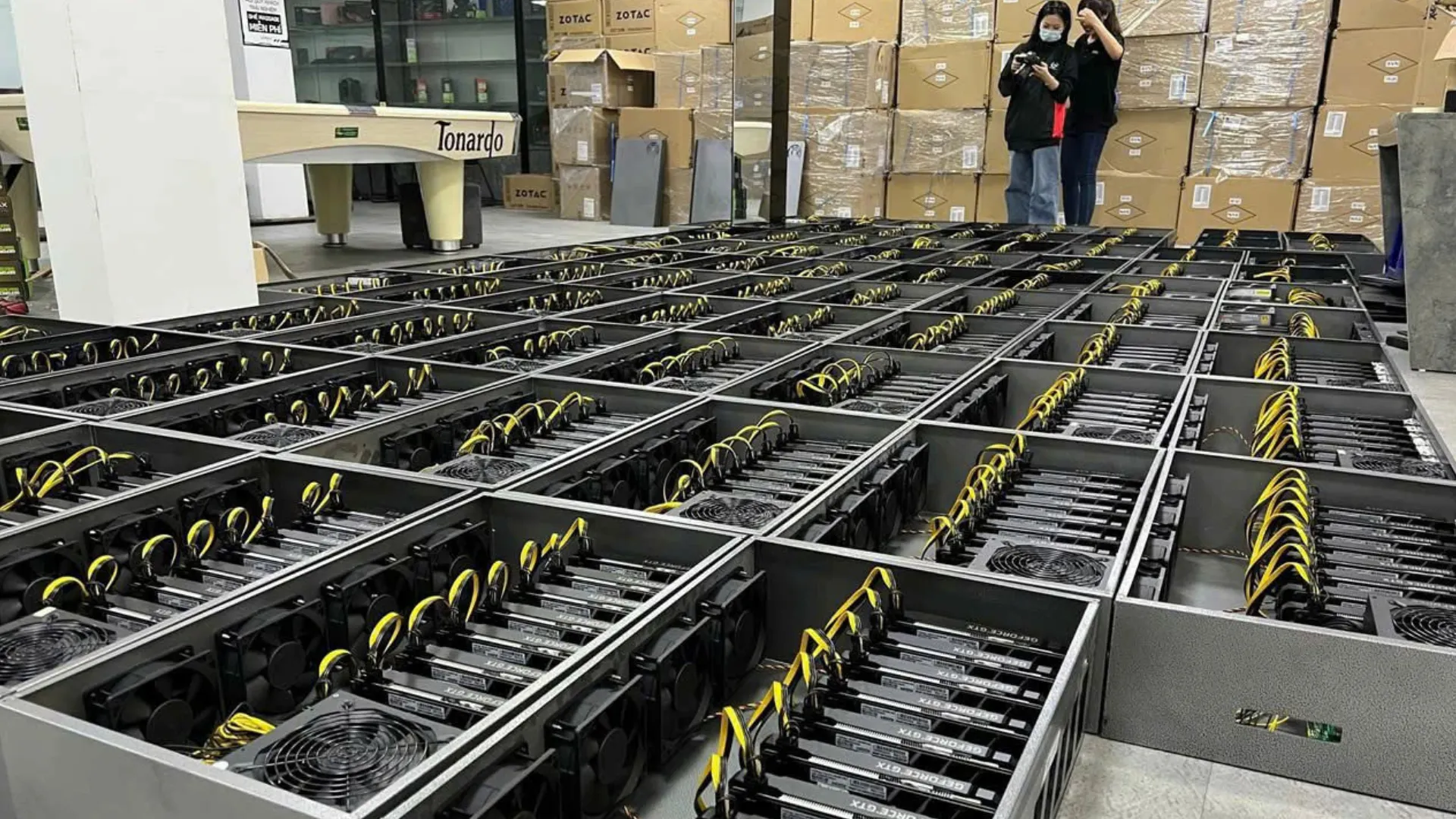
A new research preprint claims that Pearl, a Layer-1 blockchain marketed as turning cryptocurrency mining into useful artificial intelligence (AI) computation, is doing nothing of the sort, despite having recently triggered a GPU mining rush. The study estimates Pearl's network runs at roughly 24 exahashes per second (EH/s) — the equivalent of about 320,000 RTX 3090-class GPUs drawing an estimated 112 megawatts (MW) — all while producing "zero useful AI computation." Researchers saw a roughly 38% jump in budget GPU rental prices on the marketplace vast.ai go to Pearl mining, with utilization climbing from 57% to 94% after the mining software went public in May.
Instead of performing real inference or training, the paper, titled The Usefulness Gap in Proof-of-Useful-Work, says the network grinds through random matrix multiplications that merely take the shape of AI math. The self-billed “first empirical measurement of a deployed Proof-of-Useful-Work (PoUW) system” study argues that Pearl’s mining protocol verifies that miners performed matrix multiplication correctly, but does not verify whether that work came from real AI training or inference workloads.
Pearl swaps Bitcoin's SHA-256 hashing for a scheme it calls cuPOW, which asks miners to compute noised integer matrix multiplications and prove they did so correctly. That operation is the same arithmetic that underpins neural network inference and training, which is the foundation of Pearl's pitch that mining and AI compute can be one and the same job. The problem, according to the study, is that the protocol's verification step only confirms that the multiplication was performed correctly. It never checks whether the input matrices came from a real model, a paying customer, or any AI workload at all.
To demonstrate that gap, the researcher, Abhinaba Basu, built a miner that feeds the network uniformly random matrices with no inference attached, then submitted the output to a mining pool. The paper reports 44 pool-accepted shares on Nvidia and AMD hardware, with the same miner also benchmarked on a CPU and Apple Silicon, plus an on-chain payout earned by running the standard mining software unmodified. If random numbers collect rewards as readily as genuine AI work, the argument runs, then the network cannot tell the two apart, and miners have every incentive to skip the AI part entirely.
Basu also analyzed 8,012 workers in a single pool, representing about 21% of Pearl's hashrate, and found that all of them ran hardware capable of AI inference. Yet, the dominant mining binary contained no identifiable code for any machine-learning framework. That binary analysis relies on string inspection, which the paper notes can be defeated by stripped or obfuscated code, so the finding is offered as strong evidence rather than outright proof. Runtime profiling pointed the same way, with the miners showing heavy compute use and light memory-bandwidth use, a signature consistent with pure matrix math and inconsistent with the memory-hungry behavior of transformer inference.
For GPU buyers, the resource angle is the part that stings. The study attributes a roughly 38% jump in budget GPU rental prices on the marketplace vast.ai to Pearl mining, with utilization climbing from 57% to 94% after the mining software went public in May. Using a difference-in-differences comparison against pricier datacenter cards, Basu estimates around $600,000 per year in additional rental costs borne by independent researchers who compete for the same cheap hardware. However, he cautions that the figure depends on assumptions about how stable prices were beforehand. At PRL's recent price near $0.76, the paper calculates that mining is marginally profitable on budget cards such as the RTX 3060 Ti and roughly breakeven on an RTX 3090.
The work also chips away at the assumption that Pearl mining is an Nvidia-only affair. Basu reports the first Pearl shares ever mined on non-Nvidia hardware, driving an AMD Instinct MI300X at 10.6 million tiles per second, faster than the closed-source Nvidia miner managed on an RTX 3090, and benchmarking the same workload on a server CPU and on an Apple M2 through Metal compute shaders. Because the computation is commodity integer arithmetic, the paper argues there is no vendor lock-in and no technical reason for the work to remain on any one company's silicon.
Pearl may have a ready response, but the study takes it on directly. Together AI, which announced an exclusive partnership in May, framed the deal as letting "every GPU cycle powering AI training and inference" also mint the PRL token, and it now offers a discounted Gemma-4-31B-it-pearl inference endpoint subsidized by mining proceeds. Basu counters that this is financial arbitrage rather than useful mining, because Together AI's own GPUs perform that inference separately from the mining network, with PRL revenue used to trim the endpoint's price. The 8,012 mining workers he measured, he says, produced none of that inference themselves.
The study’s conclusion is not that Proof-of-Useful-Work is impossible, but that Pearl’s current design leaves a major enforcement gap. The protocol enables useful work in theory, but it does not require it in practice. That leaves Pearl in an uncomfortable middle ground — it performs real computation, but according to the paper, the network currently has no way to prove that the computation is useful AI work rather than cryptomining with AI-shaped math.

Follow Tom's Hardware on Google News, or add us as a preferred source, to get our latest news, analysis, & reviews in your feeds.