






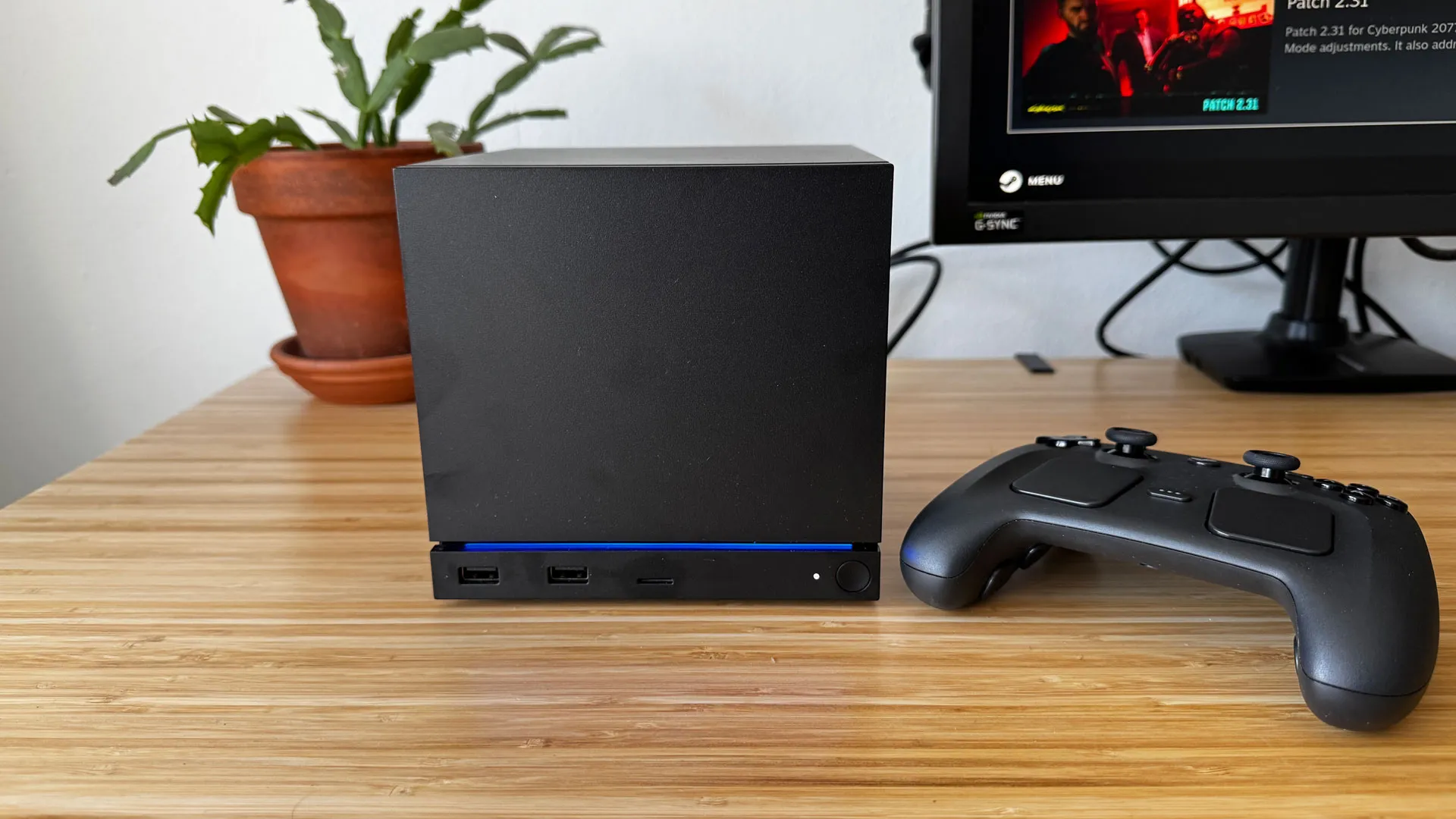
Valve's Steam Machine is launching, finally, with reservations starting today. While the hardware is the same as it was when it was announced late last year, almost nothing else in PC gaming seems the same. There's a massive component shortage. Prices are high on tech in general, and speculation about how the Steam Machine would be priced took over the conversation about the entire launch.
Ahead of the system's launch and reservation queue opening, I talked to Valve engineers Pierre-Loup Griffais and Yazan Aldehayyat to discuss the system: how it was engineered, why Valve made the decisions it did, and how the company came to pricing that starts at $1,049.
"It's definitely the case that you know our original design was based on memory and storage prices from, you know, two years ago or so," said Griffais. "And so we were in a different segment than we were hoping to be, but I think it's more of a reflection of where the market as a whole is than Steam Machine itself, right?"
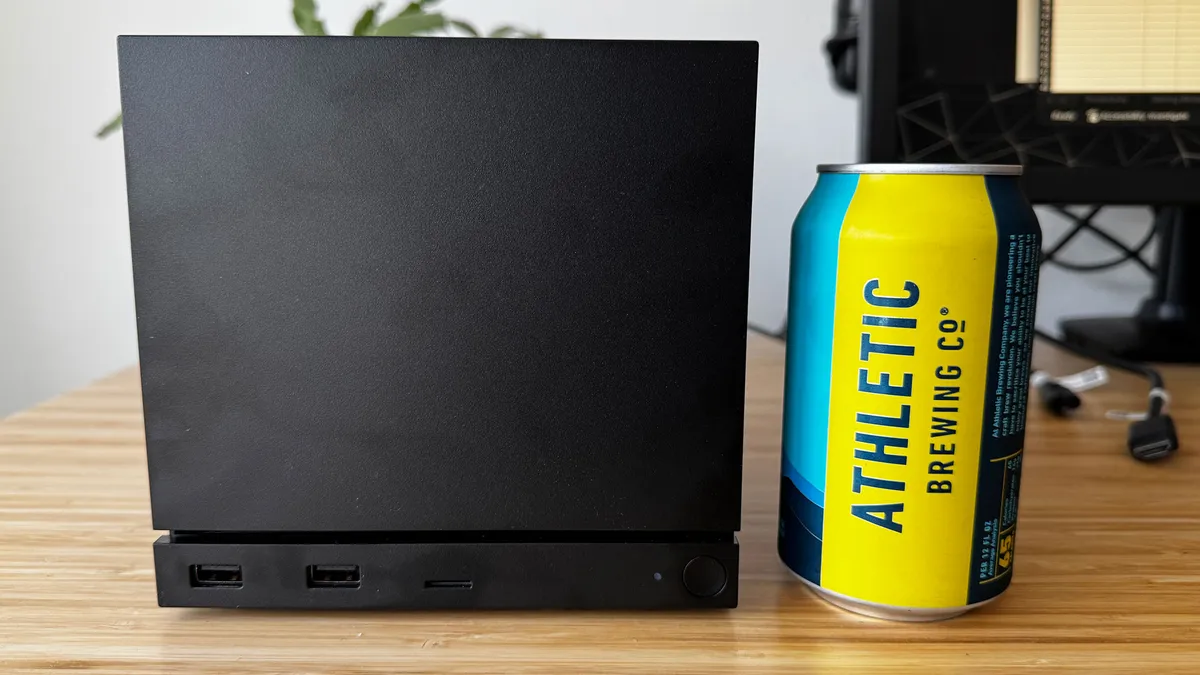
The engineers didn't dare forecast the reception to the price, nor how that would affect sales. But Griffais suggested that Valve expects anyone who wants the power in a Steam Machine would still have to pay a similar amount in another device, but highlighted what's unique to the Machine — the form factor, how quiet it is, the CEC integration, and the dedicated Bluetooth controller antenna.
I posited the possibility of people going for a console, instead. Even the PlayStation 5 Pro is currently cheaper, at $899. But the two engineers suggested that's not the right comparison.
Griffais said there's more to compare than just specs and price. He suggested that PC gamers would also have to rebuy games they want to play, and that some of them would have to get used to the idea of paying to play games online.
"I think the value of the Steam machine is inherently tied to the value of your Steam library in a lot of ways, right?" Aldehayyat said. "Like, the more games you have on Steam, the more valuable the Steam machine is to you, and the Steam machine makes your existing library even more valuable. So, those two kinds of decisions are very much intertwined. And I think at least early on, we suspect that it's for people who already have a big Steam library… it's just going to make a lot of sense to them."
The lack of subsidies
A lot has been made of the fact that Valve is not subsidizing the hardware, which the company has said would turn the PC into a more closed ecosystem. There has always been an assumption that Valve has subsidized the Steam Deck off of the profits it takes from the sales on the Steam Store.
That's not quite the case, the Valve engineers said."
If you look at like certain SKUs at certain points of time, it might be below or above cost bya small margin," Griffais said. "I think there's some comments that we made around it, you know, being painful and all that early on, that was more about being as close as possible to cost than anything, yeah, same thing [with the Steam Machine], right?"
In fact, Griffais claimed that despite recent cost increases to the Steam Deck OLED due to the component shortage (and, now, the Steam Machine), they're being more aggressive on pricing now than they used to be.
"We understand that the higher price is less accessible to people… and so we're even more aggressive now, trying to be as close as possible to the actual cost of the parts that we're shipping," he added."
But it's important that the Valve hardware is a self-sustained program, it's not subsidized by software sales," Aldehayyat said. "So that's kind of the important piece that we can get across."
8GB of VRAM? 4K support? Really?
As soon as the Steam Machine was announced, enthusiasts honed in on one very specific point on the spec sheet: the semi-custom AMD RDNA3 graphics with 28 CUs and, to many, a sparse 8GB of VRAM.
Griffais said that Valve is "very aware" that it is being "kind of aggressive" with 8GB of VRAM. But the way he talked about it, it seemed that the team was also taking a sort of artistic license with what players want out of a small box like this. He said that the team did calculations that that for "the kind of stuff that you would want to play" 8GB could support the level of detail and performance one would expect out of a small, TV-based system."
The cases where you're running out of VRAM are actually cases that you would not want to be playing on a system like that," he said. "Yeah, it'd be too slow… The cases where you're exercising the VRAM limits are actually cases that you wouldn't want to play as a real user, in my opinion" He admitted however, that it's possible that in the future that some games may need more VRAM to reach the same performance.
Still, on SteamOS, the team has been working to make VRAM more efficient. For starters, the current iteration of SteamOS was really only meant for APUs, but now has logic for discrete GPUs and VRAM. That came with a different set of features to add, like handling VRAM under stress to get the best possible outcome. The team at Valve is still working on it.
In Aldehayyat's opinion, the upgrade cycle for PCs has been "slowing down dramatically," and that they're seeing games come out with a better ability to scale across CPU and GPU generations, and that the PC ecosystem isn't designed with a single fixed performance target in mind.
"So, again, like for us, the metric that we care about is, can you play the games on Steam? Can you play every game on Steam? And we think the Steam machine absolutely can, right now, and we think the longevity for it is actually quite good, given the current reality of the upgrade cycles," Aldehayyat said. "I mean, maybe 10 years ago a device like this wouldn't last as long, wouldn't have the legs to be competitive for as long, but… given what the market is doing right now, and the upgrade cycles, it still has the longevity to be a good device for people for many years to come.”
But that 8GB of VRAM wasn't in isolation on the spec sheet. It also highlighted the idea of playing at 4K at 60 frames per second, provided you have AMD's FSR upscaling technology running. In my testing of the machine, that's possible for some games, but the Steam Machine really feels like a 1080p or 1440p box.
"A big part of that messaging actually came because we found a lot of people who are not as familiar with tuning their gaming settings want to just make sure that it's compatible [with] their 4K TV," Aldehayyat said, pointing out that not everyone understands the difference between render resolution and native TV resolutions. He agreed that 1080p and 1440p are probably the sweet spot.
Despite that messaging, 1080p is set as the default resolution across SteamOS globally out of the box, which Grifafis said was to have the "baseline be on the safe side." Like the Steam Deck and Steam Controller, Valve doesn't provide a ton of instructions when you start, so that's something players will need to figure out, whether they decide to change this on a game-by-game basis or across the system (or at all).
Griffais said the team wants to "make that more visible," though he didn't specify how Valve may do that. He also suggested that because Valve is testing games as part of the verified program, it could have different base resolutions on a per-game basis, like a higher resolution for a low-res indie game or an older game that doesn't need as many resources.
Several components, one big heat sink
Inside the Steam Machine's small frame is a massive heatsink and 120 mm fan that cools almost all of the critical components, including the CPU, GPU, and memory. That decision lets Valve make the smallest box possible, but it's certainly not the easy way of doing things.
One other benefit of not having two separate heatsinks big enough for a worst-case scenario is that the large, single option can be allocated to the CPU and GPU as needed.
Image 1 of 2
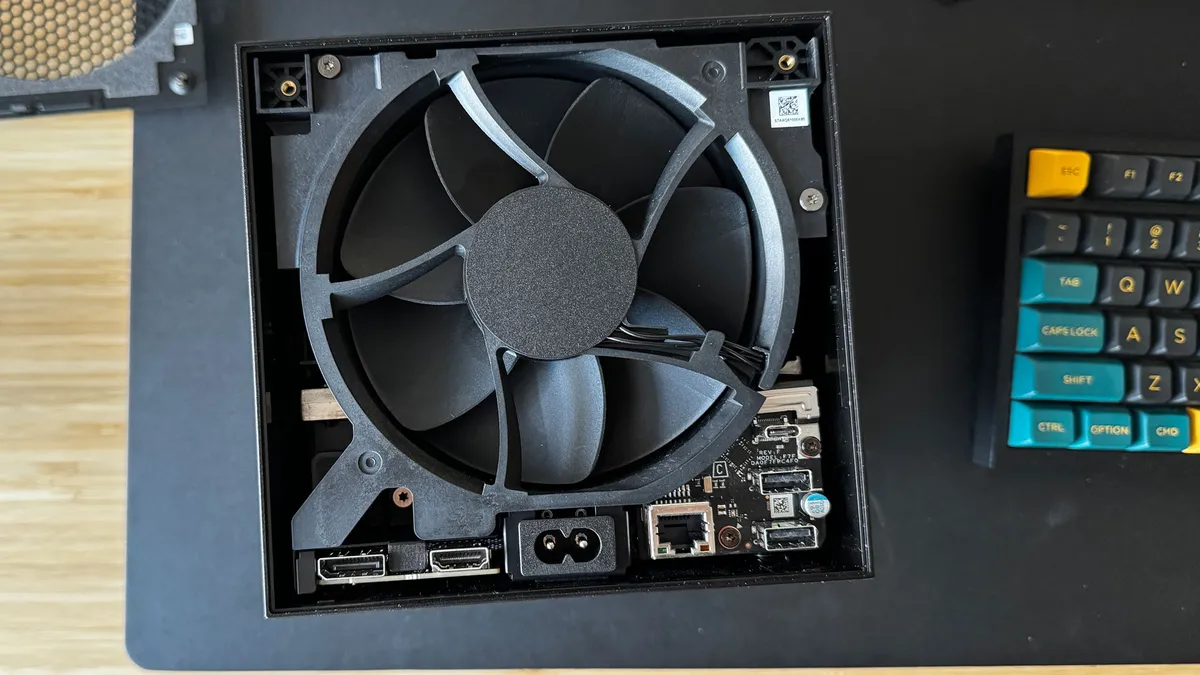
"So, if the CPU is not eating up its entire thermal budget, the GPU can use that, or if the GPU is not eating its entire thermal budget, the CPU can share that," Aldehayyat explained.
But covering all of the components is difficult. Ideally, you want the smallest gap possible between a thermal module and a CPU or a GPU.
"In reality, things vary; the CPU is tall, and the GPU is taller, and the motherboard bows and the thermal module has tolerances, so actually getting the design to have enough compliance in the right places to accommodate all those tolerances was by far the hardest challenge we had to overcome," he said. "But by overcoming it, I think we ended up at the most compact design, cost-effective design. It's also the quietest."
Having one heatsink also allows for one fan, which Valve spins at lower rotations per minute to keep the system nearly silent.
The design requires just a single screw to access the components — a Torx T9 bit. Valve will partner with iFixit again on repair guides, and also plans to have them sell replacement parts, including the many daughterboards that attach to the mainboard under the heatsink, such as the ports.
The SSD is easily accessible, beneath the power supply. But if you want to access the other major replaceable part — the memory SO-DIMMS — you'll have to take off the whole heatsink.
"I don't say it was impossible, it was just, given the time and engineering resources we have, we just could not come up with a solution that that worked," Aldehayyat said. The SSD is on a flex cable, but they weren't able to do something like that with memory because of signal integrity. Trying to make an access hatch through the power supply, he said, was a safety problem.
Shortages and availability
Valve has opened a randomized reservation system for the Steam Machine. That new portion — the fact that you don't have to be on Steam at a specific time to try to get in the first batch of systems — was built on the back of the existing Steam Deck reservation process. But other console shopping experiences were also an influence.
"My experience trying to buy a PS5 painted a lot of that stuff," Griffais said. "We think the broad strokes of the system are good, but there's still an effect where people are rushing at the door, trying to refresh. Our websites might have problems, and then that seems unfair to people that run into that, right? We want to make sure that there's an even playing field initially, and then work from there.
At the moment, Valve is predicting that the reservation queue will go through the end of the year, with the waitlist picking up spots on canceled orders. But depending on supply, things could change.
“Six months was as far as we were willing to make predictions," Aldehayyat said. "If there's more demand, we are obviously planning to make more."
Memory and storage are by far the biggest choke points in the supply chain, but they're not the only ones. Aldehayyat noted shortages in FR-4 (a material used to make printed circuit boards) as well as some capacitors, stating that that "if this was a normal time, people would be concerned about these things," but that in supply shortages for memory and storage "this just doesn't really crack the top 10 problems."
This led Griffais to think openly about what it means to find more supply right now. Getting supplies from a wide variety of vendors, he said, also means getting a bunch of different prices, suggesting that you could make more in a way where the pricing comes out differently.
"And so we're still trying to figure that out," he said. "If there's ever a bunch of people that want the machine, but the supply is not there on the back end, we'll have to make hard decisions about, okay, what are we doing to secure more supply,” Griffais pondered. “And does it still result [in] the product at this price? Or would we have to rethink that,” he said.
Finally, Griffais admitted, much like the rest of us, that Valve doesn’t know how the hardware shortages will evolve. “Maybe things are going to go back down, and then it's all good, and it can continue to go like that, but maybe not,” he said. “So I guess what we're trying to convey… is that it seems like all bets are off, and we're going to work through it, just [like] the users as well.”

Follow Tom's Hardware on Google News, or add us as a preferred source, to get our latest news, analysis, & reviews in your feeds.