


惯性聚合 高效追踪和阅读你感兴趣的博客、新闻、科技资讯
阅读原文 在惯性聚合中打开

推荐订阅源

L
LangChain Blog
有赞技术团队
有赞技术团队
博客园_首页
IT之家
IT之家
爱范儿
爱范儿
量子位
小众软件
小众软件
Jina AI
Jina AI
WordPress大学
WordPress大学
酷 壳 – CoolShell
酷 壳 – CoolShell
博客园 - 聂微东
The Cloudflare Blog
博客园 - 司徒正美
OSCHINA 社区最新新闻
OSCHINA 社区最新新闻
V
V2EX
大猫的无限游戏
大猫的无限游戏
月光博客
月光博客
雷峰网
雷峰网
V
Visual Studio Blog
博客园 - Franky
让小产品的独立变现更简单 - ezindie.com
美团技术团队
Last Week in AI
Last Week in AI
S
SegmentFault 最新的问题

Latest from Tom's Hardware in News

Analytics group signals possible delays at 40% of AI data center construction sites — companies deny schedule holdups, but satellite imagery indicates otherwise Intel hires tenured Samsung exec to lead Foundry Services — signals company focus on winning business from potential Foundry suitors Elon Musk pushing forward with Terafab at Microsoft's April patch puts Windows domain controllers into reboot loops — third known issue from KB5082063… AMD Ryzen 9 9950X3D2 appears on Amazon with $1,000 pre-order price — AMD confirms recommended pricing is still set… AMD's market cap hits all-time high, Intel hits 25-year high on Agentic AI's insatiable demand for CPUs Meta raising Quest headset prices due to AI-driven RAM shortage — Quest 3 to cost $600, Quest 3S $350 from April… Elegoo announces the Jupiter 2 resin 3D printer for $949, early bird price of $849 — new model offers massive print volume but is still physically smaller than previous models Pragmata PC performance tested: 18 GPUs take us to the Moon Chinese fabs import record volumes of US chipmaking equipment via Singapore and Malaysia — homegrown tool makers booked record 2025 revenues as price competition squeezes margins US appeals court restarts $3 billion patent infringement lawsuit against Intel — VLSI case from 2017 returns after… Two US citizens get combined 16 years in prison for running North Korean laptop farms — fake remote IT work scheme netted DPRK $5 million in around three years Intel launches Wildcat Lake as Core Series 3 for value laptops and edge systems — six consumer SKUs built on 18A promise Legendary Qualcomm, Apple, and Nuvia alumni form new CPU startup — Nuvacore promises to Bambu updates its 3D printers to print unique hues or gradients using two or three filaments — company acknowledges OrcaSlicer-FullSpectrum fork as the basis for the color prediction part of the new feature Broadcom to supply Meta with custom silicon through 2029 — Broadom CEO Hock Tan departs Meta Anonymous perps behind 86 million files scraped from Spotify hit with $322 million court judgement — Anna Non-functioning counterfeit Samsung 990 Pro SSDs are circulating in Europe — Despite convincing packaging, blue… Oklahoma farmer arrested and jailed for trespassing during AI data center town hall — removed by officers after going a few seconds over allotted speaking time, trying to hand paperwork to counselors Virginia voter support for new data centers collapses from 69% in 2023 to 35% in new poll — Multi-gigawatt, 37-building Digital Gateway project abandoned Struggling shoemaker and apparel brand Albird pivots to AI data centers, stock jumps 580% in a single day — sells core business and leveraging $50 million in financing to become a GPU-as-a-Service and AI cloud solutions provider IPv6 usage reaches historic 50% across Google services, matching IPv4 — increased usage eases pressure on the IPv4 address market as 'new' protocol designed in 1998 finally hits its stride Engineer open-sources DIY radar system that's 95% cheaper than $250,000 commercial offerings, has 20 kilometer range — Moroccan engineer designs Aeris-10 radar, shares it on GitHub Elon Musk demonstrates first sample of Tesla AI5 processor, accidentally thanks TSC rather than TSMC  — claims 40X performance boost over the predecessor Valve might be adding a 30-day price tracker to Steam — feature is already available in some EU countries to spoof… Memory cards and flash drives prices rocket 124%, some products peak at 261% jump — increases from 2025 driven by AI chip shortage across a range of formats and capacities Netgear secures conditional approval from the FCC following router ban — company can continue importing foreign-made routers through October 2027 China tests deep-sea electro-hydrostatic actuator that can cut undersea cables at a depth of 3,500 meters — state hails successful trial and hints at deployment readiness Iran reportedly bought an in-orbit Chinese satellite to target US military sites in the Middle East — purchase agreement included ongoing ground control services based in China Our lifestyle tech colleagues at Tom's Guide have overhauled their site for smarter shopping — more video and access to experts make it 'the biggest relaunch in our history'
New 3D printer tech uses elliptical laser beams to stir m...
Luke James · 2026-06-14 · via Latest from Tom's Hardware in News
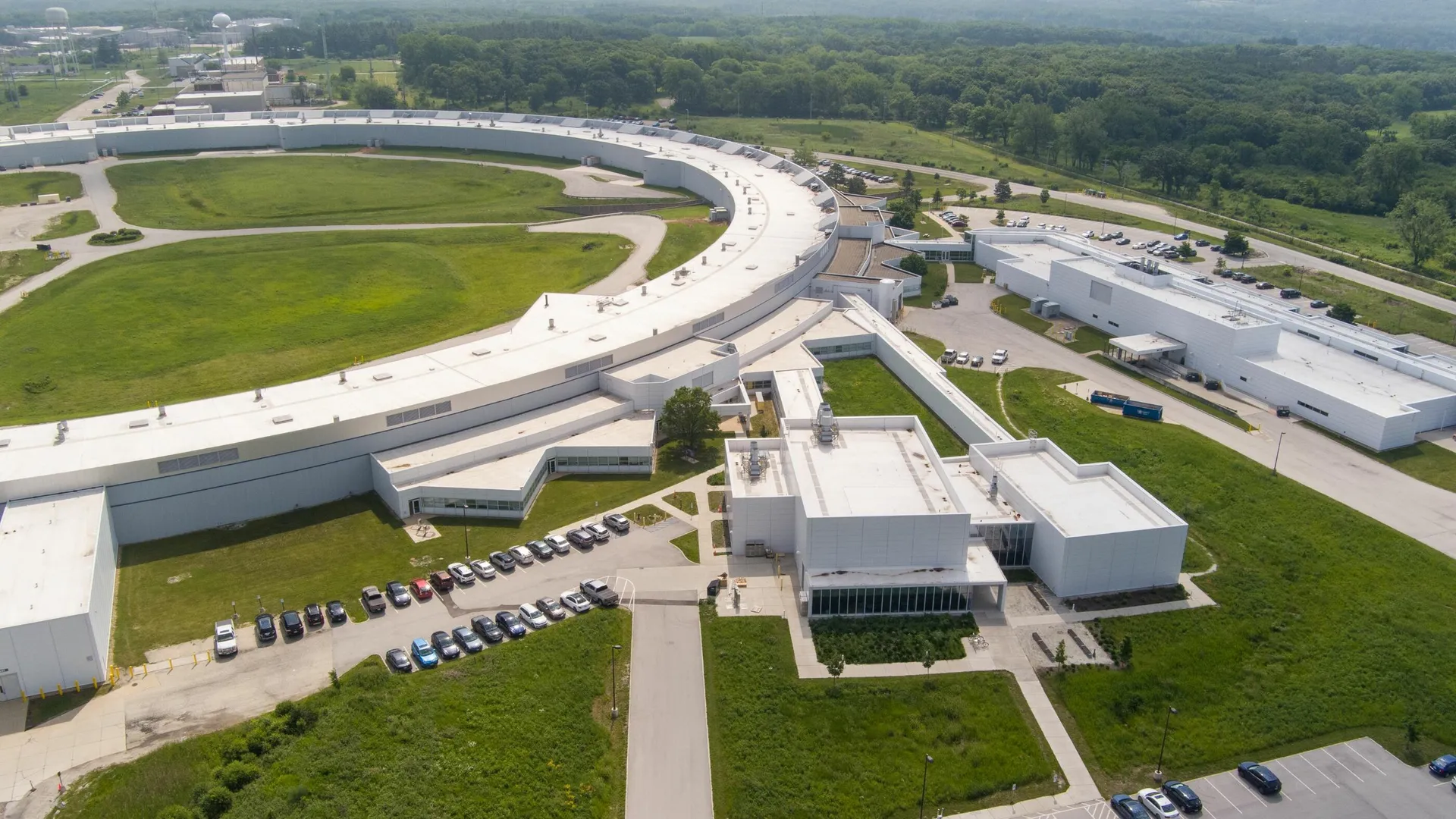
Advanced Photon Source at Argonne National Laboratory
(Image credit: Argonne National Laboratory)

The National Institute of Standards and Technology (NIST) has demonstrated a metal 3D printing method that stirs molten metal during the print by sending the laser along looping elliptical paths instead of straight lines. This technique change needs no new hardware and could let machines already in service blend alloys that resist mixing. The work, published in the journal Additive Manufacturing, was verified at Argonne National Laboratory's Advanced Photon Source, where the team fused a dense high-entropy alloy called RHEA-19 with a lightweight titanium alloy and watched the two combine into a new alloy in real time.

The technique modifies laser powder bed fusion, in which a laser melts thin layers of metal powder point by point. On a standard print, the beam tracks straight lines, and each brief melt pool blends its ingredients only slightly. NIST researcher Ho Yeung instead programmed the laser to draw loops as it advanced, churning the pool while it stayed liquid. Existing printer firmware couldn’t produce those toolpaths, so the team wrote its own control software.

Because the method changes only the scan pattern, NIST says machines on factory floors could run it after a software update. “Commercial 3D printer software can't make these patterns,” said Ho Yeung, a NIST researcher, in the agency's announcement, adding that the team had to write the software from scratch.
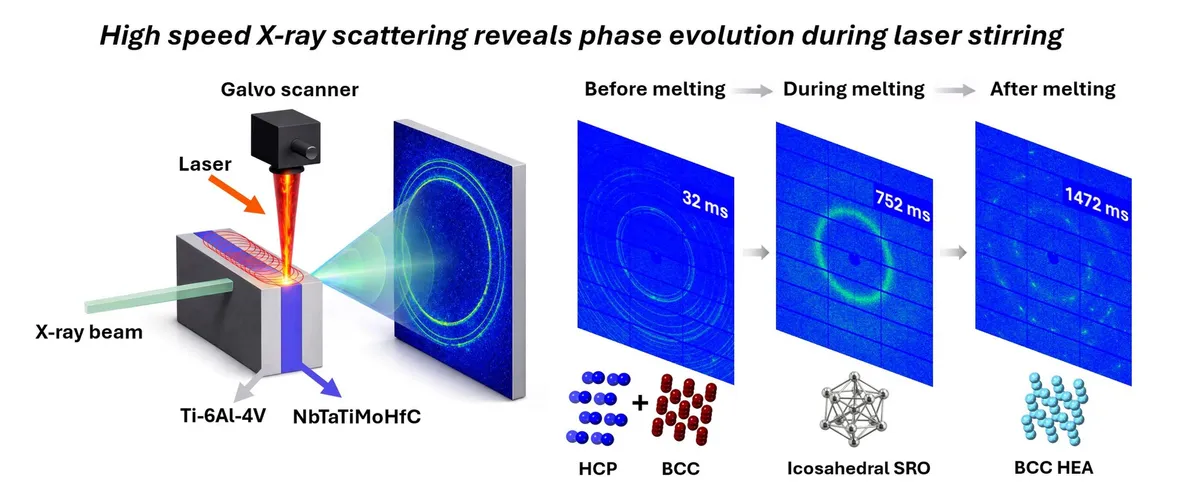
One of the most challenging parts of this research was developing a way to see what was happening inside the metal on the atomic level as it cooled.

The researchers needed to figure out a way to see what was happening inside the metal as it cooled. To do this, NIST pioneered a method using X-ray diffraction, where X-rays are passed through the metal, bouncing off some of the atoms. The X-ray patterns are then analyzed to determine how they're arranged. (Image credit: F. Zhang/NIST)

Confirming that the metals had truly alloyed (rather than separated) meant capturing the atomic structure as the pool froze, which happens in under a second. The Advanced Photon Source produces X-ray beams roughly 500 billion times brighter than a dental scanner, enough to read diffraction patterns off the dense melt as it solidified, and the team paired that with electron microscopy on the finished solid. NIST counts this in-situ diffraction as a result in itself, since tracking phase changes at that speed hadn’t been done this way before.

Metals carry different densities, melting points, and surface tension, which drives them to separate into weak, blotchy regions as a casting cools. High-entropy alloys, which mix five or more metals in roughly equal shares rather than one base metal with trace additions, are especially prone to it, and that’s why they are difficult to cast. Stirring during the print, however, sidesteps the problem.

The researchers reckon that the same method could feed a machine elemental metal powders and blend them into finished alloys on the fly, instead of stocking a separate pre-alloyed powder for every composition. NIST also points to grading composition continuously across one part, so a jet turbine blade could shift between metals without a welded joint that might fail. Metal printing is far more demanding than printing plastic, since alloys melt at extreme temperatures and pass through phase changes as they cool.

The paper was first published in Additive Manufacturing Volume 118 on February 25th. Separately, NIST has listed elliptical scan patterns among the control strategies that it’s studying to suppress defects and steer microstructure in additive manufacturing.

Get Tom's Hardware's best news and in-depth reviews, straight to your inbox.

Google Preferred Source

Follow Tom's Hardware on Google News, or add us as a preferred source, to get our latest news, analysis, & reviews in your feeds.

Luke James is a freelance writer and journalist.  Although his background is in legal, he has a personal interest in all things tech, especially hardware and microelectronics, and anything regulatory.