






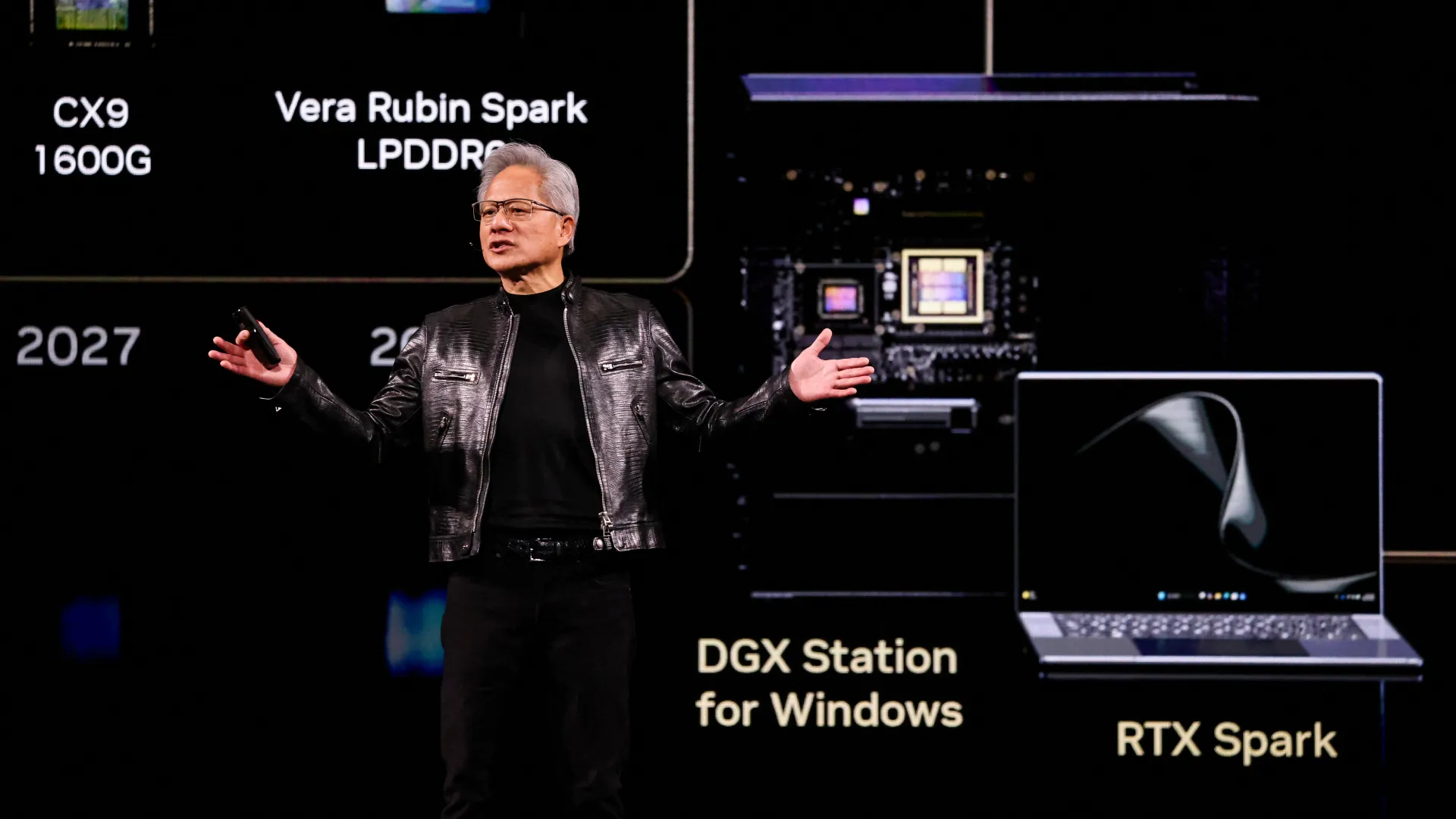
Nvidia unveiled the RTX Spark superchip on May 31st ahead of its GTC Taipei event, and right before Computex 2026. The device packs a 20-core Arm-based Grace CPU and a Blackwell RTX GPU on a single package and points it at the one corner of computing where the company has never had a foothold: the Windows PC.
The chip carries up to 128GB of unified memory, a claimed 1 petaflop of AI compute, and 6,144 CUDA cores, and it ships this fall in laptops and compact desktops from ASUS, Dell, HP, Lenovo, Microsoft Surface, and MSI, with Acer and GIGABYTE to follow. Microsoft is named as a co-developer, not just an OS supplier, having built new Windows security primitives to run on-device AI agents alongside Nvidia's OpenShell runtime. Branded as RTX Spark, it’s the chip the industry has spent three years calling N1X.
"For forty years, you launched apps. Click. Type. With RTX Spark and Microsoft Windows, you ask, and the PC does the work," said CEO Jensen Huang. Running 120-billion-parameter LLMs with up to 1 million tokens of context, RTX Spark can render 90GB 3D scenes and play AAA games at 1440p above 100 frames per second, all on a chip whose CPU was half engineered by smartphone SoC vendor MediaTek.
‘A new era of PC’
RTX Spark hasn’t come out of nowhere; it’s the consumer-oriented sibling of the GB10 Grace Blackwell superchip already shipping inside the Linux-based DGX Spark mini-PC, which carries a price tag currently approaching $5,000 due to memory shortage-related pricing pressure. The GB10 pairs a MediaTek-produced Arm CPU complex with a Blackwell GPU on a TSMC 3nm-class node, joined by Nvidia's coherent NVLink-C2C interconnect and fed by a shared 128GB pool of LPDDR5X. RTX Spark takes that architecture and repurposes it for Windows.
We first began to hear about the RTX Spark under its N1X codename back in 2023, when it was reported that Nvidia was developing Arm CPUs capable of running Windows. The chip appeared repeatedly through 2024 and 2025 via the rumor mill, with various delays attributed to factors including Microsoft’s slow next-gen work on Arm and soft notebook demand, pushing a planned second-half-2025 debut into this year.
For eight years, Microsoft's Windows on Arm program ran exclusively on Qualcomm silicon under a partnership that locked out every other chipmaker. Microsoft chose Qualcomm in 2016, and until the deal lapsed, no rival could ship an Arm chip in a Windows PC. Arm CEO Rene Haas confirmed in an interview in January 2024 that Qualcomm's exclusivity with Microsoft would lapse that year, the first on-record acknowledgment from a principal after years of the deal being treated as an open secret. Reuters had reported in 2024 that MediaTek, Nvidia, and AMD were all building Arm Windows chips to enter once the window opened.
Microsoft's role in RTX Spark goes deeper than the Copilot+ certification program it handed Qualcomm, however. The two companies built the agent security stack together at the operating-system level: identity, containment, and policy primitives in Windows, paired with OpenShell's ability to route queries to local models based on a user's privacy rules and to mask personal information in queries sent to the cloud.
Satya Nadella, chairman and CEO of Microsoft, said the launch will deliver "unmetered intelligence to every home and every desk with Windows,” an outwardly materially closer integration than the Snapdragon X program ever received.
Windows on Arm
Qualcomm spent its eight years of exclusivity demonstrating that Windows on Arm could work, but failing to make it sell. Snapdragon X laptops moved roughly 720,000 units in the third quarter of 2024, their first full quarter on sale, which Canalys data put at about 0.8% of PC shipments that quarter. ABI Research projected Arm wouldn’t clear 13% of the PC market in 2025. Qualcomm's own counter-figures were heavily conditioned: CEO Cristiano Amon's "more than 10%" share claim, made on the company's Q1 2025 earnings call, covered only U.S. retail Windows laptops priced above $800 in a single quarter.
A big factor behind this lacklustre performance was software issues. Microsoft’s Prism runs x86 apps on Arm, but in our own analysis of Snapdragon X2 Elite Extreme, we found that professional tools like AutoCAD were unsupported, and games crashed or rendered incorrectly under emulation. The original Snapdragon X pitch leaned heavily on battery life as a huge differentiator, but then Intel's Lunar Lake matched that efficiency, giving buyers long battery life on x86 chips that run every Windows app natively, with no emulation and none of the slowdowns or crashes that came with it. Ultimately, Arm's share of Windows never reached the 50% within five years that Arm and Qualcomm had floated back in 2024.
Two familiar problems
Unlike Qualcomm, Nvidia isn’t selling battery life. RTX Spark's USP is the GPU, CUDA, and the 128GB unified memory pool, hardware aimed at local AI, agents, creators, and gamers rather than all-day portability. Adobe is rearchitecting Photoshop and Premiere for the platform with a claimed two-times uplift in AI and editing workflows, and over 100 Windows software vendors, plus game developers including KRAFTON, NetEase, Remedy Entertainment, Riot Games, and Microsoft Xbox are listed as backing the platform.
Two problems dogged Windows on Arm for nearly a decade that won’t simply disappear with a faster chip, though. First: x86 emulation. Any application without a native Arm build still runs via Prism, and that has meant performance penalties and outright failures across the Snapdragon era.
Nvidia's full CUDA and RTX stack is native, which helps AI and graphics workloads, but says nothing about the long tail of legacy Windows software and peripheral drivers. The second problem is Microsoft itself: its slow progress on the next-gen Windows on Arm platform was cited as a primary cause of the N1X delays, and developers won’t be getting the full picture of the Windows agent features until Microsoft's Build keynote on June 2nd and 3rd, days after the chip was announced.
As for pricing, we’ve got nothing on that yet. The only reference point is the DGX Spark's $3,999 desktop baseline, a figure that’s now approaching $5,000 but also heavily inflated by enterprise networking hardware that consumer-grade devices will omit. That said, LPDDR5X memory costs and TSMC 3nm manufacturing both point toward premium pricing rather than the sub-$700 bracket Qualcomm targeted to broaden Arm's reach.
With the RTX Spark, Nvidia is opening a door that Qualcomm could only pry at, carrying the one asset it never had, and inheriting compatibility and OS dependencies that no amount of compute can resolve on its own.