



惯性聚合 高效追踪和阅读你感兴趣的博客、新闻、科技资讯
阅读原文 在惯性聚合中打开

推荐订阅源

D
Docker
小众软件
小众软件
让小产品的独立变现更简单 - ezindie.com
freeCodeCamp Programming Tutorials: Python, JavaScript, Git & More
钛媒体:引领未来商业与生活新知
钛媒体:引领未来商业与生活新知
酷 壳 – CoolShell
酷 壳 – CoolShell
Apple Machine Learning Research
月光博客
月光博客
人人都是产品经理
人人都是产品经理
大猫的无限游戏
大猫的无限游戏
V
V2EX
阮一峰的网络日志
阮一峰的网络日志
奇客Solidot–传递最新科技情报
奇客Solidot–传递最新科技情报
博客园 - Franky
WordPress大学
WordPress大学
有赞技术团队
有赞技术团队
Hugging Face - Blog
Hugging Face - Blog
Jina AI
Jina AI
博客园 - 聂微东
S
SegmentFault 最新的问题
量子位
宝玉的分享
宝玉的分享
OSCHINA 社区最新新闻
OSCHINA 社区最新新闻
博客园_首页

Latest from Tom's Hardware in News

Analytics group signals possible delays at 40% of AI data center construction sites — companies deny schedule holdups, but satellite imagery indicates otherwise Intel hires tenured Samsung exec to lead Foundry Services — signals company focus on winning business from potential Foundry suitors Elon Musk pushing forward with Terafab at Microsoft's April patch puts Windows domain controllers into reboot loops — third known issue from KB5082063… AMD Ryzen 9 9950X3D2 appears on Amazon with $1,000 pre-order price — AMD confirms recommended pricing is still set… AMD's market cap hits all-time high, Intel hits 25-year high on Agentic AI's insatiable demand for CPUs Meta raising Quest headset prices due to AI-driven RAM shortage — Quest 3 to cost $600, Quest 3S $350 from April… Elegoo announces the Jupiter 2 resin 3D printer for $949, early bird price of $849 — new model offers massive print volume but is still physically smaller than previous models Pragmata PC performance tested: 18 GPUs take us to the Moon Chinese fabs import record volumes of US chipmaking equipment via Singapore and Malaysia — homegrown tool makers booked record 2025 revenues as price competition squeezes margins US appeals court restarts $3 billion patent infringement lawsuit against Intel — VLSI case from 2017 returns after… Two US citizens get combined 16 years in prison for running North Korean laptop farms — fake remote IT work scheme netted DPRK $5 million in around three years Intel launches Wildcat Lake as Core Series 3 for value laptops and edge systems — six consumer SKUs built on 18A promise Legendary Qualcomm, Apple, and Nuvia alumni form new CPU startup — Nuvacore promises to Bambu updates its 3D printers to print unique hues or gradients using two or three filaments — company acknowledges OrcaSlicer-FullSpectrum fork as the basis for the color prediction part of the new feature Broadcom to supply Meta with custom silicon through 2029 — Broadom CEO Hock Tan departs Meta Anonymous perps behind 86 million files scraped from Spotify hit with $322 million court judgement — Anna Non-functioning counterfeit Samsung 990 Pro SSDs are circulating in Europe — Despite convincing packaging, blue… Oklahoma farmer arrested and jailed for trespassing during AI data center town hall — removed by officers after going a few seconds over allotted speaking time, trying to hand paperwork to counselors Virginia voter support for new data centers collapses from 69% in 2023 to 35% in new poll — Multi-gigawatt, 37-building Digital Gateway project abandoned Struggling shoemaker and apparel brand Albird pivots to AI data centers, stock jumps 580% in a single day — sells core business and leveraging $50 million in financing to become a GPU-as-a-Service and AI cloud solutions provider IPv6 usage reaches historic 50% across Google services, matching IPv4 — increased usage eases pressure on the IPv4 address market as 'new' protocol designed in 1998 finally hits its stride Engineer open-sources DIY radar system that's 95% cheaper than $250,000 commercial offerings, has 20 kilometer range — Moroccan engineer designs Aeris-10 radar, shares it on GitHub Elon Musk demonstrates first sample of Tesla AI5 processor, accidentally thanks TSC rather than TSMC  — claims 40X performance boost over the predecessor Valve might be adding a 30-day price tracker to Steam — feature is already available in some EU countries to spoof… Memory cards and flash drives prices rocket 124%, some products peak at 261% jump — increases from 2025 driven by AI chip shortage across a range of formats and capacities Netgear secures conditional approval from the FCC following router ban — company can continue importing foreign-made routers through October 2027 China tests deep-sea electro-hydrostatic actuator that can cut undersea cables at a depth of 3,500 meters — state hails successful trial and hints at deployment readiness Iran reportedly bought an in-orbit Chinese satellite to target US military sites in the Middle East — purchase agreement included ongoing ground control services based in China Our lifestyle tech colleagues at Tom's Guide have overhauled their site for smarter shopping — more video and access to experts make it 'the biggest relaunch in our history'
SpaceX unveils 11-million-square-foot Gigasat factory, a ...
Etiido Uko · 2026-06-09 · via Latest from Tom's Hardware in News
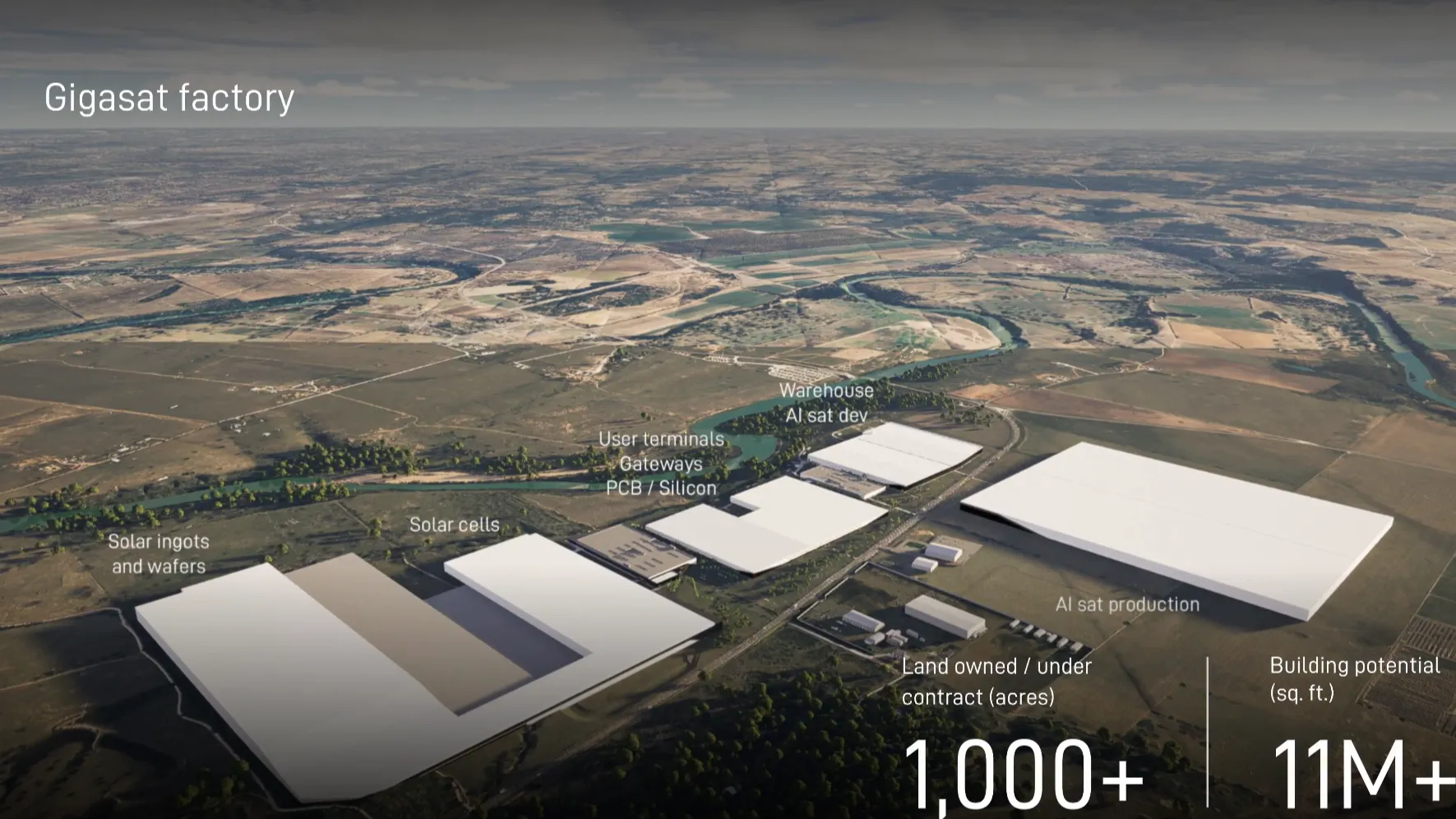
SpaceX Gigasat factory
SpaceX Gigasat factory (Image credit: SpaceX)

SpaceX has announced a new 11-million-square-foot Gigasat factory in Bastrop, Texas, dedicated to building the infrastructure needed to achieve the company's orbital data center goal. In an internally conducted interview posted on X on June 8, SpaceX CEO Elon Musk confirmed that the facility is expected to begin producing complete "AI satellites" by 2027. The company is targeting 1 gigawatt (GW) of orbital AI compute capacity by the end of next year, with plans to scale that figure by an order of magnitude annually thereafter.

Go deeper with TH Premium: AI and data centers

During the interview, Musk unveiled the build and specs of the proposed AI1 satellite, the company’s take on orbital data centers. The satellite will span roughly 70 meters (229.66 feet), with a massive solar array — generating power at a density of 250 W/m² — making up the bulk of the structure. AI1 will also feature vertically oriented, double-sided radiators for cooling, with the 150-kilowatt (kW) peak compute payload positioned right in the middle of the structure.

The massive 11-million-square-foot Gigasat facility — more than ten times larger than Starfactory, SpaceX's current largest spacecraft manufacturing complex — will vertically integrate much of the AI1 satellite supply chain on a single campus. The facility will manufacture solar ingots and wafers, solar cells, printed circuit boards (PCBs), silicon-based electronic components, user terminals, gateways, and the AI1 satellites themselves. The 1,000-acre site will also include dedicated satellite development and testing facilities, warehousing and logistics infrastructure, and a large-scale AI satellite production line.

According to Musk, the solar manufacturing facilities are already under construction, while the AI satellite production building is about to break ground. SpaceX expects to be producing a "reasonable volume" of these orbital data centers by the end of 2027. While each satellite will carry 150 kW of compute power, the company aims to achieve 1 GW per year of space AI compute in that same time. That would mean launching on the order of more than 6,000 AI1 satellites in a single year. For context, Starlink has about 10,500 active satellites as of June 2026.

Musk hopes to scale to 100 GW per year by 2030 and even has eyes on Terrawatt-level computing, completely solar-powered in space. "This is what we are going to try to do and think we probably can do, which is to get to roughly an annualized rate of a gigawatt per year by the end of next year at Space AI compute. And then aspirationally, scale that by an order of magnitude per year. So in two and a half years, hitting an annualized rate of 10 gigawatts a year at Space. And three and a half years, maybe 100 gigawatts," he said, while also expressing a desire to one day scale to a terawatt per year, depending on progress in chip making.

The largest AI data center anyone has actually announced is Meta's Hyperion in Louisiana, designed to scale up to 5 GW and house roughly 2 million GPUs at full buildout, at over $100 billion — and even that only reaches its first 2 GW phase by 2030. xAI's own Colossus 2 in Memphis just expanded to nearly 2 GW of capacity, with 555,000 GPUs, for about $18 billion, making it the world's largest single-site AI installation. So 100 GW/year is approximately 20 Hyperions or 50 Colossus-2s per year.

Achieving this will take an unprecedented volume of chips, and Musk's answer is Terafab — a SpaceX/Tesla/xAI venture in Austin aiming to fab 1 terawatt of compute a year, roughly 100 to 200 million advanced chips, in a 100-million-square-foot plant. However, the project itself is being met with widespread skepticism. For starters, none of the three companies has ever made a chip, yet they're starting at the bleeding-edge 2nm node. Our in-depth Terafab industry analysis explores various other reasons why this skepticism is valid.

Get Tom's Hardware's best news and in-depth reviews, straight to your inbox.

Multi-Gigawatt ambitions aside, Gigastat is a significant step towards orbital data center goals that are increasingly seen as a potential viable solution to the extreme power consumption of on-ground data centers. Not unexpectedly, SpaceX is leading the race. Manufacturing solar arrays, wiring, and satellite bodies at volume is largely conventional work — much of it built on technology SpaceX already produces for its Starlink V3 satellites, just at far greater scale — which is part of why a 2027 production start is credible.

Google Preferred Source

Follow Tom's Hardware on Google News, or add us as a preferred source, to get our latest news, analysis, & reviews in your feeds.

Etiido Uko is a news contributor for Tom's Hardware covering the latest updates in big tech and the PC industry. He is a mechanical engineer and senior technical writer with over nine years of experience in documentation and reporting. He is deeply passionate about all things engineering and technology, and is an expert in gadgets, manufacturing, robotics, automotive, and aerospace.