


UPDATED 16:45 EDT / MAY 26 2026
 EMERGING TECH

Quantinuum Inc., a startup that makes quantum chips based on a so-called trapped-ion qubit architecture, today filed to go public.
The Honeywell International Inc. spinoff hopes to sell about 21.05 million shares for $45 to $50 apiece. That adds up to $1.05 billion at the top end of the range. The offering will value Quantinuum at up to $12.7 billion, $2.7 billion more than what it was worth after its last funding round.
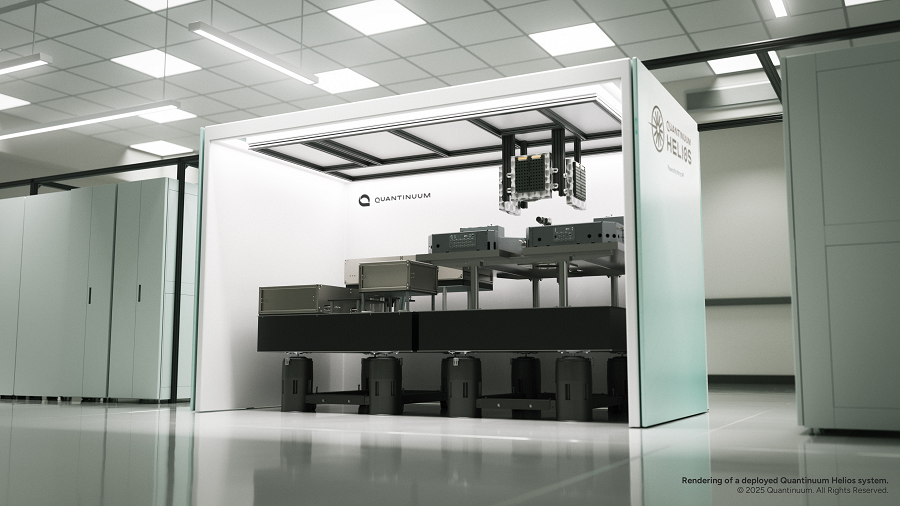
The company offers a quantum computer called Helios (pictured) that features 98 qubits. Each qubit is an ion, an atom with an electric charge. The particles are suspended in a vacuum by electromagnetic fields.
Many quantum computing calculations require qubits to be entangled, or synced. Helios entangles qubits by moving them into chambers called parallel gate zones. Laser emitters encode data into the qubits and read out processing results.
Quantinuum’s previous quantum machines used ytterbium ions as qubits. Ytterbium ions can only be programmed by expensive ultraviolet lasers that erode other components. With Helios, the company switched the qubits from ytterbium to a metal called barium. It’s compatible with visible light lasers that are significantly more affordable.
The company says its technology has several advantages over competing system designs. Helios’ lasers not only encode data into qubits and read processing results but also cool them. That cooling approach requires significantly less power than alternative methods. It also removes the need for Helium-3, a helium isotope that costs millions of dollars per pound.
One of the main obstacles to building large-scale quantum computers is that qubits are highly prone to errors. Those mistakes make it difficult to accurately carry out calculations. Helios uses a processing module powered by Nvidia Corp.’s Grace Hopper architecture to run error correction algorithms. The company says that the system provides the industry’s highest two-qubit gate fidelity, a measure of quantum circuit accuracy.
Helios ships with a software toolkit that developers can use to write programs for the machine and optimize their performance. One of the suite’s core components is a programming language called Guppy. It’s based on Python, a relatively simple syntax that reduces the amount of time involved in writing applications.
Quantinuum is not yet profitable. The company lost $192.6 million in 2024, about $48 million more than a year earlier. Its revenue grew from $23 million to $30.9 million in the same time. Quantinuum’s bookings, a measure of future sales, reached $79.3 million at the end of 2025.
The company’s growth roadmap places an emphasis on enhancing its quantum hardware. It plans to follow up Helios with SOL, a 192-qubit quantum computer set to launch next year. It hopes to build a system with more than 1,000 qubits by the end of the decade.
Guppy and the other components of the company’s software suite are also part of its long-term revenue growth strategy. The suite can run on not only Quantinuum hardware but also other quantum machines. The company’s IPO filing states that it plans to “expand monetization beyond hardware by building high-margin software, applications, and outcome-driven intellectual property that capture recurring value.”
Quantinuum will list its shares on Nasdaq under the ticker symbol “QNT.”
Support our mission to keep content open and free by engaging with theCUBE community. Join theCUBE’s Alumni Trust Network, where technology leaders connect, share intelligence and create opportunities.
About SiliconANGLE Media
SiliconANGLE Media is a recognized leader in digital media innovation, uniting breakthrough technology, strategic insights and real-time audience engagement. As the parent company of SiliconANGLE, theCUBE Network, theCUBE Research, CUBE365, theCUBE AI and theCUBE SuperStudios — with flagship locations in Silicon Valley and the New York Stock Exchange — SiliconANGLE Media operates at the intersection of media, technology and AI.
Founded by tech visionaries John Furrier and Dave Vellante, SiliconANGLE Media has built a dynamic ecosystem of industry-leading digital media brands that reach 15+ million elite tech professionals. Our new proprietary theCUBE AI Video Cloud is breaking ground in audience interaction, leveraging theCUBEai.com neural network to help technology companies make data-driven decisions and stay at the forefront of industry conversations.

XM Cyber rolls out tools to identify and revoke unused permissions across hybrid environments

Tensormesh taps Nvidia, AMD and CoreWeave for funding to fix AI model memory problems

WisdomAI brings plug-and-play conversational AI analytics capabilities to SaaS applications

Cogent Security launches autonomous vulnerability response tools as AI-assisted exploits outpace scanners

Doppel launches agentic email security to disrupt phishing campaigns at the source

AI video analysis startup Airis Labs raises $60M
此内容由惯性聚合(RSS阅读器)自动聚合整理,仅供阅读参考。 原文来自 — 版权归原作者所有。