



惯性聚合 高效追踪和阅读你感兴趣的博客、新闻、科技资讯
阅读原文 在惯性聚合中打开

推荐订阅源

S
Schneier on Security
P
Proofpoint News Feed
Apple Machine Learning Research
WordPress大学
WordPress大学
博客园 - Franky
V
V2EX
爱范儿
爱范儿
J
Java Code Geeks
小众软件
小众软件
Last Week in AI
Last Week in AI
The Cloudflare Blog
让小产品的独立变现更简单 - ezindie.com
Hugging Face - Blog
Hugging Face - Blog
T
The Blog of Author Tim Ferriss
酷 壳 – CoolShell
酷 壳 – CoolShell
The Register - Security
GbyAI
GbyAI
Vercel News
Vercel News
Y
Y Combinator Blog
腾讯CDC
F
Fortinet All Blogs
I
InfoQ
N
Netflix TechBlog - Medium
B
Blog RSS Feed
D
Docker
OSCHINA 社区最新新闻
OSCHINA 社区最新新闻
量子位
博客园 - 司徒正美
阮一峰的网络日志
阮一峰的网络日志
The GitHub Blog
The GitHub Blog
Microsoft Security Blog
V
Visual Studio Blog
博客园 - 三生石上(FineUI控件)
宝玉的分享
宝玉的分享
Blog — PlanetScale
Blog — PlanetScale
H
Help Net Security
云风的 BLOG
云风的 BLOG
A
About on SuperTechFans
Scott Helme
Scott Helme
T
Tor Project blog
U
Unit 42
Google Online Security Blog
PCI Perspectives
PCI Perspectives
钛媒体:引领未来商业与生活新知
钛媒体:引领未来商业与生活新知
NISL@THU
NISL@THU
D
Darknet – Hacking Tools, Hacker News & Cyber Security
aimingoo的专栏
aimingoo的专栏
cs.CV updates on arXiv.org
Stack Overflow Blog
Stack Overflow Blog
Security Archives - TechRepublic

SiliconANGLE

Will agentic AI governance run amok? The lesson of Asimov’s Three Laws - SiliconANGLE AI + quantum, Amazon vs. Starlink and the wide-open US-China internet battle - SiliconANGLE Team Cymru launches Total Insights Feed to replace legacy threat intelligence lists - SiliconANGLE AI Mode in Chrome adds split-screen view to enhance the web search experience - SiliconANGLE Resolve AI raises $40M at $1.5B valuation to optimize production environments - SiliconANGLE How Zscaler and OpenAI turn zero-trust security into an AI accelerator - SiliconANGLE OpenAI ratchets up Codex's agentic capabilities to rival Claude Code - SiliconANGLE Anthropic launches Claude Opus 4.7 with coding, visual reasoning improvements - SiliconANGLE Slash raises $100M at a $1.4B valuation to expand AI-powered banking platform for online businesses - SiliconANGLE Canva unveils Canva AI 2.0, recasting its platform as an agentic system for work - SiliconANGLE Data center, consumer device chips boost TSMC’s revenue - SiliconANGLE Mission-critical security cannot be bolted on, says Oracle - SiliconANGLE Agentic infrastructure reshapes enterprise AI - SiliconANGLE Data quality, and data freedom, foundational for AI success - SiliconANGLE Data trust is a bedrock in successful, scalable AI outcomes - SiliconANGLE Google introduces new agentic AI-ready tools and resources for Android developers  - SiliconANGLE Agentic AI orchestration separates winners from laggards - SiliconANGLE Data-driven tools turning the tide against human trafficking - SiliconANGLE Achieving trusted AI development goes beyond 'vibes' - SiliconANGLE Impinj boosts edge computing power in updated R700 RAIN RFID reader - SiliconANGLE Certinia powers professional services with AI - SiliconANGLE Antioch prepares to accelerate simulated testing for autonomous robots after raising $8.5M - SiliconANGLE Developer tooling startup Expo nabs $45M investment - SiliconANGLE Solidroad lands $25M to bring AI to customer support interactions - SiliconANGLE DuploCloud lands compliance and AI governance certifications as enterprise buyers tighten scrutiny - SiliconANGLE Lua lands $5.8M to help businesses build and manage AI agent workforces - SiliconANGLE Best of frenemies: Oracle's and AWS' clouds unite with dedicated, private connectivity - SiliconANGLE NIST shifts National Vulnerability Database to risk-based triage as CVE submissions hit record levels - SiliconANGLE Cisco goes to the races with new Churchill Downs multiyear partnership - SiliconANGLE Susecon 2026 will tackle the future of open-source platforms - SiliconANGLE Seriously? Footwear brand Allbirds says it has just transformed into an AI business - SiliconANGLE Hilbert nabs $28M to ease analytics projects for consumer-focused companies - SiliconANGLE Qlik debuts new agentic capabilities, aiming to enhance AI trust and transparency - SiliconANGLE Google's Gemini 3.1 Flash TTS model offers unparalleled control over AI voices - SiliconANGLE Parasail raises $32M for its pay-per-token inference cloud - SiliconANGLE Distributed multicloud architectures reshape data - SiliconANGLE Scaling the AI factory through conversational analytics - SiliconANGLE AI-driven decision-making reshapes analytics - SiliconANGLE Artemis reels in $70M to make breach remediation more efficient with AI - SiliconANGLE Cloud infrastructure: Google Cloud growth drives market - SiliconANGLE Trusted data foundation is a gating factor for enterprise AI - SiliconANGLE Redefining database infrastructure with Oracle AI database - SiliconANGLE Oracle makes database key for agentic AI development - SiliconANGLE Oracle bets on AI database convergence for agentic AI - SiliconANGLE Quantum technologies drive EU strategy for hybrid computing - SiliconANGLE Hybrid quantum-HPC computing reshapes infrastructure - SiliconANGLE Quantum computing meets HPC in hybrid models - SiliconANGLE Quantum-HPC integration enters 'software moment' - SiliconANGLE DeepMind launches Gemini Robotics-ER 1.6 to meet precise physical AI demands  - SiliconANGLE GrowthLoop targets real-time, causal decisioning with AI-infused marketing platform - SiliconANGLE Stendr snags $5.4M in pre-seed funding to develop AI-native drone-tracking tech - SiliconANGLE Salesforce bets on conversation as the new interface for developers - SiliconANGLE Emergent launches Wingman: a personal AI agent for everyone  - SiliconANGLE Axonius targets remediation gap with AI, cyber-physical assets and data trust layer - SiliconANGLE Capsule Security launches with $7M to secure AI agents at runtime - SiliconANGLE Leapwork hands off code validation to AI agents to keep pace with automated software development - SiliconANGLE SolarWinds accelerates observability with SW1, an 'agentic AI teammate' that automates IT firefighting - SiliconANGLE AI satellite constellation startup Orbital gets funded by a16z to verify space-based data center concept - SiliconANGLE Helical raises $10M to bridge the gap between foundation models and drug discovery decisions - SiliconANGLE Sectigo launches Private PQC to enable post-quantum certificate testing in existing workflows - SiliconANGLE German startup Synera lands $40M to automate engineering workflows with AI agents - SiliconANGLE Leadership shifts redefine enterprise AI - SiliconANGLE OpenAI partners with Novo Nordisk to accelerate drug discovery and delivery - SiliconANGLE Amazon debuts high-speed satellite internet antenna for commercial aircraft - SiliconANGLE Japanese tech giants launch joint venture targeting physical AI for robots and machines - SiliconANGLE Electric pickup truck startup Slate Auto raises $650M in funding - SiliconANGLE Zoom Perspectives: Why 'agentic' work is the new enterprise standard - SiliconANGLE China has erased the US lead in AI, Stanford HAI's 2026 AI index reveals - SiliconANGLE Cloudflare expands Agent Cloud with new tools to build and scale AI agents - SiliconANGLE Commvault rolls out AI capabilities to secure agentic workflows and data - SiliconANGLE Digital employees are here: What now? - SiliconANGLE Report: Cisco could acquire AI agent security startup Astrix Security for $250M+ - SiliconANGLE CoreWeave inks multiyear cloud deal with Anthropic - SiliconANGLE Agentic AI will force a rethink at the network edge - SiliconANGLE AI training data startup AfterQuery nabs $30M investment - SiliconANGLE Quantum computing market picks up steam - SiliconANGLE Healthcare IT under siege: CloudWave is fighting back - SiliconANGLE Cloud rebalancing gives service providers a new edge - SiliconANGLE Anthropic tries to keep its new AI model away from cyberattackers as enterprises look to tame AI chaos - SiliconANGLE Nutanix expands agentic AI infrastructure for neoclouds - SiliconANGLE Meta says it will spend an additional $21B on CoreWeave's AI infrastructure - SiliconANGLE Florida AG opens probe into ChatGPT alleging connection to FSU shooting - SiliconANGLE Cisco buys Galileo to strengthen Splunk's agentic monitoring capabilities - SiliconANGLE RISC-V chip design startup SiFive nabs $400M investment - SiliconANGLE Anthropic and OpenAI target big businesses with enterprise-grade controls and lower pricing - SiliconANGLE Intel inks multiyear data center chip partnership with Google - SiliconANGLE Apiiro launches command-line interface to bring AI-native security into software development workflows - SiliconANGLE Yobi teams with Microsoft to deliver predictive consumer intelligence on Azure - SiliconANGLE Amazon CEO Andy Jassy highlights AI growth in annual shareholder letter - SiliconANGLE Is a backlash brewing? Rapid innovation in AI coding and agents may force push for enterprise order and control - SiliconANGLE AI-driven guest experience reshapes hospitality IT strategy - SiliconANGLE Tether launches open-source on-device AI framework for developers - SiliconANGLE Database lifecycle management top priority in enterprise AI - SiliconANGLE AWS previews a cloud-agnostic registry for managing agentic fleets at scale - SiliconANGLE Nutanix bets on agentic AI governance - SiliconANGLE AI infrastructure modernization drives storage rethink - SiliconANGLE Haast raises $12M to help legal teams make haste with compliant AI-generated content - SiliconANGLE Blaize launches AI Services platform to move enterprise AI from pilot to production - SiliconANGLE Wasabi to acquire Seagate's Lyve Cloud business - SiliconANGLE Refiant raises $5M to refine AI models with 'nature-inspired' energy efficiency - SiliconANGLE
Arvind Krishna’s keynote at IBM Think: AI-first enterprises, hybrid as default, quantum moves from science to engineering - SiliconANGLE
Dave Vellant · 2026-05-06 · via SiliconANGLE

Arvind Krishna’s keynote at IBM Think: AI-first enterprises, hybrid as default, quantum moves from science to engineering

The artificial intelligence era is widening the gap between winners and laggards, and the delta is not only determined by who has the most AI but also how deeply AI is embedded into business processes. That’s according to IBM Corp. Chief Executive Arvind Krishna at the day 1 keynotes from IBM Think 2026 in Boston.

His talk kept coming back to the operating model change that helps organizations move past experimentation and pilots and into end-to-end workflows where AI changes decisions, cycle times and outcomes. IBM positioned this as a “day zero” moment: AI is here now, but most enterprises are still using it at the margins, and the opportunity window won’t stay open forever.

Krishna (pictured) laid out the bridge between the past and the future in three vectors:

Vector 1: Becoming an AI-first enterprise

One of the keynote segments that resonated the most was Krishna’s operating model argument. IBM’s claim is that AI is shifting from a technology initiative to “the business model,” and that’s why the old internal metrics — budget size, team size — are less important than whether the business is essentially AI-wired, end-to-end. IBM pointed to internal productivity gains of $4.5 billion and framed AI as a growth lever, with many organizations intending to reinvest productivity into new products, new services and new revenue streams.

The customer example IBM put forth was Aramco, positioned as an “AI-first enterprise” that has moved beyond pilots and put AI “in the field.” The emphasis was execution with Aramco saying “we’re not interested in PoCs…” we want to create value in the field. The company is emphasizing domain expertise, training small and medium-sized enterprises and using AI to compress cycle times and drive measurable value.

A recent McKinsey report explored what an AI operating model looks like. Here’s a graphic from that report:
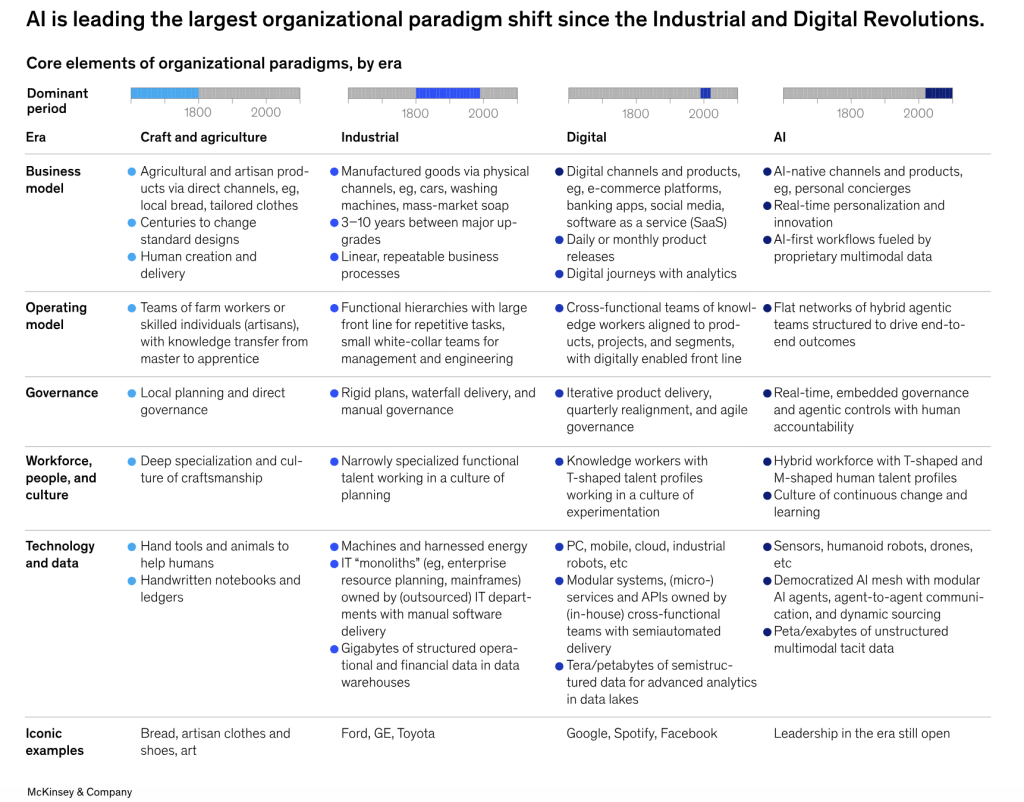
The point is this type of organizational change is non-trivial and will take the better part of a decade to play out. The only firms likely fitting into the new model paradigm are startups.

Vector 2: Hybrid architecture as the durable foundation

IBM’s hybrid message is that data lives everywhere and as such AI must be brought to the data. Resilience is IBM’s strength and single points of failure are real; so IBM’s hybrid offerings must be exceedingly reliable. The keynote connected hybrid to sovereignty and governance – and to IBM’s portfolio moves with OpenShift, the HashiCorp acquisition and Confluent (6,500-plus enterprise customers, 40% of the Fortune 500) to pull real-time streaming data into the AI foundation, paired with watsonx.data.

Elevance Health was the operational customer proof point — a member-facing virtual assistant that uses hundreds of data points to help members understand benefits and costs, plus provider interoperability via a data sharing layer (likely Snowflake), and agents monitoring payment integrity (fraud, waste, abuse). The common thread was to modernize the data and platform foundation, then embed AI in workflows with governance baked in from ideation through deployment.

Vector 3: Quantum frontier – faster than most expect

IBM pushed back on both ends of the conventional wisdom spectrum, from “quantum is sci-fi” to “quantum is oversold” – arguing it has moved from science to engineering. In his keynote, Krishna asserted that quantum advantage is approaching quickly and positioned quantum and AI as complements – that is, quantum helps uncover what AI can’t compute, and AI accelerates progress on algorithms and workflows. Cleveland Clinic was the customer example, with quantum-enabled work on biomedical discovery and simulation at scale, framed as a significant change for understanding biology and therapeutics.

The AI ‘building blocks’ IBM wants to be known for

Krisha gave a nod to a few of IBM’s product announcements that were positioned as enablers of the operating model shift:

  • IBM Bob is a full lifecycle developer platform (not just code assist) – planning through deployment – used internally at scale at IBM, tied to measurable productivity and delivery improvements;
  • Sovereign Core is IBM’s answer to sovereignty that “holds at runtime” as regulations and geopolitics shift;
  • Concert (public preview) is an AI-powered coordination layer as systems get more embedded and complex, shifting from monitoring to coordinated response.

The missing layer: End-to-end integration and an ontology-driven data harmonization story IBM can own

We believe IBM’s opportunity is to turn “AI-first+hybrid+governance” into a single, end-to-end story that closes the gap between AI ambition and operational execution. The keynote narrative pointed at the real barriers, including siloed data, fragmented infrastructure, and “multiple clouds with no coherent operating models” – and it made the claim that “the models don’t really matter unless a foundation is correct.”

The missing piece in our view is a Palantir-like harmonization layer that sits above systems of record and above the modern data platform, harmonizes meaning across domains, and becomes the “system of intelligence” feed trusted data to agents that can operate in a governed and safe manner. In plain terms, enterprises need a way to reconcile disparate data into a usable, policy-controlled representation of the business – not another pile of connectors pulled into a data store.

IBM has the ingredients to own that layer credibly, but it has to be articulated as a productized integration story, not a collection of parts:

  • Real-time+governed data foundation: The Confluent deal brings “real time streaming data into our data foundation,” and the keynote made the point that AI agents are only going to be as good as the data they can access. That sets up an integration narrative where watsonx.data plus Kafka-class streaming becomes the data supply chain for agents.
  • A semantics/ontology layer with governance baked in: The market need in our view is to map and harmonize entities, policies and processes across apps, clouds and edge (metadata, underlying application logic and process data). The keynote leaned into the right data architecture, the right governance and the right integration as the key advantage for IBM. The next step in our view is to call out an explicit harmonization layer that can support an enterprise-wide system of intelligence (ontology+lineage+policy+identity) so agents can act with auditability versus retrieving answers.
  • Hybrid as the operating architecture is not a compromise: The keynote line that “Hybrid is not a compromise… it allows you to move fast without creating new fragility” is a key value prop IBM is putting forth. The missing piece is to connect that to a concrete end-to-end integration path – for example, how Red Hat OpenShift+data foundation+ontology/policy layer+agent tooling become one operating model that customers can standardize on.

With its key pieces of the stack, including watsonx.data, IBM can win mind share by positioning itself as the vendor that operationalizes AI through a governed, context-driven integration layer. It can be a practical bridge between messy enterprise data and agentic aspiration. The keynote showed components and the opportunity is to make the harmonization layer an explicit system of intelligence that delivers unique and powerful value where data, process, identity and policy come together.

Summary

IBM’s Think 2026 keynote laid out a coherent three-part premise including: 1) An AI-first operating model change; 2) Hybrid as a durable architecture; and 3) Quantum as an engineering timeline, not a science project. The keynote thread was that AI value doesn’t show up at scale until organizations stop treating it as a separate thing – and start treating it as the core of a firm’s operating model. IBM is aiming to be the day zero to scaled deployment partner for enterprises that want to move fast without losing control.

Action item: Chief information officers should pick one cross-functional workflow that can deliver substantial value to the business (not a RAG-based chatbot) and run a 60- to 90-day integration-first sprint to prove you can harmonize data, policy and execution across systems. The deliverable is an operating capability with a shared data and ontology layer that standardizes entities, permissions and process context so AI can act safely and repeatably.

Measure success in two ways including: 1) Time-to-outcome improvement (cycle time or cost reduction) and 2) The percentage of the workflow that can run end-to-end with auditability. It’s likely you’ll discover the capabilities to accomplish this are lacking, but it will expose the gaps in your AI tech stack that you can partner with firms such as IBM to close.

Photo: Dave Vellante/SiliconANGLE

A message from John Furrier, co-founder of SiliconANGLE:

Support our mission to keep content open and free by engaging with theCUBE community. Join theCUBE’s Alumni Trust Network, where technology leaders connect, share intelligence and create opportunities.

  • 15M+ viewers of theCUBE videos, powering conversations across AI, cloud, cybersecurity and more
  • 11.4k+ theCUBE alumni — Connect with more than 11,400 tech and business leaders shaping the future through a unique trusted-based network.

About SiliconANGLE Media

SiliconANGLE Media is a recognized leader in digital media innovation, uniting breakthrough technology, strategic insights and real-time audience engagement. As the parent company of SiliconANGLE, theCUBE Network, theCUBE Research, CUBE365, theCUBE AI and theCUBE SuperStudios — with flagship locations in Silicon Valley and the New York Stock Exchange — SiliconANGLE Media operates at the intersection of media, technology and AI.

Founded by tech visionaries John Furrier and Dave Vellante, SiliconANGLE Media has built a dynamic ecosystem of industry-leading digital media brands that reach 15+ million elite tech professionals. Our new proprietary theCUBE AI Video Cloud is breaking ground in audience interaction, leveraging theCUBEai.com neural network to help technology companies make data-driven decisions and stay at the forefront of industry conversations.