


Orbital Inc., a startup that’s aiming to bring the artificial intelligence industry into low-Earth orbit ahead of Elon Musk, said today it has closed on a funding round of an undisclosed amount led by Andreessen Horowitz’s a16z Speedrun.
The money will help to finance its first test mission, “Orbital-1,” aimed at demonstrating a proof-of-concept of its orbital AI data center technology. The startup is tackling the growing energy crisis around AI, which has put terrestrial power grids under immense strain as they gobble up electricity supplies faster than new energy sources can be brought online.
There are real fears that the U.S. could soon face an energy crunch because of all the electricity being sucked up by AI data centers that house thousands of powerful graphics processing units and other advanced chips. Those fears were the primary reason why Google LLC, Microsoft Corp., Amazon.com Inc. and other big technology firms recently met with U.S. President Donald Trump at the White House. There, they signed a pledge to help mitigate the impact of their data center’s electricity usage on household costs, while also committing to bringing new energy sources online.
However, Orbital thinks it has a much better alternative, aiming to tap into the abundant free energy provided by the sun, and it thinks there’s no better place to obtain this energy than 1,200 miles up in low-Earth orbit.
The company wants to build space-based data centers that will be able to run entirely on solar energy 24/7. The plan is to put its satellite constellation into sun-synchronous orbits so they can constantly gobble up free energy, without being limited by the Earth’s day and night cycle. By putting data centers in space, Orbital can also solve the problem of cooling AI infrastructure, shedding the heat generated by AI chips directly into the vacuum of space via radiative cooling.
Co-founder and Chief Executive Euwyn Poon said there’s a real sense of urgency about his company’s mission, because the AI industry’s progress has already been constrained by power issues. “In orbit, solar power is continuous and cooling is fundamentally different,” he said. “Orbital is building compute infrastructure that removes the energy ceiling and scales with AI’s potential.”
Elon Musk has only recently begun talking seriously about orbital data centers in public, but Orbital has been working on the concept for some time already. It already has a blueprint for what its space-based data centers will look like. It’s designing a constellation of independent nodes that will be able to distribute AI inference workloads across massive orbital clusters of GPUs. Each of its satellites will house a cluster of Nvidia-powered servers, which will function as a decentralized, parallel processing powerhouse in the far reaches of the atmosphere.
Poon told SiliconANGLE the company is targeting inference workloads specifically, not just because they can be distributed across clusters, but also because they’re not affected by the unavoidable latency issues that come from having data centers in space. That said, he believes latency is not really that much of a problem anymore. “At a 500- to 600-kilometer altitude, round-trip latency is just 20 to 40 milliseconds, which is comparable to a fiber connection between L.A. and Denver,” he explained. “Starlink already demonstrates this commercially with sub-50-milliseconds latency to homes and businesses.”
To support its ambitious mission, Orbital is also opening a dedicated research and development facility in Los Angeles, called Factory-1. There, it will begin manufacturing its first specialized compute satellites.
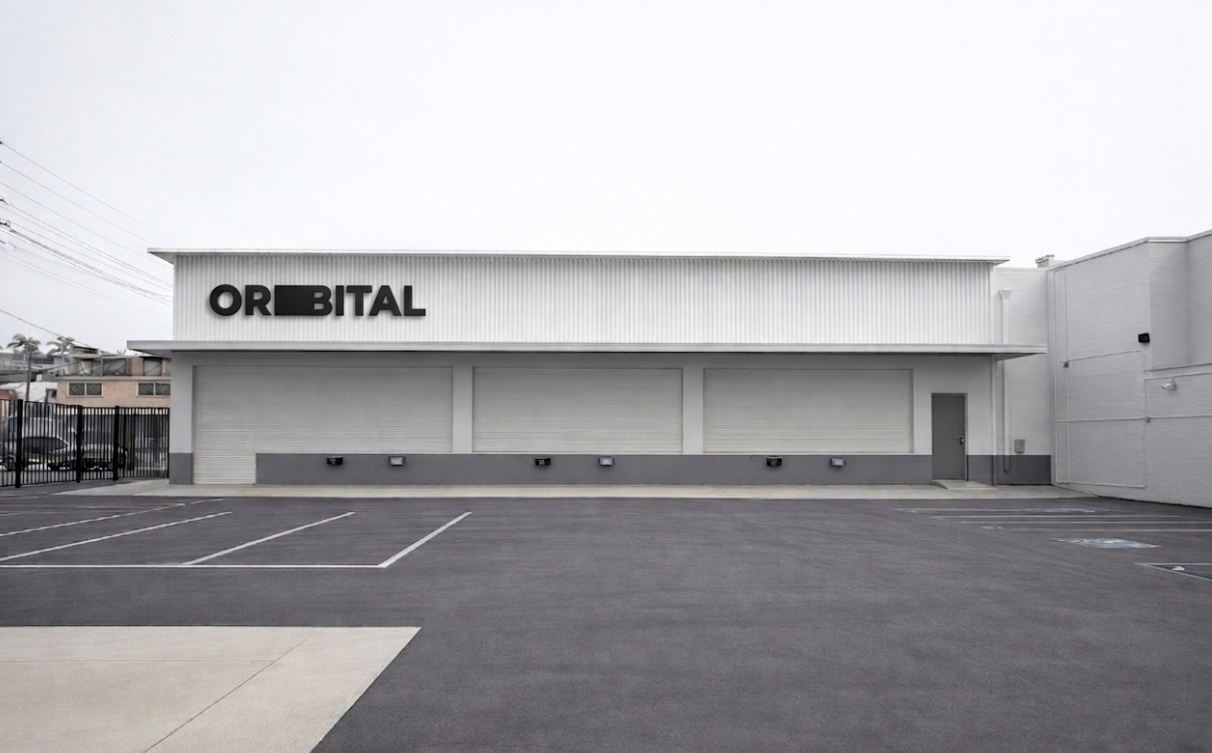
It will need to work fast. Its plan calls for its first satellite to blast off into orbit on a SpaceX Corp. Falcon 9 rocket in April 2027, just 12 months from now. The mission will serve to validate Orbital’s plans for sustained GPU operations in a high-radiation environment and test its ability to support commercial AI inference workloads. Should it succeed, it will scale things up to build a massive constellation.
Asked about the challenges his company faces, Poon said radiation protection and “bit flips” are among the most difficult aspects of orbital engineering, so the Orbital-1 test mission is all about validating the technologies his company has developed to deal with them. “Our approach focused on radiation hardening, and the test mission is designed to specifically measure these effects in real conditions,” he said. “We’re also fortunate that our target workload is inference, which is stateless. That means each request is discrete, so a corrected error doesn’t compound across runs the way it would in AI training.”
Poon also dismissed one of the main criticisms of the idea of space-based data centers, which is the difficulty of maintenance. He agreed that trying to repair or upgrade satellites in low Earth orbit is an incredibly challenging task, which is why Orbital simply does not plan even to attempt it.
“Our approach is to test our GPUs and systems extensively on the ground before launch, and then design each satellite to be replaced rather than serviced,” he said. “Every satellite will have a defined lifecycle, with controlled deorbit and complete burn-up on reentry. So compared to terrestrial data centers, which generate massive e-waste streams, Orbital is more environmentally friendly at the end of life.”
A16z General Partner Andrew Chen said the Speedrun fund was set up specifically to back founders with the most ambitious ideas. “The harder the problem, the better,” he said. “Orbital is taking on AI’s biggest constraint with a bold and radical idea.”
The startup hasn’t said much about how it’s going to overcome the numerous challenges it faces. Space is a harsh environment characterized by extreme temperate fluctuations, and there’s the problem of cosmic radiation that potentially can frazzle delicate GPU circuits. It will need to show that its radiation protection systems are capable of safeguarding those delicate processors while also overcoming the latency issues caused by having to beam data from the surface to the orbit and back again.
If Orbital can solve these problems and blast AI’s inference “brain” into orbit, it could decouple progress from the resource constraints facing terrestrial AI data centers, paving the way for a future in which cloud computing is literally performed in the sky, far above the clouds.
Support our mission to keep content open and free by engaging with theCUBE community. Join theCUBE’s Alumni Trust Network, where technology leaders connect, share intelligence and create opportunities.
About SiliconANGLE Media
SiliconANGLE Media is a recognized leader in digital media innovation, uniting breakthrough technology, strategic insights and real-time audience engagement. As the parent company of SiliconANGLE, theCUBE Network, theCUBE Research, CUBE365, theCUBE AI and theCUBE SuperStudios — with flagship locations in Silicon Valley and the New York Stock Exchange — SiliconANGLE Media operates at the intersection of media, technology and AI.
Founded by tech visionaries John Furrier and Dave Vellante, SiliconANGLE Media has built a dynamic ecosystem of industry-leading digital media brands that reach 15+ million elite tech professionals. Our new proprietary theCUBE AI Video Cloud is breaking ground in audience interaction, leveraging theCUBEai.com neural network to help technology companies make data-driven decisions and stay at the forefront of industry conversations.
此内容由惯性聚合(RSS阅读器)自动聚合整理,仅供阅读参考。 原文来自 — 版权归原作者所有。