






When a company such as Google LLP demonstrates leadership in large-scale data systems, advantages can begin to accrue in areas not readily apparent from the keynote speeches and press releases.
One of these involves the sovereign cloud.
Google itself made no major announcements during Google Cloud Next in Las Vegas this week specifically on the sovereign cloud, the storage and processing of data with a geographic area to ensure compliance with local regulations and standards. But that may well be because several of Google’s partners did all the talking for it.
Over the past few days, Red Hat, Kyndryl, Samsung, Accenture and Elastic made announcements of new collaborations with Google on sovereign initiatives. These ranged from support for Red Hat OpenShift on Google Cloud Dedicated for residency and technological autonomy to Kyndryl’s decision to expand its Distributed Cloud services with Google to maintain control over where data resides and how it is governed.
These announcements from Google’s partners were driven by growing interest among a number of customers in pursuing a sovereign cloud strategy.
“There are two common terms that are coming up in every customer conversation,” Jai Haridas, a vice president and general manager at Google Cloud Platform, said during a presentation at the conference on Thursday. “One is AI and the other is sovereignty.”
Enterprise interest in the sovereign cloud has followed the arc of artificial intelligence deployment as organizations continue to look for solutions that will scale autonomous technologies globally. Yet governance of the vast amount of data that fuels the AI machine has been the subject of much debate for the better part of three decades.
In the 1990s, the EU Data Protection Directive was implemented to regulate where data could reside. That was followed in 2018 by the passage of the General Data Protection Regulation or GDPR, in which required security and data privacy safeguards for personal information.
China introduced its own set of regulations over the past several years that imposed strict sovereignty requirements on businesses, and the U.S. government has FedRAMP, which governs where federal data can be securely stored. Continued enactment of new rules and regulations in locations around the world will keep data sovereignty in the conversation for the foreseeable future.
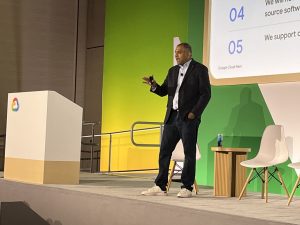
Google’s Jai Haridas spoke at Google Cloud Next in Las Vegas about the growing influence of sovereign cloud.
Google has not ignored the market opportunity that sovereign cloud represents. In addition to Google Distributed Cloud, which provides a software and hardware solution for meeting regulatory needs, the firm also offers Cloud Data Boundary and Cloud Dedicated to enable the running of secure and compliant workloads on Google’s platform.
“Customers and industries have evolved from a cloud first strategy to a sovereign first strategy,” said Haridas. “The sovereign first strategy is about giving you a choice so you can assess the risk for your data workloads and choose the solution.”
Choice and control have been key factors behind organizational interest in sovereign solutions. This has become more urgent as geopolitical pressures have intensified.
A recent survey of 3,700 information technology leaders in 21 countries by Kyndryl found that 83% believed that emerging data sovereignty and repatriation regulations have become more important in the past 12 months. The report also noted that 65% of respondents indicated they had already made changes to their cloud strategies in response to new geopolitical pressures.
Earlier this month, Kyndryl released Sovereignty Solutioning, a suite of advisory, implementation and managed services to help organizations design sovereign-ready architectures. These include moving data into on-premises infrastructure, private, hybrid or public clouds.
“This topic has now become front and center,” Giovanni Carraro, global strategic alliances leader at Kyndryl, said in an interview during Google Cloud Next with SiliconANGLE. “We have taken an approach to sovereignty that has focused on the pragmatic. It’s not just about the data; it’s also about the technology around it.”
Increasingly, the technology around the sovereign cloud is being dedicated to support AI initiatives. This has ignited a competitive battle among hyperscalers and other tech titans over who owns the control plane where AI actually does the work.
This is one key reason why sovereignty has emerged as a key theme at events such as Google Cloud Next. In the agentic world, the flow of data into and out of systems matters even more, as Google and other major tech companies continue to expand data center footprints.
“In the agentic era, compute is no longer defined by a chip, it is defined by an entire datacenter,” Amin Vahdat, chief technologist for AI infrastructure at Google, said during a panel discussion on Wednesday.
This, coupled with the rise of geopolitical tensions, will lead to a potential 20% shift in cloud infrastructure-as-a-service workloads from global to local cloud providers by next year, according to Gartner Inc. This movement, which Gartner has termed “geopatriation,” has opened the door for local cloud providers in regions such as Europe to offer sovereign capabilities at the expense of U.S.-based firms.
For Google customers and other users of hyperscaler services, the sovereign cloud has added yet one more complication in the delivery of AI services. It’s a balancing act, according to Enrico Bagnasco, deputy chief data and AI technology officer for the banking group Intesa Sanpaolo, who spoke at a panel session on Thursday.
“We are trying to anticipate the natural consequence of all the regulation in Europe,” Bagnasco said. “At times, innovation and compliance seem to collide and you have to find the right balance. It won’t take long to consider it as the new normal.”
Support our mission to keep content open and free by engaging with theCUBE community. Join theCUBE’s Alumni Trust Network, where technology leaders connect, share intelligence and create opportunities.
About SiliconANGLE Media
SiliconANGLE Media is a recognized leader in digital media innovation, uniting breakthrough technology, strategic insights and real-time audience engagement. As the parent company of SiliconANGLE, theCUBE Network, theCUBE Research, CUBE365, theCUBE AI and theCUBE SuperStudios — with flagship locations in Silicon Valley and the New York Stock Exchange — SiliconANGLE Media operates at the intersection of media, technology and AI.
Founded by tech visionaries John Furrier and Dave Vellante, SiliconANGLE Media has built a dynamic ecosystem of industry-leading digital media brands that reach 15+ million elite tech professionals. Our new proprietary theCUBE AI Video Cloud is breaking ground in audience interaction, leveraging theCUBEai.com neural network to help technology companies make data-driven decisions and stay at the forefront of industry conversations.
此内容由惯性聚合(RSS阅读器)自动聚合整理,仅供阅读参考。 原文来自 — 版权归原作者所有。