



By
Joanne Stocker
Verification producer
Joanne Stocker is a verification producer for CBS News Confirmed. She was previously chief editor of Kurdistan 24 English and managing editor at The Defense Post. She has combined open-source investigation methods with on-the-ground reporting to cover conflict, terrorism, and misinformation for over 15 years.
/ CBS News
Major shipping companies still see transiting the Strait of Hormuz as "very risky" and say there's little appetite to resume normal operations through the vital waterway until more details of the U.S.-Iran deal become clear. Multiple companies say firm security guarantees are needed, despite an assurance from President Trump of a "totally safe, secure, and pristine" route through the strait.
The U.S. and Iran are set to sign a memorandum of understanding Friday in Switzerland that will formally lift restrictions imposed by both countries on traffic in the Strait of Hormuz. Before the U.S. and Israel launched their war with Iran on Feb. 28, about a fifth of the world's oil and gas supplies typically transited the strait.
Iran's attacks on and threats against commercial vessels, launched in retaliation for the U.S.-Israel strikes, brought that traffic to a virtual standstill, driving global energy prices up significantly.
Mr. Trump, in a Sunday post on his Truth Social platform announcing the agreement with Iran, said: "I hereby fully authorize the toll free opening of the Strait of Hormuz, and, simultaneously herewith, authorize the immediate removal of the United States Naval blockade."
"Ships of the World, start your engines," Mr. Trump said. "Let the oil flow!"
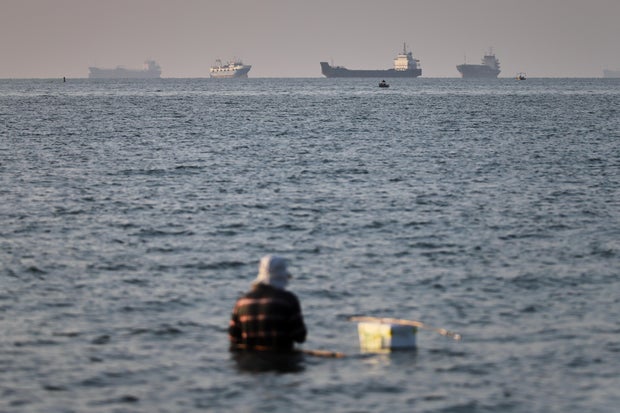
A day later, the president said tankers were "starting to move, many loaded up with Oil, out of the Strait of Hormuz." He said ships could take a southern route through the strait, "which is totally safe, secure, and pristine. There are other areas of travel, also!!!"
As Mr. Trump urged a resumption of strait crossings, however, the Joint Maritime Information Center, a multinational naval operation that includes the U.S. military, warned Monday that the U.S. blockade of Iran's ports and vessels would remain in effect until Friday, "pending execution" of the ceasefire.
"The maritime security threat level in the Strait of Hormuz remains SEVERE due to blockade operations," read an advisory note.
Amid the mixed messages, shippers have welcomed the tentative agreement between Iran and the U.S., but remained cautious.
"Our policy remains unchanged"
Mr. Trump's announcement of an agreement on the memorandum of understanding with Iran sparked a major rally on global equity markets, and crude oil prices have dropped nearly 5% this week.
Public tracking data shows shipowners have been repositioning empty vessels in anticipation of a spike in demand when the strait reopens, and a handful of tankers have transited the waterway this week, but compared to pre-war levels — around 135 ships per day — it's just a trickle.
Shipping analyst Richard Meade at Lloyd's List said "none of this should be mistaken for a return to normality."
"Due to lack of details and a history of overly optimistic reassurances, we believe the security situation for the shipping industry remains volatile, and we still consider it very risky for ships to commence transits at this point," Jakob Larsen, head of safety and security at BIMCO, one of the largest international shipping associations, said Monday.
"The next step is for shipowners to be reassured that transiting the Strait of Hormuz is not only permitted but also safe," he added.
Most shippers appear to be waiting for concrete assurances.
A spokesperson for Mitsui OSK Lines, a major Japanese logistics company, told CBS News on Tuesday that the firm recognizes "signs of movement toward a ceasefire," but its "policy remains unchanged: Operations will not be resumed until safety has been sufficiently confirmed."
"What will have to come in place is not just a simple agreement between the relevant countries, but it has to be material and translated into the real situations in the Strait of Hormuz, so that shipping lines can make themselves comfortable to go through," the company's CEO Jotaro Tamura told the Financial Times.
"Given the experiences in the last couple of months, I think it's reasonable to assume that it may take at least a couple of weeks, or if not, a month," he said.
Even that could be optimistic.
A return to normal cargo flows in the strait will "most likely take around three to four months," Leon Schulz, a spokesman for Hapag-Lloyd, another major shipping company, told CBS News on Tuesday.
The tentative agreement between Tehran and Washington does give "reason to hope" for an improved security situation, Schulz said, adding that the "risk assessment for transits of Hapag-Lloyd vessels through the Strait of Hormuz is currently being reevaluated."
The Danish shipping giant Maersk told the Reuters news agency on Monday that it was still "too early to assess" the impact of the deal, adding: "At this stage, there are no changes to our operations in the region."
"Solid evidence"
The path back to real normality in the Strait of Hormuz may be a minefield, literally and figuratively.
Reuters quoted sources in the shipping industry as saying Monday that removing Iranian sea mines from the strait could take 40 to 50 days.
"The threat of mines in the area remains a concern immediately as well as further down the line, and mine-free routes need to be established," Larsen, of BIMCO, said Monday.
The text of the agreement between the U.S. and Iran has not been shared by either government, and the practical steps expected in the immediate future to reopen the strait safely remain unclear.
In the longer term, Iran has demonstrated an ability over the last 109 days to effectively use the Strait of Hormuz as a pressure-point, and analysts believe the risks of another closure may linger.
Marine insurance firms have said they're not yet ready to readjust rates that soared during the war. Premiums are "quick to go up, slow to go down," one maritime insurer in Singapore told Lloyd's List, adding that it would only change its prices after seeing "solid evidence" of safety improvements for ships in the region.
In: