










/ CBS News
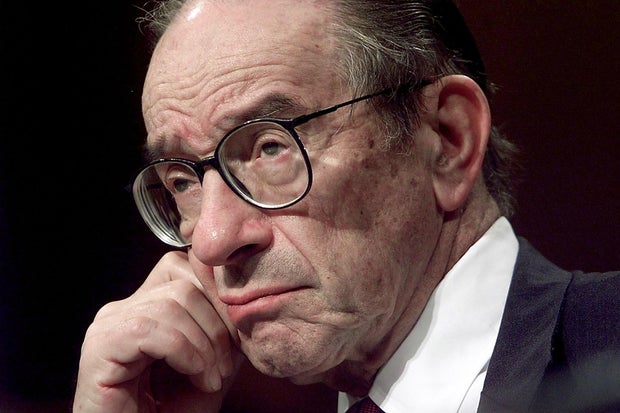
Alan Greenspan, an economist who served as chairman of the Federal Reserve under four U.S. presidents, died on Monday, his wife Andrea Mitchell said. He was 100.
Greenspan died at his home due to complications of Parkinson's Disease, Mitchell said in a statement reported by NBC News, where she is the chief Washington and foreign affairs correspondent.
As one of the longest-serving Federal Reserve chairs in U.S. history, Greenspan's reign at the central bank coincided with the so-called Great Moderation, a period of stability from the mid-1980s until 2007 that was marked by low inflation, stock market gains and strong economic growth.
At the same time, his tenure was punctuated by several financial crises, ranging from the 1987 stock market crash to the bursting of the dot-com bubble in the early 2000s. In 1996, Greenspan famously coined the phrase "irrational exuberance" to describe bubbles fueled by unbridled investor optimism, alluding to that era's craze for internet company stocks.
More controversially, Greenspan's legacy is linked to the 2008 global financial crisis and the ensuing Great Recession, even though the economic collapse occurred after he ended his final term as Fed chair in early 2006. Even so, some critics pointed to his "loose money" policies in the preceding years as contributing to the subprime housing crisis that ultimately caused the greatest U.S. economic collapse since the Great Depression.
"The main post-crisis criticism of Mr. Greenspan was that he was a naive believer in market efficiency, failing to pop bubbles in the late 1990s or mid-2000s and failing to regulate the financial sector properly," The Economist reflected in a 2017 essay.
For his part, Greenspan defended his decisions leading up to the Great Recession, telling Fortune Magazine in 2007 that he was the victim of "revisionist history" and that he had warned about subprime mortgages and other red flags brewing in the housing market.
As a younger economist, Greenspan told Fortune that he had discounted the role of human behavior in economics, saying he believed it was "not worth evaluating." But he later realized that "there were very important missing variables in the forecasting system, and these all related to systemic activities of human beings," Greenspan noted.
"You can count that human beings will become euphoric on occasion, and in deep distress and fear. What you can count on is that will never change," he told the publication..
As Fed chair, Greenspan also became known for offering gnomic economic commentary that lawmakers, economists and investors scrambled to interpret. At the same time, he championed what he described as a shift away from less informative Fed statements prior to the 1980s, pushing for more transparency by central bankers.
"You don't want to surprise the markets unless there is a purpose to it," Greenspan said in a Federal Reserve oral history in 2009. "Too often in the past we would surprise markets with no particular purpose, which was not good."
Greenspan was born in New York City on March 6, 1926, to Herbert Greenspan, a stockbroker, and Rose Greenspan, a homemaker, according to the New York Times. His parents divorced when he was five due partly to the financial stress stemming from the aftermath of the 1929 stock market crash, the Times noted.
As a child, Greenspan exhibited mathematical talent, with the Times noting he could add three-digit sums in his head at age five. As a teenager, he pursued musical interests, studying the clarinet at Juilliard before studying economics at New York University, where he eventually earned a bachelors, master's and doctoral degree.
While studying economics, Greenspan became a devotee of novelist Ayn Rand, with an NYU alumni magazine describing him as meeting regularly with her "objectivist salon" in her Manhattan apartment.
His first job was with the National Industrial Conference Board, where he analyzed demand for aluminum, copper and steel, followed by the creation of his economic consulting firm Townsend-Greenspan & Co., according to the Federal Reserve.
Later, he served as chairman of the President's Council of Economic Advisers under President Gerald Ford and as a member of President Ronald Reagan's Economic Policy Advisory Board.
Greenspan was appointed Fed chair in 1987 by President Reagan, a job he was appointed to by three other presidents: George H.W. Bush, Bill Clinton and George W. Bush.
Greenspan, who married the journalist Andrea Mitchell in 1997, retired from the Federal Reserve Board in 2006.
Asked by Fortune Magazine if any president had ever asked him to cut interest rates while he was Fed chair, Greenspan said he never got a direct request.
"[B]ut a few hinted it. However, I will tell you… no politician ever called me up and asked me to raise interest rates," he noted wryly.
Edited by Alain Sherter
In: