
惯性聚合 高效追踪和阅读你感兴趣的博客、新闻、科技资讯
阅读原文 在惯性聚合中打开

推荐订阅源

Spread Privacy
Spread Privacy
P
Palo Alto Networks Blog
P
Proofpoint News Feed
AI
AI
Help Net Security
Help Net Security
S
Securelist
T
Troy Hunt's Blog
K
KPMG report finds enterprise disconnect between AI and its ROI | CIO
C
Cisco Blogs
Scott Helme
Scott Helme
Hacker News - Newest:
Hacker News - Newest: "LLM"
Vercel News
Vercel News
Exploit-DB.com RSS Feed
CTFtime.org: upcoming CTF events
B
Blog
GbyAI
GbyAI
Recent Commits to openclaw:main
D
Darknet – Hacking Tools, Hacker News & Cyber Security
P
Proofpoint News Feed
S
Security Affairs
Cisco Talos Blog
Cisco Talos Blog
AWS News Blog
AWS News Blog
T
Tenable Blog
H
Help Net Security
NISL@THU
NISL@THU
F
Fortinet All Blogs
博客园_首页
G
GRAHAM CLULEY
L
LINUX DO - 最新话题
P
Privacy International News Feed
G
Google Developers Blog
博客园 - Franky
Cyber Security Advisories - MS-ISAC
cs.CL updates on arXiv.org
Security Archives - TechRepublic
The Register - Security
L
LangChain Blog
aimingoo的专栏
aimingoo的专栏
T
Tor Project blog
P
Privacy & Cybersecurity Law Blog
量子位
C
Cyber Attacks, Cyber Crime and Cyber Security
Forbes - Security
Forbes - Security
S
Secure Thoughts
Simon Willison's Weblog
D
Docker
Recorded Future
Recorded Future
博客园 - 三生石上(FineUI控件)
L
Lohrmann on Cybersecurity
T
Tailwind CSS Blog

Latest from TechRadar in Pro

VodafoneThree gets Ofcom approval to bring satellite connectivity to your smartphone Is this the tipping point for AI at work? New Gallup survey finds half of all US employees now use it in some way 'Every Apple user needs to know about this nasty scam': Fake warnings tell users their iCloud data will be… 'Makes it even more disappointing': Microsoft backs fossil fuel big time with $7 billion deal in race for AI… 'Maybe it’s not science fiction': Solar panels are causing rainwater to fall in one of the driest places… Maine becomes first US state to pass data centre construction ban Dozens of WordPress plugins hijacked to target thousands of sites Drone-killing laser weapons greenlit for use in US airspace – FAA and Defense Department say high-energy weapons are ‘ready to protect all air travelers from illicit drone use’ despite airspace restrictions and friendly-fire incidents 'We are currently being extorted' — crypto giant Kraken says it is facing extortion attack, here's… I tried 7 free MTD software – now I've ranked my top picks as a freelancer Jackery McGraw Hill becomes latest to see its Salesforce data hacked Looking for a new PC? Now might be great time to upgrade, as Gartner figures claim shipments are rising — while… The new engineering playbook: how AI design copilots are reshaping product development Farewell Surface Hub — Microsoft kills off its super-sized touchscreen displays, but you might still be able to get one if you act fast 'We have no interest in patient data in the UK': Palantir UK head defends record as criticisms rise Amazon’s new AI Bio Discovery tool can provide ‘every researcher’ with ‘lab-in-the-loop drug discovery’ – 40+ AI biology models can filter 300,000 novel antibody candidates down to the top results for testing in just weeks Over 100 Chrome Web Store extensions found stealing user data from thousands of accounts Europe wants tech sovereignty but is this realistic? Enterprise AI governance cannot live in a prompt. So where is the safety net? Why 2026 is the year of flexibility without friction: solving the multi-platform crisis OpenAI reveals its Mythos rival designed for cybersecurity pros When cyberattacks are inevitable, recovery becomes the strategy Closing the cloud complexity gap LaLiga uses AI to fight illegal streaming that costs its clubs $800m a year Intel and Google expand long-term chip partnership to power AI systems 'Chatbots respond not just to what you ask, but how you ask it': Report finds AI agents might be sucking up to… 'Smartphones have physical limitations': Report explains why AI is kickstarting a billion-dollar hardware arms… 'I’m pretty sure actually we really do not need to work for five days' Zoom CEO calls for end of traditional work schedules — says 3-day working week should become the norm 'It's more common than you think': Experts reveal how hackers are trying to hijack your inbox with these… 'This wasn’t just phishing — it was a full-service cybercrime platform': FBI reveals takedown of notorious W3LL phishing operation targeting thousands of victims From cloud to Agentic AI: Why security must evolve faster than innovation Basic-Fit gym group data breach exposes details of over 1 million members — here's what we know ‘Authorities can ask them to hand over data’: Report claims over 80% of Europeans don’t trust US and Chinese businesses to handle their data – Europe is desperate for homegrown AI, cloud, and telecoms as the rift with the US grows Booking.com confirms reservation data breach — tells customers hackers 'may have been able to access certain… Agility is the key to protecting against Malware-as-a-Service (MaaS) Rockstar hackers publish 78.6 million stolen records — but many of us will be disappointed Adobe issues emergency security patch — Reader and Acrobat users need to update now OpenAI flags third-party data issue — all macOS users should update now Linux rules on using AI-generated code - Copilot is OK, but humans must take 'full responsibility for the… Hackers use Claude and ChatGPT in 'a significant evolution in offensive capability' to breach government agencies, leak hundreds of millions of citizen records ‘You’re effed’: Palantir CEO says AI ‘will destroy humanities jobs’ – but Gen Z workers are apparently deliberately sabotaging AI rollouts in an effort to fight back 'This is not your typical run-of-the-mill malware': CPUID download page hacked and tools replaced with links… Anthropic is bringing Claude's AI power to Microsoft Word How businesses can turn AI pilots into scalable solutions AI can transform customer experiences – when it lives up to its promise 'Regain control of our digital destiny': France to ditch Windows for Linux to reduce reliance on US tech How the memory crisis is strangling the UK's data center boom ‘No Decision’ is the new breach: Why inaction is becoming a career risk for CISOs in 2026 'That shouldn’t translate into investing in AI blindly, without a clear strategy': Experts warn UK firms want to keep spending big on AI - even if they can't prove it makes a difference How AI is rewriting the ERP investment playbook Rockstar confirms major third-party data breach: GTA VI maker says 'no impact on our organization or our… How to deploy physical AI effectively '71% of US households get routers from ISPs': Why new FCC rules could leave millions stuck with outdated,… 'The CPU is the system’s executive layer': Intel joins SambaNova as both face existential threat from… 'Just not sustainable': Why your monthly £25 broadband internet bill could soon hit £45 '$15K bill destroyed a solo developer’s startup': How hackers are using leaked Google API keys to… 'Today is the day you've been waiting for': eGPUs can now officially turn a humble Mac Mini into an AI… Linux pulls support for ancient CPU — unsurprisingly, Linus Torvald says there is 'zero real reason' to… 'AI is a once-in-a-lifetime opportunity': Amazon CEO Andy Jassy lays out his '6 truths' for the… 'A self-inflicted hit': Washington state just rolled back sales tax exemptions for AI data centers worth… 'There’s no one-size-fits-all office chair': Vari explains the design decisions behind its award-winning… 'Small business owners have significant creative control from start to finish' — VistaPrint reveals the… 'Experts' to rent for $1 per month: Hostinger debuts 7-person AI team to help SMBs save thousands on… Microsoft hands Linux Foundation key Surface data to help fix laptop battery life Adobe Reader users beware — experts flag months-old security flaw using booby-trapped PDFs to scope out victims 'Shockingly good value': New rugged Android tablet has a built-in 1080p projector, night-vision camera, and… Stop the presses — Microsoft is actually cutting cloud PC prices for SMBs, promises to make it 'more cost-effective for small and medium businesses' 'If one piece of your supply chain is delayed, then your whole project can't deliver': Nearly half of US data centers planned for 2026 canceled or delayed — and things could soon get much worse ChatGPT’s hidden backup model just got smarter — as OpenAI adds a cheaper Pro option 'The problem is not AI’s capability...what won’t improve on its own is the human side': Major study claims white-collar workers are fighting back against AI in the workplace Introducing Perspectives — the new home for premium contributed content on TechRadar Pro Introducing Perspectives — the new home for premium contributed content on TechRadar Pro The New Internet is Coming Lazarus and Kimsuky prove why infrastructure-level analysis is crucial for cybersecurity Claude Cowork is now available for enterprise use, adds analytics, access controls and more The internet has a trust problem - identity needs to travel OpenAI halts £31 billion Stargate UK project over rising energy costs and regulatory deadlock The 70% rule: Why your AI strategy is a people strategy Top WordPress Slider plugin hijacked to spread malware — here's what to look out for Why CIOs need a single source of truth for digital operations No, Elon Musk doesn't want to give you a $5,000 tax refund — it's a scam, here's what to look out… Intermedia Unite review 2026 Why enterprise AI will be defined by integration, not model aggregation ‘It’s a potential national security threat’: Proton study finds over 3,500 US legislators’ official emails leaked and exposed on the dark web Microsoft warns worrying security flaw exposed over 50 million Android users, says 'user credentials and financial… Google Chrome rolls out a new tool to try and stop infostealer malware in its tracks How to submit an article for TechRadar Pro Perspectives 'Orwellian Notion': Federal workers can access Claude AI again after judge ditches Trump's Anthropic ban 'Almost 100 TOPS': GMKTec debuts powerful AI Mini PC that supports three 8K screens and costs less than you… 'Remember BlackBerry?': Iconic phone maker’s patents used to hit Brother in a massive lawsuit that could… Breach exposes sensitive LAPD files stored in city attorney system ‘FlamingChina’ hacker claims to have stolen over 10 petabytes of advanced military data from China’s National Supercomputing Center in possibly the biggest hack of all time Mac users beware — experts say this attack 'stood out immediately' by making a major change to try… Could AMD's former foundry be quietly building up to become a major Arm — and AMD — rival? Now that's different - hackers use miniature SVG images to try and hide credit card stealer "A future-proof powerhouse for demanding tasks": MSI's RTX5090 creative laptop gets a $300 price cut… Closing the implementation gap in America's cyber strategy UK NHS chief champions Palantir’s 'outstanding results’ in England, pushes for deeper rollout despite… French email provider accidentally leaked 40 million records — L’Oreal, Renault, French government data…
'Birds avoid turbines far more than prediction models assume': Spoor’s AI monitoring is changing how…
desire.athow · 2026-04-19 · via Latest from TechRadar in Pro
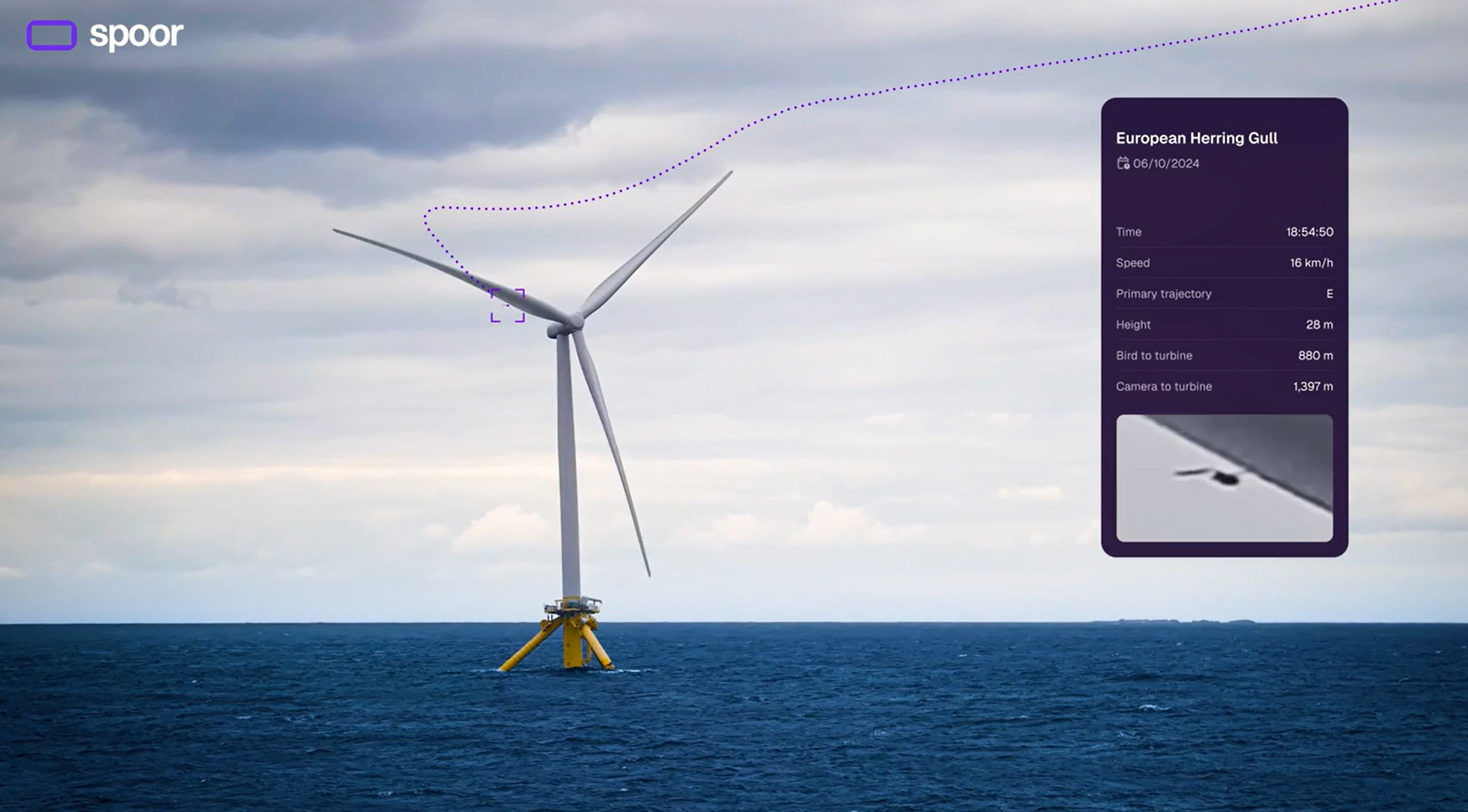
Spoor AI-powered bird protection (Image credit: Spoor)

One of the biggest hurdles facing new wind farms is proving how wildlife interacts with turbines in the real world. Developers and regulators need to understand how wildlife interacts with wind turbines, but much of the current process relies on intermittent surveys carried out by human observers using binoculars or searching sites on foot.

That uncertainty can have real consequences. Projects can face delays while additional surveys are carried out, planning decisions can become more conservative, and mitigation requirements can increase simply because the available data isn’t strong enough to support confident decisions.

Article continues below

In some cases, assumptions fill the gaps where hard evidence is missing, affecting how wind farms are approved, operated, and monitored over time.

Spoor's AI solution

This is where Spoor and its AI technology enter the picture. Rather than treating biodiversity monitoring as an occasional task tied to individual projects, the company is building systems that run continuously, collecting data across long periods instead of isolated survey windows.

This takes monitoring from short-term observation to something closer to infrastructure — always running, always recording, and producing data that can be checked and revisited as and when needed.

Spoor's technology relies on high-resolution cameras paired with computer vision models that track bird and bat activity around turbines in real time.

Sign up to the TechRadar Pro newsletter to get all the top news, opinion, features and guidance your business needs to succeed!

Instead of relying on scattered observations, it builds large datasets that can support environmental assessments, guide operational decisions, and help regulators understand how wildlife interacts with wind energy sites in practice.

Rather than focusing on reassurance or perception, the goal is to provide clearer evidence that can support more accurate decision-making across the entire lifecycle of a wind project.

I wanted to find out more, so I spoke to Ask Helseth, Spoor CEO, about the technology behind the system, the data it produces, and how it could change wind farm decision-making.

  • Where did the idea of using AI to track birds come from?

I learned that birds pose a major risk to wind farms and that the lack of good data was delaying new builds while also posing risks to existing farms. At the time, bird data was lacking and being collected manually using humans with binoculars to observe birds and dogs to find dead ones.

This was in 2021 and AI (computer vision) was becoming powerful enough to be applied with the right investment. The idea was straightforward: use cameras and AI to continuously detect and track birds. This would help us better understand and mitigate the challenges, allowing nature and industry to coexist.

  • What has the data shown up until now on the impact of wind farms on Mother Nature?

One of the most important findings is that birds avoid turbines far more than the prediction models assume. At Vattenfall's Aberdeen Bay offshore wind farm, we monitored a turbine continuously for 19 months, tracked over 2,000 bird flights, and recorded zero confirmed collisions.

The original environmental impact assessment had predicted roughly 8.5 collisions per turbine per year. The actual observed rate was several orders of magnitude lower.

That does not mean collisions never happen, but it tells us that the precautionary assumptions built into current collision risk models may be significantly overestimating the real impact at many sites.

That has direct consequences for how wind farms are consented and operated.

  • What is your target market and why would they be interested in Spoor's proposal?

Our primary market is offshore and onshore wind energy. We work with developers during the permitting phase, where bird data feeds into environmental impact assessments, and with operators during the life of the project, where it supports compliance, mitigation and re-consenting.

Our customers include Ørsted, RWE, Vattenfall, Equinor and TotalEnergies. Generally, we see that the industry is interested in having facts on the table when it comes to their impact (or lack thereof) on birds.

Without facts, assumptions can take over and they are usually not correct.

  • Once your client receives the data from Spoor's survey, what happens next? How does it help them?

The data feeds into several decision points across the project lifecycle. During permitting, it goes into the environmental impact assessment and the collision risk model, which determine the consent conditions a project must operate under.

Better data means more proportionate conditions, which means less unnecessary curtailment and fewer permitting delays.

During operations the data is used to understand the actual impact and supports adaptive management: if a wind farm is shutting down turbines during certain periods as a precaution, our data can show whether that curtailment is proportionate to actual bird activity, or whether it can be targeted more precisely.

Over the longer term, it builds the evidence base that operators need when their original consent expires and they face re-permitting.

  • What other fields could use the same technique? ESG? O&G? Health? Fraud?

We are already seeing interest from airports, transmission line operators and from the mining sector.

The underlying technology, continuous detection and classification of flying objects from camera footage using computer vision, has applications wherever you need to monitor airborne activity at scale.

Drones are an obvious adjacent use case: our system already detects them incidentally during bird monitoring.

  • What prevents others from copying what you've been doing? What's your USP?

Three things. First, our proprietary training dataset: we have been collecting and curating labelled bird detection data since 2019, with over a million tracked bird observations from real operational sites across multiple countries, species, seasons, and conditions. That dataset is what allows our models to significantly outperform off-the-shelf computer vision.

Second, our detection range and accuracy: we can reliably detect birds with very few pixels on target, which translates to detection ranges of up to 2 kilometres for large birds using off-the-shelf cameras.

Third, we are hardware independent. We work with standard, commercially available cameras rather than proprietary hardware, which keeps deployment costs lower and means we are not locked to a single manufacturer.

The technology is also patent protected.

  • What are the specific challenges associated with such a venture?

The main technical challenges are detection at range in variable conditions, managing false positives and false negatives, and operating reliably in harsh natural environments.

For an AI model a lot of stuff can look like a bird and training it on all edge cases is demanding. False positives, where the system flags a cloud or insect as a bird, are managed through weekly manual quality assurance by our in-house ornithologists. Our current precision rate is above 90%.

On the infrastructure side, offshore deployment means dealing with salt spray, power constraints, data transmission from remote locations, and maintaining equipment that may be inaccessible for weeks due to weather.

  • You mentioned turning biodiversity monitoring into a "scalable layer within the energy system." Can you expand further on that?

Today, bird monitoring at wind farms is treated as a project-by-project compliance exercise. Each site commissions its own surveys, produces its own data, and files its own reports. There is no shared infrastructure and very little data flowing between projects or across portfolios. What we are building is a platform that can be deployed across hundreds of turbines and sites, producing standardised, comparable data that feeds into both individual project decisions and industry-wide understanding of how birds interact with wind energy. When monitoring is not a bespoke consultancy engagement but a persistent data layer across a developer's portfolio, it changes what is possible in terms of cumulative impact assessment, adaptive management at scale, and the speed at which regulators can evaluate new projects.

  • Would Spoor move beyond being just the eyes? Via APIs maybe?

Yes. The Sky Intelligence Platform is designed as a software platform, not just a video monitoring tool. The data we produce, detections, species classifications, flight paths, height distributions, is structured and accessible through the platform.

Integration with wind farm control systems, including SCADA, can enhance the product. We are also exploring how our data can be enriched by complementary sources to provide a more complete operational picture.

  • How do you manage data and compute at the edge, in these rugged terrains, in terms of storage and AI?

We process video on-site using dedicated edge computing hardware co-located with the cameras inside the turbine. The cameras stream continuously to these processing units, which run our detection and tracking algorithms in real time.

Only the processed outputs, detection logs, classifications, metadata, and flagged video clips, are transmitted back to our cloud platform.

Follow TechRadar on Google News and add us as a preferred source to get our expert news, reviews, and opinion in your feeds. Make sure to click the Follow button!

And of course you can also follow TechRadar on TikTok for news, reviews, unboxings in video form, and get regular updates from us on WhatsApp too.

Désiré has been musing and writing about technology during a career spanning four decades. He dabbled in website builders and web hosting when DHTML and frames were in vogue and started narrating about the impact of technology on society just before the start of the Y2K hysteria at the turn of the last millennium.

You must confirm your public display name before commenting

Please logout and then login again, you will then be prompted to enter your display name.