
惯性聚合 高效追踪和阅读你感兴趣的博客、新闻、科技资讯
阅读原文 在惯性聚合中打开

推荐订阅源

Threat Intelligence Blog | Flashpoint
C
CXSECURITY Database RSS Feed - CXSecurity.com
L
LINUX DO - 热门话题
S
Secure Thoughts
TaoSecurity Blog
TaoSecurity Blog
Security Archives - TechRepublic
T
Threat Research - Cisco Blogs
AI
AI
B
Blog RSS Feed
S
Schneier on Security
雷峰网
雷峰网
Schneier on Security
Help Net Security
Help Net Security
Cloudbric
Cloudbric
L
LINUX DO - 最新话题
罗磊的独立博客
有赞技术团队
有赞技术团队
Recent Commits to openclaw:main
Apple Machine Learning Research
P
Proofpoint News Feed
酷 壳 – CoolShell
酷 壳 – CoolShell
The Hacker News
The Hacker News
博客园 - Franky
Attack and Defense Labs
The Cloudflare Blog
Webroot Blog
Webroot Blog
Last Week in AI
Last Week in AI
Exploit-DB.com RSS Feed
博客园 - 叶小钗
美团技术团队
L
Lohrmann on Cybersecurity
T
The Blog of Author Tim Ferriss
The Last Watchdog
The Last Watchdog
T
Troy Hunt's Blog
H
Hackread – Cybersecurity News, Data Breaches, AI and More
Vercel News
Vercel News
Know Your Adversary
Know Your Adversary
O
OpenAI News
博客园 - 【当耐特】
Hacker News - Newest:
Hacker News - Newest: "LLM"
C
Cybersecurity and Infrastructure Security Agency CISA
让小产品的独立变现更简单 - ezindie.com
www.infosecurity-magazine.com
freeCodeCamp Programming Tutorials: Python, JavaScript, Git & More
PCI Perspectives
PCI Perspectives
H
Heimdal Security Blog
I
InfoQ
GbyAI
GbyAI
T
Threatpost
C
Cisco Blogs

Careers – Silicon Republic

Women in engineering: How has the global landscape evolved? Trading 212 to create 40 jobs and establish Dublin-based European hub In 2026, how might you forge a career as a bioprocessing technician? Working in the biopharma space is a family affair for this MSD engineer Leitrim’s Future Cast creates 15 jobs amid €3.25m investment into R&D hub How returning to education mid-career 'changes your thinking' Artificial intelligence and the gap between adoption and impact Top tips for launching a career at the intersection of tech and sustainability AI, digital and tech company NTT Data creates 50 new Dublin jobs 6 women making an impact in dynamic Industry 4.0 careers BMC Manufacturing to create 500 jobs by 2028 Canada's OpenText to create 400 jobs in Cork and Galway Why Galway is ideal for organisations with a growing tech identity Industry 4.0: Free and inexpensive upskilling courses The modern leadership capabilities becoming critical as companies scale What skills will give you an edge in the Industry 4.0 space? WHO picks NIBRT for European biomanufacturing training ‘Pace of change across tech, health and business has been astonishing’ Shortage of skills and people putting pressure on organisations, finds EY Rethink Ireland launches €1.5m Skills for Tomorrow Fund What to know about a career in Ireland’s software landscape Microcredential fee subsidy to support a range of modern-day skills Almost half of Irish adults face barriers to learning new skills, finds report Renewables company Greenvolt Next to create 90 Ireland and UK jobs Chief purpose officers: Leadership solution or management fad? 10 companies actively recruiting for roles in future health Life sciences consultancy Primecore to create another 50 new jobs What do you need to know about the EU Pay Transparency Directive? In 2026, how might engineers ‘get noticed’ by large tech organisations? US SaaS firm Rippling announces 150 new Dublin jobs Qashio to create 50 jobs amid official opening of European headquarters Irish tech salaries outpacing European counterparts – report Engineering Skillnet unveils strategy to tackle industry skills challenges What does EHS look like in today’s working landscape? Irish AI health-tech xWave to create 30 jobs amid €3m funding drive The must-attend medtech events of the year Which programming languages can aid a medtech career? Galway adtech Buymedia plans 30 jobs at new Belfast office Empyrean Solutions’ new R&D project to create 40 jobs in Cork Medtronic creating 85 Galway jobs with new software development hub Report – nearly half of Irish employers have scaled back entry-level hiring In 2026, what medtech skills will empower you to face the future head on? Ireland and Northern Ireland share strong skill commonalities, finds research Exciting courses to kick-start your career in future health When it comes to academic authorship, are women at a disadvantage? 12 women making waves in the future health space Australian analytics consulting platform creating 23 new Belfast jobs Report: How ‘shadow workloads’ are impacting Ireland’s employees Biopharma Evumed to create 30 new jobs in Cork What are some of the top biopharmas looking for in a job applicant? AI interviews creating negative experience for Irish jobseekers, finds report In 2026, what does a career in data engineering look like? In the flexible work era, how can we make the most of co-working spaces? Global fintech platform Currenxie to create 30 Dublin-based jobs Self-belief, expanding your role and turning potential into opportunity Artificial intelligence and the modern cybersecurity landscape 10 companies in Ireland actively recruiting in cybersecurity How can organisations ‘stay safe’ amid intense geopolitical pressures? How does this systems analyst navigate personal and professional change? For this CEO innovating in a space that isn’t ‘taken seriously’ is the challenge Ireland has ‘one of the worst disability employment records’, finds report What skills drive a senior software engineer’s work at Yahoo? How can modern professionals navigate security risks in 2026? Report: 60pc of large companies report mental health issues among IT workers 4 easy ways to stay on top of cybersecurity in the workplace 15 companies you’ll see at NIBRT Careers in Biopharma 2026 MongoDB to create 200 new jobs as it invests €74m into Irish operations Why it's full STEAM ahead for young people upskilling in Ireland's west Government launches new AI initiative for greater access to essential skills Free and inexpensive cybersecurity courses to undertake in 2026 Professional job openings across Ireland increased in Q1, finds report Contract hiring evidence of a cautious jobs market, finds report When it comes to leadership, do companies know what they are doing? Communication and storytelling key skills, finds strategy manager Major gap between leaders' traits and employee expectations, finds report How are balance, inclusion and skills critical to the workforce of the future? What interview mistakes are jobseekers still making in 2026? Waterford's HCS unveils €13.2m investment, plans 125 new jobs Do data and AI talent needs conflict with a workforce seeking stability? How this master’s programme is building tech leadership talent The biopharma senior associate whose career was fuelled by FUEL Investing in part of the workforce creates an AI skills gap, finds report How are software engineering graduates adjusting to AI? The diverse responsibilities of a principal software engineer ‘Positive workplace culture starts with respect, trust and communication' Report: 60pc of companies could lay off employees that won’t adopt AI Prove to create 50 new 'high-value' roles in Ireland What do you need to know about a career in Ireland’s DevOps space? Irish drone delivery firm Manna confirms $50m raise, plans 400 new jobs What skills do professionals need for an engineering career in 2026? Software company Craxel to create 27 new Belfast-based jobs AI legal-tech Harvey officially opens Dublin office, plans 40 jobs How does mentorship impact a professional’s career longevity? 21 organisations currently adding to their engineering teams New Qumulo European software R&D hub to create 50 jobs in Cork Engineering courses for Ireland’s students and professionals Are interdisciplinary teams reshaping work in the engineering space? Newcode to hire 30 in Dublin as it establishes Irish presence Version 1 opens new Dublin HQ, adds 250 local jobs Are you thinking about a new role in Ireland’s life sciences space?
How can you make your memory work more effectively?
2026-04-13 · via Careers – Silicon Republic

Trinity College Dublin’s Elva Arulchelvan highlights five tips for improving both your working and long-term memory.

As a researcher investigating how electric brain stimulation can improve people’s powers of recollection, I’m often asked how memory works – and what we can do to use it more effectively. Happily, decades of research have given us some clear answers to both questions.

Memory essentially operates in three stages, with different brain regions contributing to each one.

Sensory memory, which can last only milliseconds, registers raw information such as sights, sounds and smells. These are first processed by the brain’s five primary sensory cortices (visual cortex for sights, auditory cortex for sounds and so on).

Working (short-term) memory holds and manipulates a small amount of information over several seconds or more. Think of this as your brain’s mental workspace: the system that lets you do mental arithmetic, follow instructions and comprehend what you’re reading. So it mainly involves the prefrontal cortex – the front part of your brain that supports attention, decision-making and reasoning.

Finally, long-term memory stores information more permanently, from minutes to a lifetime. This includes both ‘explicit’ memories (facts and life events) and ‘implicit’ ones (skills, habits and emotional associations).

For long-term memories, the hippocampus and temporal lobes – located deep within the brain, around the sides of your head near your temples – contribute largely to memories involving facts or life events, while the amygdala (near the hippocampus), cerebellum (at the back of the brain) and basal ganglia (deep in the brain) process emotional or procedural memories.

Working memory often acts as a conscious gateway to long-term memory – but it has its limits. In 1956, the American psychologist George Miller proposed that we can only hold about seven ‘chunks’ of information in our working memory at any time.

While the exact number is debated to this day, the principle holds: working memory is limited. And that limitation can shape how effectively we learn and remember things.

But you can also get your memory working more effectively. Here are five easy steps for improving both your working and long-term memory.

Put your phone away

Smartphones reduce your working memory capacity. Even just having a phone nearby – no matter if it’s face down and on silent – can reduce performance on memory and reasoning tasks.

The reason is that part of your brain is still subtly monitoring it. Even resisting the urge to check notifications consumes mental resources – which is why researchers sometimes call smartphones a “brain drain”. The solution is simple: put your phone in another room when you need to focus. Out of sight really does free up mental capacity.

Stop your mind racing

Stress and anxiety can take up valuable mental space. When you’re worrying about something or are distracted by racing thoughts, part of your working memory is already in use.

Relaxation training and mindfulness practices can improve both working memory and academic performance, probably by reducing stress levels. And if meditation feels intimidating, try breathing techniques such as ‘cyclic sighing’. Inhale deeply through your nose, take a second shorter inhale, then slowly exhale through your mouth. Repeating this for five minutes can calm the nervous system and create better conditions for learning.

Get chunking

Everyone can expand their working memory using the technique of chunking – grouping information into meaningful units. In fact, you probably already do it to remember some phone numbers or lists of words – breaking long sequences into bite-size chunks that your brain can recall as a mini-group.

The same principles apply if you’re delivering a presentation, to help your audience remember your key points more effectively. Chunking would involve grouping 10 case studies, say, into three or four themes, each with a short headline and single key takeaway.

Repeat this structure on each slide: one idea, a few supporting details, then move on. By organising information into meaningful patterns, you reduce cognitive load and make it more memorable.

Become a retriever

In the 19th century, German psychologist Hermann Ebbinghaus demonstrated how quickly we forget information after learning it. Within about 30 minutes, we lose roughly half of what we have learned, with much more fading over the next day. Ebbinghaus called this the forgetting curve. The light blue line on the chart below illustrates this.

The forgetting curve – and how to disrupt it
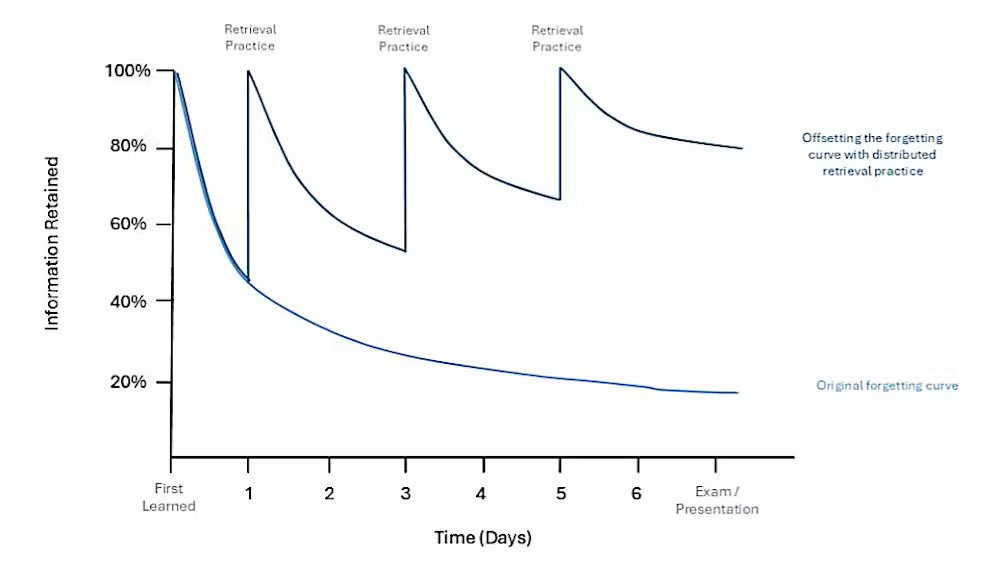
The forgetting curve. Image: Elva Arulchelvan (CC BY-SA 4.0)

However, there is a way of ensuring that more sinks in when you are trying to learn a lot of information in a short period of time: retrieval practice.

When preparing to give a talk or studying for an exam, rather than simply rereading your notes, keep testing how much you remember. Use flash cards, answer practice questions, or try explaining the material out loud without notes.

Memory works through associations. Each time you successfully retrieve information, you link the material to new prompts, examples and contexts. This builds more cues to accessing the information, and strengthens each memory pathway. Often when we ‘forget’, the memory isn’t gone – we just lack the right retrieval cue.

Give yourself a break

Research shows that memory is more effective when study or practice sessions are spread out, rather than massed together. If you are studying for an exam, build solid blocks of downtime into your revision schedule. The dark blue line on the chart above illustrates how spacing out your practice sessions can help you remember more information over time, by adjusting Ebbinghaus’s forgetting curve.

One study suggests leaving gaps between each revision session that equate to 10-20pc of the time left until your exam or presentation. So, if your deadline is five days away and you do hours of revision a day, you should still take between a half and full day off in between sessions. In other words, don’t overdo it – you probably won’t see the rewards!

If you only remember one thing from this article about improving memory, make it this. Memory isn’t just about intelligence, it’s about strategy. Small changes in how you study or work can make a real difference in how well, and how long, you remember crucial information.

The Conversation

By Elva Arulchelvan

Elva Arulchelvan is completing a PhD in psychology and neuroscience for the Lab for Clinical and Integrative Neuroscience in Trinity College Dublin (TCD), Ireland. She is also a lecturer in psychology for social work students in TCD. Arulchelvan’s PhD research focuses on memory and forgetting processes. In particular, her PhD research involves investigating peripheral nerve stimulation’s effect on memory and forgetting in both clinical and non-clinical groups. 

Don’t miss out on the knowledge you need to succeed. Sign up for the Daily Brief, Silicon Republic’s digest of need-to-know sci-tech news.