


惯性聚合 高效追踪和阅读你感兴趣的博客、新闻、科技资讯
阅读原文 在惯性聚合中打开

推荐订阅源

博客园 - 聂微东
S
Secure Thoughts
P
Palo Alto Networks Blog
Google DeepMind News
AI
AI
H
Hacker News: Front Page
Schneier on Security
C
CXSECURITY Database RSS Feed - CXSecurity.com
Cloudbric
Cloudbric
TaoSecurity Blog
TaoSecurity Blog
T
Tor Project blog
L
LINUX DO - 热门话题
Cyberwarzone
Cyberwarzone
V2EX - 技术
V2EX - 技术
Google DeepMind News
GbyAI
GbyAI
S
Security @ Cisco Blogs
S
Security Affairs
P
Privacy International News Feed
I
Intezer
S
SegmentFault 最新的问题
F
Full Disclosure
H
Heimdal Security Blog
www.infosecurity-magazine.com
S
Securelist
V
Vulnerabilities – Threatpost
C
CERT Recently Published Vulnerability Notes
cs.CV updates on arXiv.org
Google Online Security Blog
Security Latest
Security Latest
C
Cybersecurity and Infrastructure Security Agency CISA
Attack and Defense Labs
Forbes - Security
Forbes - Security
Cyber Security Advisories - MS-ISAC
freeCodeCamp Programming Tutorials: Python, JavaScript, Git & More
I
InfoQ
WordPress大学
WordPress大学
Vercel News
Vercel News
小众软件
小众软件
大猫的无限游戏
大猫的无限游戏
美团技术团队
IT之家
IT之家
Threat Intelligence Blog | Flashpoint
aimingoo的专栏
aimingoo的专栏
Y
Y Combinator Blog
Last Week in AI
Last Week in AI
博客园 - 【当耐特】
D
Docker
D
Darknet – Hacking Tools, Hacker News & Cyber Security
Hugging Face - Blog
Hugging Face - Blog

Science – Silicon Republic

IBM unveils tech capable of producing chips smaller than one nanometre Good vibrations, dancing bridges and a sustainable IoT Dublin's TensorX to partner with Solstice on sovereign European AI How are mini biosensors and antibodies changing modern healthcare? Irish projects among recipients of European Research Council Grant UCD PhD student explores link tying maths and spatial skills in children If AI robots can be tricked into ‘going rogue’, what are the implications? Students behind assistive tech start-up win NovaUCD contest Tencent tests new AI agent Xiaowei on WeChat 3,900 Waymo robotaxis recalled after new software issue Ireland quadruples solar energy capacity in three-year period New Irish bill to supervise EU AI Act gets greenlit Ireland’s NIBRT, Canada’s CASTL strengthen partnership for biomanufacturing talent Maynooth expert leading group on future of computational chemistry For conservation experts, is AI a powerful tool or dangerous shortcut? Irish Manufacturing Research announces ESA Phi-Lab Open Call for 2026 Horizon Quantum to build second quantum computer in Dublin RCSI scientists develop 'first of its kind' artificial heart valve Irish Government invests €460m in new 'Rinn' research centres The CEO innovating in Ireland’s ‘controlled and cautious’ medical cannabis space Anthropic rolls out ‘Mythos-like’ AI model Claude Fable 5 Maynooth’s new pathway fellow on quantum research and its applications Huawei makes UCD pit stop to showcase latest in renewables tech EU AI Act – the high-risk classification guidelines explained Will AI ‘digital twins’ transforming heart care work for women? Research Ireland’s Barometer project set to impact engagement Dublin's Pilot Photonics bags €1m from ESA to upgrade satellite tech Past the ‘wow phase’ of robotics, delivery and safety are paramount AI changing jobs faster than companies can keep up with, finds report Kerry’s RDI Hub opens AI collaboration with Luxembourg IQM raises PIPE to $146m with Finnish pension fund backing Biochemistry expert leads University of Galway DNA research Investigating how hormones affect brain health NASA’s Webb telescope reveals black hole formed before galaxy ‘AI scientists’ are improving, but what are the fundamental limits? Ireland sees a boost in R&D activity as tax credit drives investment Neurovalens gets US FDA approval for PTSD treatment device IoT Tribe to scale X_Potential innovation with ESB partnership Maynooth PhD researcher on GIS and its many applications Huawei proposes new path for chips as Moore’s Law runs out of road France bets fresh €1bn on quantum as global race intensifies US pumps $2bn into quantum computing via CHIPS Act Trinity College Dublin student wins 2026 Mary Mulvihill Award Managing watts with bits for Ireland's solar decade IMR to lead €6.9m project to double EU remanufacturing output Gas Networks Ireland to integrate Cork waste-to-energy plant Trinity PhD student probes new biology-based mental health model As AI meets science, what is in store for the future of research? Dublin’s Ubotica teams with Novi for real-time orbital data analysis The science of time: How horology developed through the ages Irish quantum start-up Equal1 unveils RacQ data centre computer Research Ireland to invest €20m into 22 high-risk, high-reward projects Waymo trouble: 3,800 robotaxis recalled after software glitch OpenAI launching security AI initiative to compete with Claude Mythos UCD innovator awarded for medtech commercialisation work Irish student wins European category of 2026 Earth Prize Opinion: Europe can’t afford to sit on the agentic commerce sidelines Could heat-resistant corals help reefs adapt to climate change? Moonshot AI valued at $20bn after $2bn raise for Kimi creator Probing the link between inflammation and schizophrenia Kerry team takes top spot at ESA CanSat Ireland final Galway’s Orreco signs up with MLS Innovation Lab Why critical infrastructure needs critical cybersecurity €37.5m research boost for Irish agri-food, forestry, bioeconomy Bloomberg: China pauses AV permits after Baidu disruption Milestone reached in Celtic Interconnector project linking France and Ireland Ireland’s solar sector hits 1GW of energy for first time China's DeepSeek unveils long-awaited V4 AI model UL looking for ‘changemakers’ amid Research Week 2026 Can you rely on AI chatbots for medical advice? €6.9m awarded to final four National Challenge Fund winners Space-tech Mbryonics plans new production facility in Shannon Are electric vehicles about to take off for good? OpenAI to rival Google’s AlphaFold with new AI model for life sciences research Are we ready to place lab experiments in non-human hands? Irish space AI start-up Ubotica on board for NASA’s FAME Boston Scientific announces €75m R&D investment in Galway Nvidia unveils open-source quantum AI model Ising Stanford: China ‘effectively’ closes AI model performance gap to US Ireland to invest €17m in leading facilities for AI, medtech and more Cork Airport to get Ireland's largest solar carport next year Opinion: The future of insurance is AI, so why the hesitation? Anthropic reportedly mulls designing own chips amid shortage Equal1 partners with Q-Ctrl for quantum data centre deployment Meta’s Superintelligence Labs debuts first product Muse Spark Agentic commerce and purchase disputes: Did you mean to buy that? Circuléire makes fresh call for 2026 accelerator applicants Anthropic, Google, Broadcom announce 3.5GW TPU deal What impact might Medtronic’s new lab have on Galway’s medtech ecosystem? Microsoft releases foundational AI models targeting enterprises What issues arise when code has the ability to write and review itself? A professor's journey from humble beginnings to a higher doctorate of science France buys supercomputer maker Bull in tech sovereignty push Anthropic accidentally leaks Claude Code source in npm slip The deep-tech founder using AI to address immunology challenges Research Ireland awards €4.4m to 46 enterprise-engaged projects Plans for new Irish supercomputer CASPIR move to next stage New German battery recycling plant salvages lithium and graphite Investigating 3D-printed metals for aeronautical engineering 341 innovative research projects to receive more than €36m in funds
New Artemis II images give fresh look at our lunar neighbour
2026-04-08 · via Science – Silicon Republic

Earth as captured by the Artemis II crew from behind the cratered surface of the moon. Image: NASA

From ancient lunar lava to personal tributes, the new images released from the Artemis II space mission capture fresh perspectives of our celestial neighbour.

Yesterday (7 April), NASA released the first images of the moon captured by the Artemis II astronauts during their historic test flight.

The Artemis II mission took off last week (1 April) from the Kennedy Space Center in Florida, beginning an approximately 10-day mission for NASA astronauts Reid Wiseman, Victor Glover, Christina Koch and Canadian Space Agency astronaut Jeremy Hansen.

Yesterday’s images were taken on 6 April during the crew’s seven-hour pass over the lunar far side – the first crewed lunar flyby in more than 50 years – and provide a fresh look at Earth’s closest celestial neighbour.

From an eclipse to ancient lava, here is just a handful of some of the most interesting images captured by the Artemis II crew so far.

Near and far
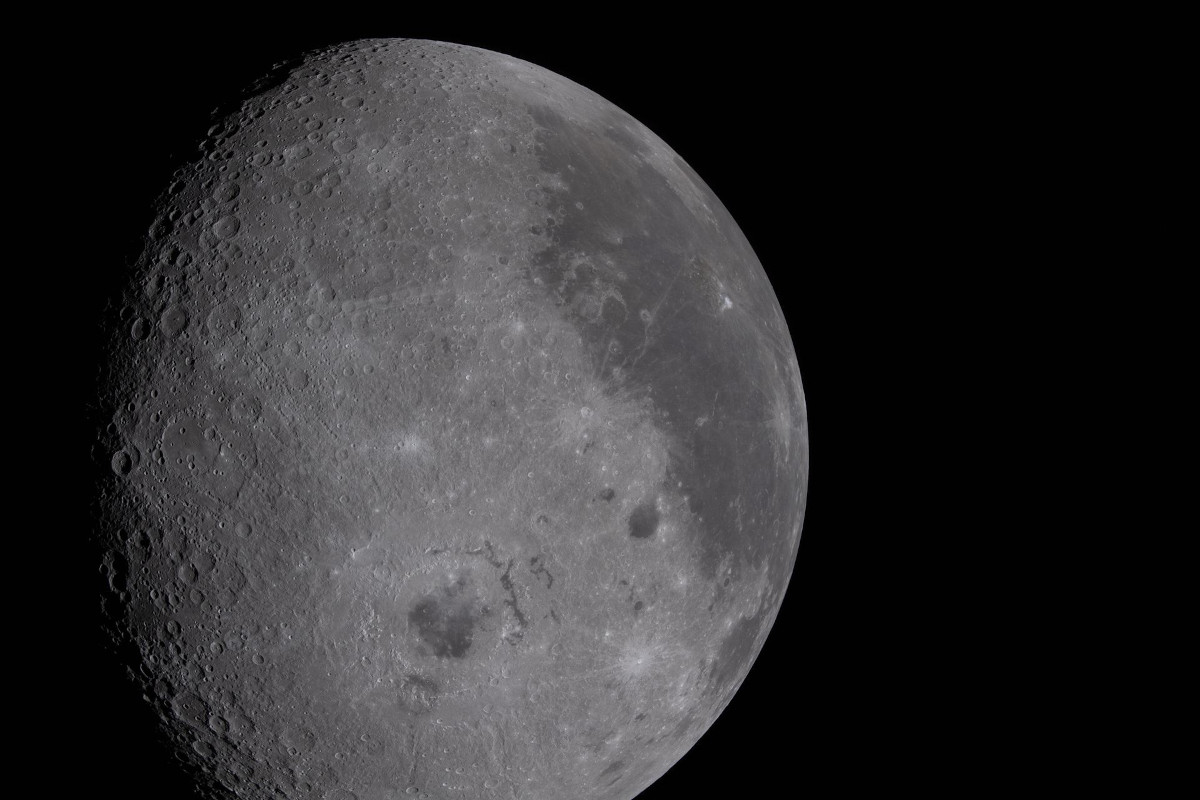
A wide picture of the moon, showing a grey landscape filled with craters and a darker grey patch to the right of the moon.

A picture capturing two-thirds of the moon. Towards the bottom of the image, the Orientale basin can be seen. North-east of the Orientale, seen as a dark spot, is the Grimaldi crater. Image: NASA

One of the crew’s most striking images captures two-thirds of the moon, showcasing the “intricate features of the near side”, according to NASA. The 600-mile-wide impact crater, the Orientale basin, lies along the transition between the near and far sides and can be seen at the bottom of the image.

The round black spot north-east of Orientale is the Grimaldi crater, known for its exceptionally “dark mare lava floor and heavily degraded rim”.

In-space eclipse
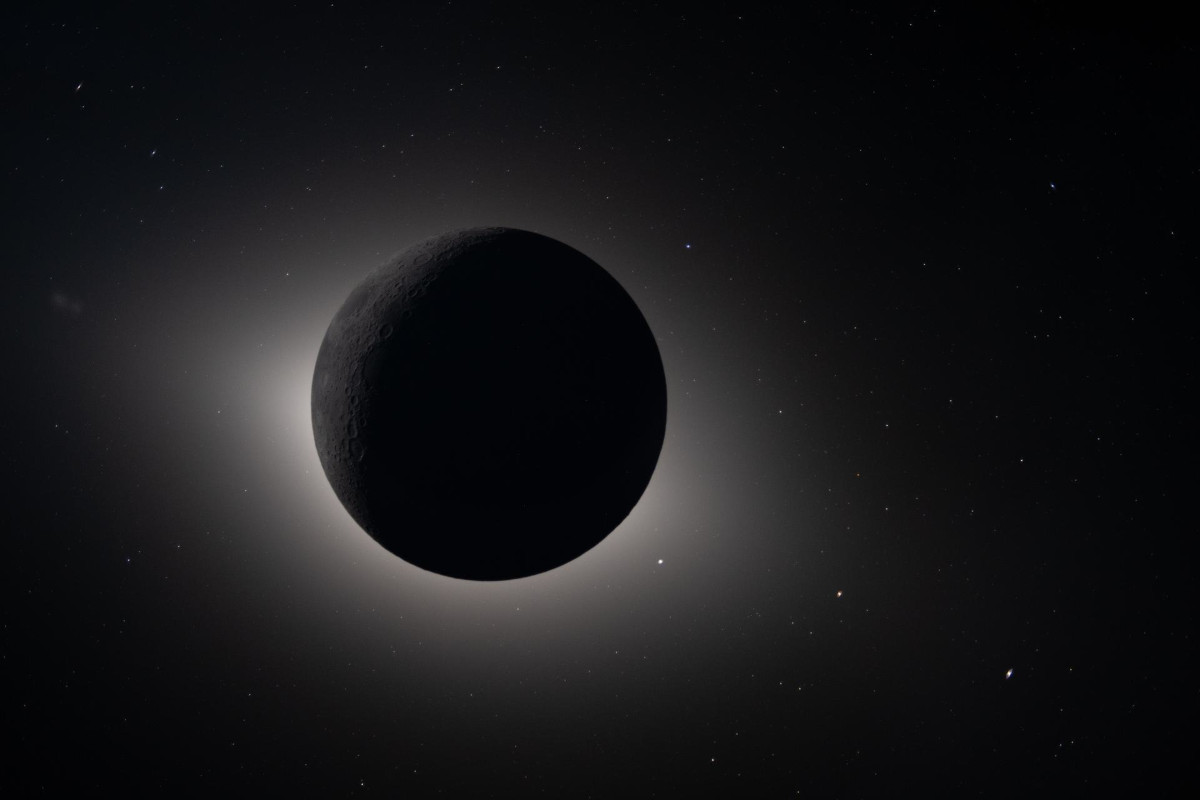
An image of the moon covering the face of the sun in space. A faint bright halo can be seen around a dark moon.

The moon fully eclipsing the sun, as taken by the Artemis II crew. Image: NASA

One of the most unique images taken by the Artemis II crew captures the moon fully eclipsing the sun. The corona of the sun forms a glowing halo around the moon, while light reflected off Earth forms a faint, glowing outline of the near side of the moon.

Nearly 54 minutes of totality – when the moon completely blocks the bright face of the sun – was observed by the crew.

Stars are also visible around the spectacle, which are typically too faint to see when imaging the moon, but are readily visible with the moon in darkness.

“This unique vantage point provides both a striking visual and a valuable opportunity for astronauts to document and describe the corona during humanity’s return to deep space,” according to NASA.

A different perspective
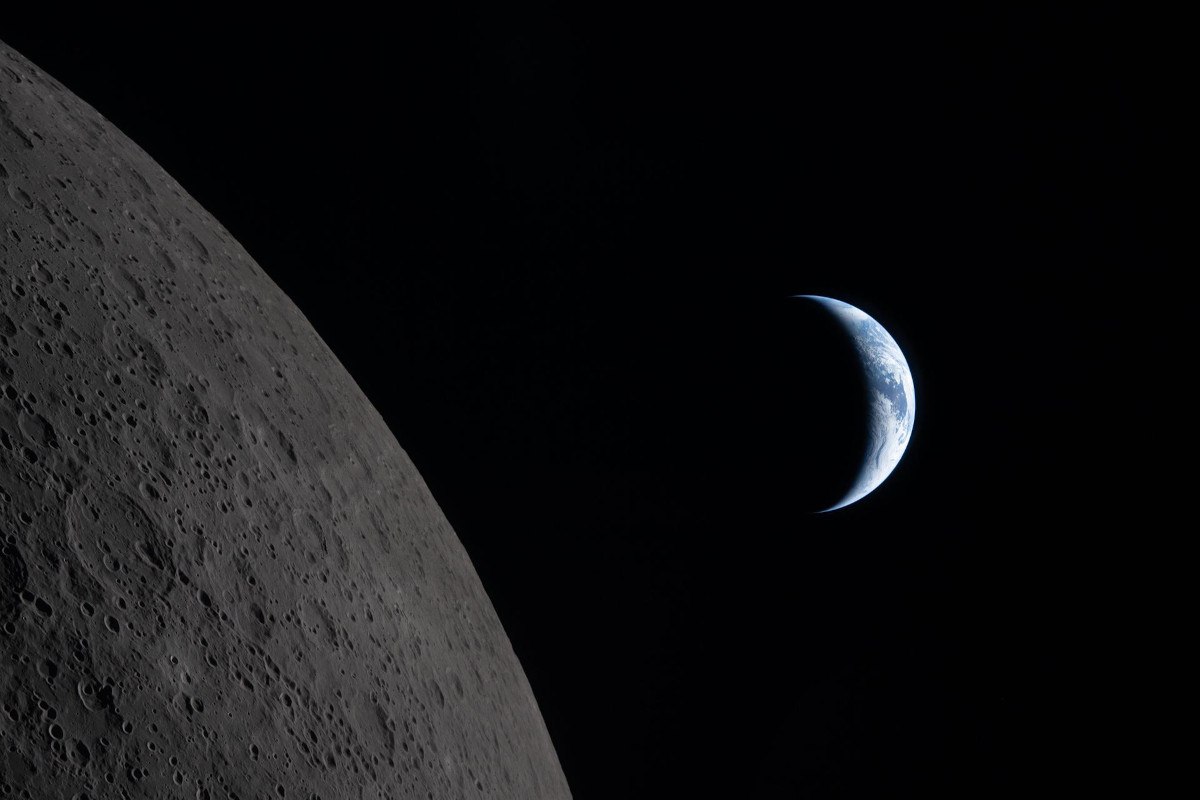
A picture taken of Earth in a crescent phase next to the grey darker side of the moon in space.

Earth in a crescent phase showing the cutoff between day and night on the planet, as seen from the Artemis II spacecraft as it conducted the lunar flyby. Image: NASA

Another image captured during the lunar flyby shows Earth split between daytime and nighttime.

Earth can be seen in a crescent phase, with sunlight coming from the right of the image. On the day side, swirling clouds are visible over the Australia and Oceania region.

Meanwhile, the lines of small indentations seen on the moon’s surface to the left of the image are secondary crater chains. These structures are formed by material ejected during a violent primary impact.

Ancient lava
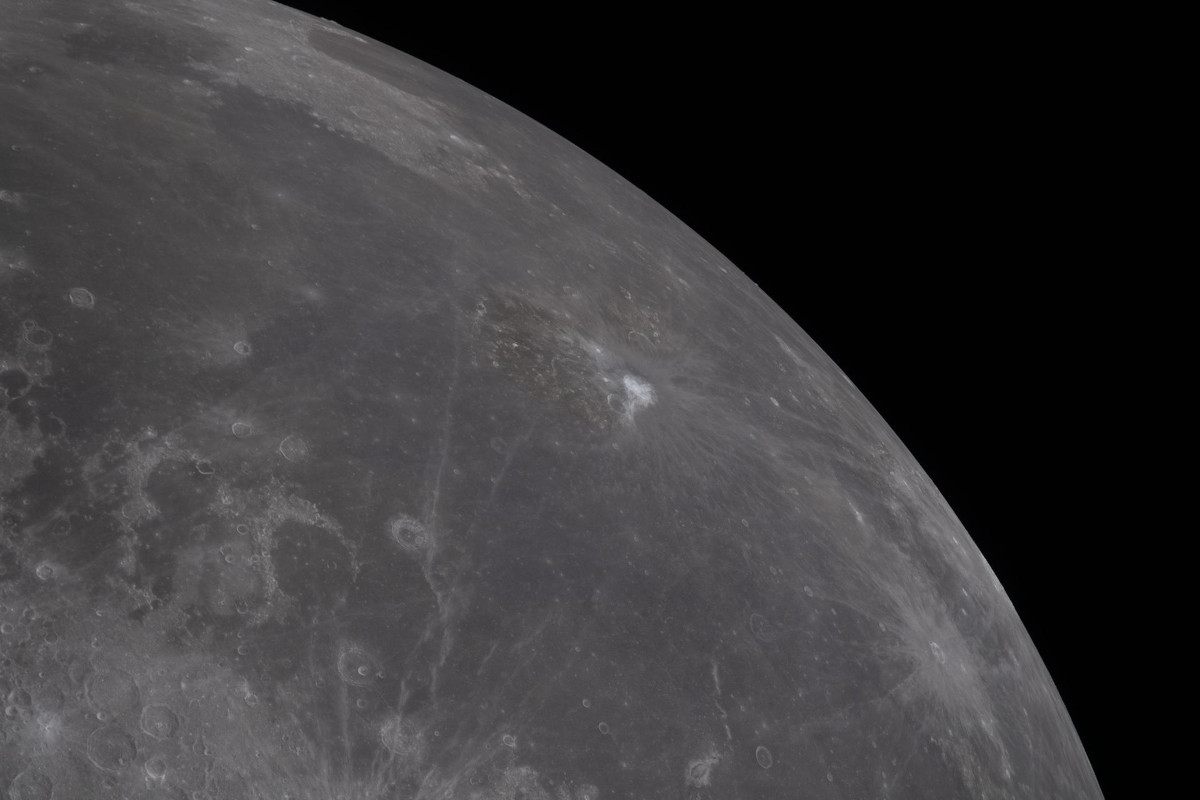
A picture of the moon's surface with bright circles representing craters and dark patches representing ancient lava.

A close-up snapshot of the moon as the crew approached for the flyby. The Aristarchus crater is the bright white dot in the middle of a dark grey lava flow at the top of the image. Image: NASA

In one close-up shot of the moon’s surface, taken as the NASA Orion spacecraft approached for the lunar flyby, an interesting ancient remnant can be observed.

According to NASA, dark patches visible on the top third of the lunar disc represent ancient lava.

Meanwhile, the bright white dot in the middle of a dark grey lava flow at the top of the image is the Aristarchus crater, which measures at a depth of 2.7km – making it deeper than the Grand Canyon.

A personal tribute
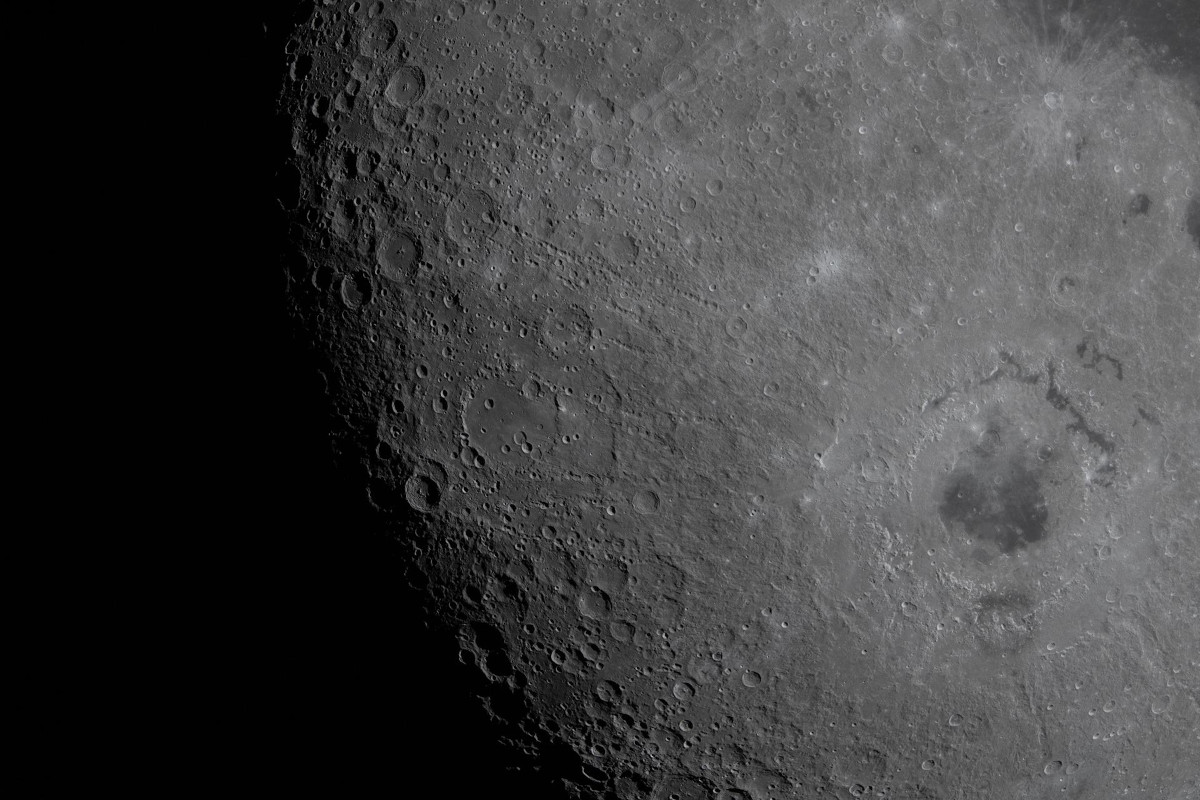
A picture of the moon's surface displaying a number of craters and basins.

A picture of the Orientale basin, seen in the middle right of the image. The first crater named by the crew, called Integrity, lies just above the centre of the image. North of the Orientale at the top right corner of the image is the Glushko crater. To the north-west of that is the second crew-named crater, seen as a bright white spot, which the crew has called Carroll. Image: NASA

During the mission’s lunar flyby observation period, the Artemis II crew snapped an image showing the rings of the Orientale basin, one of the moon’s youngest and best-preserved large impact craters.

According to NASA, these concentric rings offer scientists a rare window into how massive impacts shape planetary surfaces, “helping refine models of crater formation and the moon’s geologic history”.

At the 10 o’clock position of the Orientale basin, two smaller craters are visible. The Artemis II astronauts submitted names for these two craters for approval by the International Astronomical Union: the first being Integrity, named after the crew’s spacecraft; and the second being Carroll, named after mission commander Reid Wiseman’s late wife.

“A number of years ago, we started this journey in our close-knit astronaut family and we lost a loved one,” said mission specialist Hansen to mission control at the time of the proposal. “And there is a feature in a really neat place on the moon, and it is on the near side/far side boundary. In fact, it’s just on the near side of that boundary, and so at certain times of the moon’s transit around Earth, we will be able to see this from Earth.

“And so we lost a loved one. Her name was Carroll, the spouse of Reid, the mother of Katie and Ellie. And if you want to find this one, you look at Glushko, and it’s just to the northwest of that, at the same latitude as Ohm, and it’s a bright spot on the moon. And we would like to call it Carroll.”

‘A human story’

Eight days into the Artemis II mission, and a number of remarkable moments have been observed in humanity’s latest major space voyage, including the crew surpassing the record for human spaceflight’s farthest distance at 248,655 miles from Earth.

But for many, the human side of the voyage – such as the crew’s sentimental proposal to name a crater – have stuck as dually important alongside the mission’s technical feats.

This rings true with award-winning Irish scientist Dr Niamh Shaw, who was present on the Kennedy Space Center’s media lawn for the historic launch.

“Space has always been a kind of compass in my life,” she told SiliconRepublic.com. “It has a way of stripping everything back, reminding me of what matters, of how small we are and how extraordinary it is that we are here at all.

“It keeps me grounded in my questions. In curiosity. In wonder. And also in responsibility. Because one of the things space teaches us, very clearly, is that there is no rescue mission coming for Earth. No one arriving to solve our problems.”

Shaw told us that what struck her just as much as the launch itself was “what happened afterwards”.

“The level of interest, the appetite for connection … People want to understand, to feel part of it, to ask questions,” she explained.

“I haven’t stopped: media calls, messages, Zooms with my Town Scientist families.

“And I found myself trying to share it in a way that made it personal for them – sending photos, describing moments, answering questions,” she added.

“Because I genuinely believe that’s where the real impact lies. Not just in the engineering achievement, extraordinary as it is. But in how it reaches people.

“In how it shifts perspective, even slightly. In how it reminds us that we are all part of something much bigger and that the story of space exploration is, ultimately, a human story.”

Don’t miss out on the knowledge you need to succeed. Sign up for the Daily Brief, Silicon Republic’s digest of need-to-know sci-tech news.