



惯性聚合 高效追踪和阅读你感兴趣的博客、新闻、科技资讯
阅读原文 在惯性聚合中打开

推荐订阅源

Security Archives - TechRepublic
罗磊的独立博客
T
The Blog of Author Tim Ferriss
The GitHub Blog
The GitHub Blog
Apple Machine Learning Research
The Register - Security
J
Java Code Geeks
V2EX - 技术
V2EX - 技术
Vercel News
Vercel News
N
News and Events Feed by Topic
腾讯CDC
P
Proofpoint News Feed
N
News | PayPal Newsroom
www.infosecurity-magazine.com
爱范儿
爱范儿
O
OpenAI News
酷 壳 – CoolShell
酷 壳 – CoolShell
月光博客
月光博客
Martin Fowler
Martin Fowler
Engineering at Meta
Engineering at Meta
D
Docker
Y
Y Combinator Blog
博客园 - 聂微东
G
Google Developers Blog
S
Security @ Cisco Blogs
Simon Willison's Weblog
S
Schneier on Security
H
Hackread – Cybersecurity News, Data Breaches, AI and More
S
SegmentFault 最新的问题
云风的 BLOG
云风的 BLOG
阮一峰的网络日志
阮一峰的网络日志
C
CXSECURITY Database RSS Feed - CXSecurity.com
CTFtime.org: upcoming CTF events
C
CERT Recently Published Vulnerability Notes
I
Intezer
G
GRAHAM CLULEY
有赞技术团队
有赞技术团队
Attack and Defense Labs
V
Visual Studio Blog
博客园 - Franky
博客园 - 三生石上(FineUI控件)
W
WeLiveSecurity
钛媒体:引领未来商业与生活新知
钛媒体:引领未来商业与生活新知
让小产品的独立变现更简单 - ezindie.com
Hugging Face - Blog
Hugging Face - Blog
Scott Helme
Scott Helme
T
Troy Hunt's Blog
Hacker News - Newest:
Hacker News - Newest: "LLM"
L
LINUX DO - 最新话题
C
Cybersecurity and Infrastructure Security Agency CISA

NetBird - Networking Knowledge Hub - RSS Feed

NetBird Is Now on the Vultr Marketplace Native NetBird on the GL.iNet Comet Pro (GL-RM10) NetBird v0.71 - IPv6 Overlay Addressing NetBird Exit Nodes - Appear at Home, or Anywhere Else Reporting Bugs and Requesting Features in NetBird Setup and Use Local AdGuard Home Anywhere with NetBird DNS How to Set Up NetBird on PiKVM for Secure Remote KVM Access NetBird v0.69 - CrowdSec IP Reputation for the Reverse Proxy Cloudflare Mesh vs NetBird vs Tailscale: Performance Compared Self-Hosting Nextcloud with Docker and NetBird Implementing Zero Trust with NetBird NetBird v0.67 - Layer 4 Proxy Support for TCP, UDP, and TLS Solwr Enhances Remote Connectivity with NetBird Self-Hosting NetBird with Authentik Jellyfin Media Server - Self-Host Your Movies, TV, and Music Cloudflare Tunnels vs. NetBird Reverse Proxy INFITX Builds Zero-Touch Kubernetes Networking with NetBird NetBird v0.66 - Expose Local Services to the Internet from the CLI Pangolin vs. NetBird Home Assistant Setup Guide with EASY Remote Access NetBird v0.65 - Built-in Reverse Proxy with Custom Domains Docker for Beginners - Everything You Need to Get Started NetBird for SOC 2 Compliance NetBird v0.63 - Custom DNS Zones for Private Network Resolution Vibecode This in a Weekend and Take 5% of the Company NetBird v0.62 - Built-in Local Users with Optional IdP Integration NetBird v0.61.0 - Granular SSH Access Control and Automatic Updates Top 5 Alternatives to OpenVPN Top 5 Open Source Alternatives to Tailscale Top 5 Alternatives to ZeroTier How to Set Up ZeroByte and REST Server for Backups with NetBird How to Install n8n v2.0 with NPM and PM2 ZeroTier vs. NetBird The Ultimate Immich Guide - Ditch Google and Amazon Photos for Good NetBird as Your Help with ISO 27001 Compliance NetBird and Huntress - Secure Network Access for MSPs How to Access Windows Shares from Anywhere with NetBird netgo Relies on Modern ZTNA with NetBird Connect to Your Homelab from Anywhere with a Raspberry Pi NetBird SSH - A New, Identity-Aware Approach Connect Multiple Ollama GPUs to OpenWebUI with NetBird Top 5 Tailscale Alternatives SSH and RDP, now in your browser NetBird–Acronis Integration: Empowering MSPs for Advanced Ransomware and Threat Defense Introducing the Control Center - Remote Access, Beautifully Visualized NetBird at MSP Global 2025 Understanding Overlay Networks - The Basics NetBird and SentinelOne Singularity™ - Automate Threat Response NetBird and Microsoft Intune - Enforcing Device Compliance for Zero Trust Rethinking Zero Trust Security with NetBird and pfSense Improving Unidirectional Access Control Proxmox VE for Beginners Guide with NetBird LXC Stronger Security: NetBird + GitHub Secure Open Source Fund NetBird's MSP Partner Program Signicat Enhances Cross-Cloud Accessibility with NetBird SonicWall SSL VPN NetExtender vs. NetBird NetBird Is Embracing the AGPLv3 License NetBird Profiles Have Landed - Manage Multiple Accounts Effortlessly Rethinking Access Control to Secure Your On-Premises SharePoint Servers Sport Alliance Increases Efficiency with Zero Trust Networking at Scale Rethinking Network Access: qwertiko Goes Zero Trust with NetBird Optimizing Network Efficiency with NetBird's Lazy Connections Use Port Ranges in Access Control Policies Generic HTTP Endpoint for Network Events Streaming NetBird’s Response to Spear-Phishing Campaign Targeting Financial Executives Zero-Trust Access to Internal Resources Without Installing Agents Enhance Network Visibility with NetBird’s Traffic Events Logging TrueNAS Made Easy - Install, Set Up, and Access From Anywhere Top 5 Alternatives for WireGuard Jump Hosts. Gateways for Remote Access NetBird Network Routes and Exit Nodes Security for All - SSO and MFA for Free Enhancing Network Access Control with NetBird's Identity Provider Feature Twingate vs. NetBird Limit Network Access Based on Running Applications FortiClient ZTNA vs. NetBird OpenVPN vs. NetBird Tailscale vs. NetBird Getting Started with an Azure Site-to-Site VPN Getting Started with an On-premise-to-AWS Site-to-Site VPN Secure Remote Access to VPCs, LANs, and Offices regreSSHion - A New OpenSSH Server Remote Code Execution Vulnerability Evolve Bank & Trust Data Breach. What Happened? What Is a Site-to-Site VPN? IPSec Tunneling Demystified. Enhancing Data Security Across Networks Understanding IPSec Tunnel and Transport Modes Understanding the Differences Between IKEv1 and IKEv2 Understanding the IKEv1 Protocol in IPSec ZeroTier versus NetBird - Which Should You Choose? AWS Lambda Serverless Security. Mistakes, Oversights, and Potential Vulnerabilities Using NetBird for Kubernetes Access Serverless Security Vulnerabilities and Best Practices to Mitigate Them Security Best Practices for Serverless Azure Functions A Guide to Remote Access Security for SMEs IoT Security Essentials. How to Achieve Secure Remote Access Open Source Zero Trust Networking Using SSH for Secure Remote Access How We Integrated Rosenpass in NetBird The First Quantum-Resistant Mesh VPN Using eBPF and XDP to Share Default DNS Port Between Multiple Resolvers
The AI Mega Mesh: How to Connect 30+ GPU Cloud Providers
Written byMisha Bragin · 2025-11-11 · via NetBird - Networking Knowledge Hub - RSS Feed

We've built what we call the "Mega Mesh"-a distributed AI inference demo infrastructure that connects GPU resources across multiple cloud providers using Argo CD, MicroK8s, vLLM, and NetBird. Rather than being locked into a single provider's GPU availability and pricing, this architecture creates a flexible, geographically distributed platform for serving large language models with simple and secure remote access for easy management.

Backstory

A while back, we had a very normal idea:

Demonstrate that multi-cloud networking isn’t complicated. That you don’t need to learn the quirks of every provider’s VPC tools, mess with firewall configs, or open random ports and hope for the best. After all, that’s what we build at NetBird - a secure, peer-to-peer networking platform that connects machines across clouds and regions as if they were on the same private LAN.

Meanwhile, the rest of the world was getting swept up in AI “excitement.” We didn't. We’re a private networking company, the kind that makes "boring" (but necessary) tasks like remote access and machine connectivity even more boring (by which we mean: simpler).

So we asked ourselves: how can we show the world that multi-cloud networking is easy - and show how it relates to the latest trends and developments of technologies? The answer, as it turned out, began with a simple question: what if we connected a few different cloud GPU providers into one big private network?

The Idea That Got Out of Hand

It started as a fun weekend project.

We figured: let’s show that secure, zero-trust connectivity across providers isn’t only possible - it’s easy. Even fun.

And then, as these things go, someone casually said, “What if we connected thirty cloud GPU providers?” We laughed - and then thought, why not? After all, that’s exactly what our technology was built to do - connecting machines at scale.

We called it the Multi-Cloud AI Mega Mesh, because when you’re connecting dozens of clouds into a single, unified overlay network, you might as well sound dramatic.
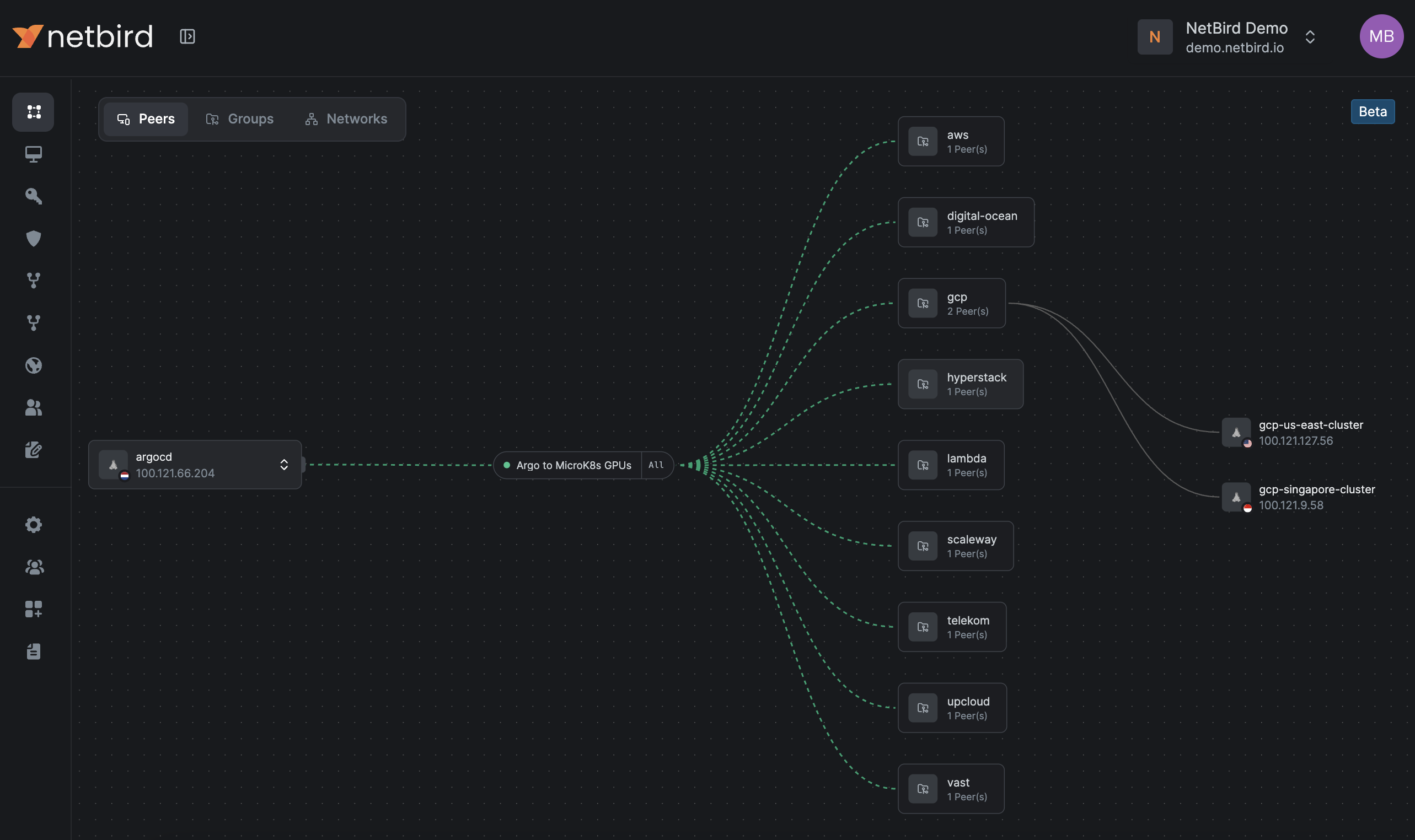
Mega Mesh

From NetBird Relays to AI Inference

When we started brainstorming what kind of use case would actually show this off, we realized we didn’t need to invent anything new just for it.

At NetBird, our relay architecture is distributed across multiple data centers and cloud providers. Relays step in when direct peer-to-peer connections aren’t possible, ensuring machines can still connect. The architecture already does something clever: it routes traffic intelligently based on geography and load. If a user in Europe connects, they’re routed to a nearby relay. U.S. traffic stays in the U.S. It’s all about minimizing latency without anyone needing to think about it.

So we thought - why not apply the same idea to AI inference for our demo?

Each region runs vLLM on a MicroK8s cluster deployed with Argo CD, connected through NetBird’s peer-to-peer WireGuard network. When someone in Europe sends an inference request, it goes to a GPU node in Europe. U.S. requests land on U.S. GPUs.
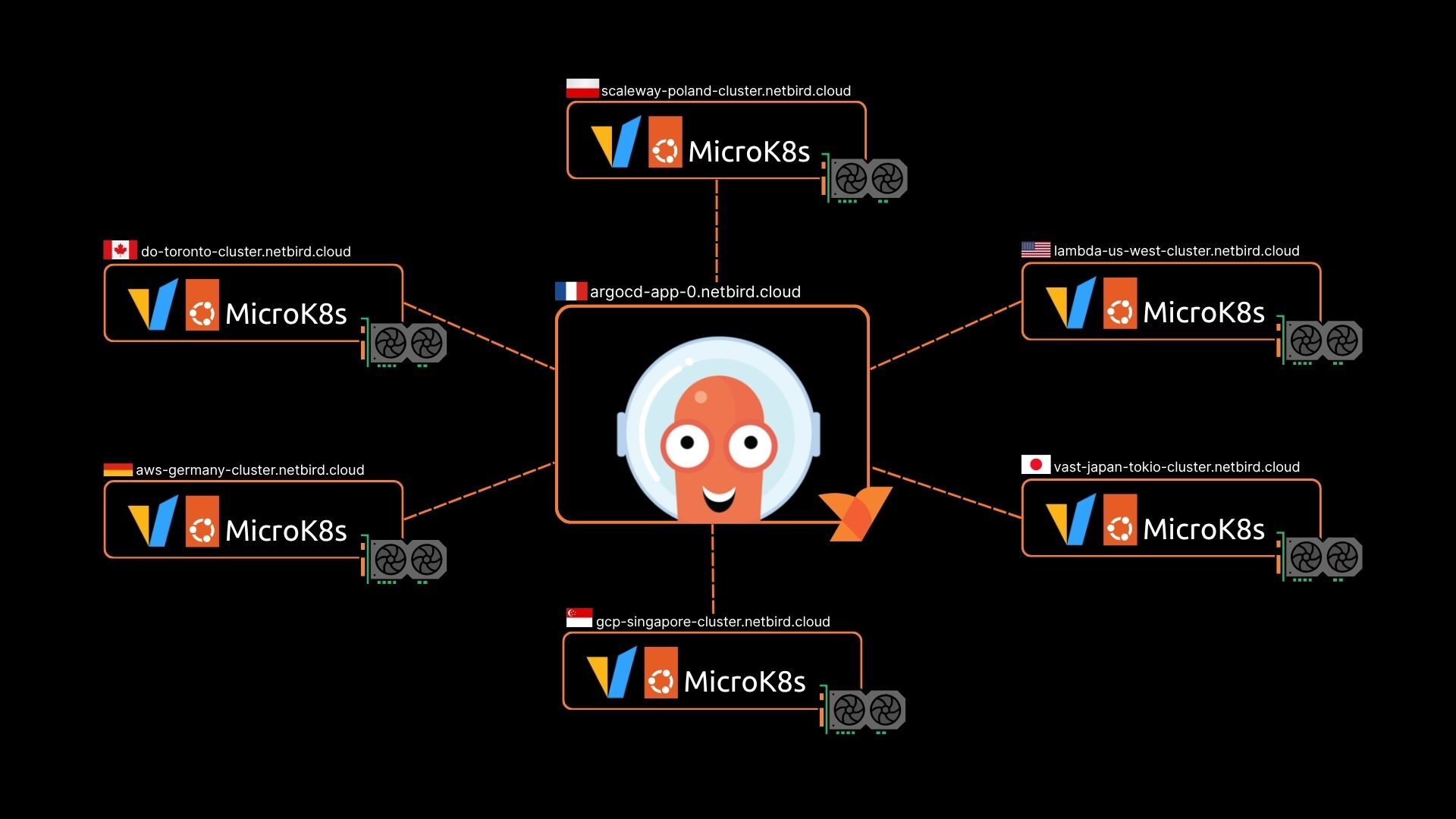
Argo MicroK8s

It’s the same routing logic we use in our production network, just applied to serving AI workloads instead of relays.

In other words, we didn’t have to make up a new demo. We just reused the architecture we already knew worked and replaced “traffic” with “AI inference.”

The Users We Didn't Expect

When we started this project, we thought we were building a demo. A proof of concept that would showcase NetBird's capabilities at scale.

What we found instead was a user segment we'd underestimated: AI companies that don't use cloud AI services.

These aren't the companies using OpenAI's API or Anthropic's Claude. They're training their own models, running their own inference, and managing their own infrastructure. Some are in the cloud, some are on-prem, many are both. They're dealing with the same GPU scarcity everyone else faces, but they need more control than managed services provide.

Multi-cloud networking is not a new concept. Enterprises have connected multiple clouds and on-prem environments for years. But AI workloads have different characteristics than traditional enterprise applications. They're compute-intensive, latency-sensitive, and increasingly distributed across whatever infrastructure you can actually provision.

The Part That Should Have Been Hard

Connecting infrastructure across multiple cloud providers should be a nightmare. Every networking engineer knows this. You'd normally need VPN configurations for each provider, firewall and security groups rules that inevitably conflict, and someone on permanent standby to troubleshoot when region X can't talk to region Y after.

We spend more time creating accounts than connecting machines.

I'm not exaggerating for effect. The actual time breakdown looked like this: navigating 30 different signup flows, waiting for credit card verification, requesting GPU quota increases (and getting denied), filling out "tell us about your use case" forms, waiting for sales calls we didn't want, all of that took days. Connecting the machines that we did provision? Minutes per provider.

That's the insight that matters here. Multi-cloud networking has historically been complex because we've tried to solve it at the wrong layer. When you operate at the WireGuard level with a proper architecture, the underlying provider becomes nearly irrelevant.

So we did what any reasonable engineers would do: we worked with what we had. We connected nine providers, got our mesh running, and decided to demonstrate the concept anyway.

Because the surprising part, the part that actually matters, is how trivial the networking turned out to be.

And of course, once our cards are verified and sales reps have blessed our “use case,” we’ll finally achieve the dream: connecting all 30 providers in perfect harmony.

Build Your Own AI Mega Mesh

In the spirit of open source, we’ve shared the entire Mega Mesh demo setup and published a detailed guide so anyone can build on it, adapt it to their needs, and join the community pushing it forward. And for the visual learners out there, Brandon, our technology evangelist, is putting together a video walkthrough.

If you’re ready to get your hands dirty right away, create a free NetBird account and see just how easy private networking can be.