



惯性聚合 高效追踪和阅读你感兴趣的博客、新闻、科技资讯
阅读原文 在惯性聚合中打开

推荐订阅源

L
LINUX DO - 最新话题
C
Cyber Attacks, Cyber Crime and Cyber Security
G
GRAHAM CLULEY
T
Tenable Blog
T
Threatpost
C
CXSECURITY Database RSS Feed - CXSecurity.com
I
Intezer
cs.CL updates on arXiv.org
D
Darknet – Hacking Tools, Hacker News & Cyber Security
K
Kaspersky official blog
Security Latest
Security Latest
P
Privacy & Cybersecurity Law Blog
Google Online Security Blog
SecWiki News
SecWiki News
P
Palo Alto Networks Blog
TaoSecurity Blog
TaoSecurity Blog
Webroot Blog
Webroot Blog
Spread Privacy
Spread Privacy
O
OpenAI News
The Last Watchdog
The Last Watchdog
P
Proofpoint News Feed
C
Check Point Blog
cs.CV updates on arXiv.org
人人都是产品经理
人人都是产品经理
S
Security @ Cisco Blogs
Scott Helme
Scott Helme
OSCHINA 社区最新新闻
OSCHINA 社区最新新闻
cs.AI updates on arXiv.org
月光博客
月光博客
S
Securelist
酷 壳 – CoolShell
酷 壳 – CoolShell
V
V2EX
T
Troy Hunt's Blog
W
WeLiveSecurity
GbyAI
GbyAI
N
News | PayPal Newsroom
Y
Y Combinator Blog
C
Cisco Blogs
H
Help Net Security
The GitHub Blog
The GitHub Blog
Threat Intelligence Blog | Flashpoint
博客园 - 【当耐特】
Jina AI
Jina AI
MongoDB | Blog
MongoDB | Blog
P
Proofpoint News Feed
让小产品的独立变现更简单 - ezindie.com
CTFtime.org: upcoming CTF events
云风的 BLOG
云风的 BLOG
小众软件
小众软件
N
News and Events Feed by Topic

NetBird - Networking Knowledge Hub - RSS Feed

NetBird Is Now on the Vultr Marketplace Native NetBird on the GL.iNet Comet Pro (GL-RM10) NetBird v0.71 - IPv6 Overlay Addressing NetBird Exit Nodes - Appear at Home, or Anywhere Else Reporting Bugs and Requesting Features in NetBird Setup and Use Local AdGuard Home Anywhere with NetBird DNS How to Set Up NetBird on PiKVM for Secure Remote KVM Access NetBird v0.69 - CrowdSec IP Reputation for the Reverse Proxy Cloudflare Mesh vs NetBird vs Tailscale: Performance Compared Self-Hosting Nextcloud with Docker and NetBird Implementing Zero Trust with NetBird NetBird v0.67 - Layer 4 Proxy Support for TCP, UDP, and TLS Solwr Enhances Remote Connectivity with NetBird Self-Hosting NetBird with Authentik Jellyfin Media Server - Self-Host Your Movies, TV, and Music Cloudflare Tunnels vs. NetBird Reverse Proxy INFITX Builds Zero-Touch Kubernetes Networking with NetBird NetBird v0.66 - Expose Local Services to the Internet from the CLI Pangolin vs. NetBird Home Assistant Setup Guide with EASY Remote Access NetBird v0.65 - Built-in Reverse Proxy with Custom Domains Docker for Beginners - Everything You Need to Get Started NetBird for SOC 2 Compliance NetBird v0.63 - Custom DNS Zones for Private Network Resolution Vibecode This in a Weekend and Take 5% of the Company NetBird v0.62 - Built-in Local Users with Optional IdP Integration NetBird v0.61.0 - Granular SSH Access Control and Automatic Updates Top 5 Alternatives to OpenVPN Top 5 Open Source Alternatives to Tailscale Top 5 Alternatives to ZeroTier How to Set Up ZeroByte and REST Server for Backups with NetBird How to Install n8n v2.0 with NPM and PM2 ZeroTier vs. NetBird The Ultimate Immich Guide - Ditch Google and Amazon Photos for Good NetBird as Your Help with ISO 27001 Compliance NetBird and Huntress - Secure Network Access for MSPs How to Access Windows Shares from Anywhere with NetBird netgo Relies on Modern ZTNA with NetBird Connect to Your Homelab from Anywhere with a Raspberry Pi NetBird SSH - A New, Identity-Aware Approach The AI Mega Mesh: How to Connect 30+ GPU Cloud Providers Connect Multiple Ollama GPUs to OpenWebUI with NetBird Top 5 Tailscale Alternatives SSH and RDP, now in your browser NetBird–Acronis Integration: Empowering MSPs for Advanced Ransomware and Threat Defense Introducing the Control Center - Remote Access, Beautifully Visualized NetBird at MSP Global 2025 Understanding Overlay Networks - The Basics NetBird and SentinelOne Singularity™ - Automate Threat Response NetBird and Microsoft Intune - Enforcing Device Compliance for Zero Trust Rethinking Zero Trust Security with NetBird and pfSense Improving Unidirectional Access Control Proxmox VE for Beginners Guide with NetBird LXC Stronger Security: NetBird + GitHub Secure Open Source Fund NetBird's MSP Partner Program Signicat Enhances Cross-Cloud Accessibility with NetBird SonicWall SSL VPN NetExtender vs. NetBird NetBird Is Embracing the AGPLv3 License NetBird Profiles Have Landed - Manage Multiple Accounts Effortlessly Rethinking Access Control to Secure Your On-Premises SharePoint Servers Sport Alliance Increases Efficiency with Zero Trust Networking at Scale Rethinking Network Access: qwertiko Goes Zero Trust with NetBird Optimizing Network Efficiency with NetBird's Lazy Connections Use Port Ranges in Access Control Policies Generic HTTP Endpoint for Network Events Streaming NetBird’s Response to Spear-Phishing Campaign Targeting Financial Executives Zero-Trust Access to Internal Resources Without Installing Agents Enhance Network Visibility with NetBird’s Traffic Events Logging TrueNAS Made Easy - Install, Set Up, and Access From Anywhere Top 5 Alternatives for WireGuard Jump Hosts. Gateways for Remote Access NetBird Network Routes and Exit Nodes Security for All - SSO and MFA for Free Enhancing Network Access Control with NetBird's Identity Provider Feature Twingate vs. NetBird Limit Network Access Based on Running Applications FortiClient ZTNA vs. NetBird OpenVPN vs. NetBird Tailscale vs. NetBird Getting Started with an Azure Site-to-Site VPN Getting Started with an On-premise-to-AWS Site-to-Site VPN Secure Remote Access to VPCs, LANs, and Offices regreSSHion - A New OpenSSH Server Remote Code Execution Vulnerability Evolve Bank & Trust Data Breach. What Happened? What Is a Site-to-Site VPN? IPSec Tunneling Demystified. Enhancing Data Security Across Networks Understanding IPSec Tunnel and Transport Modes Understanding the Differences Between IKEv1 and IKEv2 Understanding the IKEv1 Protocol in IPSec ZeroTier versus NetBird - Which Should You Choose? Using NetBird for Kubernetes Access Serverless Security Vulnerabilities and Best Practices to Mitigate Them Security Best Practices for Serverless Azure Functions A Guide to Remote Access Security for SMEs IoT Security Essentials. How to Achieve Secure Remote Access Open Source Zero Trust Networking Using SSH for Secure Remote Access How We Integrated Rosenpass in NetBird The First Quantum-Resistant Mesh VPN Using eBPF and XDP to Share Default DNS Port Between Multiple Resolvers
AWS Lambda Serverless Security. Mistakes, Oversights, and Potential Vulnerabilities
Written byJames Walker · 2024-04-30 · via NetBird - Networking Knowledge Hub - RSS Feed

Amazon Web Services (AWS) Lambda is a serverless function-as-a-service (FaaS) platform that lets you deploy, run, and scale code in the cloud as self-contained functions without having to manually configure any infrastructure. Lambda runs your functions on demand in response to specific events, such as an HTTP request from the internet or activity in another AWS service.

Using Lambda helps accelerate your development cycles by letting engineers stay focused on code, but going serverless is also a potential security risk. Incorrectly configured functions can harbor several kinds of vulnerabilities that can be exploited to allow unauthorized access or cause instability in your deployments.

In this guide, you'll explore some common Lambda security pitfalls and learn how to properly protect your functions. You need to understand how serverless changes the cloud security model so that you can confidently adopt the architecture while keeping your apps, data, and users safe.

Why Does AWS Lambda Serverless Security Matter

Security should be a primary concern when deploying a new AWS Lambda serverless function. Although Lambda handles infrastructure management for you, this doesn't mean you can trust its default configuration to automatically secure your functions and related resources.

Lambda operates under a shared responsibility security model. AWS secures the physical infrastructure that runs the service—including software components, such as the operating system and Lambda platform—but you're responsible for protecting your functions, their code, the generated data, and network routes to other stack components.

Correctly configuring serverless security is vital so you can safely use functions in business-critical scenarios, such as when your code processes sensitive or proprietary data. There are two main aspects to consider:

  1. Code security: This relates to vulnerabilities that exist within your function's code. It includes areas such as dependency supply chain security and the use of effective user input validation and sanitization.
  2. Function security: This covers the security of your Lambda functions and AWS environment, including the correct configuration of rate-limiting controls, resource constraints, and authorization requirements.

Unfortunately, it's easy to make errors in both of these areas.

Common AWS Lambda Security Mistakes and Oversights

Now that you've seen why it's important to secure your Lambda functions, let's analyze some of the most commonly experienced mistakes and oversights. Your functions could be vulnerable to these threats if you haven't already taken action to address them.

Inadequate Function-Level Permission Restrictions

Inadequate permission checks within your function's code can allow attackers to gain unauthorized access to your data. This risk can be present in any service, but the fast-paced Lambda development cycle can mean the threat easily goes unnoticed. Developers may also have a false sense of security that resources running within AWS or Lambda are already being protected.

You can address this problem by auditing all code for security issues before deployment. Additionally, you should shift security left and identify any privileged actions before you start development. This ensures that engineers know how to implement relevant permission checks as they build their functions.

Insufficient Error Handling and/or Logging

Functions should be observable so that you can spot errors and analyze suspected attack activity. Codes with insufficient error reporting and logging mask security incidents, making it easier for threat actors to acquire long-term access.

Log collection issues can be easily solved by instrumenting your function to emit logs on its standard output and error streams. Lambda automatically sends this output to the AWS CloudWatch Logs management service, allowing you to monitor log output and verify your function is working as expected.

Insufficient Resource Allocation

Lambda functions that have been allocated insufficient memory or CPU resources can cause resource exhaustion. At best, this leads to instability; at worst, malicious users could exploit it to achieve a denial-of-service (DoS) attack against your functions.

Resource constraints are controlled by setting the memory available to your Lambda functions. The available CPU capacity is then scaled automatically based on the amount of memory you've requested. You should assess your function's memory requirement before you deploy, then select an allocation that provides enough headroom for real-world usage. It's also important to set up CloudWatch alerts to receive notifications when a function invocation approaches its memory limit or exceeds defined thresholds for CPU or IO activity.

Excessive Resource Allocation

It's not just inadequate resource allocation that poses a security threat—assigning too much memory can be equally impactful. Because Lambda pricing is determined based on the amount of memory allocated and the total duration of each invocation, excessive allocation causes an unnecessary increase in your operating costs. Attackers could abuse this by directing malicious traffic to your services, forcing you to accept a higher bill.

To mitigate this threat, ensure you regularly monitor the actual resource utilization of your functions using the metrics available in CloudWatch. You can then rightsize your memory allocations to achieve an optimal balance of performance and cost efficiency.

Use of Insecure Dependencies

Functions that depend on vulnerable or outdated third-party packages pose security risks when running in Lambda, just like when any other deployment method is used.

Using unmaintained packages exposes you to actively exploited Common Vulnerabilities and Exposures (CVEs), insecure or buggy code, and the prospect of backdoors or intentional weaknesses inserted by malicious authors. You should practice safe supply chain security to identify these problems before you deploy, such as by generating a software bill of materials (SBOM) that lists your dependencies and any known issues they contain.

Data Injection

Unprotected Lambda functions can be vulnerable to data injection issues, such as improper user input sanitization or acceptance of malformed commands generated by attacks against other AWS services that can trigger your function. These weaknesses give threat actors the opportunity to execute code while making it difficult for you to detect them. Practicing robust code reviews, static and dynamic source security scans (static/dynamic application security testing [SAST/DAST]), and fuzz testing can help you uncover potential weaknesses.

Improper Access Control

Missing or incorrectly configured access controls allow unauthorized users to invoke your functions. You can prevent this by creating appropriate AWS Identity and Access Management (IAM) policies to precisely define which users and applications can interact with your functions.

It's also important to assign your functions a narrowly scoped execution role . This configures the AWS resources that your function's code can access using the credentials that are injected into its environment. Functions should be assigned the minimum privileges they require, such as permission to access files in a specific Amazon Simple Storage Service (Amazon S3) bucket but not any other type of resource.

Secure AWS Lambda: Protect Your Functions with a Mesh Network

Lambda security issues often stem from functions being unnecessarily publicly exposed. Although this can be unavoidable in some situations, many functions interact only with other components in your stack. Setting up private networking flows for these functions removes the need to expose them on the internet, reducing your attack surface.

The best way to securely connect your functions to your other resources is with an encrypted mesh network like NetBird . NetBird lets you link your infrastructure together using a zero-config private WireGuard network that works across cloud, serverless, and on-premise infrastructure.

Joining serverless environments like AWS Lambda to a mesh network has traditionally been difficult because you can't directly access the network interfaces on the hosts that run your functions. The NetBird netstack mode addresses this by providing a simulated TUN device and a SOCKS5 proxy that targets that device. This allows your Lambda function to access other services in your NetBird network via the proxy.

How to Securely Run Lambda Functions with NetBird

To use NetBird with your Lambda functions, you need to follow a few simple steps :

  1. Write your function's code: Create your function in the usual way, including any network connections you require. However, you should ensure the networking libraries you use are configured to connect using the SOCKS5 proxy that NetBird provides.
  2. Create a Docker image for your function: Your Lambda functions must be deployed as container images so the NetBird binary can be run alongside your code. Within your container image's build, you should select a relevant AWS Lambda image as your base image, then add your code and the binary from the NetBird official image .
  3. Enable the NetBird netstack mode: You need to set the and environment variables inside your container image to ensure NetBird is correctly configured for in-container netstack operation.
  4. Create a command script that starts NetBird before your function runs: You can achieve this by setting a custom script as your container's entry point. It should start the NetBird binary and then invoke your code using the AWS Lambda platform binary.
  5. Set your NetBird setup key as a Lambda environment variable: Before running your function, you should set the environment variable using the Lambda console or API. Setup keys connect your apps to your NetBird network. You can generate one by logging into your NetBird account.

After following these steps, you can deploy your Lambda project. NetBird will register your function in the network and assign it a private NetBird IP address. You can use this IP to call your function. It executes inside the container using the image you've created. Because the NetBird binary is configured to run inside the container, too, your code can access the other resources in your network without being exposed to the public internet. You can even connect your Lambda to on-premise resources like databases or legacy systems, or even multiple serverless functions running in different cloud providers.
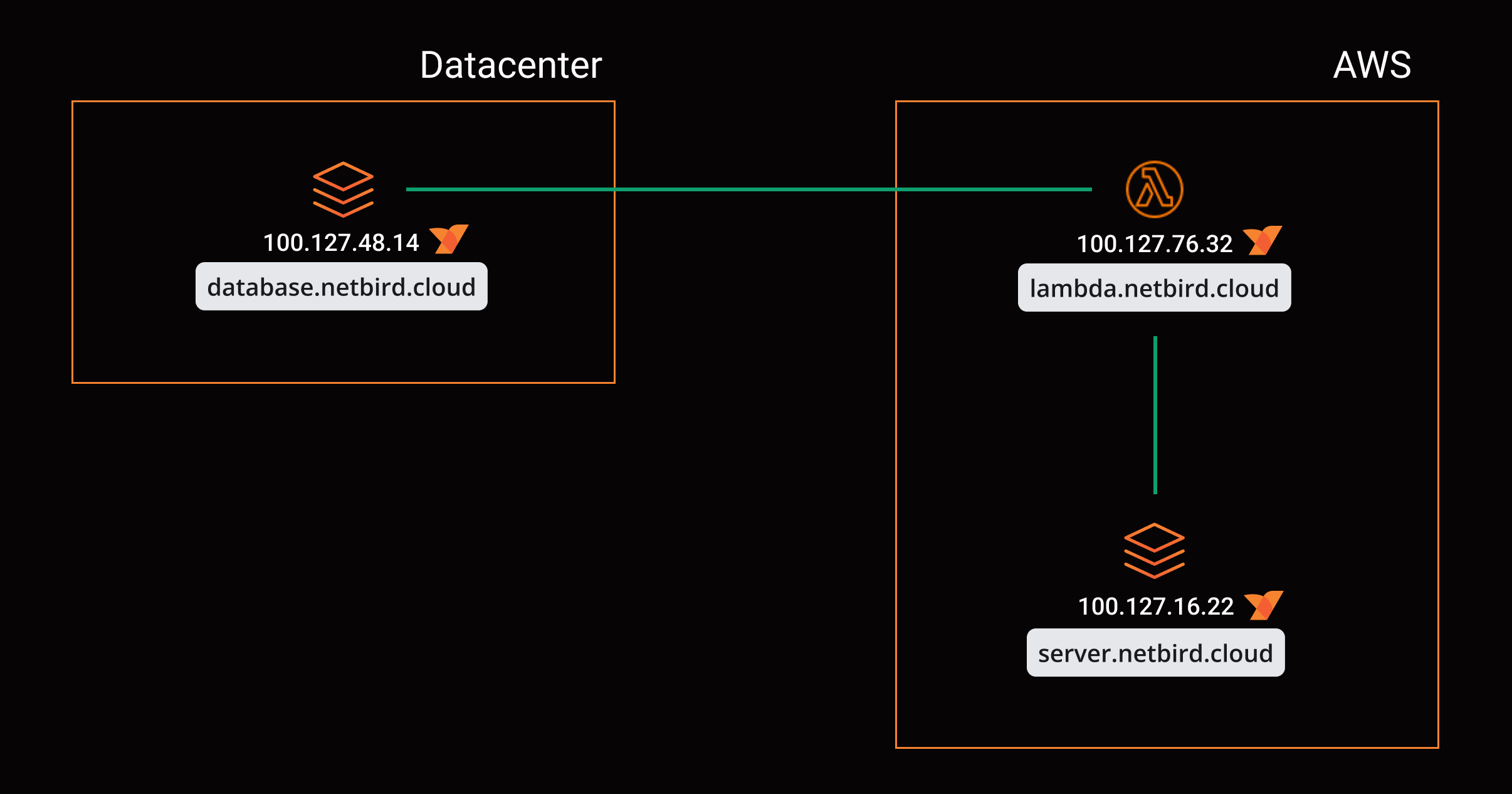
NetBird AWS Lambda

Check out the NetBird documentation for more information on how to set up your Lambda functions with NetBird.

Best Practices for AWS Lambda Security

AWS Lambda simplifies cloud deployment by letting you launch services as serverless functions that run on demand with high availability and scalability. Although this can help you deliver code more quickly and cost-effectively, it also makes you vulnerable to new security threats if you don't properly harden your AWS accounts and the functions within them. Here's a recap of the best practices you should follow to defend your serverless functions against these risks:

  • Configure correct IAM policies to restrict access to your functions.
  • Allocate appropriate resources to your Lambda functions to avoid resource exhaustion or overprovisioning.
  • Practice secure coding methods, including proper input sanitization and safe supply chain hygiene.
  • Ensure that activities in functions are observable through logs and error reports.
  • Avoid exposing functions on the public internet.
  • Connect functions to other infrastructure using a private VPN.

These steps ensure your Lambda functions are performant, safe, and secure, letting you fully benefit from the development efficiency improvements that serverless computing allows.