惯性聚合 高效追踪和阅读你感兴趣的博客、新闻、科技资讯
阅读原文 在惯性聚合中打开

推荐订阅源

罗磊的独立博客
Apple Machine Learning Research
The Cloudflare Blog
WordPress大学
WordPress大学
钛媒体:引领未来商业与生活新知
钛媒体:引领未来商业与生活新知
奇客Solidot–传递最新科技情报
奇客Solidot–传递最新科技情报
博客园 - 叶小钗
博客园 - 聂微东
阮一峰的网络日志
阮一峰的网络日志
腾讯CDC
博客园 - 三生石上(FineUI控件)
V
V2EX
有赞技术团队
有赞技术团队
V
Visual Studio Blog
小众软件
小众软件
Jina AI
Jina AI
酷 壳 – CoolShell
酷 壳 – CoolShell
博客园 - Franky
量子位
T
Tailwind CSS Blog
cs.CV updates on arXiv.org
P
Palo Alto Networks Blog
Cisco Talos Blog
Cisco Talos Blog
I
Intezer
Project Zero
Project Zero
A
Arctic Wolf
P
Privacy International News Feed
V
Vulnerabilities – Threatpost
L
Lohrmann on Cybersecurity
S
Securelist
C
Cybersecurity and Infrastructure Security Agency CISA
C
CXSECURITY Database RSS Feed - CXSecurity.com
T
Tor Project blog
Hacker News - Newest:
Hacker News - Newest: "LLM"
S
Security @ Cisco Blogs
cs.AI updates on arXiv.org
Threat Intelligence Blog | Flashpoint
Google DeepMind News
N
News and Events Feed by Topic
TaoSecurity Blog
TaoSecurity Blog
L
LINUX DO - 热门话题
G
GRAHAM CLULEY
Help Net Security
Help Net Security
N
News | PayPal Newsroom
W
WeLiveSecurity
G
Google Developers Blog
Microsoft Security Blog
Engineering at Meta
Engineering at Meta
MongoDB | Blog
MongoDB | Blog
C
Check Point Blog

NetBird - Networking Knowledge Hub - RSS Feed

NetBird Is Now on the Vultr Marketplace Native NetBird on the GL.iNet Comet Pro (GL-RM10) NetBird v0.71 - IPv6 Overlay Addressing NetBird Exit Nodes - Appear at Home, or Anywhere Else Reporting Bugs and Requesting Features in NetBird Setup and Use Local AdGuard Home Anywhere with NetBird DNS How to Set Up NetBird on PiKVM for Secure Remote KVM Access NetBird v0.69 - CrowdSec IP Reputation for the Reverse Proxy Cloudflare Mesh vs NetBird vs Tailscale: Performance Compared Self-Hosting Nextcloud with Docker and NetBird Implementing Zero Trust with NetBird NetBird v0.67 - Layer 4 Proxy Support for TCP, UDP, and TLS Solwr Enhances Remote Connectivity with NetBird Self-Hosting NetBird with Authentik Jellyfin Media Server - Self-Host Your Movies, TV, and Music Cloudflare Tunnels vs. NetBird Reverse Proxy INFITX Builds Zero-Touch Kubernetes Networking with NetBird NetBird v0.66 - Expose Local Services to the Internet from the CLI Pangolin vs. NetBird Home Assistant Setup Guide with EASY Remote Access NetBird v0.65 - Built-in Reverse Proxy with Custom Domains Docker for Beginners - Everything You Need to Get Started NetBird for SOC 2 Compliance Vibecode This in a Weekend and Take 5% of the Company NetBird v0.62 - Built-in Local Users with Optional IdP Integration NetBird v0.61.0 - Granular SSH Access Control and Automatic Updates Top 5 Alternatives to OpenVPN Top 5 Open Source Alternatives to Tailscale Top 5 Alternatives to ZeroTier How to Set Up ZeroByte and REST Server for Backups with NetBird How to Install n8n v2.0 with NPM and PM2 ZeroTier vs. NetBird The Ultimate Immich Guide - Ditch Google and Amazon Photos for Good NetBird as Your Help with ISO 27001 Compliance NetBird and Huntress - Secure Network Access for MSPs How to Access Windows Shares from Anywhere with NetBird netgo Relies on Modern ZTNA with NetBird Connect to Your Homelab from Anywhere with a Raspberry Pi NetBird SSH - A New, Identity-Aware Approach The AI Mega Mesh: How to Connect 30+ GPU Cloud Providers Connect Multiple Ollama GPUs to OpenWebUI with NetBird Top 5 Tailscale Alternatives SSH and RDP, now in your browser NetBird–Acronis Integration: Empowering MSPs for Advanced Ransomware and Threat Defense Introducing the Control Center - Remote Access, Beautifully Visualized NetBird at MSP Global 2025 Understanding Overlay Networks - The Basics NetBird and SentinelOne Singularity™ - Automate Threat Response NetBird and Microsoft Intune - Enforcing Device Compliance for Zero Trust Rethinking Zero Trust Security with NetBird and pfSense Improving Unidirectional Access Control Proxmox VE for Beginners Guide with NetBird LXC Stronger Security: NetBird + GitHub Secure Open Source Fund NetBird's MSP Partner Program Signicat Enhances Cross-Cloud Accessibility with NetBird SonicWall SSL VPN NetExtender vs. NetBird NetBird Is Embracing the AGPLv3 License NetBird Profiles Have Landed - Manage Multiple Accounts Effortlessly Rethinking Access Control to Secure Your On-Premises SharePoint Servers Sport Alliance Increases Efficiency with Zero Trust Networking at Scale Rethinking Network Access: qwertiko Goes Zero Trust with NetBird Optimizing Network Efficiency with NetBird's Lazy Connections Use Port Ranges in Access Control Policies Generic HTTP Endpoint for Network Events Streaming NetBird’s Response to Spear-Phishing Campaign Targeting Financial Executives Zero-Trust Access to Internal Resources Without Installing Agents Enhance Network Visibility with NetBird’s Traffic Events Logging TrueNAS Made Easy - Install, Set Up, and Access From Anywhere Top 5 Alternatives for WireGuard Jump Hosts. Gateways for Remote Access NetBird Network Routes and Exit Nodes Security for All - SSO and MFA for Free Enhancing Network Access Control with NetBird's Identity Provider Feature Twingate vs. NetBird Limit Network Access Based on Running Applications FortiClient ZTNA vs. NetBird OpenVPN vs. NetBird Tailscale vs. NetBird Getting Started with an Azure Site-to-Site VPN Getting Started with an On-premise-to-AWS Site-to-Site VPN Secure Remote Access to VPCs, LANs, and Offices regreSSHion - A New OpenSSH Server Remote Code Execution Vulnerability Evolve Bank & Trust Data Breach. What Happened? What Is a Site-to-Site VPN? IPSec Tunneling Demystified. Enhancing Data Security Across Networks Understanding IPSec Tunnel and Transport Modes Understanding the Differences Between IKEv1 and IKEv2 Understanding the IKEv1 Protocol in IPSec ZeroTier versus NetBird - Which Should You Choose? AWS Lambda Serverless Security. Mistakes, Oversights, and Potential Vulnerabilities Using NetBird for Kubernetes Access Serverless Security Vulnerabilities and Best Practices to Mitigate Them Security Best Practices for Serverless Azure Functions A Guide to Remote Access Security for SMEs IoT Security Essentials. How to Achieve Secure Remote Access Open Source Zero Trust Networking Using SSH for Secure Remote Access How We Integrated Rosenpass in NetBird The First Quantum-Resistant Mesh VPN Using eBPF and XDP to Share Default DNS Port Between Multiple Resolvers
NetBird v0.63 - Custom DNS Zones for Private Network Resolution
Written byBrandon Hopkins · 2026-01-17 · via NetBird - Networking Knowledge Hub - RSS Feed

NetBird now supports private DNS zones, allowing you to host DNS records directly within your network, with no external DNS servers needed. Version 0.63 brings a feature that homelab enthusiasts and enterprise teams alike have been asking for: the ability to create internal DNS zones, add records, and distribute them to exactly the peers that need them.

You can create a zone like , add A, AAAA, or CNAME records, and distribute them to specific peer groups. Resolution happens locally on each peer, and records propagate automatically when group membership changes. With search domain support, peers can query short names like instead of the full .
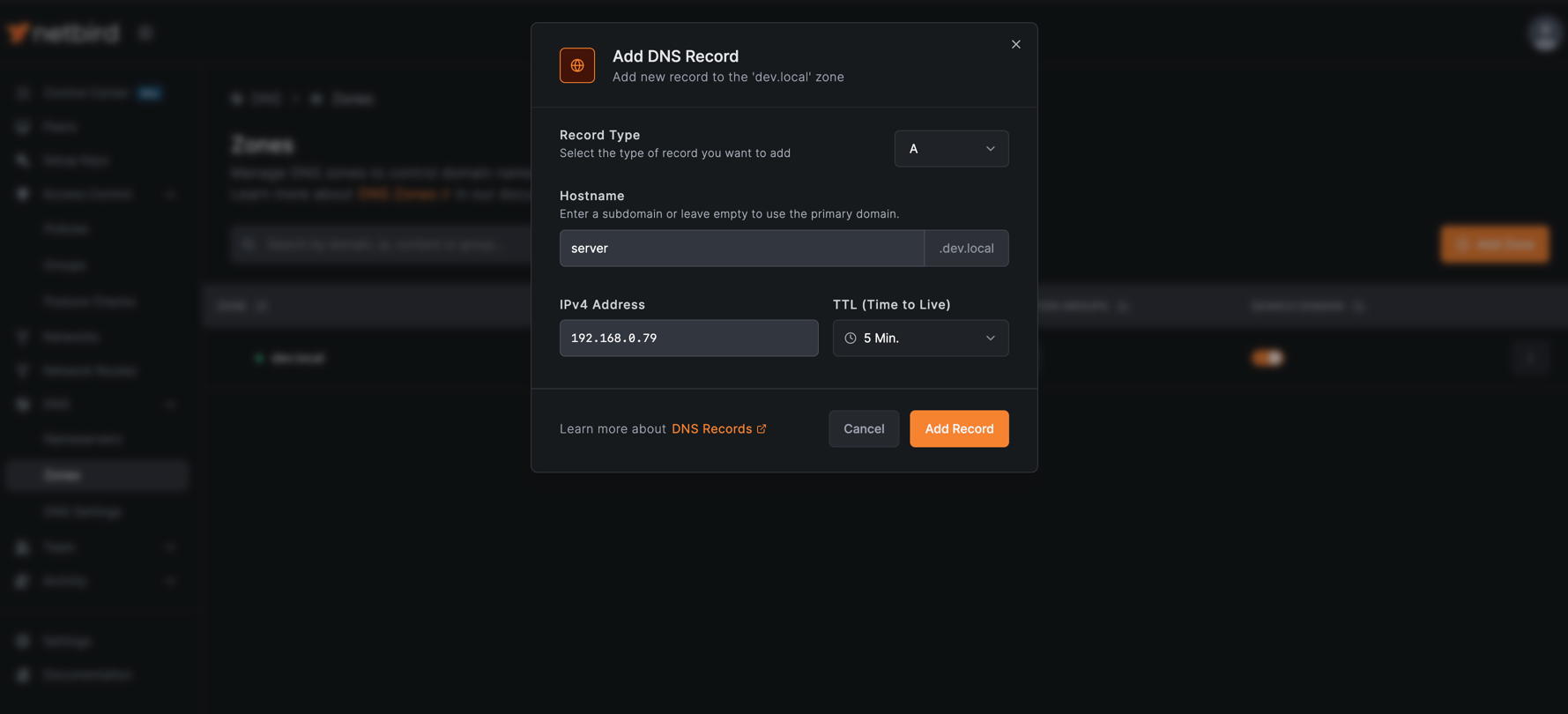
Update DNS Zones

Here's what's new:

  • Private DNS zones - Create internal zones and manage DNS records directly from the Dashboard, with no external DNS servers needed
  • Group-based distribution - Distribute zones to specific peer groups, giving different teams access to different records or entirely separate zones
  • Search domain support - Enable short name resolution so resolves to
  • Routed network integration - Map friendly DNS names to private IPs behind routing peers, and NetBird handles both resolution and traffic routing

Custom zones take precedence over nameserver configurations, giving you full control over how specific domains resolve within your network.

The Problem with External DNS

Managing internal DNS usually means one of two things: maintaining separate DNS servers for your private network, or manually configuring hosts files across all your devices. Neither option scales well.

For homelabs and small teams, running a full DNS server like Pi-hole or Unbound just for internal resolution adds complexity and another service to maintain. For enterprises, coordinating DNS across multiple environments, including production, staging, and development, often requires dedicated infrastructure teams.

What most people actually want is simpler: point at and have it just work for the right people.
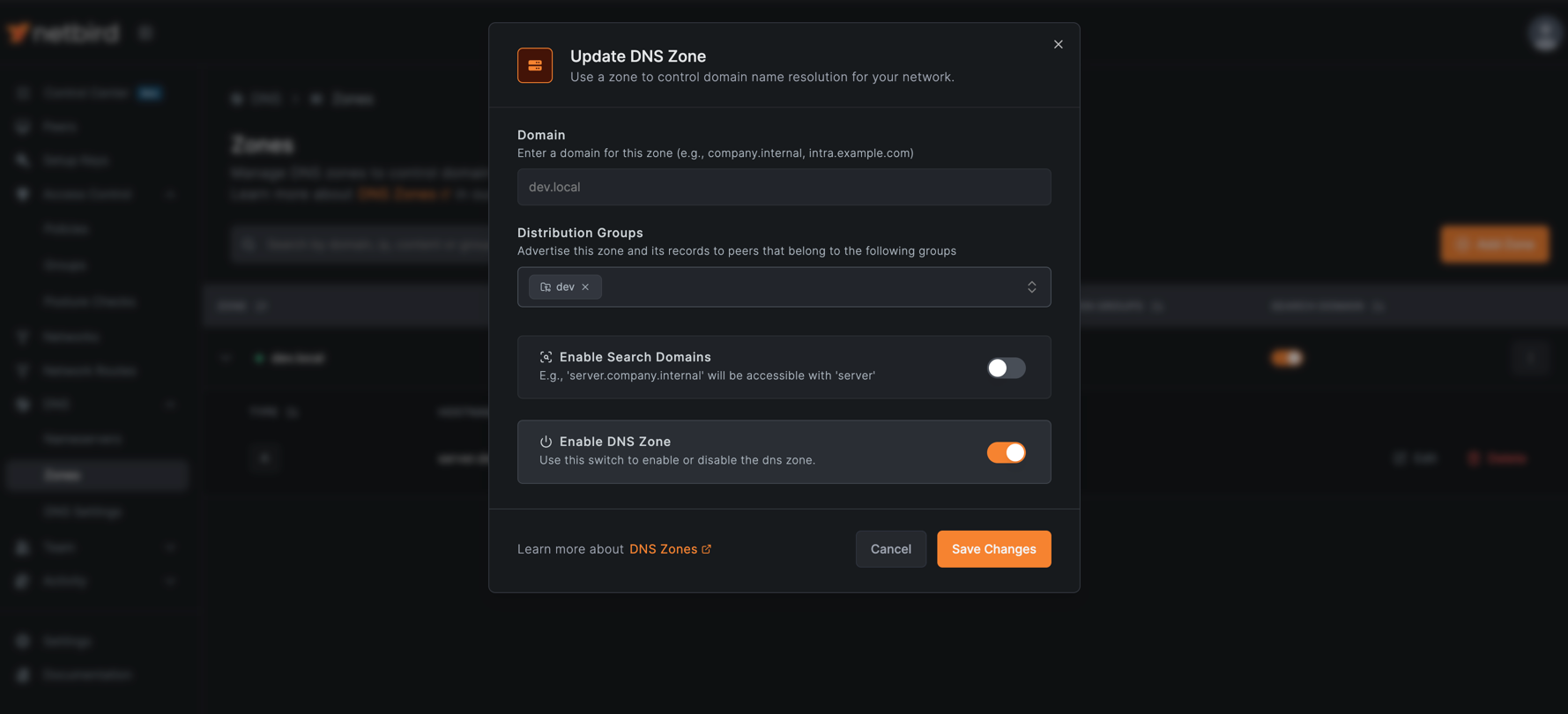
Custom DNS Zones

Create Zone

Creating a Zone

  1. Navigate to DNSDNS Zones
  2. Click Create Zone
  3. Enter your zone name (e.g., )
  4. Select the peer groups that should have access to this zone
  5. Optionally enable Search Domain to allow short name resolution
  6. Click Create

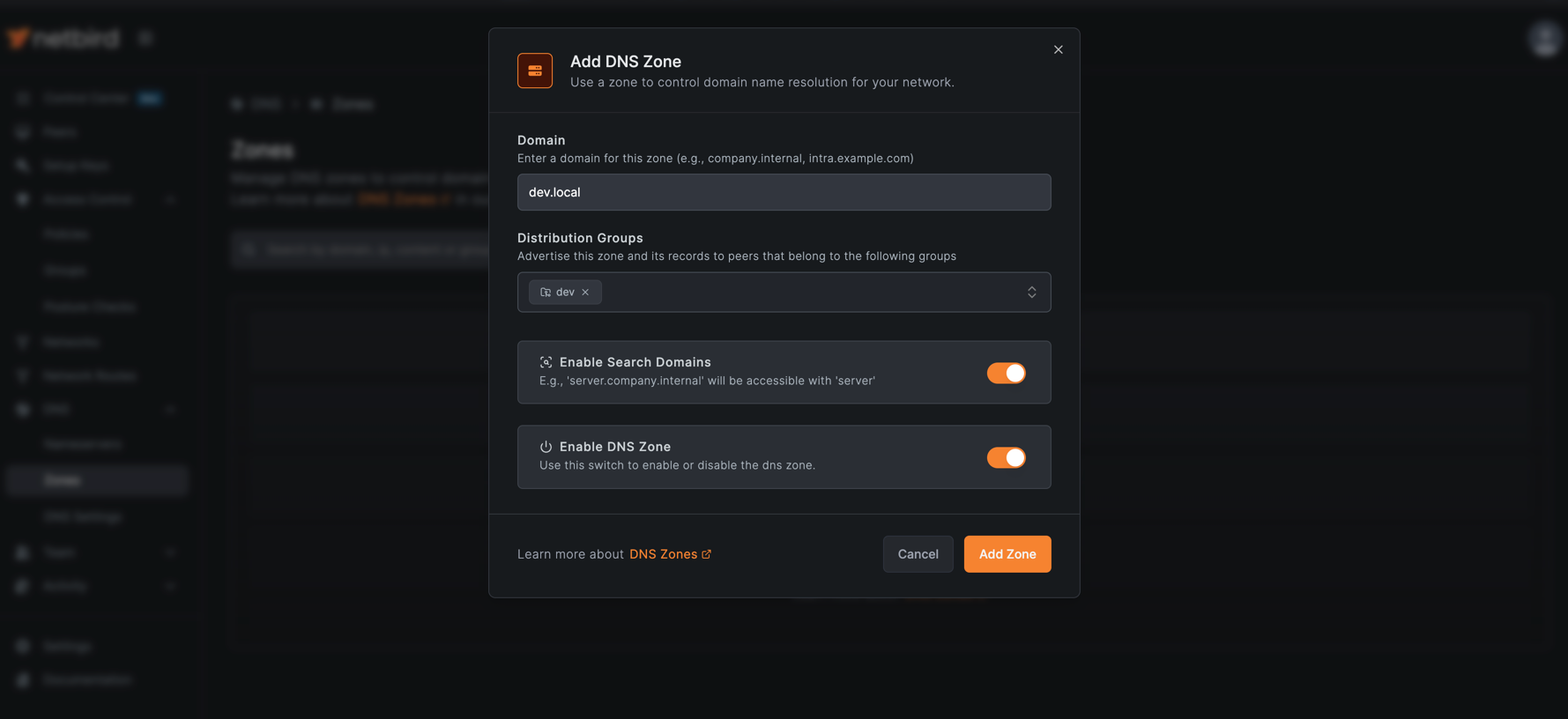
Create Record

Adding Records

Once you've created a zone, adding records is straightforward:

  1. Click on your zone to view its records
  2. Click Add Record
  3. Choose the record type:
    • A - Maps a hostname to an IPv4 address
    • AAAA - Maps a hostname to an IPv6 address
    • CNAME - Maps a hostname to another hostname
  4. Enter the hostname and target value
  5. Click Create

Records propagate automatically to all peers in the assigned groups. When a peer joins or leaves a group, their DNS configuration updates accordingly.
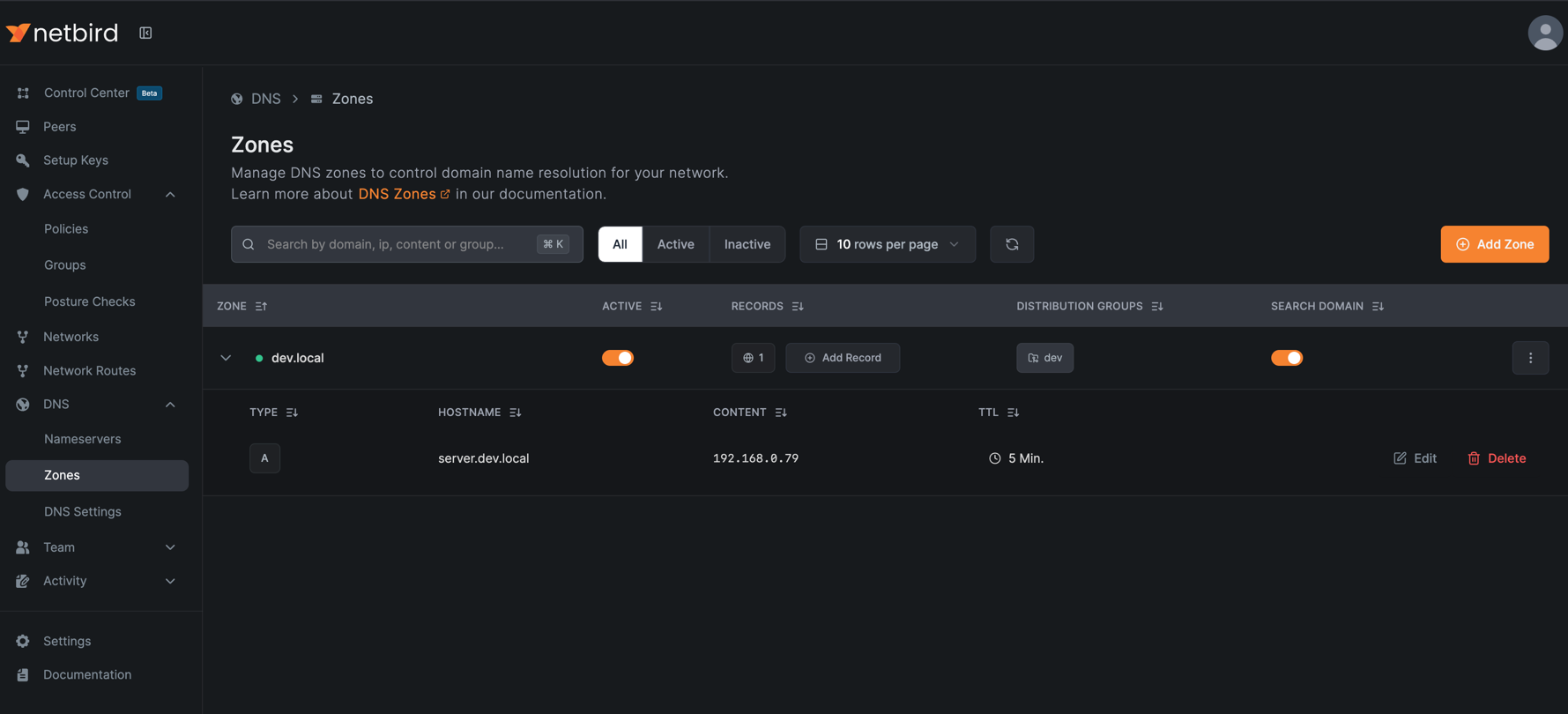
Zone Records

How Resolution Works

DNS resolution for custom zones happens locally on each peer:

  1. Peer queries a hostname (e.g., )
  2. NetBird's local resolver checks if the domain matches a custom zone
  3. If matched, the resolver returns the configured IP directly
  4. If not matched, the query falls through to configured nameservers

Custom zones take precedence over nameserver configurations, so you can override external DNS for specific domains while letting everything else resolve normally.

With search domains enabled, peers can query instead of . NetBird automatically appends the zone suffix during resolution.

Integration with Routed Networks

Custom DNS zones pair naturally with NetBird's network routes. When you have resources in a data center or cloud VPC accessible through a routing peer, you can now give them friendly DNS names.

Instead of telling your team to connect to for the staging database, you create a record:


NetBird handles both the DNS resolution and the traffic routing. When your team accesses , the local resolver returns the private IP, and NetBird routes the traffic through the appropriate routing peer.

This works for any routed network, including on-premises data centers, cloud VPCs, or remote sites connected via routing peers.

Get Started