惯性聚合 高效追踪和阅读你感兴趣的博客、新闻、科技资讯
阅读原文 在惯性聚合中打开

推荐订阅源

www.infosecurity-magazine.com
D
DataBreaches.Net
T
Tailwind CSS Blog
M
MIT News - Artificial intelligence
Stack Overflow Blog
Stack Overflow Blog
F
Full Disclosure
V2EX - 技术
V2EX - 技术
N
News and Events Feed by Topic
Help Net Security
Help Net Security
L
LangChain Blog
Y
Y Combinator Blog
宝玉的分享
宝玉的分享
Google Online Security Blog
P
Proofpoint News Feed
OSCHINA 社区最新新闻
OSCHINA 社区最新新闻
T
The Blog of Author Tim Ferriss
Google DeepMind News
The Register - Security
B
Blog RSS Feed
N
Netflix TechBlog - Medium
N
News | PayPal Newsroom
TaoSecurity Blog
TaoSecurity Blog
酷 壳 – CoolShell
酷 壳 – CoolShell
V
Vulnerabilities – Threatpost
B
Blog
C
Cyber Attacks, Cyber Crime and Cyber Security
I
Intezer
H
Hackread – Cybersecurity News, Data Breaches, AI and More
博客园_首页
CTFtime.org: upcoming CTF events
AI
AI
aimingoo的专栏
aimingoo的专栏
大猫的无限游戏
大猫的无限游戏
Threat Intelligence Blog | Flashpoint
Cyberwarzone
Cyberwarzone
P
Proofpoint News Feed
Google DeepMind News
G
GRAHAM CLULEY
Vercel News
Vercel News
罗磊的独立博客
MyScale Blog
MyScale Blog
Last Week in AI
Last Week in AI
博客园 - 司徒正美
C
CERT Recently Published Vulnerability Notes
GbyAI
GbyAI
Scott Helme
Scott Helme
K
KPMG report finds enterprise disconnect between AI and its ROI | CIO
T
Troy Hunt's Blog
A
About on SuperTechFans
P
Privacy International News Feed

PYMNTS.com

Google Accelerates Agentic AI Shift With New Enterprise Platform OpenAI Begins Briefing Governments on Cybersecurity Capabilities DeFi Security Suffers New Blow With $3 Million Volo Exploit Uninvited Users Access Anthropic’s Mythos AI Model Block and Uber Expand Partnership Across Several Global Markets OpenAI Pledges $1.5 Billion to PE Enterprise AI Project Podcast: Inside the $9 Billion DeFi Hack That’s Shaking Crypto’s Foundations Synchrony CFO Flags Momentum in Spending and Credit Banks Risk Slowing the Emerging Middle Market Firms Driving Growth Paysafe Expands Digital Wallet Availability Across 18 European Markets Bad Data Can Break Good AI in Payments 50% More Digital Shopping Days Put Parents at the Center of Retail’s Shift 65% Call Insurance Essential. Why Most Spending Isn’t So Clear-Cut Amazon Recasts Marketplace Fraud as a Broader Trust Problem Capital One’s Q1 Shifts Attention From Spending to Strategy Lawmakers Question JetBlue About Surveillance Pricing Allegations Small Businesses Stop Chasing Amazon on Delivery Speed Google Embeds AI Into Chrome for 3.5 Billion Users Adobe Plans Outcome-Based Pricing for New AI Product Suite UnitedHealth Spends $1.5 Billion on AI and Wants Double Back MiCA Forces Crypto Firms to Get Licensed or Get Out Prediction Market Kalshi Targets Crypto Perpetuals New York Sues Coinbase and Gemini Over Prediction Markets Amazon and Anthropic Deepen Ties With Investment and Hardware Pact Commercial Loans Show US Economy Defies Sluggish Forecasts The Web Is Gaslighting AI Agents and Nobody Can Tell OCC Enters the Interchange Fight and Raises the Stakes Amazon Dismisses New Evidence in California Antitrust Suit AI Finds Its Best Customer on Main Street Coinbase Opens Services Marketplace for Agentic Commerce Feds Start Processing $127 Billion in Tariff Refunds for Importers Zenskar Raises $15 Million For Agentic-Powered Revenue Automation Payments Modernization Is Insurance’s Next Big Margin Engine Instant Payments Grow but the Real Barrier Is Human The Old-School Card Product Banks May Need Most 43% of SMBs Would Pay to Make Purchases in Installments The Real AI Edge in Payments Comes From Better Judgment In the Age of Agentic AI, Data Control Is Power Verizon’s Dan Schulman Tells CEOs to Be Open About AI Job Cuts Walmart Eyes Stores as Warehouse Space for Same-Day Delivery QVC Was TikTok Shop Before TikTok Shop Loop Raises $95 Million to Bridge Supply Chain Data Gap Cursor Eyes $50 Billion Valuation as AI Coding Demand Surges Commercial Lending Rescues Regional Banks From Consumer Slowdown Anthropic and White House Aim to Make Peace in Friday Meeting Home Depot Buys SIMPL Automation to Support Same-Day Delivery The Riskiest Words in B2B: This Is How We’ve Always Done It France Urges Euro Stablecoins to Break Dollar Dependency Importers Prep for Monday Opening of Tariff Refund Portal Permitting Hurdles and Labor Shortages Threaten AI Data Center Timelines Token Freezes Force CFOs to Rethink Stablecoin Risk X Money Tests Whether Social Commerce Can Hold Consumer Deposits Anthropic Briefs EU Regulators on Mythos Cybersecurity Concerns Welcome to Vibe Ordering, ChatGPT Is Taking Your Order Now Nvidia Says AI Can Finally Make Quantum Computing Work QVC Files Chapter 11 to Slash Debt and Pursue Growth Uber Eats Lets Customers Return Their Retail Purchases Financial Officials Sound Alarm About Anthropic’s Banking Risk 71% of Billion-Dollar Firms Face Agent Identity Threats What If Clearing Had Its Stripe Moment? The Hidden Cost of Swiping Personal Credit Cards for Business Payments Leaders Need AI Controls They Can Explain in 24 Hours Podcast: Why the Biggest Market in the World Is Money. And Up for Grabs 44% of Healthcare Treasurers Lack Cash Flow Visibility as Payment Friction Persists OpenAI Targets Pharma Giants With Purpose-Built AI Model California Claims Amazon Punishes Sellers for Lower Prices on Other Sites CFTC Chairman Says AI Helps Agency Run More Like a Business Global Finance Chiefs Call for Mythos Information Sharing Big Bank Earnings Show Digital Activity Drives Deposits OCC Clears JPMorgan Chase After Trade Surveillance Program Upgrade Accounts Receivable Gets an AI Upgrade BNY’s AI Strategy Signals a New Era of Platform Banking Bank of England Probes AI Threats to UK Financial Stability Rising AI Adoption Is Driving Up Enterprise Costs Google Faces EU Order to Share Search Data With Rivals Delivery Robots Lead Grab’s AI Expansion Circle Chief Says China Could Issue Stablecoin in 3 to 5 Years Amex Acquires Hyper to Boost AI and Expense Management Offerings Anthropic Ready to Offer Mythos to British Banks Issuers Face a New Reality as Credit Goes Real Time How Payments Gaps Are Limiting Deposit Growth at Community Banks AI May Run Payments but Humans Still Own the Risk 90% of Millennials Feel Pressure at the Grocery Store The New Checkout Is Where the Best Offer Wins Payments Alone No Longer Cut It for Small Businesses Apple Pushes Siri Programmers to Adopt AI Coding Tools Amazon Sellers Protest Policy Changes With One-Day Ad Boycott FanDuel and DraftKings Fund $41 Million Lobbying Effort by Super PAC Live Nation Loses Antitrust Case Brought by 33 States Fed Beige Book Finds Tax Refund Relief Running Into Higher Gas Prices Anthropic’s New Design Tool Rivals Adobe and Figma Goldman Sachs Seeks SEC Approval for New Bitcoin ETF What AI-Driven Attack Chains Mean for CFOs and CISOs Healthcare’s AI Boom Moves From Bedside to Back Office Accel Prepares to Pour $5 Billion Into Global AI Breakouts Velera Launches Cloud Platform to Modernize Credit Union Tech SoFi Uses Galileo to Power Real-Time FedNow Transfers Palo Alto Founder Eyes Liberty Bank for AI Banking Experiment Surcharge Surge Hits Consumers as Fee Fatigue Sets In Walmart CFO Says Marketplace Revenue Up 20% Over 2025
How Visa Is Rewiring Bank Infrastructure for the AI Era
PYMNTS · 2026-04-20 · via PYMNTS.com

Banks’ legacy core systems were built to prioritize stability, accuracy and scale, and they still deliver on those goals. But as banks attempt to modernize, digitize and incorporate artificial intelligence (AI) into everyday operations, those same systems are increasingly limiting what institutions can do and how fast they can do it.

“Legacy core is an impediment to innovation,” PYMNTS CEO Karen Webster noted during a recent conversation with Kathleen Pierce-Gilmore, senior vice president and global head of issuing solutions at Visa, as part of the “The Edit” series. What has changed, Pierce-Gilmore said, is how visible and costly that constraint has become.

AI Turns Infrastructure Into a Business and Risk Issue

Artificial intelligence (AI) has raised the stakes for infrastructure decisions. AI depends on timely, governed access to data — something with which legacy, batch-based environments struggle.

“If you don’t have well understood, well-managed, well-governed data, it’s going to be really hard to use AI,” Pierce-Gilmore said.

In many banks, data is fragmented across systems, limiting real-time use. Pierce-Gilmore referred to those silos as “data prisons,” where information is trapped inside infrastructure and cannot easily be mobilized for analytics, personalization or compliance.

Advertisement: Scroll to Continue

That limitation affects far more than customer experience. It also shapes how banks evidence controls, monitor activity and respond to regulatory inquiries in an AI-driven environment.

Regulatory expectations are tightening just as banks attempt to move faster. AI adds new complexity to long-standing requirements around data usage, transparency and governance.

Pierce-Gilmore noted that regulators themselves are still working through how to oversee emerging technologies. That uncertainty makes infrastructure choices more consequential, not less. Banks must be able to explain how data flows through systems, how decisions are made and how controls are enforced, even as AI models evolve.

The result is a compressed timeline. Banks are no longer debating whether modernization is necessary. They are deciding how to modernize without increasing risk or creating new forms of technical debt.

“I do think there is a greater sense of urgency than ever,” Pierce-Gilmore said.
Unlocking Data Enables Real-Time, Compliant Engagement

Unlocking data embedded inside infrastructure allows banks to move from static processes to real-time engagement. When events can be consumed as they occur, banks can respond with timely alerts, personalized offers and more accurate risk management.

Pierce-Gilmore offered a straightforward example: a cardholder pays down a balance and immediately sees available credit update, receives a relevant alert and is presented with a promotion tied to that action.

“You can do that in a much more seamless and relevant way if you’ve got the data at the time that it’s happening,” she said.

Batch processing makes those experiences difficult. Real-time event streaming makes them possible, and also auditable.

Future-Proofing Is Now a Requirement

Infrastructure decisions made today must accommodate technologies and regulations that do not yet exist. Pierce-Gilmore stressed that banks can no longer modernize with a fixed end state in mind.

“We just don’t know today how data is going to be used or how additional layers of technology are going to be built out,” she said.

That uncertainty places a premium on modularity and configurability. Systems must be flexible enough to adapt as AI use cases expand and as regulators clarify expectations, without locking banks into rigid architectures that become the next generation of legacy.

Speeding Innovation’s Time to Market

One of the most acute challenges banks face is time. Many institutions want to launch new products or experiences but face technology queues that stretch multiple years.

Pierce-Gilmore described scenarios where issuers are “desperate to get a new product to market” but are blocked by core system backlogs. Waiting for full modernization is often not an option.

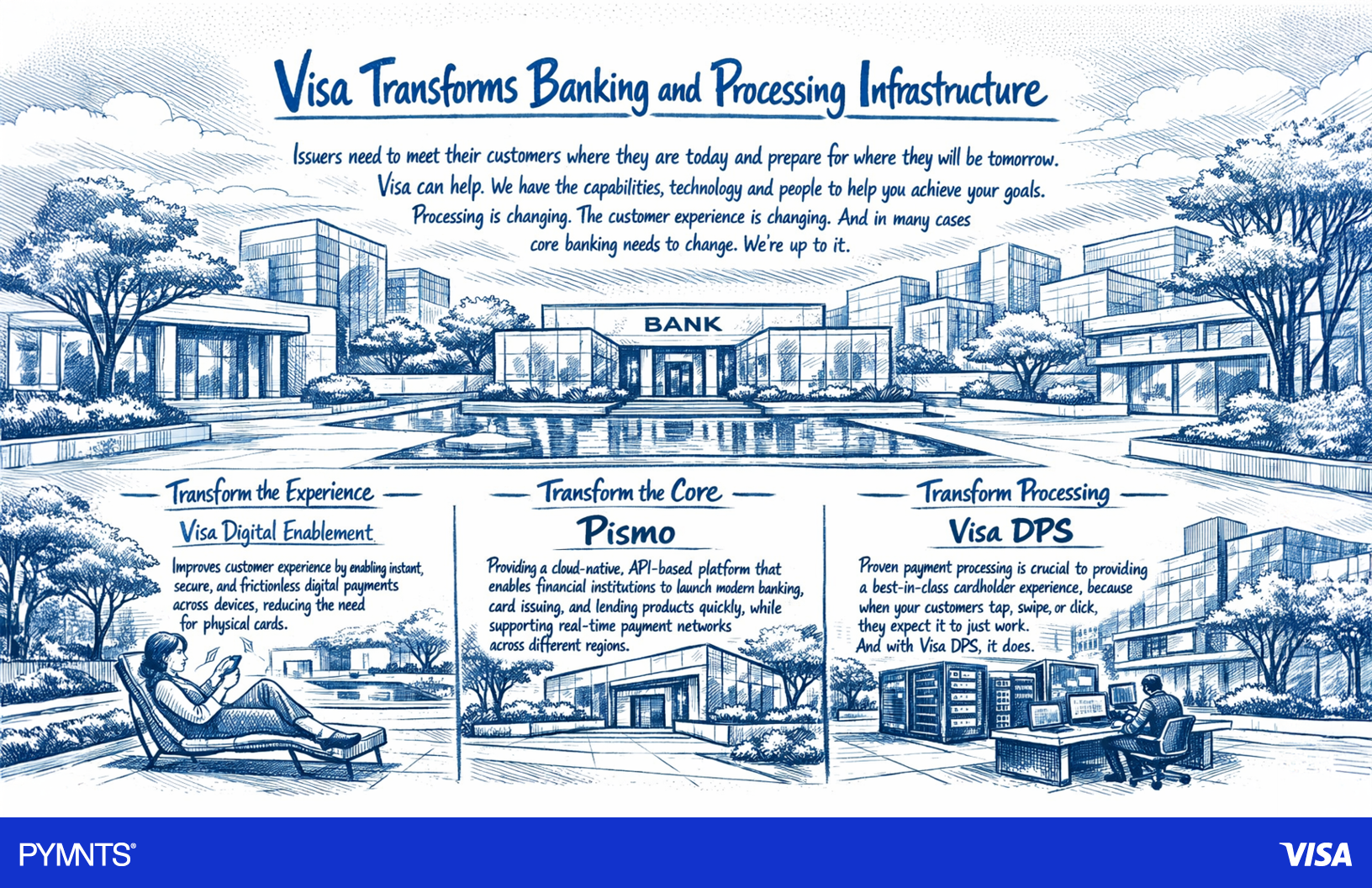
Visa’s approach allows banks to move forward without ripping out existing infrastructure. Capabilities can be deployed on a standalone basis or layered alongside existing systems, enabling faster launches while deeper transformation continues in parallel.

Why Pismo Matters More Than Ever

Pismo sits at the center of that strategy. Its real-time event streaming and flexible issuing capabilities allow banks to modernize incrementally, aligning infrastructure changes with immediate business priorities.

Rather than forcing banks into an all-or-nothing transformation, Pismo supports targeted progress—whether launching a new digital product, improving servicing or enabling real-time engagement.

Crucially, Pismo also supports operational readiness. Real-time infrastructure only delivers value if banks can consume and act on events across servicing, risk and compliance functions.

Visa’s Modular, Ecosystem-Scale Approach

Visa’s infrastructure strategy reflects its scale across tens of thousands of issuers globally. Rather than selling isolated features, the focus is on modular components that can be combined to deliver measurable outcomes.

“Our clients don’t want to buy features and functionality,” Pierce-Gilmore said. “They want to buy outcomes.”

That approach allows Visa to act as what Pierce-Gilmore termed a force multiplier, applying lessons learned across markets and regulatory regimes to help banks modernize more efficiently and responsibly.

A Clear Direction of Travel

Legacy cores may still keep banks running, but the ability to unlock data, operate in real time and adapt to AI and regulatory change will determine which institutions can compete—and which remain constrained by the systems they rely on most.

Pierce-Gilmore weighed in confidence. “I would put my whole life savings on the modernization of infrastructure,” she said.

PYMNTS CEO Karen Webster is one of the world’s leading experts in payments innovation and the digital economy, advising multinational companies and sitting on boards of emerging AI, healthtech and real-time payments firms, including a non-executive director on the Sezzle board, a publicly traded BNPL provider. She founded PYMNTS.com in 2009, a top media platform covering innovation in payments, commerce and the digital economy. Webster is also the author of the NEXT newsletter and a co-founder of Market Platform Dynamics, specializing in driving and monetizing innovation across industries.
