



A shopper walks into a grocery store with discounts sitting in three different places: their loyalty app, their credit card and a manufacturer rebate. The shopper ultimately leaves after using none of them.
That missed moment is not an anomaly, nor the opening shot of a retail-themed horror story. It is the contemporary operating model of 21st-century retail.
New findings in the PYMNTS Intelligence report “Embedded Offers: The Billion-Dollar Opportunity Inside Recent Consumer Spending,” done in collaboration with FIS, highlight the scale of the problem. Multiply that one shopper moment of missed offer opportunities across millions of transactions, and the result is a $42.4 billion hole in the retail economy representing value that exists but never converts.
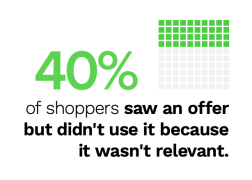
The incentives exist. The demand exists. What is missing is a system capable of connecting the two at the moment of decision.
As a result, banks, merchants and technology providers are increasingly converging on a single, shared objective to build the next-generation systems that can automatically identify and apply the best available offer in real time.
Platform Competition
Leading retail infrastructure stakeholders are increasingly competing over the same moment, checkout, which is the only point in the customer journey where all these elements (product choice, price, payment and reward) intersect.
Advertisement: Scroll to Continue
Each participant brings a different asset base. Merchants have direct access to the shopping experience and first-party data. Banks and card networks control payment credentials and rewards infrastructure. Technology firms bring the ability to integrate across systems and scale rapidly.
The report data suggests that offers, when delivered effectively, do not simply reduce price. They alter behavior. Roughly 7 in 10 consumers change what they buy when presented with a relevant offer, and that includes switching products, adjusting quantities and even changing payment methods.
If the payment layer can determine which incentives are surfaced and which payment method unlocks them, it becomes the mechanism through which demand is directed. A card, wallet or checkout interface that consistently delivers the best outcome ceases to be a passive tool. It becomes an active agent in shaping the basket.
Read the report: Embedded Offers: The Billion-Dollar Opportunity Inside Recent Consumer Spending
The marketplace response is already converging on the concept of embedded offers: a checkout experience that aggregates all available discounts, rewards and incentives and applies them automatically in real time.
Nearly 9 in 10 consumers surveyed for the report said they want to see all discounts before deciding what to buy, and more than 80% say such a system would influence their choice of merchant. Just as significantly, 77% say they would change their default payment method if it delivered real-time savings.
This has the characteristics of a platform shift. Control is moving away from discrete components such as cards, coupons, loyalty programs, etc., and toward the systems that coordinate them. That system becomes the interface through which value is experienced and, by extension, the place where loyalty is established.
What makes this development strategically significant is that no single player currently owns this layer.
Commerce has always been shaped by whoever controls the critical interface. In physical retail, it was the shelf. In eCommerce, it was search and recommendations.
The next interface is emerging as a repricing of the checkout experience itself. Historically, checkout has been viewed as a cost center, necessary, but not a source of competitive advantage. That assumption may no longer be a viable one. As offers, payments and data converge, checkout increasingly becomes the point at which value is created or lost.
The shopper with three unused discounts is a symptom of a fragmented system. The race now under way is to replace that system with one that is unified, intelligent and, above all, effortless.