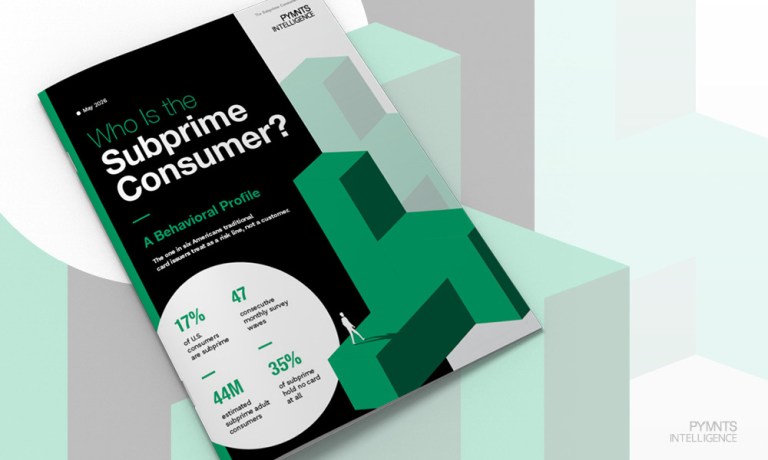
The report finds that 17% of U.S. consumers, or roughly 44 million adults, fall into the subprime credit range. That share has held within a narrow band across 47 monthly survey waves from March 2022 through January 2026. In other words, this is a durable segment with distinct behaviors, needs and product opportunities.
The data also shows that subprime consumers aren’t just heavy credit card revolvers. In fact, the share of subprime consumers who always or usually revolve their balances has fallen from about 50% in mid-2023 to 38% in January 2026. At the same time, 35% of subprime consumers have no credit or store cards at all, creating a gap for issuers, merchants and installment providers that can serve this group with products built around cash flow rather than traditional prime-card assumptions.
That shift is especially visible in BNPL and healthcare. Subprime consumers use BNPL at higher rates than the overall population, but they concentrate this usage among specific providers. Younger subprime consumers also report delaying care, skipping prescriptions and borrowing from family or friends to manage healthcare costs. Tax refunds and one-time government payments play a similar role: Subprime consumers often use these to cover bills, repay debt or stabilize household finances.
For banks, card issuers, merchants, BNPL providers and healthcare finance firms, the message is clear. Subprime consumers are not outside the credit economy. They are navigating it differently, and the companies that understand those behaviors may put themselves in a better position to build lasting relationships with this 44 million-consumer market.
In “Who Is the Subprime Consumer? A Behavioral Profile,” learn how:
- Subprime consumers are moving across credit products. Always-or-usually revolving has declined, while BNPL and installment products are taking on a larger role in how these consumers manage purchases.
- Healthcare costs are creating new financing needs. Young subprime consumers are delaying care, negotiating bills and using installment options at rates that point to unmet demand at the provider office, pharmacy and telehealth checkout.
- Cash flow timing can shape product strategy. These consumers often use refunds and one-time payments to cover bills or repay debt, giving issuers and lenders clearer moments to reach them with relevant offers.
About the Report
The findings in “Who Is the Subprime Consumer? A Behavioral Profile” are drawn from three PYMNTS Intelligence studies that analyzed results by self-reported credit score, with a fourth essential-spending study (more than 3,400 U.S. consumers asked to classify 22 household line items) used selectively for context.
- New Reality Check: The Paycheck-to-Paycheck Report. Monthly U.S. consumer finance report, currently in its 47th wave, covering March 2022 through January 2026. The headline January 2026 wave surveys 2,486 U.S. consumers, nationally representative. Historical trend figures use all 47 available waves.
- Financing the Decision: How BNPL and Installments Reshape Merchant Choice (The Pay Later Ecosystem Report, April 2026). February 2026 wave, 2,763 U.S. consumers. Used for card holdings, pay later persona, balance management, BNPL provider mix and BNPL use persona.
- Generations Under Pressure: How Younger Consumers Work Harder to Cope as Costs Stay Elevated. January 2026 study, 2,747 U.S. adult consumers. Used for healthcare access effects, coping tactics and healthcare cost burden.