

惯性聚合 高效追踪和阅读你感兴趣的博客、新闻、科技资讯
阅读原文 在惯性聚合中打开

推荐订阅源

F
Fox-IT International blog
Recent Announcements
D
Docker
IT之家
IT之家
B
Blog
Jina AI
Jina AI
奇客Solidot–传递最新科技情报
奇客Solidot–传递最新科技情报
博客园 - 【当耐特】
Google DeepMind News
F
Fortinet All Blogs
量子位
C
Check Point Blog
Microsoft Azure Blog
罗磊的独立博客
博客园 - 司徒正美
李成银的技术随笔
美团技术团队
Blog — PlanetScale
Blog — PlanetScale
雷峰网
雷峰网
The GitHub Blog
The GitHub Blog
让小产品的独立变现更简单 - ezindie.com
J
Java Code Geeks
T
The Blog of Author Tim Ferriss
酷 壳 – CoolShell
酷 壳 – CoolShell
MongoDB | Blog
MongoDB | Blog
P
Proofpoint News Feed
L
LangChain Blog
Cyber Security Advisories - MS-ISAC
OSCHINA 社区最新新闻
OSCHINA 社区最新新闻
Y
Y Combinator Blog
大猫的无限游戏
大猫的无限游戏
有赞技术团队
有赞技术团队
钛媒体:引领未来商业与生活新知
钛媒体:引领未来商业与生活新知
V
Visual Studio Blog
T
Tailwind CSS Blog
H
Help Net Security
Engineering at Meta
Engineering at Meta
小众软件
小众软件
B
Blog RSS Feed
Stack Overflow Blog
Stack Overflow Blog
月光博客
月光博客
M
Microsoft Research Blog - Microsoft Research
宝玉的分享
宝玉的分享
人人都是产品经理
人人都是产品经理
freeCodeCamp Programming Tutorials: Python, JavaScript, Git & More
GbyAI
GbyAI
H
Hackread – Cybersecurity News, Data Breaches, AI and More
Last Week in AI
Last Week in AI
Martin Fowler
Martin Fowler
Stack Overflow Blog
Stack Overflow Blog

Vectra AI Blog

AI-Driven Network Detection and Response: Insights from a 2026 Gartner® Magic Quadrant™ Leader Securing AI Adoption Starts with Visibility by Aakash Gupta The Missing Data Layer Behind SIEM and SOAR Why Most SIEM/SOAR Integrations Break — and How to Fix Them Shai-Hulud Part 2: When the Worm Forged Its Own Security Certificate Improve SIEM and SOAR Workflows with Better Security Signal by Gearóid Ó Fearghaíl ShinyHunters isn’t a group. It’s a pattern. How Vectra AI Secures the AI Enterprise AI agents: the new workforce — and attack surface. by Tiffany Nip How Vectra AI Scoring Helps Security Teams Focus on What Matters First What’s Next for the Enterprise After Two GenAI Tidal Waves? If An Identity was Compromised, Would We Know? Help Over Hype: Claude Mythos, Project Glasswing and the Real Questions CISOs Want Answered Azure Logging just Changed - Your Detections May be Missing it by Alex Groyz When the Defender Becomes the Door: BlueHammer, RedSun, and UnDefend in the Wild by Justin Howe 4 Ways to Improve SOC Efficiency with AI by Jesse Kimbrel Why triage alerts - when AI can do it for you? Attackers Don’t Hack In — They Log In: The MFA Blind Spot The rise of supply chain-driven data theft in SaaS environments by Lucie Cardiet AI-Assisted Search: Clarity at the Speed of a Question What We Learned from Analyzing Millions of Alerts FortiClient EMS Zero-Day: When the Control Plane Becomes Initial Access by Lucie Cardiet Detecting Compromise After the Axios Supply Chain Attack. by Yusri Mohd Yusop Who’s Doing What on Your Network? by Mark Wojtasiak Breaking down the axios supply chain incident by Lucie Cardiet Detecting Sliver C2: When Advanced Beaconing Tries to Hide in Plain Sight Prompt Control: How Context Becomes the Command-and-Control Layer for AI Agents How Attackers Move Through Hybrid Networks After the Initial Breach How Attackers Establish Persistence in Hybrid Environments What the Stryker Incident Reveals About Handala’s Attack Playbook Why Cyber Resilience is Lagging in the AI Era 5-Minute Hunt: Six Queries to Detect Iranian APT Activity AI-Powered Attacks Are Here, But So Is AI-Powered NDR to Stop Them What is hiding in AI traffic AWS Compromised by AI Agents in Minutes The UX of Cybersecurity AI: Designing for Behavior at Machine Speed Molt Road and the Automation of Underground Marketplaces Moltbook and the Illusion of “Harmless” AI-Agent Communities From Network Detections to Understanding Risk: The Vectra AI Take on Gartner’s Redefinition of NDR From Clawdbot to OpenClaw: When Automation Becomes a Digital Backdoor Securing the AI Enterprise: How I’m Thinking About It as a CEO Cybersecurity Predictions 2026: AI, Agents, and SOC Defense OPSEC Failures: How Threat Actor Mistakes Help Defenders How Threat Actors Turned AI Into a Weapon CVE-2025-14847 MongoBleed in the Wild: Identifying MongoDB Exposure and Exploitation with Network Metadata Pro-Russia Hacktivists Are Targeting Critical Infrastructure How Vectra AI Connects Network Detections to Endpoint Processes Automatically by Dale O’Grady How Vectra AI and CrowdStrike Deliver Complete Context Across Endpoint and Network by Tiffany Nip You are the Blackboard - AI Agent Assisted Bug Hunting TCP Reset Does Not Stop Modern Attacks – Here's Why Shai-Hulud: When a Supply-Chain Incident Turns Into a Worm How Typhoon APTs Infiltrate Infrastructure Without Leaving a Trace Think Your Microsoft Environment Is Resilient to Attacks? Think Again by Tiffany Nip Operation ENDGAME and the Battle for Initial Access by Lucie Cardiet What 400+ NDR Power Users Taught Us About Network Visibility How Attackers Gain Initial Access in Hybrid Environments Can Your SOC's AI Actually Think? Evaluating LLMs with the Vectra AI MCP Server How Vectra AI Hybrid NDR Enables Proactive Threat Hunting and Outcome-Driven Defense by Tiffany Nip Introducing the Vectra AI MCP Server for On-Premises (QUX) by Fabien Guillot From Conti to Black Basta to DevMan: The Endless Ransomware Rebrand by Lucie Cardiet How the F5 Breach Exposed Critical Edge Security Gaps Qilin’s 2025 Playbook, and the Security Gap it Exposes by Lucie Cardiet Vectra Fusion: Extending the Vectra AI Platform to Build Resilience Both Pre and Post Compromise Seeing Beneath the Surface: What Crimson Collective Reveals About Cloud Detection Depth Cl0p Is Back, Exploiting Supply Chains Again. How to Choose the Best NDR for Hybrid Environments Red Hat GitLab Breach Shows Why Consulting Data is a Goldmine for Attackers When GoAnywhere Lets Attackers Go Everywhere by Lucie Cardiet Vectra AI with Netography Redefining the SOC Platform around Modern Attack Resilience Beyond Endpoints: How BRICKSTORM Exposed Security Blind Spots by Lucie Cardiet EDR Isn’t Enough: Why Forward-Thinking CISOs Are Turning to Network + Identity by Mark Wojtasiak What Modern SOCs Should Know About NDR Alternatives Scattered Lapsus$ Hunters Announce They Are Going Dark but the Threat Remains LockBit is Back: What’s New in Version 5.0 The Npm Exploit Is The Entry Point, What Follows Is Just As Critical. How AI is Fueling Cybercrime and Why Security Gaps Are Growing by Lucie Cardiet 5-Minute Hunt: Detecting Risky Multi-Tenant Apps in Microsoft 365 GLOBAL RaaS: Dissecting a Modern Ransomware Franchise What the CISA Advisory Reveals About Nation-State Attacks New Technologies bring new risks: MCP-Powered Swarm C2 4 Real-World Attacks That Show Why SOCs Need NDR Why insider threats go undetected by security tools Black Hat USA 2025: What Security Teams Asked Us in Las Vegas Vectra AI and Google Security Operations: Breaking Down Security Silos by Zoey Chu Black Hat Takeaway: Everyone Talks Prevention, But Who Detects Compromise? Black Hat USA 2025: What It Told Me About Protecting the Modern Network from Modern Attacks Introducing the Vectra AI MCP Server Cloud Security Grey Zone: Who Owns the Risk of Managed Identities? CVE-2025-53770: A 9.8/10 Critical Exploit Targeting SharePoint 5 Ways Security Teams Can Start Driving Outcomes with Agentic AI Behind the Hunt: Real-World Threat Hunting Practices and How Vectra AI Makes the Difference Vectra AI named in Gartner hype cycle for security operations 2025 Choosing the Right NDR: Gartner’s 5 Questions Every Security Buyer Should Be Asking Gartner Security and Risk Conference – Chaos meets Opportunity Are Iranian APTs Already inside Your Hybrid Network? You Have the Right Tools. So Why Are Attackers Still Getting In? Vectra AI Named a Leader and Outperformer in the 2025 GigaOm Radar Report for Network Detection and Response (NDR) The Two Control Points That Will Define the Future of Cybersecurity – Network and Identity Challenges in Microsoft Log Monitoring: Insights for Your SOC The Cutting Edge: AI’s Inevitable Rise in Offensive Security
How Sanofi Detected and Stopped a Cyberattack
2025-06-30 · via Vectra AI Blog

What do identity theft, WhatsApp, and a maliciously crafted Microsoft Word document have in common? To answer that, allow me to rewind a bit.

It’s been several years since the start of the COVID-19 pandemic, and pharmaceutical companies continue to face high pressure to secure their data as healthcare remains a prime target for organized cybercrime. The widespread shift to remote and hybrid work has led to the continued growth of cloud adoption across all industries, especially for healthcare organizations where there has been an increase in telemedicine and new remote work requirements.

With all eyes are still on healthcare, we’ve seen cyberattackers become even more creative when infiltrating organizations under the radar.

Enter: an attacker posing as a recruiter leveraging a fraudulent LinkedIn profile based off an actual person with an extensive background in recruiting. This threat actor contacts people with the lure of a lucrative job offer, establishing rapport with their target via WhatsApp over several days. Finally, the target receives an infected Word document that, upon opening, would provide the attacker with access to an organization’s system. This social engineering allowed hackers to target and compromise company staff, just like the unsuspecting Employee Zero at Sanofi, a multinational pharmaceutical company. This is where our story starts.

I had the privilege of sitting down with Jean-Yves Poichotte, Group Head of Cybersecurity at Sanofi, and Richard Webster, Head of Cyber Security Operations Center at Sanofi, to discuss how this attack unfolded and why partnering with Vectra was critical to preventing a data breach.

Vectra is an exemplary vendor... Best in class detection and response.

"We have many vendors,” Jean-Yves said. “Rare are those which dedicate a certain level of partnership. Vectra and its team are bringing a partnership mindset.


Adding value with Vectra

What happens when accounts are compromised, and an attacker infiltrates your organization through completely legitimate tools and processes? The malicious behavior of the attacker is hidden amongst the “normal” noise and doesn’t stand out with endpoint scans. In cases like this, endpoint detection and response (EDR) solutions have already been infected and can no longer combat the threat. This is precisely the problem that Sanofi solved with Vectra.  

We filled a specific gap in Sanofi’s security journey, giving them full visibility and coverage between their enterprise and cloud deployments including their AWS infrastructure. During red team testing, Sanofi required a solution that would detect attacks that bypass existing tools such as EDR and would be impossible to find in security information and event management (SIEM) systems.  

The Vectra Platform applies AI-derived machine learning algorithms to automatically detect, prioritize, and respond to in-progress cyberattack behaviors. Vectra AI provides high-fidelity visibility into the entire network and cloud, as well as all applications, operating systems, and devices, including bring your own device (BYOD) and Internet of Things (IoT).

This is why extending detection across every environment, including the cloud, was a core part of Sanofi’s strategy. As part of that effort, Sanofi leveraged Vectra AI to analyze behavior in their AWS environment — a focus that was reaffirmed with a renewed commitment to AWS coverage in 2024.  

Visibility into AWS proved essential. It enabled Sanofi to catch behaviors other tools had missed and respond in real-time before the attack could escalate. By surfacing signals directly from AWS infrastructure, the team could investigate activity that would have gone unseen by endpoint tools alone. This level of insight was critical in tracing the attacker’s movements and taking decisive action.

“We are long-standing AWS and Vectra customers. We rely on Vectra as an important component of our detect and response tool kit,” Jean-Yves explained, “Leveraged to monitor our enterprise network and our cloud management plane, Vectra’s ability to detect threats and its deep well of data for forensics and investigation bring context and make it a powerful capability. It brings critical visibility of attack behaviors across network, identity, and cloud. Specifically, we have seen, in aggressive red team testing, powerful cloud detection capabilities. And the instant investigation page shows all actions an account has taken across our tenant, an efficient investigation feature. In real and complex incidents, it brings enormous context.”

Cybersecurity is different from other things in IT. Attacks are evolving and we have to adapt.

Vectra’s ability to deliver this type of coverage, plus the addition of AWS VPC Traffic Mirror data, makes it nearly impossible for attackers to circumvent. Prioritizing the highest-risk threats with a high degree of certainty enables a confident approach to automating threat surveillance. According to Richard, the Vectra technology is what allowed their organization to detect and shut down the attack.


NDR augments the SOC

Even though Sanofi’s security architecture is built to handle complex operations, this particular attack managed to evade the tools already in place. Richard disclosed, “I'm always telling my team that we need to build new detection nets all the time. We're adding layer after layer of detection nets, but only two of them worked for this attack." The two in question? Endpoint detection and response (EDR) and NDR.

When I asked Jean-Yves and Richard to choose between EDR and NDR, Richard said that both are critical to maintaining a secure environment. "For me, it isn't one or the other – I need both. I want as much visibility as possible, and I want to do deep forensics with EDR and NDR.” He shared how adversaries could compromise the endpoint device and disable the EDR solution, whereas attackers can’t do the same for NDR. “It's harder to defeat NDR,” he said.
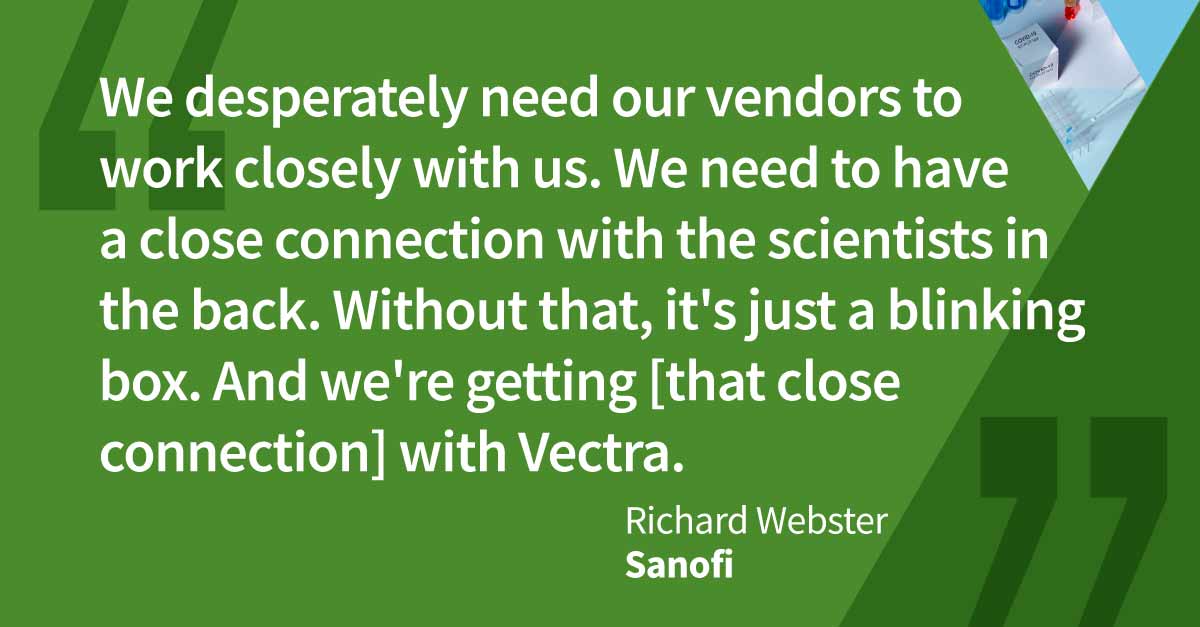
We need our vendors to work closely with us. And we are getting that close connection with Vectra.

While EDR is important is important for endpoints, NDR is critical to the network. Sanofi used Detect and Recall in tandem to detect threats and trace the attack progression. While Detect assisted in real time, Recall assisted the Sanofi team afterwards to conduct forensics. Richard noted, “In this particular attack, we could go into Recall and we could see line by line exactly what the share enumeration was. We could see the file opens, the file read, what the names of files were, we could see the bytes count.” Such complete visibility of the attack progression then educated and informed the team as they created detection frameworks to prevent similar tactics in the future.

Sanofi and Vectra: Better together

Jean-Yves, Richard, and I closed out by reinforcing the strength of the partnership between our organizations. This attack has demonstrated that when an attacker manages to steal credentials and bypass traditional endpoint solutions, NDR effectively bridges the gap.

Thwarting this attack also exemplifies the collaborative benefits derived from enthusiastic cooperation among our teams. Vectra offers the platform while Sanofi brings their unique use cases, which allows us to innovate together, solve problems, and exchange technical expertise.

As Sanofi continues to evolve its security operations and expand its cloud footprint, Jean-Yves and Richard shared that they’re looking forward to an ongoing partnership with us at Vectra. Jean-Yves commented, “Vectra brings their innovation and deep technical value. My team at Sanofi is bringing the solution feedback. And the combination is the path of progress and maturity.”

We wrapped up our conversation with an excellent Q&A session featuring questions submitted by the audience. Though we couldn’t respond to all the submissions live, we’ve answered all of them in them in this document, featuring Jean-Yves and Richard’s unedited comments.  

Get the full story on the methods used by cybercriminals to carry out the attack—leveraging LinkedIn, WhatsApp, and Microsoft Word—and how Sanofi used Detect and Recall from Vectra to stop the attack in its tracks.