











The upstream compromise of the axios npm package serves as a critical case study in supply chain weaponization. These incidents underscore that dependency poisoning has evolved from a theoretical outlier into a high-efficacy initial access vector, allowing sophisticated adversaries to achieve Remote Code Execution (RCE) within hardened enterprise environments
Technical forensics indicates that the compromised axios releases (v1.14.1 and v0.30.4) were trojanized to pull in the malicious plain-crypto-js@4.2.1 payload. This incident represents a critical departure from traditional software risk; it was not an exploit of a code-level vulnerability, but a targeted hijacking of the package publication pipeline.
Most security postures are built around identifying vulnerable functions via static analysis, yet few are equipped to handle a scenario where the package manager itself serves as the delivery vehicle for obfuscated malware. Once this malicious dependency achieves runtime execution, the scope of the incident shifts immediately. It is no longer a matter of dependency hygiene, but a post-exploitation detection challenge focused on understanding behavior after execution.
How the compromise begins
Forensic telemetry and behavioral analysis have successfully mapped the axios poisoning to a maintainer account takeover (ATO), allowing for the manual injection of a malicious transitive dependency bypassing traditional CI/CD guardrails. Current intelligence high-confidently attributes this campaign to BlueNoroff, a sophisticated threat cluster within the Lazarus Group (DPRK-nexus), known for aggressive financial and intellectual property exfiltration.
While attribution remains a dynamic field of study, the tactical priority for the security teams is clear: a trusted dependency became the Initial Access vector. This incident underscores the collapse of implicit trust in the open-source ecosystem. For organizations managing CI/CD infrastructure or cloud-hosted build environments, this marks a critical shift in the attack surface—standard developer workflows are no longer 'pre-authenticated' safe zones, but high-value targets for state-sponsored Remote Access Trojan (RAT) deployment
How the investigation needs to change
Legacy security models are largely built on CVE-centric risk assessments, prioritizing the identification of latent vulnerabilities within the codebase. However, these models fail to account for the weaponization of the distribution channel, where the package manager transitions from a trusted administrative utility to a primary malware delivery vector.
At the moment of runtime execution, the incident pivots from a dependency hygiene deficit to an active operational intrusion. If a developer workstation, build runner, or release pipeline has ingested a trojanized version of axios, the scope of the investigation must immediately expand beyond simple removal. An effective post-execution threat hunt must address:
- Anomalous Process Execution: Did the npm or node process spawn unexpected shell activity or binary execution (e.g., cmd.exe, /bin/sh)?
- C2 Beaconing: Is there telemetry indicating outbound egress to non-standard or suspicious external infrastructure?
- Persistence Establishment: Were there unauthorized modifications to system startup scripts, cron jobs, or registry keys?
- Secret Harvesting: Was there attempted access to environment variables; credentials, or local keychains?
- Lateral Movement: Is there evidence of internal reconnaissance or credential usage originating from the affected build runner?
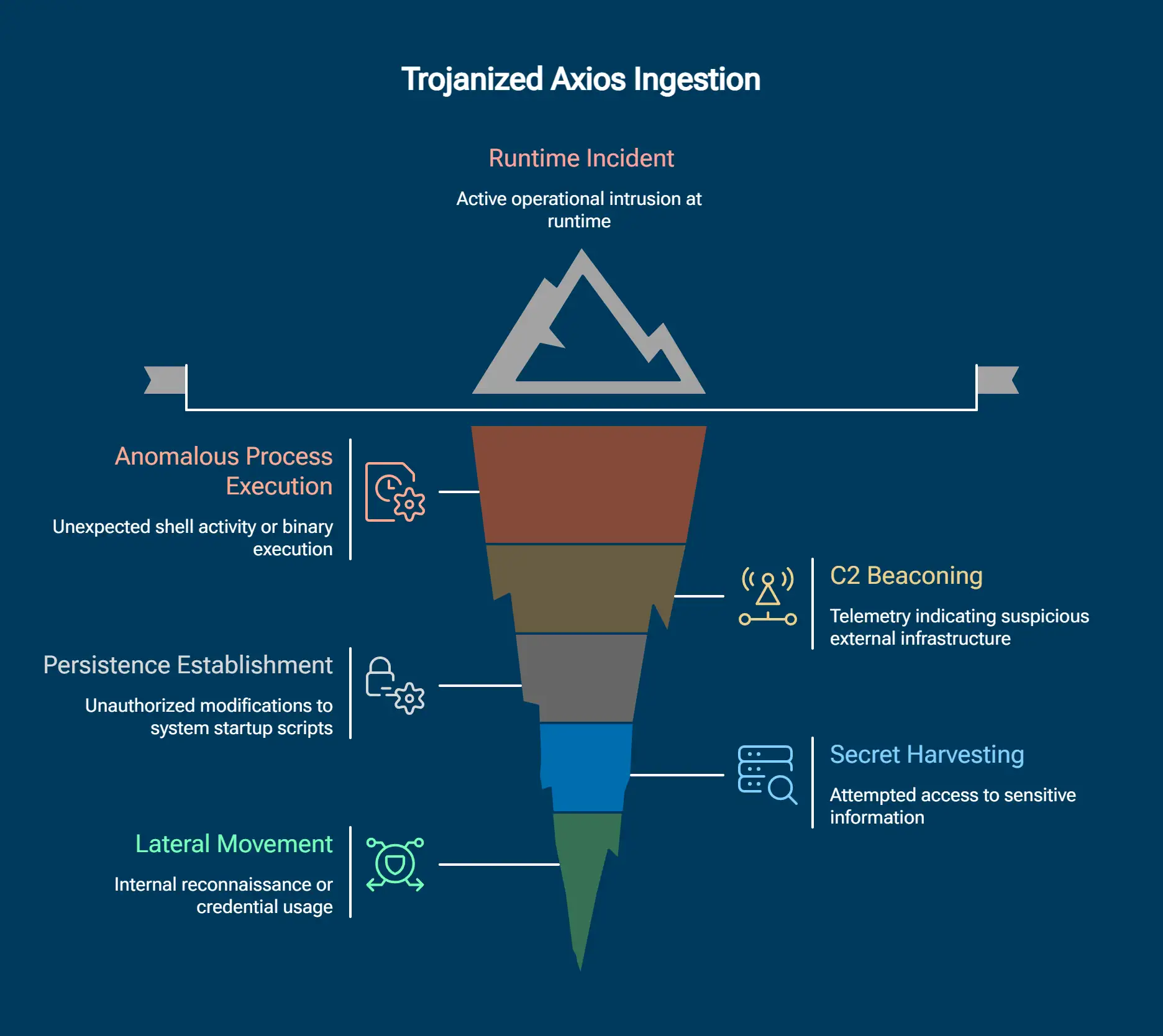
This is the critical failure point in modern detection: treating supply chain compromises as isolated 'package problems' rather than established beachheads. To deter sophisticated actors, defenders must operate under a Zero Trust architecture that handles every malicious dependency as a full-scale network breach.
If you are still not listening
Once execution is achieved, the attacker no longer depends on the package, but on the access available within the environment.
And if the BlueNoroff attribution holds, the initial exfiltration of CI/CD secrets, cloud access keys, and source code repositories is merely the precursor to a high-impact operational pivot.
The compromise of developer-level credentials effectively provides a logical bypass for the production air-gap, transforming a local workstation infection into a cloud control plane breach. In the hands of a state-sponsored actor, this exfiltration leads directly to:
- Operationalizing Stolen Secrets: The rapid weaponization of harvested Cloud API keys and Kubernetes secrets to establish persistent, high-privilege persistence within the infrastructure.
- Secondary Supply Chain Contamination: Utilizing stolen code-signing certificates or repository write-access to inject further malicious code into the organization’s own customer-facing products, expanding the blast radius to its entire user base.
- Credential-Based Lateral Expansion: Pivoting from the developer ecosystem into highly sensitive production databases or financial systems. Because the attacker is using legitimate, harvested credentials, they can bypass traditional signature-based security, making behaviorals the only viable method for identifying the intrusion.
What the axios compromise looks like on the network
In a supply chain attack like the axios compromise, host-level logs are often scrubbed or bypassed by "trusted" binaries. The Network Truth remains the only immutable record of the intruder’s tactical intent.
The following "on the wire" behaviors expose the attack as it transitions from a simple package install to a high-stakes intrusion:
- C2 Heartbeat & Protocol Anomalies: Detects the "low-and-slow" rhythm of Command & Control (C2) hidden in HTTPS.
- Malicious Staging (Outbound Egress): Flags the specific moment the installation process pulls a second-stage payload.
- Internal Reconnaissance (East-West Traffic): Captures the "noise" of the intruder mapping your environment on the wire long before the attacker attempts their first internal exploit.
- Privileged Access Anomalies: Identifies Identity-based attacks in transit. The wire surfaces anomalous requests or first-time authentication to production systems using harvested developer credentials.
- Data Smuggling & Tunneling: Monitors for Exfiltration as it happens. It flags data "chunking" within encrypted tunnels or anomalous DNS queries used to smuggle environment secrets and cloud keys out of the network.
This is no longer a perimeter problem
The axios incident is more than a supply chain failure; it is a wake-up call regarding the collapse of the traditional perimeter. For too long, developer infrastructure has existed as a "security blind spot"—isolated from core detection strategies while offering the path of least resistance to sophisticated actors like BlueNoroff.
To stay ahead of state-sponsored clusters, defenders must abandon the "norm" of production-only focus and adopt a mindset that accounts for the entire software lifecycle as a unified attack surface.
The question is no longer "Did a malicious package enter our environment?" The question is: "Does our visibility extend deep enough into our developer ecosystem to catch the intruder before they pivot to our production crown jewels?" Shifting this mindset transforms a systemic vulnerability into a managed defensive advantage, ensuring that no part of the infrastructure sits outside the protective umbrella of network detection and response
If your team is rethinking how to detect attacker behavior beyond package scanning and preventive controls, this is exactly where Vectra AI can help surface suspicious post-compromise activity across cloud, identity, and networked environments.