











The illusion of coverage
Every security leader who’s built their business leveraging the Microsoft ecosystem has asked the same question: Are we covered?
MFA is enabled. Conditional Access is enforced. EDR is deployed.
Yet attackers still slip through - not by exploiting vulnerabilities, but by abusing trust.
Groups like Midnight Blizzard, Scattered Spider, Mango Sandstorm, and Peach Sandstorm keep proving this:
- Scattered Spider - Cost the UK Co-operative Group $107M after a credential-theft–driven hybrid attack on its retail and services operations.
- Midnight Blizzard (APT29) - Continues to breach government and public-sector organizations, using large-scale credential-based intrusions and access-token theft.
- Mango Sandstorm (MERCURY) - Executed destructive attacks across on-prem and cloud assets in hybrid Microsoft environments.
According to IBM, the average cost of remediating a public cloud breach is $4.7M.
Attackers don’t break in; they log in. They hijack legitimate human and machine identities, and operate within the bounds of policies designed to protect the enterprise. Once in, they move laterally across on-prem Data Center, Active Directory, Entra ID, M365, and Azure cloud, living off the land and blending in with legitimate activity.
The problem isn’t prevention - it’s detection when prevention fails. Microsoft tools excel at blocking known threats and enforcing posture, but they provide limited visibility into post-compromise behaviors: privilege abuse, lateral movement, living-off-the-land techniques and data exfiltration that unfold quietly across interconnected domains.
Modern attackers exploit the seams between these systems - the blind spots where telemetry stops and context is lost. That’s where real damage happens, and where post-compromise detection, investigation and response is critical.
Where native tools fall short
Microsoft’s security stack monitors configuration, identity, and endpoints - but often misses the movement of threat actors as they pivot between disjointed surfaces of the ecosystem. Even within Entra ID, M365, and Azure, native detections often miss subtle but common attacker activity.
Another challenge SOC teams face is correlating signals across Microsoft surfaces, especially when alerts originate from disparate tools with inconsistent telemetry formats. Each surface speaks a different language, leaving defenders to translate and stitch context in real time. Valuable hours are lost chasing low-priority alerts that, when viewed together, reveal a coordinated attacker moving across surfaces. Events that appear benign in isolation often become critical when correlated and contextualized - and that clarity is exactly what’s missing.
To understand why this signal clarity matters, let’s look at three real-world attacks in environments that leverage the Vectra AI platform alongside Microsoft’s native security suite.
Cloud ransomware attack (Fortune 500 financial services)
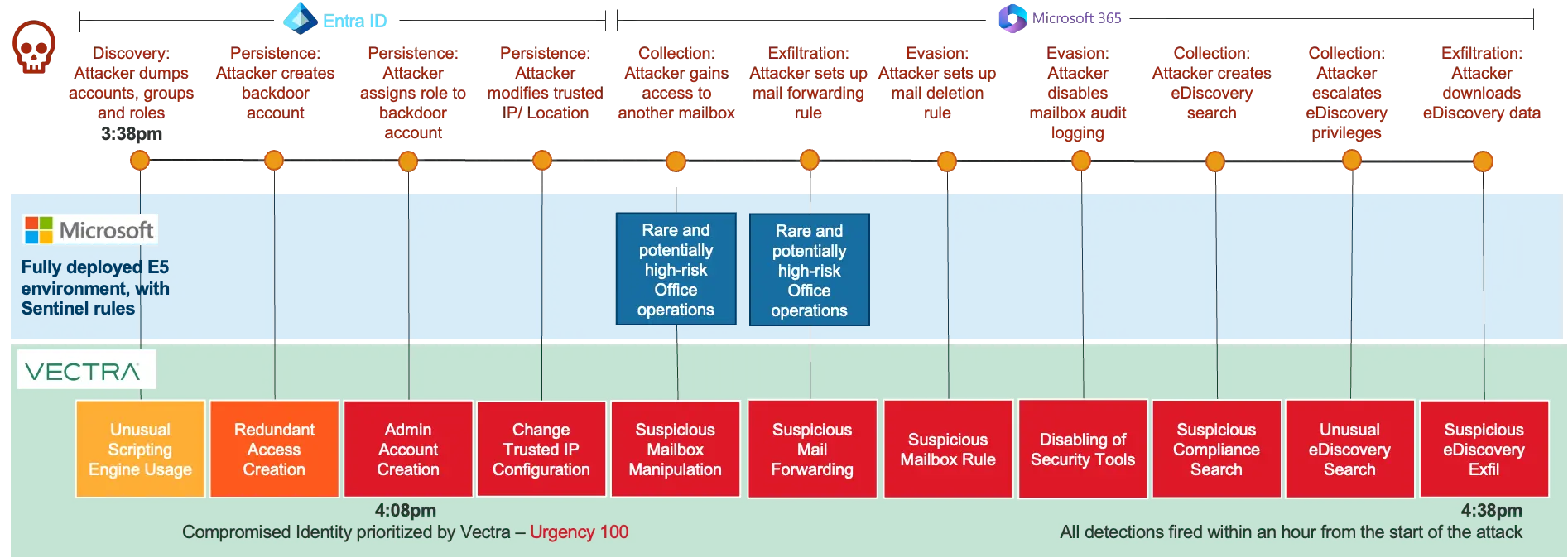
During a Scattered Spider attack in which lateral movement played out across Entra ID and M365, Microsoft Defender raised 1 low priority finding. Vectra AI detected 11 attacker behaviors, correlating and prioritizing signals across domains into one single urgent entity and stopping the attacker before damage.
Hybrid cloud attack (large insurance group)
The attacker started on-prem, stole credentials, and stealthily moved to Entra ID with follow on behaviours across the M365 suite and AWS cloud. Microsoft raised two low-priority alerts, one day after the initial attack. On the first day within 30 minutes, Vectra AI identified nine techniques across five domains, connecting suspicious behaviors across the on-prem data center, Active Directory, Entra ID, Microsoft 365 and AWS cloud - a complete hybrid kill chain surfaced 24 hours before Microsoft’s first detection.

Multi-cloud attack (global fintech)
An attacker used stolen credentials to access Azure, pivoted to Entra ID, and deployed a malicious Azure policy to disable logging and prepare for data exfiltration. Native Microsoft tools flagged a single “suspicious sign-on”. Vectra AI correlated six related techniques across Azure cloud and Entra ID in under 90 minutes, exposing the full story behind the breach.

These examples indicate that while native tools show symptoms, they often miss the full picture. The lesson is clear: when prevention fails, a layered, defense-in-depth strategy is critical to keep an incident from becoming a breach.
How Vectra AI closes these gaps
Vectra AI’s Hybrid NDR Platform reinforces and extends the value of Microsoft’s native defenses by unifying detections across on -prem data centers, IoT & OT, remote locations, identity, multi-cloud, and M365. Its patented Attack Signal Intelligence looks for attacker behavior to deliver:
- Coverage - 100+ behavior-based AI detections for Microsoft across Active Directory, Entra ID, M365, Copilot for M365, and Azure Cloud. It spots behaviors like policy hijacking, managed identity abuse, and suspicious automation account use that posture tools can’t.
- Clarity - AI triage and prioritization cut alert noise by up to 99% and boost SOC efficiency by 40%. Correlated, identity-centric signals automatically stitch and contextualize both human and non-human entities for investigation. Analysts can move from alert to root cause in minutes, and with guided attack graphs and AI-assisted hunting, defenders can proactively expose patterns and emerging threats faster.
- Control - Native integrations with Microsoft Sentinel and Defender for Endpoint enable playbook automation, initiate account lockdown, and device isolation for rapid containment and mitigation across Microsoft environments.
Vectra AI supercharges investments in Microsoft’s native tools – enabling a true defense-in-depth approach.
Proof in numbers
Independent research from IDC quantifies this layered approach. Organizations that use Vectra AI Platform achieves:
- 52% more threats identified in 37% less time
- 40% more efficient SOC teams
- 50% less time spent on investigations
When integrated with Microsoft Sentinel and Defender, Vectra AI shortens the path from detection to decision - turning hybrid complexity into actionable certainty.
Customer validation: clarity that changes outcomes
The difference between knowing and seeing is clarity. Three customers show what that looks like in action:
Van Gogh Museum
“With Microsoft, everything is just an ID – correlation IDs, user IDs, endless strings of
characters. I’d spend 25 minutes jumping between portals trying to make sense of it, only to discover it was nothing. I’m human. I need names and context. Vectra AI speaks my language. It tells me exactly what’s happening, whether it’s a user trying to access sensitive files or a server behaving suspiciously. That kind of clarity, all in one place, is priceless when every minute counts.”
- Rob de Zwaan, CISO, Van Gogh Museum
Protecting priceless digital and cultural assets, the museum achieved an 84% true positive rate and early detection across network, identity, and Azure environments. With unified visibility and explainable detections, the team now responds in minutes instead of hours.
Fortune 500 Financial Services Firm
“Microsoft is a critical piece of our IT ecosystem, but when it comes to security, we need to be better than basics. With Vectra AI, we get the integrated, aggregated threat signal we need to effectively defend our Microsoft environment, it also centralizes the analysis and correlation of those signals, saving us time and effort.”
- CISO, Fortune 500 Financial Services
Operating across Azure and on-prem environments, this global investment company stopped two identity-based attacks that Microsoft E5 missed, including a phishing-as-a-service AiTM campaign. During a separate adversary emulation test, Vectra AI detected all nine simulated attack techniques that E5 failed to identify, thanks to unified visibility and low-noise detection across M365, Entra ID, and Azure.
Advens
“Having a joint view of M365 and on-prem environments is really helpful. That ability to pivot is essential. It lets us investigate faster and with more accuracy. Many clients still don’t believe multi-domain attacks are real until we show them. We run purple team exercises, like golden HTML attacks, and Vectra AI consistently detects them - while Microsoft tools miss the cross-domain movement.”
- Sébastien Wojcicki, Head of Operations & Security Excellence at Advens.
As a leading MSSP supporting nearly 200 hybrid clients, Advens used Vectra AI to replace fragmented, noisy alerts with unified visibility across network, identity, and cloud -accelerating investigations by up to 100x.
With that clarity, Advens exposes the attacker behaviors hidden between Microsoft environments, turning investigations that once took hours into minutes.
In these stories, the breakthrough wasn’t more alerts - it was clarity. Seeing everything meant nothing until it could be understood instantly.
Securing the spaces in between
Modern attacks don’t live in one domain - neither should your defenses. As enterprises adopt AI-driven tools, hybrid workloads, and distributed identities, attackers increasingly exploit the invisible connections between them.
Vectra AI Platform gives defenders the same visibility advantage attackers use - unifying network, identity, SaaS, and cloud signals into one intelligent platform. Because securing your Microsoft environment isn’t just about protecting each surface. It’s about protecting the spaces between.
Ready to close the gaps in your Microsoft defenses? See Vectra AI Platform in action: https://youtu.be/ytWOynLTAco
Or