


Socket proactively blocks malicious open source packages in your code. Install
Secure your dependencies with us
After months of targeting security tools, CI/CD workflows, and open source packages, TeamPCP is now promoting Shai-Hulud as required tooling for a competition that rewards the biggest compromise with a tiny crypto payout.
According to Dark Web Informer, the competition was announced on BreachForums by an account identified as the forum’s owner, in collaboration with TeamPCP. Participants are being offered $1,000 USD in Monero to compromise open source packages with Shai-Hulud, along with the usual cybercrime forum currency of reputation and bragging rights.
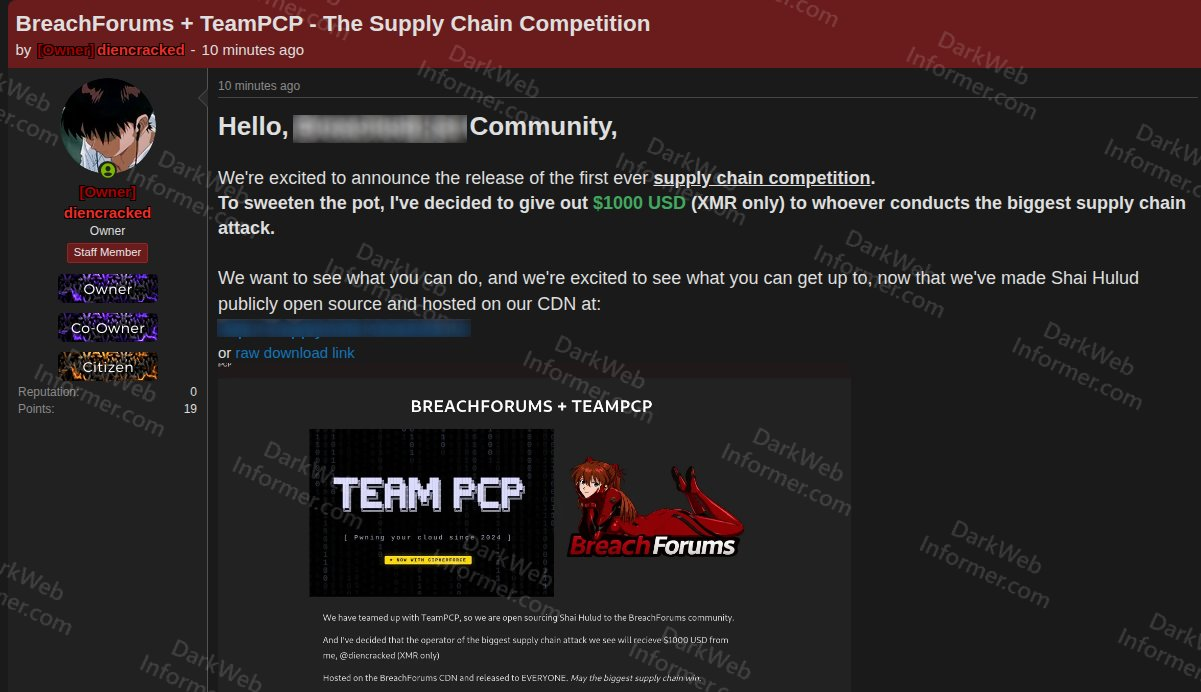
Source: Dark Web Informer
The post says participants must use Shai-Hulud in their attacks, submit their forum handle or Breached profile, and provide “reasonable proof” of access.
The winner will be determined by weekly and monthly download counts for the compromised packages. Smaller package compromises can also be combined toward the total, turning package reach into the scoreboard.
Under that scoring system, a high-download package is the obvious prize. But a pile of smaller compromises can also count, giving participants a reason to go broad across the ecosystem instead of only chasing a single marquee target. The rule rewards a worm that devours indiscriminately.
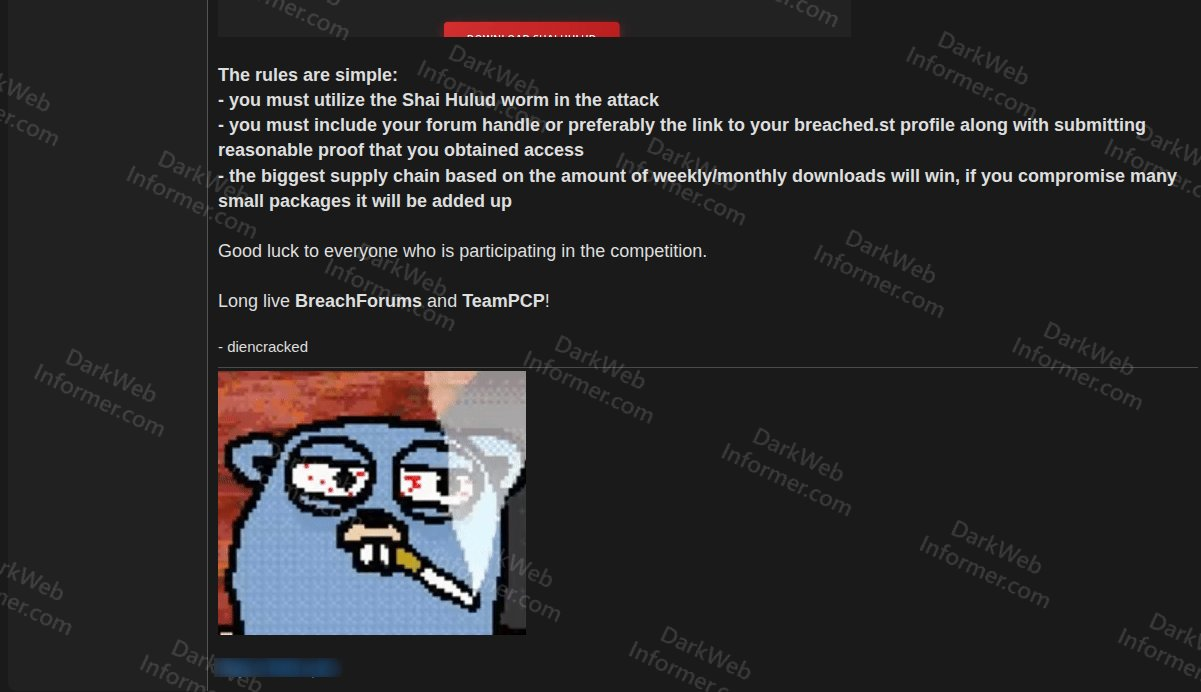
Source: Dark Web Informer
The prize, however, is almost comically small for the kind of access TeamPCP is asking participants to burn. A successful supply chain compromise can expose CI/CD secrets, cloud credentials, maintainer tokens, source code access, and downstream enterprise environments. That access is worth far more than $1,000 to actors who know how to monetize it.
The contest essentially functions as a public recruitment stunt, turning supply chain compromise into a leaderboard for lower-tier actors willing to trade risk for recognition.
TeamPCP, never ones to miss a punchline, also released Shai-Hulud as open source attack tooling, hosted on the Breached CDN. A GitHub-hosted copy circulated before being taken down, according to users tracking the repository on X.
TeamPCP has been systematically targeting security tools and critical open source infrastructure. In forum posts, the group has called out security vendors directly: “These companies were built to protect your supply chains yet they can't even protect their own, the state of modern security research is a joke, as a result we're gonna be around for a long time stealing terrabytes of trade secrets with our new partners.”
Socket has been tracking TeamPCP’s activity across security tools, CI/CD workflows, GitHub Actions, Docker images, OpenVSX extensions, npm, PyPI, and Packagist. The group frequently targets tools that already run inside developer and enterprise environments, then uses that access to harvest credentials for follow-on attacks.
It is possible that a $1,000 prize will not motivate skilled operators to burn high-value access. The amount is negligible compared to the value of credentials stolen from CI/CD pipelines, cloud environments, maintainer accounts, and enterprise developer tooling.
TeamPCP has become one of the more successful access-broker operations in recent supply chain activity because it focuses on compromising tools that already have privileged access built in. That is why these incidents keep producing downstream victims.
Vect announced its TeamPCP partnership on BreachForums less than seven weeks ago, though in supply chain attack time it already feels like 84 years. Since then, ransomware and extortion claims tied to the broader TeamPCP credential-theft fallout have touched AI training data, AI model development, property management technology, manufacturing, sports data infrastructure, and government cloud platforms, with other alleged claims spanning pharmaceuticals, financial data services, and major enterprise tech. Reporting has also pointed to overlapping claims from Vect, ShinyHunters, and Lapsus$, making attribution messy even when the credential-theft pipeline traces back to the same supply chain activity.
The contest extends that pipeline outward. TeamPCP has already been positioning supply chain compromise as a way to harvest credentials, expose enterprise environments, and hand access to groups that know how to monetize it. Now it is giving forum users an open source worm, a scoring system, and a reason to rack up compromises.
A $1,000 prize may not bring in serious operators. It can still bring in reckless ones. For maintainers and security teams already tired of the constant stream of open source supply chain attacks, the contest adds another weight they did not need: a public incentive for copycat attempts against package ecosystems.
此内容由惯性聚合(RSS阅读器)自动聚合整理,仅供阅读参考。 原文来自 — 版权归原作者所有。