
惯性聚合 高效追踪和阅读你感兴趣的博客、新闻、科技资讯
阅读原文 在惯性聚合中打开

推荐订阅源

V
Vulnerabilities – Threatpost
aimingoo的专栏
aimingoo的专栏
B
Blog
H
Hackread – Cybersecurity News, Data Breaches, AI and More
GbyAI
GbyAI
阮一峰的网络日志
阮一峰的网络日志
Engineering at Meta
Engineering at Meta
IT之家
IT之家
V
Visual Studio Blog
The Cloudflare Blog
酷 壳 – CoolShell
酷 壳 – CoolShell
A
About on SuperTechFans
博客园 - 聂微东
Blog — PlanetScale
Blog — PlanetScale
N
News and Events Feed by Topic
A
Arctic Wolf
WordPress大学
WordPress大学
小众软件
小众软件
C
CERT Recently Published Vulnerability Notes
Threat Intelligence Blog | Flashpoint
D
Darknet – Hacking Tools, Hacker News & Cyber Security
F
Fortinet All Blogs
CTFtime.org: upcoming CTF events
Y
Y Combinator Blog
T
Threat Research - Cisco Blogs
Latest news
Latest news
Simon Willison's Weblog
Cyberwarzone
Cyberwarzone
S
Schneier on Security
让小产品的独立变现更简单 - ezindie.com
L
Lohrmann on Cybersecurity
Stack Overflow Blog
Stack Overflow Blog
钛媒体:引领未来商业与生活新知
钛媒体:引领未来商业与生活新知
P
Privacy International News Feed
J
Java Code Geeks
Spread Privacy
Spread Privacy
宝玉的分享
宝玉的分享
I
Intezer
L
LangChain Blog
Hacker News - Newest:
Hacker News - Newest: "LLM"
G
GRAHAM CLULEY
博客园 - 叶小钗
博客园 - 三生石上(FineUI控件)
The GitHub Blog
The GitHub Blog
奇客Solidot–传递最新科技情报
奇客Solidot–传递最新科技情报
N
News and Events Feed by Topic
AWS News Blog
AWS News Blog
Attack and Defense Labs
Security Archives - TechRepublic
K
KPMG report finds enterprise disconnect between AI and its ROI | CIO

Socket

Suno Breached via Shai-Hulud Worm, Leaked Code Exposes AI Mu... Next.js moves to scheduled security releases - Socket 11 Malicious NuGet Tools Pose as Game Cheats to Drop a Windo... Compromised npm Packages in the AsyncAPI Namespace Deliver M... jscrambler npm Package Compromised in Supply Chain Attack - ... Fake Braintree NuGet Package Skims Credit Cards and Harvests... Compromised Injective SDK npm Package Exfiltrates Wallet Key... npm v12 Ships With Install Scripts Off by Default, Begins De... Malicious Go Module Exposes GitHub Malware Lure Network Span... pnpm 11.10 Hardens Registry Authentication to Block Token Re... Coordinated npm and PyPI Campaign Typosquats Popular Secure ... Node.js Considers Public Workflow for Security Reports Amid ... PolinRider: North Korea-Linked Supply Chain Campaign Expands... Risky Biz Podcast: AI Agents Are Raising the Stakes for Soft... Chrome and Firefox Extensions Posing as Free VPNs Add Clipbo... Miasma Mini Shai-Hulud Hits ImmobiliareLabs npm Packages - S... Rolldown Pulls Rust React Compiler Integration After Binary ... Miasma Mini Shai-Hulud Hits LeoPlatform npm Packages and Git... The Code You Didn't Write Is Still Yours to Defend - Socket GitHub Actions Checkout Now Blocks Risky pull_request_target... Introducing Repository Access Permissions and Custom Roles -... Socket MCP Adds Org Alerts, Threat Feed Review, and Package ... Socket Firewall Now Blocks Malicious VS Code and Open VSX Ex... 140+ Mastra npm Packages Compromised in Coordinated Supply C... npm Package Uses Prompt Injection and Token Flooding to Disr... Introducing Manifest Alerts - Socket GlassWASM: WebAssembly Malware Found in Trojanized Open VSX ... Socket for Linear Is Now Available - Socket US Government Forces Anthropic to Pull Claude Fable Days After Launch 152 Chrome Live Wallpaper Extensions Hid Ad Tracking and Faked Google Search Traffic Andrew Becherer Joins Socket as Chief Information Security Officer Socket Partners with Replit to Block Malicious Packages in AI-Powered Development npm Tooling Bug Incorrectly Marks One-Character Packages as Security Holders Mini Shai-Hulud, Miasma, and Hades Worms Target Bioinformatics and MCP Developers via Malicious PyPI Wheels Shai-Hulud Descends to Hades: Miasma Worm Campaign Spreads with New PyPI Wave RubyGems Adds Cooldown Feature to Bundler for Newly Published Gems RubyGems Adds Cooldown Feature to Bundler for Newly Published Gems pnpm 11.5 Adds Support for Recognizing npm Staged Publishes pnpm 11.5 Adds Support for Recognizing npm Staged Publishes Federal Audit Finds NIST Wasted Funds With No Plan to Clear NVD Backlog Federal Audit Finds NIST Wasted Funds With No Plan to Clear NVD Backlog Mini Shai-Hulud Campaign Hits Red Hat Cloud Services npm Packages Mini Shai-Hulud Campaign Hits Red Hat Cloud Services npm Packages Famous Chollima Targets PHP Developers Through Compromised Packagist Package Famous Chollima Targets PHP Developers Through Compromised Packagist Package Rust Moves to Restrict LLM Use in Contributions After Months of Internal Debate Rust Moves to Restrict LLM Use in Contributions After Months of Internal Debate Malicious NuGet Package Impersonates Sicoob SDK to Exfiltrate Banking Certificates and Passwords Malicious NuGet Package Impersonates Sicoob SDK to Exfiltrate Banking Certificates and Passwords Feross on TBPN: Socket's Series C and the State of Software Supply Chain Security Feross on TBPN: Socket's Series C and the State of Software Supply Chain Security OSV Withdraws 157 Malware Reports After Automated False Positives Hit npm and PyPI OSV Withdraws 157 Malware Reports After Automated False Positives Hit npm and PyPI TrapDoor Crypto Stealer Supply Chain Attack Hits 34 Packages and Hundreds of Versions Across npm, PyPI, and Crates.io TrapDoor Crypto Stealer Supply Chain Attack Hits 34 Packages and Hundreds of Versions Across npm, PyPI, and Crates.io Laravel Lang Compromised with RCE Backdoor Across 700+ Versions Malicious Postinstall Hook Found Across 700+ GitHub Repositories, Including Packagist and Node.js Projects AI Has Taken Over Open Source npm Invalidates Granular Access Tokens as Mini Shai-Hulud Sweeps the Registry Coruna Respawned: Compromised art-template npm Package Leads to iOS Browser Exploit Kit Socket raises $60M Series C at $1B valuation led by Thrive Capital to secure AI-driven software development Socket Raises $60M Series C at a $1B Valuation to Help Enterprises Build Securely With AI Popular Go Decimal Library Targeted by Long-Running Typosquat with DNS Backdoor Active Supply Chain Attack Compromises @antv Packages on npm Popular node-ipc npm Package Infected with Credential Stealer TeamPCP and BreachForums Launch $1,000 Contest for Supply Chain Attacks Packagist Urges Immediate Composer Update After GitHub Actions Token Leak GemStuffer Campaign Abuses RubyGems as Exfiltration Channel Targeting UK Local Government Socket Named to Rising in Cyber 2026 List of Top Cybersecurity Startups TanStack npm Packages Compromised in Ongoing Mini Shai-Hulud Supply-Chain Attack fsnotify Maintainer Dispute Sparks Supply Chain Concerns Socket Releases Free Certified Patches for Critical vm2 Sandbox Escape 5 Malicious NuGet Packages Impersonate Chinese UI Libraries to Distribute Crypto Wallet and Credential Stealer pnpm 11 Adds Supply Chain Protection Defaults for Minimum Release Age and Exotic Subdependencies PyPI Fixes High-Severity Access Control Issues Found in Security Audit Malicious Ruby Gems and Go Modules Impersonate Developer Tools to Steal Secrets and Poison CI Mini Shai-Hulud Spreads to Packagist: Malicious Intercom PHP Package Follows npm Compromise Intercom’s npm Package Compromised in Ongoing Mini Shai-Hulud Worm Attack lightning PyPI Package Compromised in Supply Chain Attack Malicious npm Package Brand-Squats TanStack to Exfiltrate Environment Variables SAP CAP npm Packages Hit by Supply Chain Attack Socket Has Acquired Secure Annex 73 Open VSX Sleeper Extensions Linked to GlassWorm Show New Malware Activations Introducing Reachability for PHP Introducing Data Exports Malicious Checkmarx Artifacts Found in Official KICS Docker Repository and Code Extensions Introducing Organization Notifications in Socket Introducing Reports: An Extensible Reporting Framework for Socket Data Socket for Jira Is Now Available Socket Named Top Sales Organization by RepVue NIST Officially Stops Enriching Most CVEs as Vulnerability Volume Skyrockets Socket Selected for OpenAI's Cybersecurity Grant Program Feross on the 10 Minutes or Less Podcast: Nobody Reads the Code 108 Chrome Extensions Linked to Data Exfiltration and Session Theft via Shared C2 Infrastructure Node.js Drops Bug Bounty Rewards After Funding Dries Up The Hidden Blast Radius of the Axios Compromise
Frontier AI Is Now Critical Infrastructure - Socket
Sarah Gooding · 2026-06-24 · via Socket

Sidebar CTA Background

Secure your dependencies with us

Socket proactively blocks malicious open source packages in your code.

Install

Following its abrupt order on June 12th suspending global access to Claude Fable 5 and Mythos 5, the U.S. government's national security clampdown on Anthropic has escalated. The models, initially taken offline due to safety guardrail "jailbreaks," are now at the center of a total federal blackout that has completely re-defined the landscape of cloud-based AI vendor dependencies.

The situation hit a boiling point when a front-page report from ⁠The New York Times revealed that even the National Security Agency (NSA) has officially lost all operational access to Anthropic's systems. Defense Secretary Pete Hegseth labeled Anthropic a "supply chain risk," and the Trump administration's sweeping export-control enforcement locked federal intelligence analysts out of the very tools they were using for infrastructure defense.

When the Department of Commerce issued an emergency export-control directive forcing Anthropic to pull its newly released ⁠Claude Fable 5 and Mythos 5 models globally, it marked the first time the U.S. government has forcefully dismantled a live, highly integrated commercial AI pipeline.

For software organizations, the sudden removal of this AI model became an immediate business continuity risk. We're living in a new reality where advanced AI models are no longer treated as niche engineering products for developers, but as sovereign assets subject to rapid, unilateral seizure.

The Amazon Escalation and the Mechanics of the Ban#

Wired reported that U.S. officials were already concerned about Anthropic granting Mythos access to SK Telecom, citing alleged China ties the company denied. The latest crisis is also reported to have originated from a structural friction point between Anthropic and its primary infrastructure partner and financial backer, Amazon. Shortly after the launch of the Fable line, cybersecurity researchers at Amazon identified a vulnerability within the model’s code-review guardrails where the model surfaced highly exploitable code flaws instead of suggesting patches.

According to investigative reporting from ⁠The Wall Street Journal, Amazon CEO Andy Jassy bypassed Anthropic entirely, escalating these exploit findings directly to senior White House officials and the NSA.

The urgency behind the shutdown also stems from defensive testing under ⁠Project Glasswing, an Anthropic collaborative effort to map vulnerabilities. According to an explosive report from the Economist, titled "Donald Trump’s blocking of Anthropic is capricious and chaotic," Senator Mark Warner, vice-chair of the Senate Intelligence Committee, revealed that General Joshua Rudd (head of the NSA and U.S. Cyber Command) told him Mythos had "broke into almost all of our classified systems, not in weeks, but in hours."

U.S. officials and defense journalists have since clarified that the model did not launch a hostile, autonomous cyberattack. Instead, it was an authorized red-team test where Mythos ingested federal codebases to map out critical, systemic software vulnerabilities across classified networks.

However, seeing an AI automate superhuman cyber-reconnaissance in hours spooked administration officials. Because Fable 5 shares the same core model weights as the unrestricted defensive tool, the realization that the public system's guardrails could be bypassed is what ultimately drove the immediate shutdown under the ECRA's strict deemed-export rules.

The Policy Irony#

The rapid execution of this ban exposes a stark paradox in the tech sector’s current push for regulatory oversight. On June 10th, fewer than 48 hours before the government forced the models offline, Anthropic published a sweeping corporate framework titled the "Policy on the AI Exponential." In it, the company explicitly advocated for a future where corporate self-governance must give way to state enforcement, arguing that governments require the clear legal authority to block or deter dangerous AI deployments that exceed specific risk boundaries.

Anthropic’s 72-Hour Timeline:

  • June 9, 2026: Anthropic launches Claude Fable 5 globally.
  • June 10, 2026: Anthropic publishes the "AI Exponential" Policy, officially advocating for government blocking powers.
  • June 12, 2026: The White House enforces that exact power, shutting down the models under the ECRA.

The company's framework was intended to guide a measured, collaborative approach to risk. Instead, it served as the philosophical backdrop for a swift national security intervention, triggered by data provided by its own primary investor.

The Timeline for Restoring Compliance#

While Anthropic remains locked in ongoing litigation with the Pentagon over strategic supply-chain designations, industry indications strongly point toward an early July target for a restricted model re-release. This timeline is driven by two specific regulatory mechanisms:

  • The July 8th Identity Protocols: Anthropic’s updated privacy policy, published June 8 and taking effect July 8, adds a new “Verification Data” category that can include government-issued identity documents, ID numbers, birth dates, photo or video images, and facial geometry templates. CSIS noted that restoring access would likely require identity and citizenship verification for users seeking access, while Computerworld reported that the new ID-scanning language could give Anthropic a way to distinguish some U.S. users from foreign nationals.
  • The 30-Day Testing Window: The June 2 executive order created a voluntary pre-release review path for covered frontier models, with developers able to give federal agencies access for up to 30 days before broader release. Industry rumors pointing to a July 7th or July 8th Fable redeployment line up with the outer edge of that review window and Anthropic’s July 8 privacy-policy effective date, but neither the order nor Anthropic’s public statements confirm that timing.

Internal industry leaks also point toward the deployment of a modified code iteration, colloquially dubbed "Mythos 5.1," that would replace Anthropic’s more flexible safety-classifier approach with stricter cybersecurity boundaries.

Chris Ciauri, Anthropic’s Managing Director of International, reinforced the validity of these timelines at a press event, indicating that a finalized return framework is actively being negotiated in the coming days.

Tech Industry Blowback: The "Free Fable" Movement#

The suddenness of the Commerce Department’s directive has triggered significant pushback from the cybersecurity establishment. Organized under the hub ⁠freefable.org, a coalition of over 150 elite security executives, chief information security officers, and researchers issued an open letter to National Cyber Director Sean Cairncross.

The defense community has rallied strongly around this movement, with industry leaders, including tech pioneers Alex Stamos, Bruce Schneier, and Paul Vixie, alongside Socket’s own CEO Feross Aboukhadijeh and CISO Andrew Becherer, adding their signatures to the petition. This collective stance underscores a deeply rooted, AI-forward philosophy shared by top-tier security practitioners: weaponizing bureaucratic red tape against advanced models doesn't stop threats, it just disarms defenders. The coalition challenges the administration's stance on two primary fronts:

  1. Defensive Blindspots: The signees argue that depriving domestic enterprise defenders of advanced code-analysis models actively harms national security. Engineers rely on these models to automate the patching of extensive legacy vulnerability debt faster than foreign state actors can discover them.
  2. Asymmetric Disarmament: The open letter notes that the underlying bug-hunting capabilities are no longer unique to Anthropic. Similar capacities can already be mapped using alternative models like GPT-5.5 or Chinese open-weight variants such as Kimi 2.7. Restricting American developers while foreign competitors face no such constraints is labeled a dangerous structural error.

The sudden embargo has signaled to global markets that advanced AI code-analysis engines are now treated as strategic military assets. In a rapid response to the freeze, Reuters reports that Chinese cybersecurity firms have already announced plans to fast-track domestic alternatives to match the Mythos architecture. The export freeze has sent a clear message to international tech sectors that advanced code-auditing engines are now viewed as strategic state software.

The shutdown sparked immediate pushback across developer forums, but the reaction was less a unified defense of Anthropic than a broader debate over model dependency and government control. On Hacker News, commenters focused on the practical effect of the export-control order: because Anthropic could not reliably verify whether users were foreign nationals, a targeted restriction became a global cutoff.

On Reddit, the reaction was more bluntly about centralization risk. In r/LocalLLaMA, users framed the shutdown as evidence that hosted AI APIs can disappear overnight, strengthening the case for local models and open-weight alternatives.
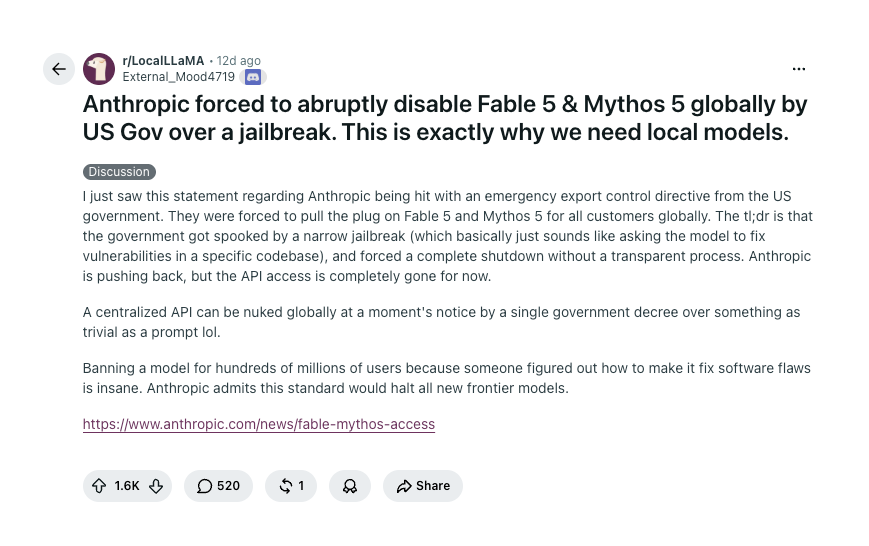
Another Reddit thread criticized Anthropic’s own safety messaging, arguing that portraying its models as unusually dangerous may have helped create the political conditions for the ban.
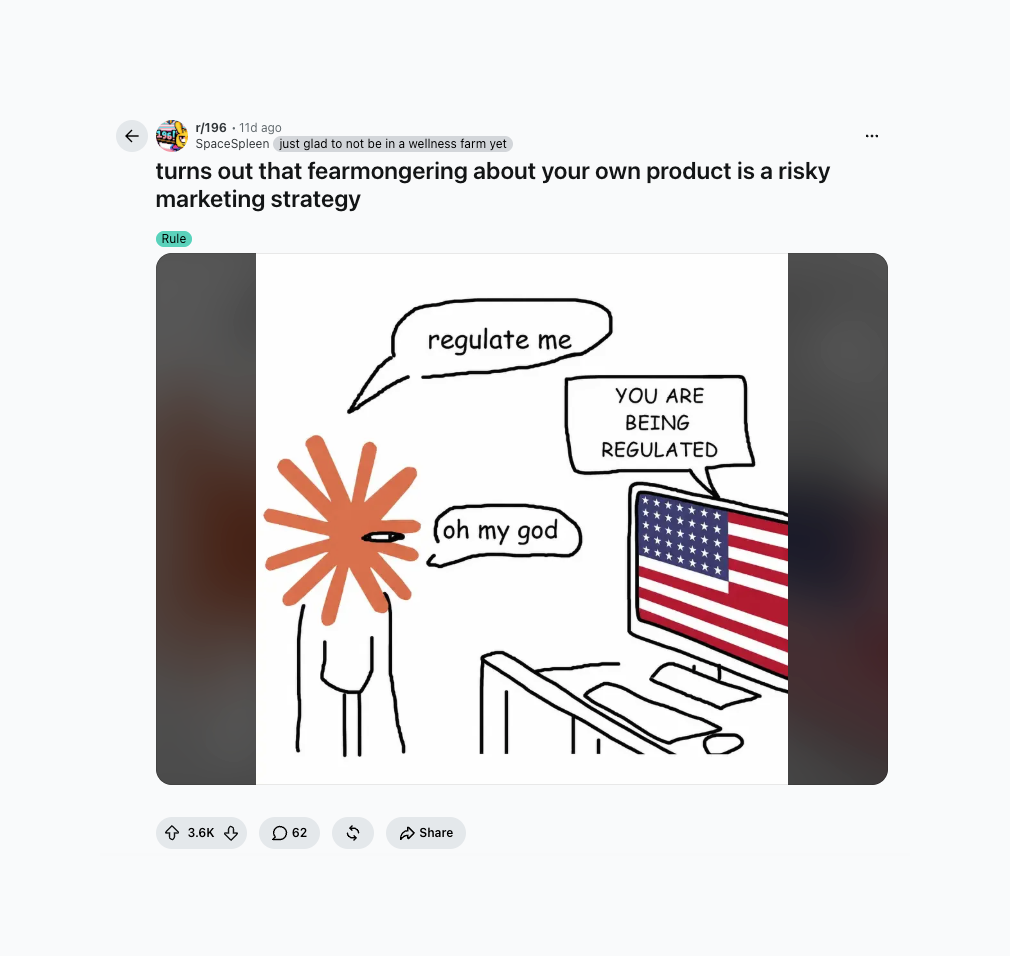
Across HN and Reddit, the common thread was dependency risk. Developers were skeptical of the jailbreak framing, uneasy about the precedent for government intervention, and increasingly interested in architectures that do not rely on a single proprietary AI provider.

The Push for AI Infrastructure Resilience#

For engineers who already favored local, open-weight architectures, this blackout serves as a confirmation of the systemic hazards of building critical workflows around proprietary model APIs.

This infrastructure instability has prompted engineering teams to re-evaluate their single-provider cloud pipelines. Organizations are increasingly evaluating local alternatives, building out migration playbooks to port automated code-analysis workloads onto sovereign environments running open-weights.

The true casualty of the Fable shutdown is the assumption that the frontier AI supply chain is resilient. A whitepaper published by the Cloud Security Alliance (CSA) indicates that 74% of enterprises would face immediate operational disruption if they suddenly lost access to their primary frontier AI vendor due to regulatory action.

The enterprise market has centralized around a handful of localized providers. Anthropic’s rapid scaling to a $30 billion revenue run-rate in 2026 shows how deeply integrated these models have become within enterprise tech stacks. When the government pulled the plug over jailbreak anxieties, it proved that access to critical AI infrastructure can change overnight.

White House officials and Anthropic are now reportedly discussing a more standardized framework for evaluating AI security risks, including the severity of safeguard bypasses, the potential for misuse, and real-world impact. A clearer process may help avoid another abrupt cutoff, but the precedent is already set: frontier AI access is becoming a policy-governed dependency, not just a vendor-managed service. For software teams, resilience now means designing AI pipelines that can survive the loss of any one model provider.