

惯性聚合 高效追踪和阅读你感兴趣的博客、新闻、科技资讯
阅读原文 在惯性聚合中打开

推荐订阅源

T
Threatpost
Exploit-DB.com RSS Feed
S
Security Affairs
N
News and Events Feed by Topic
T
Tenable Blog
P
Proofpoint News Feed
W
WeLiveSecurity
Simon Willison's Weblog
Google DeepMind News
C
CERT Recently Published Vulnerability Notes
Help Net Security
Help Net Security
I
Intezer
T
Threat Research - Cisco Blogs
S
Secure Thoughts
C
Cyber Attacks, Cyber Crime and Cyber Security
L
Lohrmann on Cybersecurity
AWS News Blog
AWS News Blog
Google Online Security Blog
cs.AI updates on arXiv.org
Know Your Adversary
Know Your Adversary
Project Zero
Project Zero
The Hacker News
The Hacker News
Security Archives - TechRepublic
T
Tor Project blog
N
News | PayPal Newsroom
cs.CL updates on arXiv.org
Hacker News - Newest:
Hacker News - Newest: "LLM"
A
Arctic Wolf
Forbes - Security
Forbes - Security
O
OpenAI News
K
KPMG report finds enterprise disconnect between AI and its ROI | CIO
Security Latest
Security Latest
P
Palo Alto Networks Blog
S
Schneier on Security
S
Securelist
C
Cybersecurity and Infrastructure Security Agency CISA
H
Heimdal Security Blog
V
Vulnerabilities – Threatpost
www.infosecurity-magazine.com
博客园_首页
T
Troy Hunt's Blog
Latest news
Latest news
Recent Announcements
MyScale Blog
MyScale Blog
人人都是产品经理
人人都是产品经理
L
LINUX DO - 热门话题
M
MIT News - Artificial intelligence
N
Netflix TechBlog - Medium
V
Visual Studio Blog
H
Hacker News: Front Page

Socket

Suno Breached via Shai-Hulud Worm, Leaked Code Exposes AI Mu... Next.js moves to scheduled security releases - Socket 11 Malicious NuGet Tools Pose as Game Cheats to Drop a Windo... Compromised npm Packages in the AsyncAPI Namespace Deliver M... jscrambler npm Package Compromised in Supply Chain Attack - ... Fake Braintree NuGet Package Skims Credit Cards and Harvests... Compromised Injective SDK npm Package Exfiltrates Wallet Key... npm v12 Ships With Install Scripts Off by Default, Begins De... Malicious Go Module Exposes GitHub Malware Lure Network Span... pnpm 11.10 Hardens Registry Authentication to Block Token Re... Coordinated npm and PyPI Campaign Typosquats Popular Secure ... Node.js Considers Public Workflow for Security Reports Amid ... PolinRider: North Korea-Linked Supply Chain Campaign Expands... Risky Biz Podcast: AI Agents Are Raising the Stakes for Soft... Chrome and Firefox Extensions Posing as Free VPNs Add Clipbo... Miasma Mini Shai-Hulud Hits ImmobiliareLabs npm Packages - S... Rolldown Pulls Rust React Compiler Integration After Binary ... Miasma Mini Shai-Hulud Hits LeoPlatform npm Packages and Git... Frontier AI Is Now Critical Infrastructure - Socket The Code You Didn't Write Is Still Yours to Defend - Socket GitHub Actions Checkout Now Blocks Risky pull_request_target... Introducing Repository Access Permissions and Custom Roles -... Socket MCP Adds Org Alerts, Threat Feed Review, and Package ... Socket Firewall Now Blocks Malicious VS Code and Open VSX Ex... 140+ Mastra npm Packages Compromised in Coordinated Supply C... npm Package Uses Prompt Injection and Token Flooding to Disr... Introducing Manifest Alerts - Socket GlassWASM: WebAssembly Malware Found in Trojanized Open VSX ... Socket for Linear Is Now Available - Socket US Government Forces Anthropic to Pull Claude Fable Days After Launch 152 Chrome Live Wallpaper Extensions Hid Ad Tracking and Faked Google Search Traffic Andrew Becherer Joins Socket as Chief Information Security Officer Socket Partners with Replit to Block Malicious Packages in AI-Powered Development npm Tooling Bug Incorrectly Marks One-Character Packages as Security Holders Mini Shai-Hulud, Miasma, and Hades Worms Target Bioinformatics and MCP Developers via Malicious PyPI Wheels Shai-Hulud Descends to Hades: Miasma Worm Campaign Spreads with New PyPI Wave RubyGems Adds Cooldown Feature to Bundler for Newly Published Gems RubyGems Adds Cooldown Feature to Bundler for Newly Published Gems pnpm 11.5 Adds Support for Recognizing npm Staged Publishes pnpm 11.5 Adds Support for Recognizing npm Staged Publishes Federal Audit Finds NIST Wasted Funds With No Plan to Clear NVD Backlog Federal Audit Finds NIST Wasted Funds With No Plan to Clear NVD Backlog Mini Shai-Hulud Campaign Hits Red Hat Cloud Services npm Packages Mini Shai-Hulud Campaign Hits Red Hat Cloud Services npm Packages Famous Chollima Targets PHP Developers Through Compromised Packagist Package Famous Chollima Targets PHP Developers Through Compromised Packagist Package Rust Moves to Restrict LLM Use in Contributions After Months of Internal Debate Rust Moves to Restrict LLM Use in Contributions After Months of Internal Debate Malicious NuGet Package Impersonates Sicoob SDK to Exfiltrate Banking Certificates and Passwords Malicious NuGet Package Impersonates Sicoob SDK to Exfiltrate Banking Certificates and Passwords Feross on TBPN: Socket's Series C and the State of Software Supply Chain Security Feross on TBPN: Socket's Series C and the State of Software Supply Chain Security OSV Withdraws 157 Malware Reports After Automated False Positives Hit npm and PyPI OSV Withdraws 157 Malware Reports After Automated False Positives Hit npm and PyPI TrapDoor Crypto Stealer Supply Chain Attack Hits 34 Packages and Hundreds of Versions Across npm, PyPI, and Crates.io TrapDoor Crypto Stealer Supply Chain Attack Hits 34 Packages and Hundreds of Versions Across npm, PyPI, and Crates.io Laravel Lang Compromised with RCE Backdoor Across 700+ Versions Malicious Postinstall Hook Found Across 700+ GitHub Repositories, Including Packagist and Node.js Projects npm Invalidates Granular Access Tokens as Mini Shai-Hulud Sweeps the Registry Coruna Respawned: Compromised art-template npm Package Leads to iOS Browser Exploit Kit Socket raises $60M Series C at $1B valuation led by Thrive Capital to secure AI-driven software development Socket Raises $60M Series C at a $1B Valuation to Help Enterprises Build Securely With AI Popular Go Decimal Library Targeted by Long-Running Typosquat with DNS Backdoor Active Supply Chain Attack Compromises @antv Packages on npm Popular node-ipc npm Package Infected with Credential Stealer TeamPCP and BreachForums Launch $1,000 Contest for Supply Chain Attacks Packagist Urges Immediate Composer Update After GitHub Actions Token Leak GemStuffer Campaign Abuses RubyGems as Exfiltration Channel Targeting UK Local Government Socket Named to Rising in Cyber 2026 List of Top Cybersecurity Startups TanStack npm Packages Compromised in Ongoing Mini Shai-Hulud Supply-Chain Attack fsnotify Maintainer Dispute Sparks Supply Chain Concerns Socket Releases Free Certified Patches for Critical vm2 Sandbox Escape 5 Malicious NuGet Packages Impersonate Chinese UI Libraries to Distribute Crypto Wallet and Credential Stealer pnpm 11 Adds Supply Chain Protection Defaults for Minimum Release Age and Exotic Subdependencies PyPI Fixes High-Severity Access Control Issues Found in Security Audit Malicious Ruby Gems and Go Modules Impersonate Developer Tools to Steal Secrets and Poison CI Mini Shai-Hulud Spreads to Packagist: Malicious Intercom PHP Package Follows npm Compromise Intercom’s npm Package Compromised in Ongoing Mini Shai-Hulud Worm Attack lightning PyPI Package Compromised in Supply Chain Attack Malicious npm Package Brand-Squats TanStack to Exfiltrate Environment Variables SAP CAP npm Packages Hit by Supply Chain Attack Socket Has Acquired Secure Annex 73 Open VSX Sleeper Extensions Linked to GlassWorm Show New Malware Activations Introducing Reachability for PHP Introducing Data Exports Malicious Checkmarx Artifacts Found in Official KICS Docker Repository and Code Extensions Introducing Organization Notifications in Socket Introducing Reports: An Extensible Reporting Framework for Socket Data Socket for Jira Is Now Available Socket Named Top Sales Organization by RepVue NIST Officially Stops Enriching Most CVEs as Vulnerability Volume Skyrockets Socket Selected for OpenAI's Cybersecurity Grant Program Feross on the 10 Minutes or Less Podcast: Nobody Reads the Code 108 Chrome Extensions Linked to Data Exfiltration and Session Theft via Shared C2 Infrastructure Node.js Drops Bug Bounty Rewards After Funding Dries Up The Hidden Blast Radius of the Axios Compromise
AI Has Taken Over Open Source
André Staltz · 2026-05-22 · via Socket

Sidebar CTA Background

Secure your dependencies with us

Socket proactively blocks malicious open source packages in your code.

Install

I’ve spent a lot of time looking at what the data reveals about open source, from the speed at which open source alternatives emerge to how maintainer compensation compares with the broader software industry. I’m interested in what the data says, not in predictions based on anecdotes.

At Socket, I've had the privilege of accessing our massive database across all major ecosystems, including npm, PyPI, Go, and Rust. We essentially replicate all open source packages, including the very fringe cases. Within minutes, a nefarious package is replicated, analyzed, and reported to our customers.

This unparalleled, real-time visibility into the entire software supply chain has surfaced unique and often surprising insights as our industry has rushed into the AI era. Socket was created just before “vibe coding” was coined as a term, and we have had a front-row seat to observe how it is impacting the open source community.

I found three interesting insights that I want to share with you today, all related to AI coding trends: the number of packages on npm is growing exponentially, pull requests and contributions are increasingly seen negatively by maintainers, and dependency shopping is on a downward spiral. AI is driving the production and consumption of open source, as well as fundamentally transforming the dynamics between maintainers and contributors.

The Rising Tide of Packages#

Last year, I took a deep dive into Socket's package database, and I developed a theory that npm might have reached its peak. The explosive surge that defined the 2013 to 2016 period seems to have leveled off. I remember that a decade ago, the developer community was using the term "JavaScript fatigue" to describe the then-normal torrent of new tools and ways of working. Since then, the ecosystem has moved toward a more predictable cadence, and those familiar frustrations within the community have largely quieted down.

Everything changed in January 2026. AI coding tools became so effective at producing working code, that they became the driver of many developers' workflow to produce side-projects, open source packages, automations, and enterprise source code.

This is visible in open source ecosystems such as npm. I compiled the following chart from Socket’s database, where I spread all packages by their creation date over time, and measured how many such packages exist per creation-month. To ignore fake packages, dead packages, and other registry-abusing cases, I added a filter for packages that have at least 100 weekly downloads. Thus this counts the real and reusable packages.
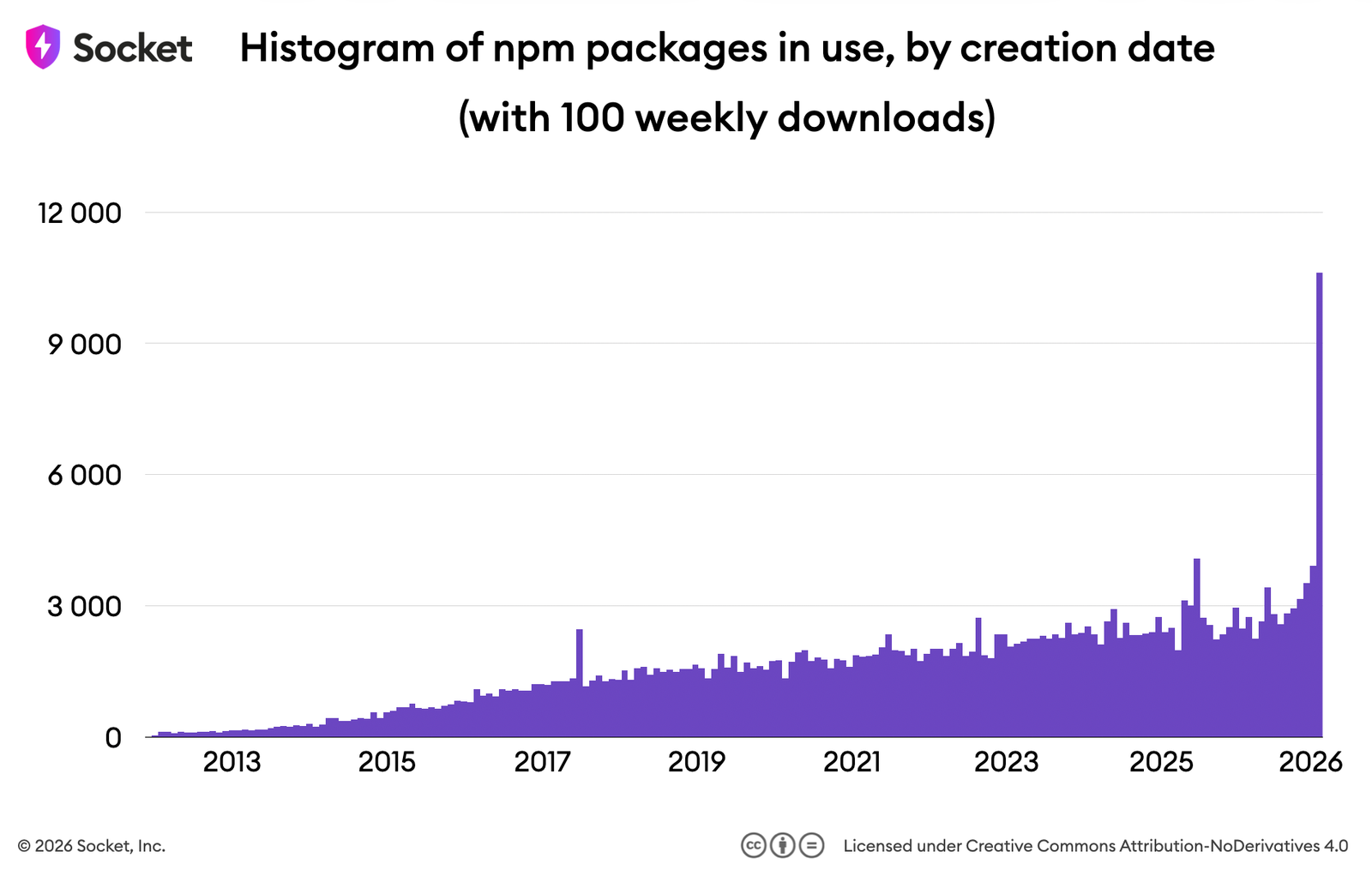
Time series chart of the number of NPM packages by creation date from the years 2013 to 2026. It displays exponential growth from the years 2013 to 2016 totaling approximately 1000 packages, then a linear growth until mid-2025 up to 3000 packages, and then the sudden explosive exponential growth towards 2026 crossing the mark of 10000 packages.

There is an unprecedented pattern going on. While it is possible the recent spike includes packages gaming the system for artificial popularity, we haven’t seen this kind of sudden growth in 15 years of npm. The immediate question is: where do they come from? How can there be this many? Even during the periods when there were swarms of prolific developers publishing as many packages as they humanly could, we did not reach the mark of 10,000 real and reusable packages per month. It seems like something superhuman is happening.
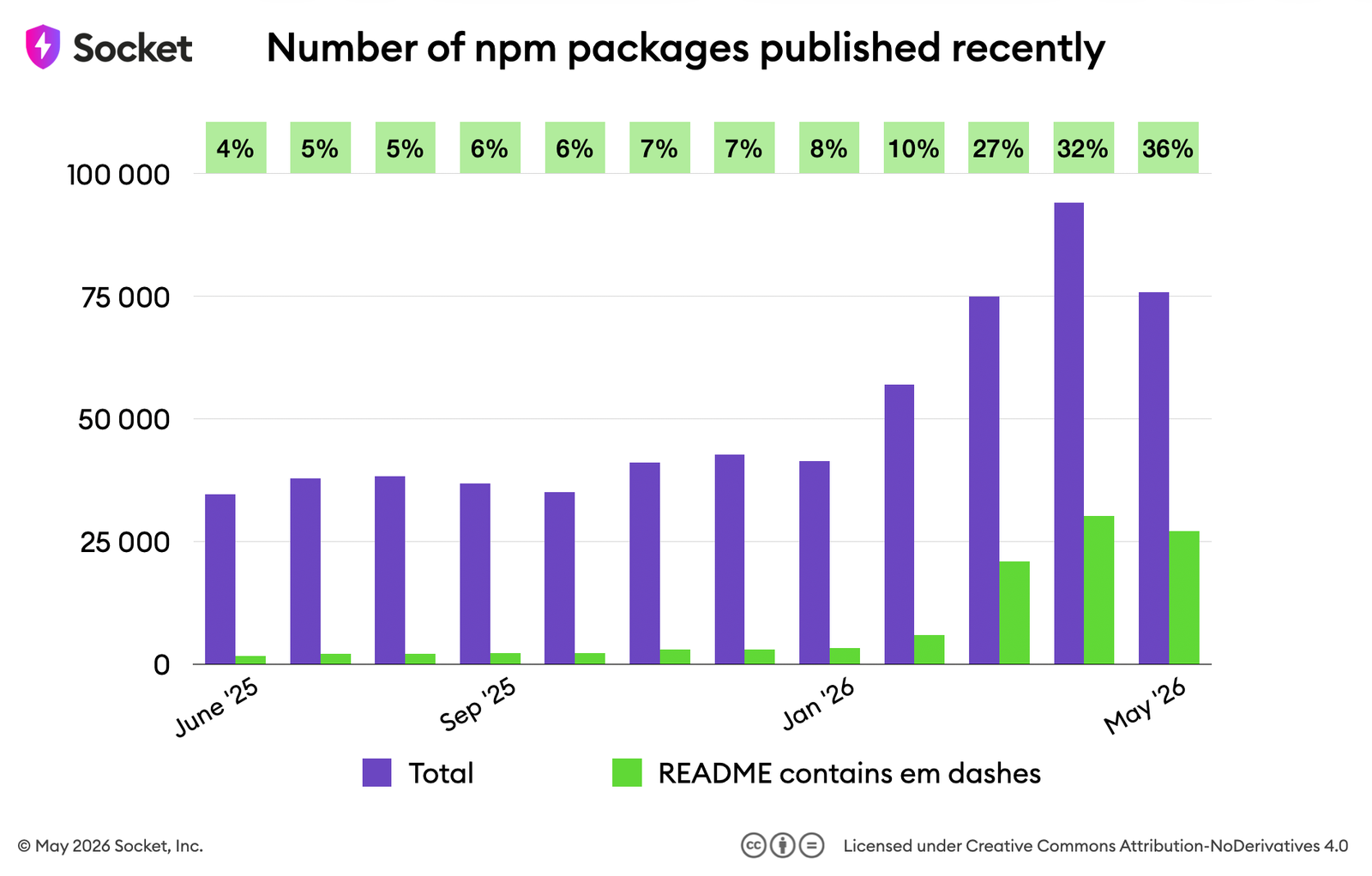
A time series chart of the number of NPM packages published in the past 12 months. For each month there are two numbers displayed, the total number of packages and the proportion of those that contain em dash in the README. From June 2025 until May, January 2026, there are about 40,000 NPM packages each month, of which 5% have em dash. Afterward until May 2026, there is a linear growth up until 100,000 NPM packages per month of which 30% containing em dash in the README.

This sparked my curiosity and I pondered how I could distinguish which of these packages were “written by AI”. Trying to differentiate between human machine output is a challenge that borders on a modern Turing test. That said, fortunately current AI coding tools are unusually fond of em dashes. So for the time being, they give themselves away easily. I measured the number of packages published recently, and the proportion of those which had em dashes in their README files, and the following chart was produced. (Please note that this was produced mid-May 2026, so the count of packages in May is still incomplete)

It is normal to expect approximately 5% of em dash “background radiation” produced by humans, so the recent sharp increase in em dash usage (30%+) indicates that AI is indeed employed in the creation of new npm packages. It is more than doubling the number of packages per month.

Maintenance Fatigue: PRs not welcome#

AI coding tools are used not only for the creation of new packages but also for contributing pull requests to existing open source projects. Given the normalization of AI assistance in most IDEs, this is not surprising. What's new is the flood of low-quality and often automated pull requests, which bypass human interaction, spamming maintainers with noise.

Maintainers of projects such as curl, Godot, Ghostty, tldraw, and others are now vocally describing contributions in a negative light. Some are resorting to disabling pull requests entirely, others are considering how contributor allowlists could be an answer.

It was once standard practice in the open source community to use "good first issue" labels to encourage and onboard new programmers. Yet, this label is increasingly counterproductive, often attracting AI automation executing on a user's instruction. As a result, contributions are now often leveraged to boost online presence and popularity, eroding the culture of solidarity that historically defined the open source ethos.

AI is reshaping the work of maintainers as much as it is reshaping the work of contributors. Maintainers are now using those tools to help review pull requests, or to simply rewrite the contribution from scratch given the maintainer’s better-informed prompt.

Software Supply Chain as a Black Box#

We built Socket’s package search feature – free for everyone – to support “dependency shopping”. This is the process of searching for suitable dependencies, filtering away the fake and the unpopular, and assessing many other criteria. Let’s take a look at how this too was impacted by AI recently.

What simple “health indicator” for dependency shopping could we probe? In modern software development, UI components for routine tasks like date selection are a fundamental requirement. However, when I examined Google Search trends for “date pickers” in the past 4 years, I discovered a surprisingly consistent decline:
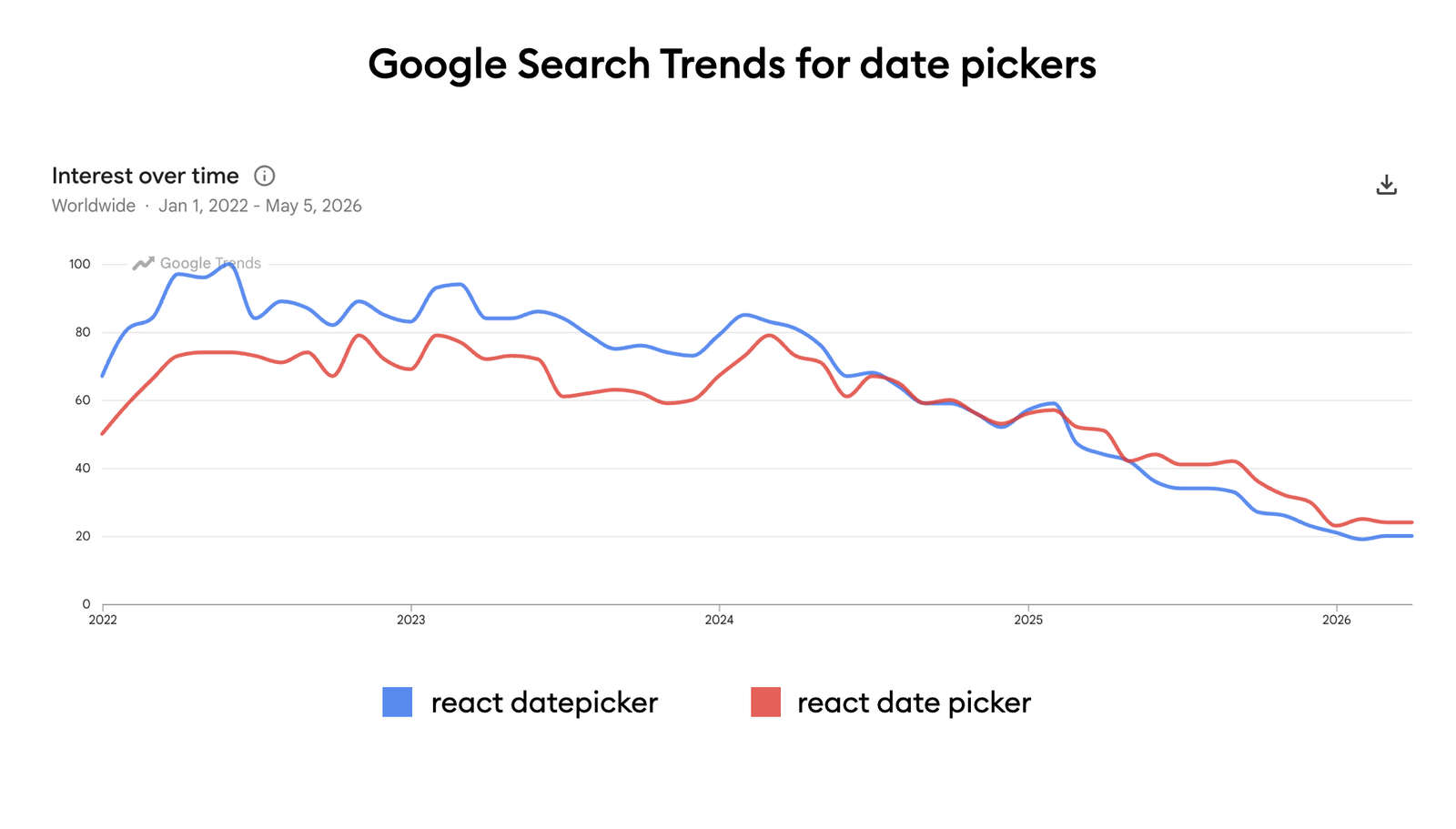
Time series chart from Google Search Trends displaying the interest over time for keywords such as React date picker from the years 2022 to 2026. The numbers look somewhat constant from the years 2020 until 2024 and afterward there is a linear decline that goes down about 80% until 2026.

Based on the chart above, one might be inclined to conclude that React date pickers are on their way out of software being produced lately. Contrarily, the statistical data for downloads regarding this specific package reveals a conflicting narrative: react-datepicker usage is steadily growing, and even picking up more steam in 2026!
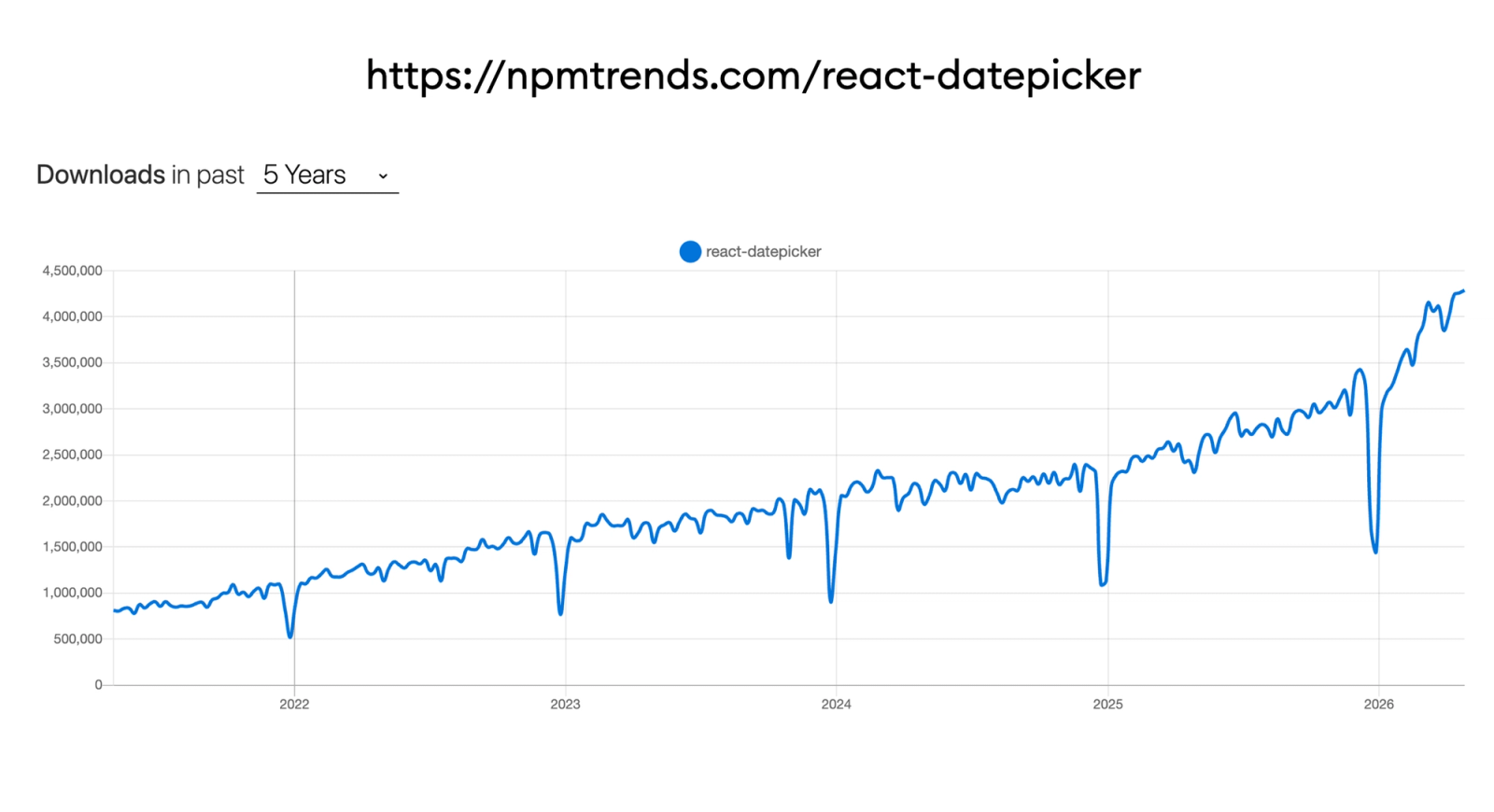
A time series chart from npmtrends.com for the keyword React date picker showing a linear growth from the years 2021 until mid-2025, when afterward it starts growing exponentially through the year 2026.

Open source used to be consumed consciously, intentionally and informed by package popularity or human review. This is no longer true. Developers more and more rely on their AI coding tools to build entire features or products, and in the process include the packages deemed necessary. Packages themselves used to contain transitive dependencies that were hand-picked by maintainers. That is also no longer true.

The result is that AI is now primarily in control of software supply chains. There are other fields disrupted by AI, such as image generation or the production of music, but software is uniquely impacted. AI is now driving both the production and consumption of open source software. AI-generated music ends in human ears, and AI-generated images mostly benefit humans, but AI-generated software is an ouroboros (a snake eating its own tail) which is just getting started.

The software that AI writes is often good, and the open source packages it chooses for consumption are by and large better than what humans would choose. But the fact remains that the software supply chain is now an automated black box, fundamentally changing the landscape of security and transparency.

It is not feasible to manually review every new dependency selection, and the pace of AI-accelerated productivity reduces the economic benefit of pausing to inspect the packages and their source code. The only viable solution to remain secure in this new world ridden with malware campaigns is to automate the scanning of third-party code to surface risk indicators based on how that code behaves.

Developers are moving faster, tools are making more decisions on their behalf, and the supply chain is becoming too large and too automated for manual review to remain the primary defense.

That does not mean open source is going away. It is human nature to share useful things with the wider community. But in a world where AI is helping produce, select, and install open source packages, automated analysis of third-party code becomes a baseline requirement for production software.