



惯性聚合 高效追踪和阅读你感兴趣的博客、新闻、科技资讯
阅读原文 在惯性聚合中打开

推荐订阅源

TaoSecurity Blog
TaoSecurity Blog
博客园 - 司徒正美
奇客Solidot–传递最新科技情报
奇客Solidot–传递最新科技情报
博客园 - 【当耐特】
M
MIT News - Artificial intelligence
罗磊的独立博客
让小产品的独立变现更简单 - ezindie.com
Stack Overflow Blog
Stack Overflow Blog
The GitHub Blog
The GitHub Blog
Google DeepMind News
Security Archives - TechRepublic
宝玉的分享
宝玉的分享
N
News and Events Feed by Topic
The Hacker News
The Hacker News
Google DeepMind News
C
CERT Recently Published Vulnerability Notes
F
Full Disclosure
Threat Intelligence Blog | Flashpoint
S
Security @ Cisco Blogs
H
Hacker News: Front Page
L
LangChain Blog
Microsoft Security Blog
Y
Y Combinator Blog
B
Blog RSS Feed
H
Heimdal Security Blog
Google Online Security Blog
Apple Machine Learning Research
博客园 - 三生石上(FineUI控件)
V2EX - 技术
V2EX - 技术
V
Vulnerabilities – Threatpost
Help Net Security
Help Net Security
Hacker News - Newest:
Hacker News - Newest: "LLM"
T
Tailwind CSS Blog
W
WeLiveSecurity
T
Tenable Blog
D
DataBreaches.Net
Martin Fowler
Martin Fowler
Cyberwarzone
Cyberwarzone
Cisco Talos Blog
Cisco Talos Blog
S
Secure Thoughts
O
OpenAI News
L
LINUX DO - 热门话题
Vercel News
Vercel News
阮一峰的网络日志
阮一峰的网络日志
Jina AI
Jina AI
J
Java Code Geeks
Know Your Adversary
Know Your Adversary
IT之家
IT之家
Latest news
Latest news
Cloudbric
Cloudbric

Sysdig Blog

Masterclass: AI is more than ChatGPT and LLMs CVE-2026-39987 update: How attackers weaponized marimo to deploy a blockchain botnet via HuggingFace Kubernetes 1.36 - New security features 5 steps to securing AI workloads Marimo OSS Python Notebook RCE: From Disclosure to Exploitation in Under 10 Hours Security briefing: March 2026 The Sysdig MCP server is now available in AWS Marketplace AI infrastructure security: Why it deserves its own category Three pillars for building effective runtime-powered cloud defense, the right way Closing the cloud security gap with runtime security Seeing risk isn’t stopping it: Why visibility alone isn’t enough TeamPCP expands: Supply chain compromise spreads from Trivy to Checkmarx GitHub Actions AI coding agents are running on your machines — Do you know what they're doing? Runtime security for AI coding agents: Protecting AI-assisted development How runtime insights power every cloud security use case CVE-2026-33017: How attackers compromised Langflow AI pipelines in 20 hours Inline Cloud Response: Accelerating AWS threat containment for SOC teams Runtime malware detection for AWS Fargate Detecting CVE-2026-3288 & CVE-2026-24512: Ingress-nginx configuration injection vulnerabilities for Kubernetes Malware detection with Sysdig Security briefing: February 2026 Leveling up Kubernetes Posture: From baselines to risk-aware admission Eliminating runtime blind spots: How CleanStart and Sysdig build continuous trust across the container lifecycle LLMjacking: From Emerging Threat to Black Market Reality Real risks live at runtime: Why CISOs must care about deep telemetry in 2026 Sysdig named a Leader in the Forrester Wave™: Cloud Native Application Protection Solutions, Q1 2026 How to run rootless containers AI-assisted cloud intrusion achieves admin access in 8 minutes Security briefing: January 2026 Securing GPU-accelerated AI workloads in Oracle Kubernetes Engine Bringing OSS runtime security to AWS: Falco integration with AWS Security Hub CSPM Our customers have spoken: Sysdig rated a Strong Performer in Gartner® Voice of the Customer for Cloud-Native Application Protection Platforms Protecting sensitive business data in preparation for the organization's Gen AI VoidLink threat analysis: Sysdig discovers C2-compiled kernel rootkits AI is still a workload: A practical guide to securing AI workloads How threat actors are using self-hosted GitHub Actions runners as backdoors How Sysdig Sage delivers AI-powered, real-world vulnerability management Security briefing: December 2025 Top 10 ways to get breached in 2026 EtherRAT dissected: How a React2Shell implant delivers 5 payloads through blockchain C2 Introducing runtime file integrity monitoring and response with Sysdig FIM How to detect multi-stage attacks with runtime behavioral analytics EtherRAT: DPRK uses novel Ethereum implant in React2Shell attacks Detecting React2Shell: The maximum-severity RCE vulnerability affecting React Server Components and Next.js The rise of AI agents: How autonomous AI Is transforming cloud security Kubernetes 1.35 - New security features The Urgency of Securing AI Workloads for CISOs Security briefing: November 2025 Quantum and the cloud: Science fiction turned security strategy Cloud security, the right way: What the industry should demand (and why "good enough" isn't) Return of the Shai-Hulud worm affects over 25,000 GitHub repositories Detecting CVE-2024-1086: The decade-old Linux kernel vulnerability that’s being actively exploited in ransomware campaigns What’s old is new again: How to demystify AI security with AIBOMs Securing Kubernetes with agentic cloud security How agentic cloud security reduces real risks Hunting reverse shells: How the Sysdig Threat Research Team builds smarter detection rules Shifting left with AI and MCP: Sysdig + Amazon Q Developer How Falco and Stratoshark close the gap between open source runtime detection and deep forensic analysis Investigating security issues with ChatGPT and the GitHub MCP server New runc vulnerabilities allow container escape: CVE-2025-31133, CVE-2025-52565, CVE-2025-52881 Harden your LLM security with OWASP Security briefing: October 2025 How agentic AI is changing cloud security Kubernetes Incident Response: Detect, investigate, and contain in under 10 minutes Sysdig recognized as a Cloud Security Leader in Latio Tech Cloud Security Market Report AI echolocation of cloud risks using Sysdig & Snyk MCP servers Sysdig MCP Server: Bridging AI and cloud security insights Understanding CVE-2025-49844: “RediShell” Critical Remote Code Execution in Redis How Sysdig secures your containers and Kubernetes Sysdig Security Briefing: September 2025 Cloud security, the right way: The 3 pillars of real-time defense Open source spotlight: Bringing web application security to Falco with Falcoya's Nginx plugin Malicious NPM packages: Are you exposed? AI for SOC teams: 5 cloud security prompts to start your day with Sysdig Sage™ Shai-Hulud: The novel self-replicating worm infecting hundreds of NPM packages ZynorRAT technical analysis: Reverse engineering a novel, Turkish Go-based RAT Modern vulnerability management, built for the cloud Build your AWS incident response playbook with open source tools 2025 Gartner® CNAPP Market Guide: Runtime visibility is no longer optional Threat hunting with Sysdig: Uncovering “IngressNightmare” Open source spotlight: From alerts to action with AI-powered Falco Vanguard From triage to action: How Sysdig’s agentic cloud security platform slashes noise and accelerates remediation The vision comes to life: Agentic cloud security with Sysdig Sage™ Data security findings: A technical deep dive Connecting runtime to source: Sysdig and Semgrep integration Fix what matters, faster: How Sysdig and Semgrep are unifying security without silos – from code to runtime Defending sensitive data with Sysdig Secure Redefining cloud security, the right way Join the movement: The Sysdig Open Source Community is live A smarter, safer cloud in the age of AI Unifying detection and response: Sysdig + Cortex XSOAR for security at cloud speed The future of security is open, and it needs a unified hub: The Sysdig Open Source Community is here CVE-2025-53104: Command injection via GitHub Actions workflow in gluestack-ui Why MCP server security is critical for AI-driven enterprises What’s new in Sysdig — June 2025 AI-powered CNAPP with Sysdig Sage™ Revolutionizing Cybersecurity Search with Sysdig Sage™ Sysdig Threat Bulletin: Iranian Cyber Threats The end of the prioritization-only era: Vulnerability management needs action Dangerous by default: Insecure GitHub Actions found in MITRE, Splunk, and other open source repositories
Risk isn’t reduced until you take action: How teams resolve issues in the cloud
Matt Kim · 2026-04-02 · via Sysdig Blog

Security teams today have more data than ever before. Modern cloud security tools surface vulnerabilities, misconfigurations, and other alerts at massive scale, giving organizations widespread visibility into their environments and where risk is present. Over the past several years, security programs have also made real progress on prioritization, helping narrow that data down to the issues that matter most.

But identifying risk is only the first step. Security teams are ultimately measured by how effectively they reduce risk, not by how much of it they can see.

A prioritized vulnerability that is not fixed is still a vulnerability that exposes the environment. Even well-understood risks can cause issues when there isn’t a clear path to address them. The real challenge organizations face is consistently translating the large volumes of data their tooling produces into the right actions at the right time.

The gap between data and action

For many organizations, this gap between insights and response shows up in everyday security workflows. One common use case where this appears is vulnerability management. In a typical scenario, security teams scan their environments and prioritize thousands of vulnerabilities, narrowing them down to a smaller set of high-risk issues. This is an important part of the process, but those vulnerabilities still need to be fixed, and in many cases, they can stay unresolved for weeks or longer.

At the core, this problem often comes down to context. Security often has to rely on other teams to patch vulnerabilities, like development teams who own the specific image or package. Acting on these findings requires full context of why the vulnerability is important and practical guidance on how to fix it. Without this level of clarity, developers who own vulnerabilities can feel like these requests are distractions from core development work, and even issues at the top of the priority list can stall, leaving known risk unresolved.

The same pattern appears in threat detection. Alerts can surface suspicious behavior, but they do not resolve the incident. Teams still need to understand what happened, determine the blast radius, and take action to stop it. Until that happens, the threat remains active, and the environment remains exposed.

What taking action looks like today

The key moment in modern cloud security is what happens next after the risk is identified. In the scenarios above, this means actually remediating vulnerabilities before they are exploited and responding to threats in real time as they occur.

Effective vulnerability remediation requires context

On the vulnerability management side, effective action is about fixing the vulnerabilities that meaningfully reduce risk, not just fixing everything. Updating everything to the latest version may eliminate vulnerabilities on paper, but it can also create instability across the application. Developers aren’t going to risk breaking critical systems just to clear a list of CVEs.

Taking action means identifying the fixes that address the most risk without breaking application dependencies, applying them efficiently, and resolving issues at the source so they do not repeatedly surface in future builds.

Once these fixes are identified, they need to be automatically routed to the proper owners with context on their impact. For example, a single patch may address vulnerabilities across multiple workloads. They also need clear, actionable remediation guidance on which patches to apply. AI is increasingly helping to bridge this gap by analyzing vulnerability data and translating it into practical, easy-to-follow remediation steps. With this level of clarity, remediation becomes more focused and more efficient, reducing both risk and wasted effort.
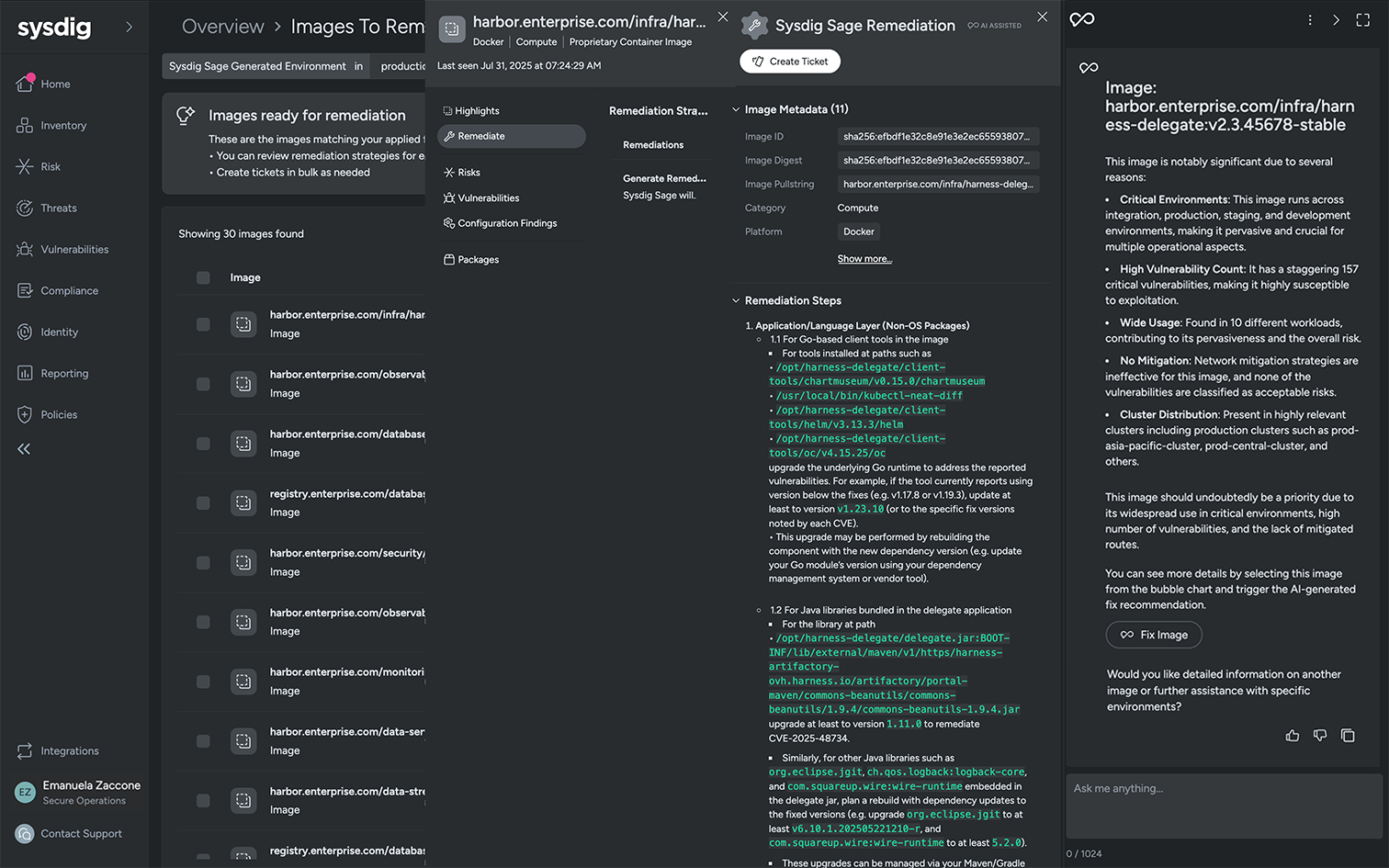
AI can generate vulnerability remediation guidance to resolve issues faster

Effective remediation requires real-time insight

On the threat detection side, action begins once suspicious behavior is detected. SecOps and SOC teams need to move quickly from detection to understanding to containment. This involves determining what triggered the alert, what systems are affected, and whether the activity represents a real threat. This requires rapid investigation, correlating related events across systems to build a clear picture of what actually happened before taking action.

From there, action becomes more concrete. Teams may isolate a suspicious network connection to prevent further communication, stop the container where the malicious process was running, or restart a compromised workload to remove persistence. At the same time, they may collect logs or forensic data to better understand what occurred and prevent similar issues in the future.

What matters in both these scenarios is speed and precision. Overly broad or delayed response actions can be disruptive or incur downtime costs if systems are taken offline. Effective action targets the specific issue, limits impact, and reduces risk without unnecessary side effects.
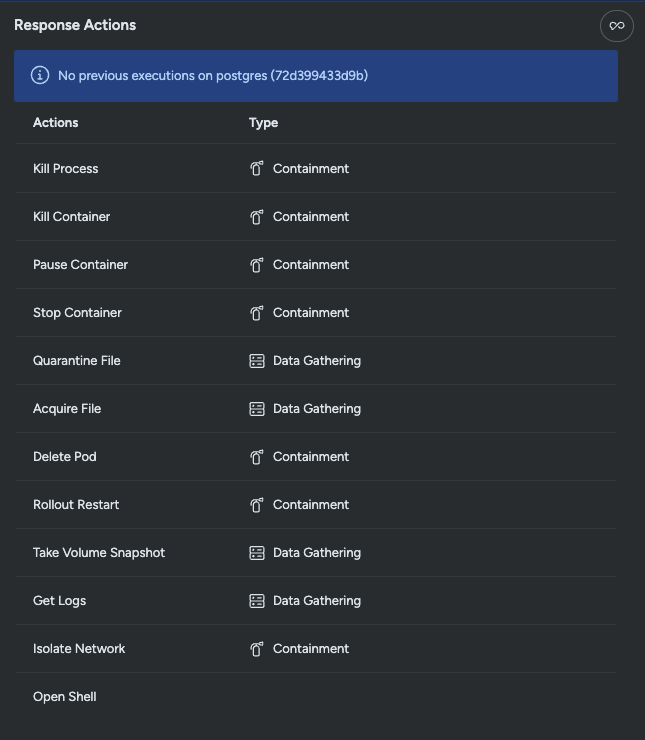
Targeted response actions like stopping a container or deleting a Kubernetes pod limit the impact of a security incident

How security teams deliver value

Visibility and prioritization remain essential steps of cloud security, but they don’t reduce risk on their own. Vulnerabilities that remain open and threats that remain active continue to expose the business, regardless of how well they are understood.

Security outcomes are defined by what gets fixed, contained, and resolved before real damage can be done. Taking action is where security proves its value, delivering outcomes that the business can clearly see and measure.