













Data — such as personally identifiable information (PII), protected health information (PHI), and financial records — are the coin of the realm for organizations and adversaries alike. This data fuels critical operations, enhances customer experience, and powers analytics-driven decisions, which makes it a high-value target for cybercriminals and state actors.
Defending sensitive data against threats and meeting regulatory compliance is often an expensive, manual process. Data sprawls across cloud environments, including in relational database services (RDS) and simple storage service (S3) buckets in AWS, which makes it difficult to understand where and what data is. At the same time, many security programs are playing a game of whack-a-mole with sensitive data: chasing alerts, battling backlogs, and scrambling to respond.
While there are no silver bullets in cybersecurity, there are solutions that can take some of the burden off of the teams tasked with stopping threat actors — and the developers relied upon to reduce risk in their builds. When you can accurately identify risk and detect when adversaries are targeting sensitive data, you’re able to quickly respond to the most urgent threats, vulnerabilities, and misconfigurations.
Data security findings is a new add-on feature powered by an integration with Bedrock Security that’s now available in Sysdig Secure. Data security findings provides the strategic clarity that business and security leaders need to proactively manage risk to valuable data. For practitioners, this new feature eliminates blind spots and uncertainty about data location and classification.
With data security findings, you gain the continuous scanning and AI-powered fingerprinting necessary to identify where data resides and classify what types of sensitive data you’re protecting. Bolstered by this information, you can reveal sensitive data exposure, focus remediation — including patching and misconfiguration fixes — and contextualize threats for faster, more confident response.
Data security findings provides organizations with many capabilities found in standalone cloud-native data security posture management (DSPM) tools, without the need to swivel between solutions or tabs. With Data Security Findings, you can:
Together, these capabilities empower security and DevOps teams to protect sensitive data more confidently and efficiently.
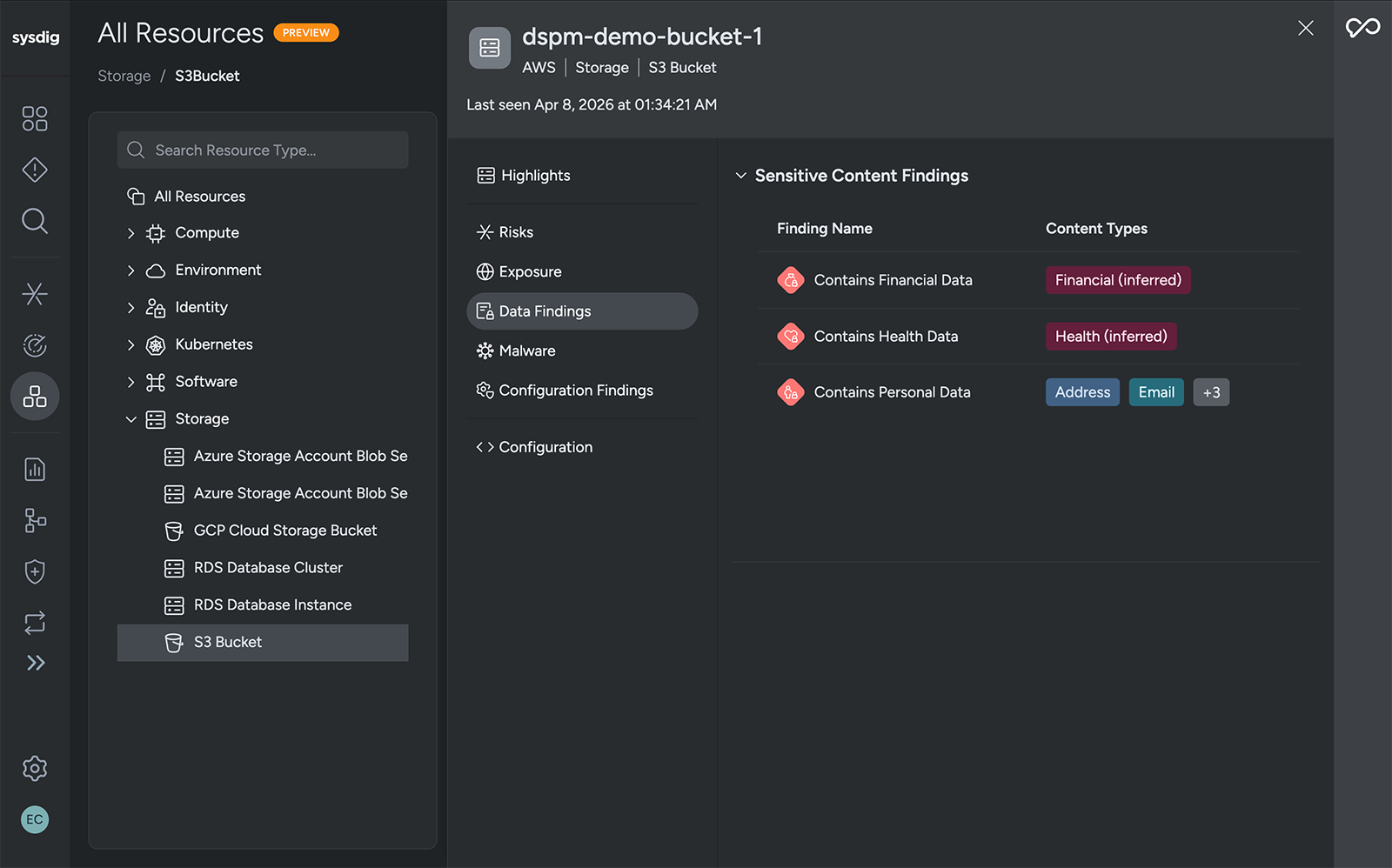
Data security findings supports a wide range of data-centric use cases, including:
By addressing these critical use cases, Sysdig’s data security findings help organizations take a proactive, data-driven approach to security. Users can minimize risk, respond to threats faster, and accelerate vulnerability and misconfiguration management.
With the addition of data security findings, Sysdig is continuing to add to a portfolio of features designed to enhance risk detection and remediation, reduce visibility gaps, and eliminate tool sprawl. Other Sysdig Secure capabilities include:
Cloud security posture management (CSPM): Enables users to monitor, identify, and remediate compliance risks and misconfigurations. CSPM features help you better prevent attacks, improve security hygiene with runtime insights, and understand what is in use in production.
Cloud workload protection (CWP): Provides robust security with deep runtime visibility and control for physical servers, virtual machines, containers, and serverless functions across cloud and on-premises architectures.
Cloud detection and response (CDR): Cloud attacks move fast — happening in 10 minutes or less. Sysdig CDR, underpinned by open source Falco, gives you real-time visibility into cloud assets and activities to meet the 555 Benchmark for Cloud Detection and Response.
Vulnerability management: Combines deep runtime with AI-powered remediation guidance to help you identify high-impact fixes and take fast, confident action.
Cloud infrastructure entitlement management (CIEM): Offers a comprehensive view of cloud resources to help prevent unauthorized access and lateral movement.
Almost 95% of companies [1] have a cloud footprint. While cloud infrastructures accelerate innovation and reduce operational overhead, they can also make protecting sensitive data more difficult. Cloud complexity introduces blind spots in data visibility — 83% of organizations said they have visibility gaps [2] — and these gaps increase risk while slowing remediation.
Data Security Findings enables you to quickly identify risk and detect when adversaries are targeting sensitive data. With this information, you can confidently manage vulnerabilities and configuration fixes while putting yourself into the best position to respond to the most urgent threats.
[1] Colorlib, “Cloud Computing Statistics,” July 2024.
[2] Bedrock Security, 2025 Enterprise Data Security Confidence Index, 2025.
此内容由惯性聚合(RSS阅读器)自动聚合整理,仅供阅读参考。 原文来自 — 版权归原作者所有。