

惯性聚合 高效追踪和阅读你感兴趣的博客、新闻、科技资讯
阅读原文 在惯性聚合中打开

推荐订阅源

GbyAI
GbyAI
Google DeepMind News
WordPress大学
WordPress大学
腾讯CDC
P
Privacy & Cybersecurity Law Blog
V
Vulnerabilities – Threatpost
小众软件
小众软件
有赞技术团队
有赞技术团队
大猫的无限游戏
大猫的无限游戏
P
Privacy International News Feed
CTFtime.org: upcoming CTF events
C
CXSECURITY Database RSS Feed - CXSecurity.com
Cyber Security Advisories - MS-ISAC
Scott Helme
Scott Helme
Simon Willison's Weblog
Forbes - Security
Forbes - Security
Recent Commits to openclaw:main
G
Google Developers Blog
S
Secure Thoughts
Application and Cybersecurity Blog
博客园 - 司徒正美
Exploit-DB.com RSS Feed
Blog — PlanetScale
Blog — PlanetScale
TaoSecurity Blog
TaoSecurity Blog
cs.CL updates on arXiv.org
Last Week in AI
Last Week in AI
H
Heimdal Security Blog
Spread Privacy
Spread Privacy
P
Proofpoint News Feed
Security Latest
Security Latest
SecWiki News
SecWiki News
D
Darknet – Hacking Tools, Hacker News & Cyber Security
S
Security Affairs
V2EX - 技术
V2EX - 技术
S
Schneier on Security
Stack Overflow Blog
Stack Overflow Blog
雷峰网
雷峰网
博客园_首页
AI
AI
Help Net Security
Help Net Security
I
Intezer
Engineering at Meta
Engineering at Meta
N
Netflix TechBlog - Medium
Google DeepMind News
OSCHINA 社区最新新闻
OSCHINA 社区最新新闻
T
The Exploit Database - CXSecurity.com
奇客Solidot–传递最新科技情报
奇客Solidot–传递最新科技情报
Hacker News: Ask HN
Hacker News: Ask HN
Project Zero
Project Zero
D
Docker

Sysdig Blog

Masterclass: AI is more than ChatGPT and LLMs CVE-2026-39987 update: How attackers weaponized marimo to deploy a blockchain botnet via HuggingFace Kubernetes 1.36 - New security features 5 steps to securing AI workloads Marimo OSS Python Notebook RCE: From Disclosure to Exploitation in Under 10 Hours Security briefing: March 2026 The Sysdig MCP server is now available in AWS Marketplace Risk isn’t reduced until you take action: How teams resolve issues in the cloud AI infrastructure security: Why it deserves its own category Three pillars for building effective runtime-powered cloud defense, the right way Closing the cloud security gap with runtime security Seeing risk isn’t stopping it: Why visibility alone isn’t enough TeamPCP expands: Supply chain compromise spreads from Trivy to Checkmarx GitHub Actions AI coding agents are running on your machines — Do you know what they're doing? Runtime security for AI coding agents: Protecting AI-assisted development How runtime insights power every cloud security use case CVE-2026-33017: How attackers compromised Langflow AI pipelines in 20 hours Inline Cloud Response: Accelerating AWS threat containment for SOC teams Detecting CVE-2026-3288 & CVE-2026-24512: Ingress-nginx configuration injection vulnerabilities for Kubernetes Malware detection with Sysdig Security briefing: February 2026 Leveling up Kubernetes Posture: From baselines to risk-aware admission Eliminating runtime blind spots: How CleanStart and Sysdig build continuous trust across the container lifecycle LLMjacking: From Emerging Threat to Black Market Reality Real risks live at runtime: Why CISOs must care about deep telemetry in 2026 Sysdig named a Leader in the Forrester Wave™: Cloud Native Application Protection Solutions, Q1 2026 How to run rootless containers AI-assisted cloud intrusion achieves admin access in 8 minutes Security briefing: January 2026 Securing GPU-accelerated AI workloads in Oracle Kubernetes Engine Bringing OSS runtime security to AWS: Falco integration with AWS Security Hub CSPM Our customers have spoken: Sysdig rated a Strong Performer in Gartner® Voice of the Customer for Cloud-Native Application Protection Platforms Protecting sensitive business data in preparation for the organization's Gen AI VoidLink threat analysis: Sysdig discovers C2-compiled kernel rootkits AI is still a workload: A practical guide to securing AI workloads How threat actors are using self-hosted GitHub Actions runners as backdoors How Sysdig Sage delivers AI-powered, real-world vulnerability management Security briefing: December 2025 Top 10 ways to get breached in 2026 EtherRAT dissected: How a React2Shell implant delivers 5 payloads through blockchain C2 Introducing runtime file integrity monitoring and response with Sysdig FIM How to detect multi-stage attacks with runtime behavioral analytics EtherRAT: DPRK uses novel Ethereum implant in React2Shell attacks Detecting React2Shell: The maximum-severity RCE vulnerability affecting React Server Components and Next.js The rise of AI agents: How autonomous AI Is transforming cloud security Kubernetes 1.35 - New security features The Urgency of Securing AI Workloads for CISOs Security briefing: November 2025 Quantum and the cloud: Science fiction turned security strategy Cloud security, the right way: What the industry should demand (and why "good enough" isn't) Return of the Shai-Hulud worm affects over 25,000 GitHub repositories Detecting CVE-2024-1086: The decade-old Linux kernel vulnerability that’s being actively exploited in ransomware campaigns What’s old is new again: How to demystify AI security with AIBOMs Securing Kubernetes with agentic cloud security How agentic cloud security reduces real risks Hunting reverse shells: How the Sysdig Threat Research Team builds smarter detection rules Shifting left with AI and MCP: Sysdig + Amazon Q Developer How Falco and Stratoshark close the gap between open source runtime detection and deep forensic analysis Investigating security issues with ChatGPT and the GitHub MCP server New runc vulnerabilities allow container escape: CVE-2025-31133, CVE-2025-52565, CVE-2025-52881 Harden your LLM security with OWASP Security briefing: October 2025 How agentic AI is changing cloud security Kubernetes Incident Response: Detect, investigate, and contain in under 10 minutes Sysdig recognized as a Cloud Security Leader in Latio Tech Cloud Security Market Report AI echolocation of cloud risks using Sysdig & Snyk MCP servers Sysdig MCP Server: Bridging AI and cloud security insights Understanding CVE-2025-49844: “RediShell” Critical Remote Code Execution in Redis How Sysdig secures your containers and Kubernetes Sysdig Security Briefing: September 2025 Cloud security, the right way: The 3 pillars of real-time defense Open source spotlight: Bringing web application security to Falco with Falcoya's Nginx plugin Malicious NPM packages: Are you exposed? AI for SOC teams: 5 cloud security prompts to start your day with Sysdig Sage™ Shai-Hulud: The novel self-replicating worm infecting hundreds of NPM packages ZynorRAT technical analysis: Reverse engineering a novel, Turkish Go-based RAT Modern vulnerability management, built for the cloud Build your AWS incident response playbook with open source tools 2025 Gartner® CNAPP Market Guide: Runtime visibility is no longer optional Threat hunting with Sysdig: Uncovering “IngressNightmare” Open source spotlight: From alerts to action with AI-powered Falco Vanguard From triage to action: How Sysdig’s agentic cloud security platform slashes noise and accelerates remediation The vision comes to life: Agentic cloud security with Sysdig Sage™ Data security findings: A technical deep dive Connecting runtime to source: Sysdig and Semgrep integration Fix what matters, faster: How Sysdig and Semgrep are unifying security without silos – from code to runtime Defending sensitive data with Sysdig Secure Redefining cloud security, the right way Join the movement: The Sysdig Open Source Community is live A smarter, safer cloud in the age of AI Unifying detection and response: Sysdig + Cortex XSOAR for security at cloud speed The future of security is open, and it needs a unified hub: The Sysdig Open Source Community is here CVE-2025-53104: Command injection via GitHub Actions workflow in gluestack-ui Why MCP server security is critical for AI-driven enterprises What’s new in Sysdig — June 2025 AI-powered CNAPP with Sysdig Sage™ Revolutionizing Cybersecurity Search with Sysdig Sage™ Sysdig Threat Bulletin: Iranian Cyber Threats The end of the prioritization-only era: Vulnerability management needs action Dangerous by default: Insecure GitHub Actions found in MITRE, Splunk, and other open source repositories
Runtime malware detection for AWS Fargate
Tiziano Tarolla · 2026-03-17 · via Sysdig Blog

Application platform modernization is pushing cloud security teams to increasingly support infrastructure teams in new ways as they adopt new cloud architectures. One avenue that is gaining steam is the use of serverless container environments, often described as serverless containers or container-as-a-service (CaaS).

AWS Fargate, which allows developers to run containerized workloads without managing the underlying compute infrastructure, is an example of this.

Sysdig now extends its runtime malware detection capabilities to AWS Fargate environments, enabling SOC and CSIRT teams to maintain runtime malware detection coverage while workloads run in fully managed container services.

This operational model can simplify infrastructure management, improve scalability, and allow development teams to focus on building and deploying applications rather than maintaining servers. Platform teams can also benefit from faster deployment cycles and reduced operational overhead.

But for SOC and CSIRT teams, this architectural shift introduces a new operational consideration. As organizations move workloads to AWS Fargate, analysts need to ensure that runtime security visibility and malware detection coverage remain consistent with what is applied across other containerized environments.

Why AWS Fargate still requires runtime security

It's easy to assume that fully managed container services like AWS Fargate would reduce the risk of malware because of their different operational model. There is no underlying host to manage, no traditional host-based agent deployment model, and less direct visibility into runtime activity than in self-managed container environments.

However, malware remains a risk that security teams must address.

Containers running in AWS Fargate still execute application code, access cloud services, and interact with sensitive data. Similar to other containerized environments, if attackers compromise an application they can introduce malicious processes, deploy cryptominers, or execute compromised container images inside running tasks.

For defenders responsible for detecting runtime threats in AWS Fargate, the challenge becomes maintaining visibility into workloads even when infrastructure management responsibilities are handled by the platform.

Runtime visibility challenges in serverless environments

Traditional container security strategies typically rely on host-level instrumentation, infrastructure monitoring, and static scanning of container images. These approaches work well when teams have complete control of their Kubernetes nodes or virtual machines running their container infrastructure.

AWS Fargate introduces a different operational model for how container workloads are deployed and managed. Cloud security teams cannot deploy host-level agents or rely on the same infrastructure-level access available in self-managed environments. This can create concerns that adopting serverless containers may reduce visibility into runtime threats such as malware.

At the same time, the types of threats security teams monitor remain consistent across container environments. Malware can still be introduced into container environments through compromise, vulnerabilities, manipulated container images, or exploited application services.

Attackers can deploy malicious binaries, execute unauthorized processes, or run cryptomining software inside container workloads. Runtime detection capabilities help security teams investigate these activities and support compliance requirements.

To support organizations adopting serverless container architectures, Sysdig is introducing runtime malware detection support for AWS Fargate. This capability allows security teams to extend malware detection capabilities into their serverless environment.

With this release, organizations running containers in AWS Fargate can maintain malware detection coverage while continuing to use the same investigation and response workflows.

This functionality builds on Sysdig malware detection capabilities trusted in containerized host and cloud environments.
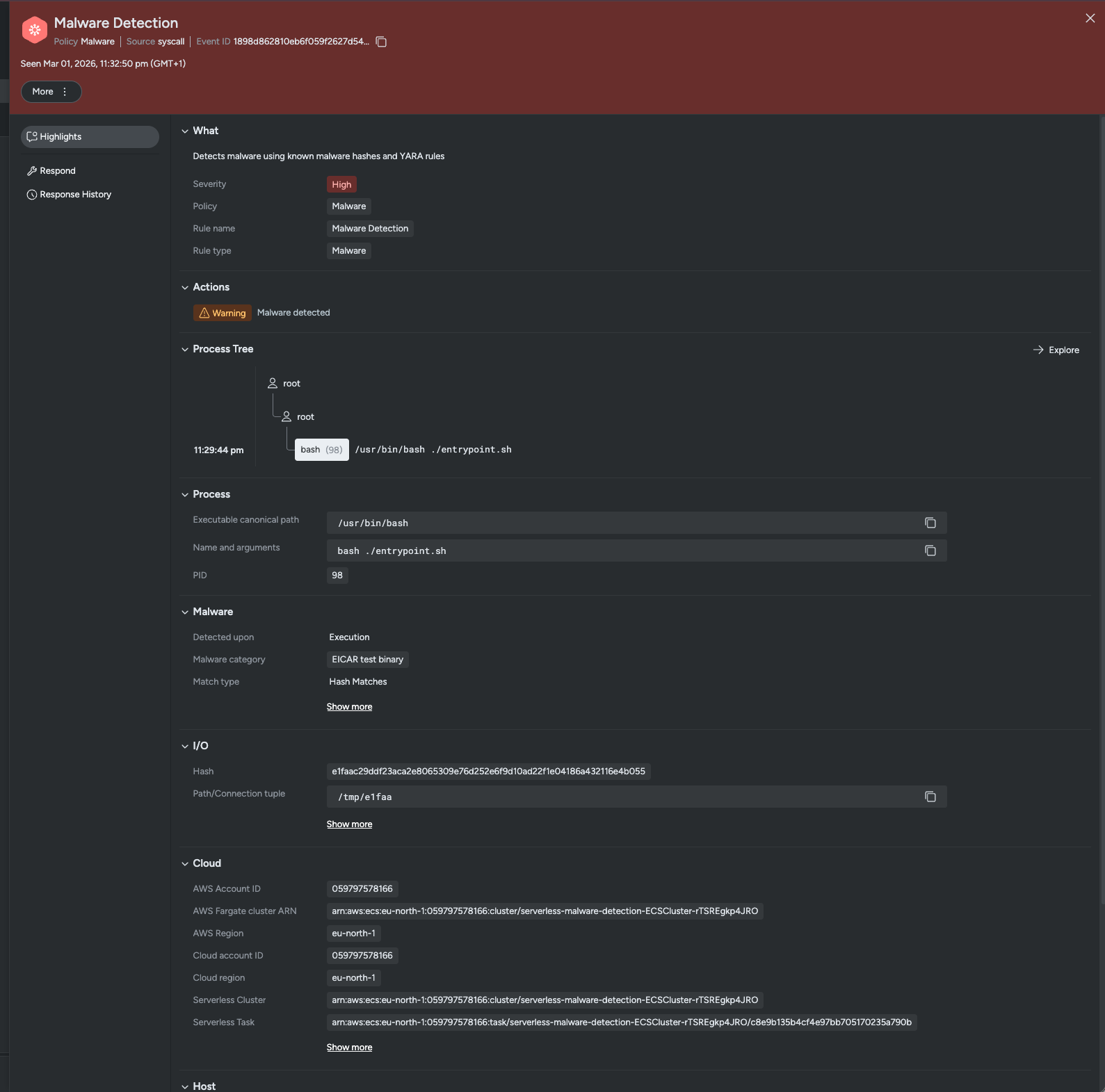
In the scenario above, an analyst would see an alert triggered through Malware Hash Detection.The system identifies the EICAR Anti-Virus Test File, an industry-standard file used to test and verify the detection efficacy of security programs. While this specific instance utilizes the EICAR file as an academic exercise to validate the detection, the underlying technology is the same used to neutralize real-world threats. Whether the threat in question is a known ransomware variant or a sophisticated cryptominer, Sysdig’s Malware Hash Detection ensures that if the signature is known, the threat is detected.

Detecting malware during runtime execution

Preventative container security controls often rely on scanning container images during the build process. Image scanning remains an important preventative control, but it falls short of detecting threats at runtime.

Sysdig malware detection focuses on identifying malicious activity during workload execution.

Malware can be detected when malicious binaries are written to the container filesystem, or when suspicious processes attempt to execute. This allows analysts to detect threats based on runtime behavior.

Runtime detection provides visibility into malware that may bypass preventative controls earlier in the software lifecycle. If a malicious binary is introduced into a container after deployment, runtime detection can still identify the activity.

For SOC and CSIRT teams, this means alerts are generated based on active runtime behavior. Analysts can investigate suspicious execution attempts, determine the scope of activity, and respond to threats before they spread to other services.

Consistent security across Kubernetes and AWS Fargate

Most modern organizations operate multiple compute platforms simultaneously. A typical environment may include Kubernetes clusters, self-managed container environments, traditional virtual machines, and serverless container services like AWS Fargate. Security analysts need consistent protection across all of these environments.

Sysdig extends malware detection and runtime protection into Fargate environments, enabling defenders to detect malicious execution attempts even in fully managed container runtimes. This helps maintain runtime protection across Kubernetes clusters, self-managed containers, and AWS Fargate.

With Sysdig, SOC teams can investigate threats using familiar workflows, regardless of where the workload is running.

Supporting cloud modernization without losing compliance coverage

For CISOs and security leaders, infrastructure modernization often involves balancing operational efficiency with security and compliance requirements.

Platform teams adopt AWS Fargate to accelerate development and reduce infrastructure management overhead. Security leaders must ensure that these architectural decisions do not reduce security visibility or introduce compliance gaps.

By extending runtime malware detection into AWS Fargate environments, Sysdig helps organizations support platform modernization while maintaining consistent runtime security controls. Analysts can continue detecting malware and suspicious execution attempts while infrastructure teams adopt serverless container platforms.

This alignment allows organizations to modernize their application platforms without sacrificing runtime security visibility and detection coverage.

Runtime security that evolves with cloud architecture

AWS Fargate represents an important evolution in cloud application deployment. By removing infrastructure management responsibilities, it allows organizations to deploy and scale containerized applications more efficiently.

However, removing infrastructure management does not remove the need for runtime threat detection. Security visibility must evolve alongside cloud architecture.

By extending runtime malware detection into AWS Fargate environments, Sysdig enables SOC and CSIRT teams to maintain detection coverage across modern cloud environments. Cloud security teams retain the ability to detect malicious execution attempts, investigate runtime activity, and respond to threats across Kubernetes clusters, traditional container platforms, and AWS Fargate workloads.

With Sysdig, organizations can adopt modern serverless container architectures while maintaining strong runtime malware detection and cloud security visibility.