


惯性聚合 高效追踪和阅读你感兴趣的博客、新闻、科技资讯
阅读原文 在惯性聚合中打开

推荐订阅源

V
V2EX
爱范儿
爱范儿
Martin Fowler
Martin Fowler
T
The Blog of Author Tim Ferriss
B
Blog RSS Feed
博客园 - 聂微东
G
GRAHAM CLULEY
Engineering at Meta
Engineering at Meta
Threat Intelligence Blog | Flashpoint
WordPress大学
WordPress大学
Scott Helme
Scott Helme
AI
AI
S
Security Affairs
T
Threat Research - Cisco Blogs
M
MIT News - Artificial intelligence
T
Troy Hunt's Blog
H
Hackread – Cybersecurity News, Data Breaches, AI and More
人人都是产品经理
人人都是产品经理
AWS News Blog
AWS News Blog
T
Threatpost
Cyberwarzone
Cyberwarzone
www.infosecurity-magazine.com
U
Unit 42
V
Vulnerabilities – Threatpost
J
Java Code Geeks
博客园 - Franky
月光博客
月光博客
Blog — PlanetScale
Blog — PlanetScale
NISL@THU
NISL@THU
D
Docker
小众软件
小众软件
N
News and Events Feed by Topic
Microsoft Security Blog
Y
Y Combinator Blog
A
Arctic Wolf
D
DataBreaches.Net
云风的 BLOG
云风的 BLOG
Forbes - Security
Forbes - Security
量子位
PCI Perspectives
PCI Perspectives
美团技术团队
K
KPMG report finds enterprise disconnect between AI and its ROI | CIO
I
InfoQ
Security Archives - TechRepublic
有赞技术团队
有赞技术团队
腾讯CDC
P
Proofpoint News Feed
S
Security @ Cisco Blogs
G
Google Developers Blog
C
Cisco Blogs

Sysdig Blog

Masterclass: AI is more than ChatGPT and LLMs CVE-2026-39987 update: How attackers weaponized marimo to deploy a blockchain botnet via HuggingFace Kubernetes 1.36 - New security features 5 steps to securing AI workloads Marimo OSS Python Notebook RCE: From Disclosure to Exploitation in Under 10 Hours Security briefing: March 2026 The Sysdig MCP server is now available in AWS Marketplace Risk isn’t reduced until you take action: How teams resolve issues in the cloud AI infrastructure security: Why it deserves its own category Three pillars for building effective runtime-powered cloud defense, the right way Closing the cloud security gap with runtime security Seeing risk isn’t stopping it: Why visibility alone isn’t enough TeamPCP expands: Supply chain compromise spreads from Trivy to Checkmarx GitHub Actions AI coding agents are running on your machines — Do you know what they're doing? Runtime security for AI coding agents: Protecting AI-assisted development How runtime insights power every cloud security use case CVE-2026-33017: How attackers compromised Langflow AI pipelines in 20 hours Inline Cloud Response: Accelerating AWS threat containment for SOC teams Runtime malware detection for AWS Fargate Detecting CVE-2026-3288 & CVE-2026-24512: Ingress-nginx configuration injection vulnerabilities for Kubernetes Malware detection with Sysdig Security briefing: February 2026 Leveling up Kubernetes Posture: From baselines to risk-aware admission Eliminating runtime blind spots: How CleanStart and Sysdig build continuous trust across the container lifecycle LLMjacking: From Emerging Threat to Black Market Reality Real risks live at runtime: Why CISOs must care about deep telemetry in 2026 Sysdig named a Leader in the Forrester Wave™: Cloud Native Application Protection Solutions, Q1 2026 How to run rootless containers AI-assisted cloud intrusion achieves admin access in 8 minutes Security briefing: January 2026 Securing GPU-accelerated AI workloads in Oracle Kubernetes Engine Bringing OSS runtime security to AWS: Falco integration with AWS Security Hub CSPM Our customers have spoken: Sysdig rated a Strong Performer in Gartner® Voice of the Customer for Cloud-Native Application Protection Platforms Protecting sensitive business data in preparation for the organization's Gen AI VoidLink threat analysis: Sysdig discovers C2-compiled kernel rootkits AI is still a workload: A practical guide to securing AI workloads How threat actors are using self-hosted GitHub Actions runners as backdoors How Sysdig Sage delivers AI-powered, real-world vulnerability management Security briefing: December 2025 Top 10 ways to get breached in 2026 EtherRAT dissected: How a React2Shell implant delivers 5 payloads through blockchain C2 How to detect multi-stage attacks with runtime behavioral analytics EtherRAT: DPRK uses novel Ethereum implant in React2Shell attacks Detecting React2Shell: The maximum-severity RCE vulnerability affecting React Server Components and Next.js The rise of AI agents: How autonomous AI Is transforming cloud security Kubernetes 1.35 - New security features The Urgency of Securing AI Workloads for CISOs Security briefing: November 2025 Quantum and the cloud: Science fiction turned security strategy Cloud security, the right way: What the industry should demand (and why "good enough" isn't) Return of the Shai-Hulud worm affects over 25,000 GitHub repositories Detecting CVE-2024-1086: The decade-old Linux kernel vulnerability that’s being actively exploited in ransomware campaigns What’s old is new again: How to demystify AI security with AIBOMs Securing Kubernetes with agentic cloud security How agentic cloud security reduces real risks Hunting reverse shells: How the Sysdig Threat Research Team builds smarter detection rules Shifting left with AI and MCP: Sysdig + Amazon Q Developer How Falco and Stratoshark close the gap between open source runtime detection and deep forensic analysis Investigating security issues with ChatGPT and the GitHub MCP server New runc vulnerabilities allow container escape: CVE-2025-31133, CVE-2025-52565, CVE-2025-52881 Harden your LLM security with OWASP Security briefing: October 2025 How agentic AI is changing cloud security Kubernetes Incident Response: Detect, investigate, and contain in under 10 minutes Sysdig recognized as a Cloud Security Leader in Latio Tech Cloud Security Market Report AI echolocation of cloud risks using Sysdig & Snyk MCP servers Sysdig MCP Server: Bridging AI and cloud security insights Understanding CVE-2025-49844: “RediShell” Critical Remote Code Execution in Redis How Sysdig secures your containers and Kubernetes Sysdig Security Briefing: September 2025 Cloud security, the right way: The 3 pillars of real-time defense Open source spotlight: Bringing web application security to Falco with Falcoya's Nginx plugin Malicious NPM packages: Are you exposed? AI for SOC teams: 5 cloud security prompts to start your day with Sysdig Sage™ Shai-Hulud: The novel self-replicating worm infecting hundreds of NPM packages ZynorRAT technical analysis: Reverse engineering a novel, Turkish Go-based RAT Modern vulnerability management, built for the cloud Build your AWS incident response playbook with open source tools 2025 Gartner® CNAPP Market Guide: Runtime visibility is no longer optional Threat hunting with Sysdig: Uncovering “IngressNightmare” Open source spotlight: From alerts to action with AI-powered Falco Vanguard From triage to action: How Sysdig’s agentic cloud security platform slashes noise and accelerates remediation The vision comes to life: Agentic cloud security with Sysdig Sage™ Data security findings: A technical deep dive Connecting runtime to source: Sysdig and Semgrep integration Fix what matters, faster: How Sysdig and Semgrep are unifying security without silos – from code to runtime Defending sensitive data with Sysdig Secure Redefining cloud security, the right way Join the movement: The Sysdig Open Source Community is live A smarter, safer cloud in the age of AI Unifying detection and response: Sysdig + Cortex XSOAR for security at cloud speed The future of security is open, and it needs a unified hub: The Sysdig Open Source Community is here CVE-2025-53104: Command injection via GitHub Actions workflow in gluestack-ui Why MCP server security is critical for AI-driven enterprises What’s new in Sysdig — June 2025 AI-powered CNAPP with Sysdig Sage™ Revolutionizing Cybersecurity Search with Sysdig Sage™ Sysdig Threat Bulletin: Iranian Cyber Threats The end of the prioritization-only era: Vulnerability management needs action Dangerous by default: Insecure GitHub Actions found in MITRE, Splunk, and other open source repositories
Introducing runtime file integrity monitoring and response with Sysdig FIM
Paolo Polidori · 2025-12-16 · via Sysdig Blog

Traditional file integrity monitoring (FIM) tools were not built for Kubernetes, containers, or cloud-scale environments. They rely on resource-heavy scans and alert on routine activity, often overwhelming security teams with noise and limited context. Agentless snapshot methods often fail to detect short-lived runtime changes or provide process-level forensic context.

Sysdig runtime FIM changes that. By leveraging Falco for event-driven detection, Sysdig delivers fast, lightweight, and context-rich file integrity monitoring. It monitors critical file paths in real time, triggers only if a file has been written to and the hash doesn't match. Through this process, Sysdig provides forensic detail that enables faster investigation, preserves system performance, reduces mean time to containment (MTTC), and meets compliance requirements without the complexity of legacy tools.

Why traditional FIM falls short

Legacy FIM tools typically operate through periodic scans that recalculate cryptographic hashes across large file sets, regardless of whether changes have occurred. In modern environments like Kubernetes, where workloads are short-lived and constantly shifting, this method results in wasted compute, excessive I/O, and a lag in threat detection. The resulting lack of reactivity in this legacy approach can lead to potential misses.

These tools also generate high volumes of low-fidelity alerts, including benign operations like log reads or configuration access. This simply adds to the already high levels of alert fatigue without delivering meaningful signals. Even when a real change is detected, traditional FIM tools often lack the context needed to investigate, and they may not even identify which process made the change, under what user, or as part of which broader event chain. Without this critical context, teams are limited in their ability to execute on their containment and remediation workflows.

How Sysdig runtime FIM works

Sysdig runtime FIM takes a fundamentally different approach. Instead of scanning files on a schedule or triggering on every access, it listens for file system events in real time and only recalculates hashes when a file is written to.

This begins with a baseline hash inventory, defined through a FIM policy. From there, Sysdig listens at runtime and selectively re-checks hashes on write events. If a file write occurs then we compare the hashes to see if a change was made. If a violation is found, an alert is surfaced along with full forensic context.

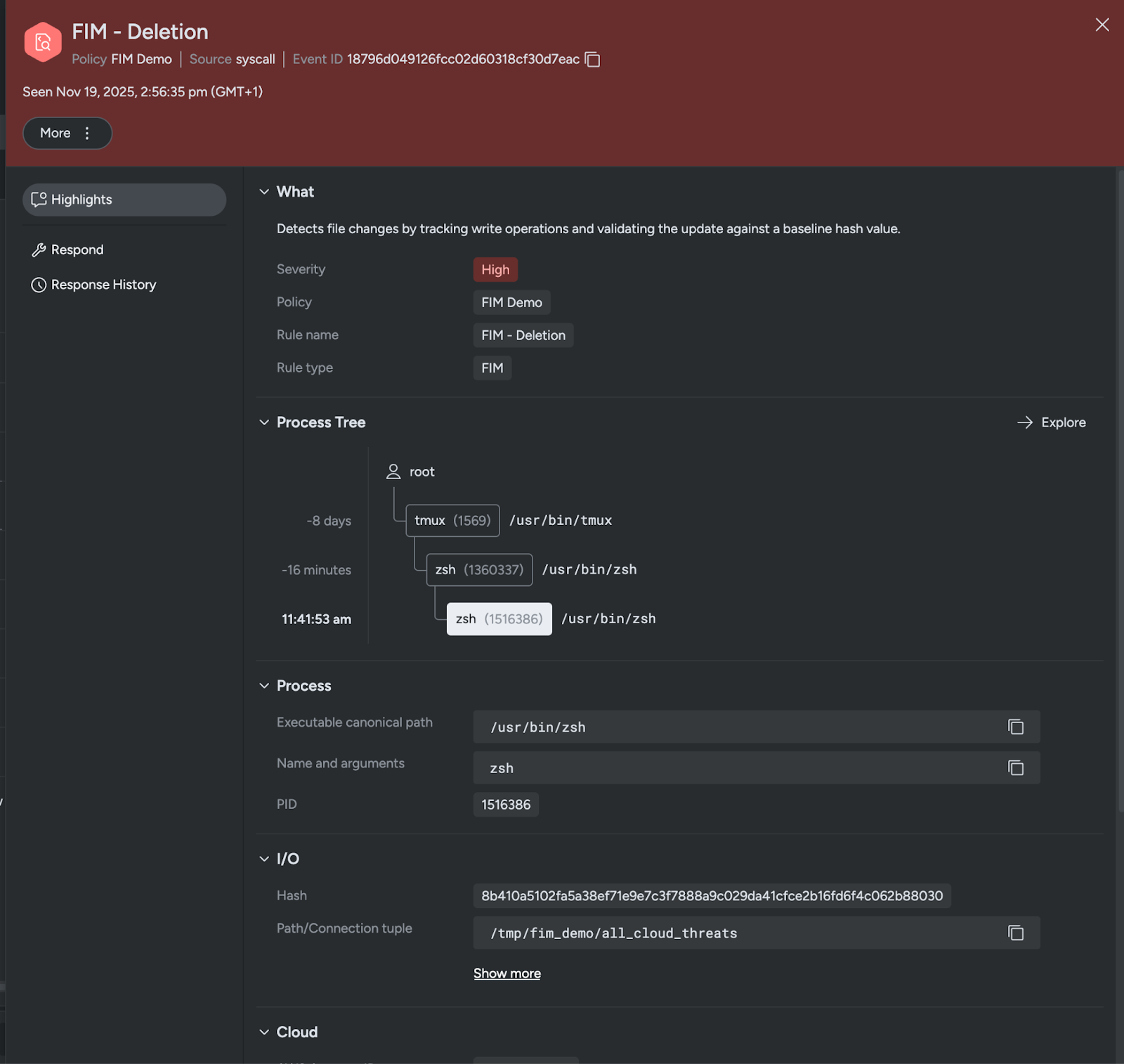
Security teams gain deep visibility into the change, including the responsible process, parent process, and container metadata. This accelerates the investigation and helps determine whether the modification is benign, suspicious, or clearly malicious.
Reducing false positives and improving performance

By calculating hashes only when write events occur, Sysdig avoids the two biggest problems of legacy FIM tools: unnecessary resource consumption and excessive alert noise. This event-driven model allows FIM to scale efficiently in containerized environments running across many nodes and clusters.

Because detection is driven by system events captured in real time, there is no need for a background process continuously scanning the file system. The result is lower CPU usage, reduced I/O pressure, and better overall performance for monitored workloads.

Reducing MTTC with real-time forensics

Sysdig FIM does more than detect unauthorized file changes. It enables faster, more accurate responses by providing security analysts with critical context tied to each alert, including the process tree, user ID, and container or pod metadata.

One of the most valuable aspects of detection context is process lineage. In many attacks, malicious changes are made by short-lived processes or under generic service accounts. Without lineage data, security teams can struggle to piece together what happened. Sysdig solves this by tracing file modifications back to their origin with high fidelity.

Through Sysdig Automations, teams can also collect the modified files for examination. These collections are automatic, without complications and delivered in a timely manner, before any further changes can happen. This post event analysis can help you to understand if the event in question was malicious, simply a bad practice, or even a false positive, just by looking at the file content. Alternatively, you can also take responsive actions, such as choosing to contain the action and take definitive countermeasures like killing the Kubernetes pod or the process that wrote it.
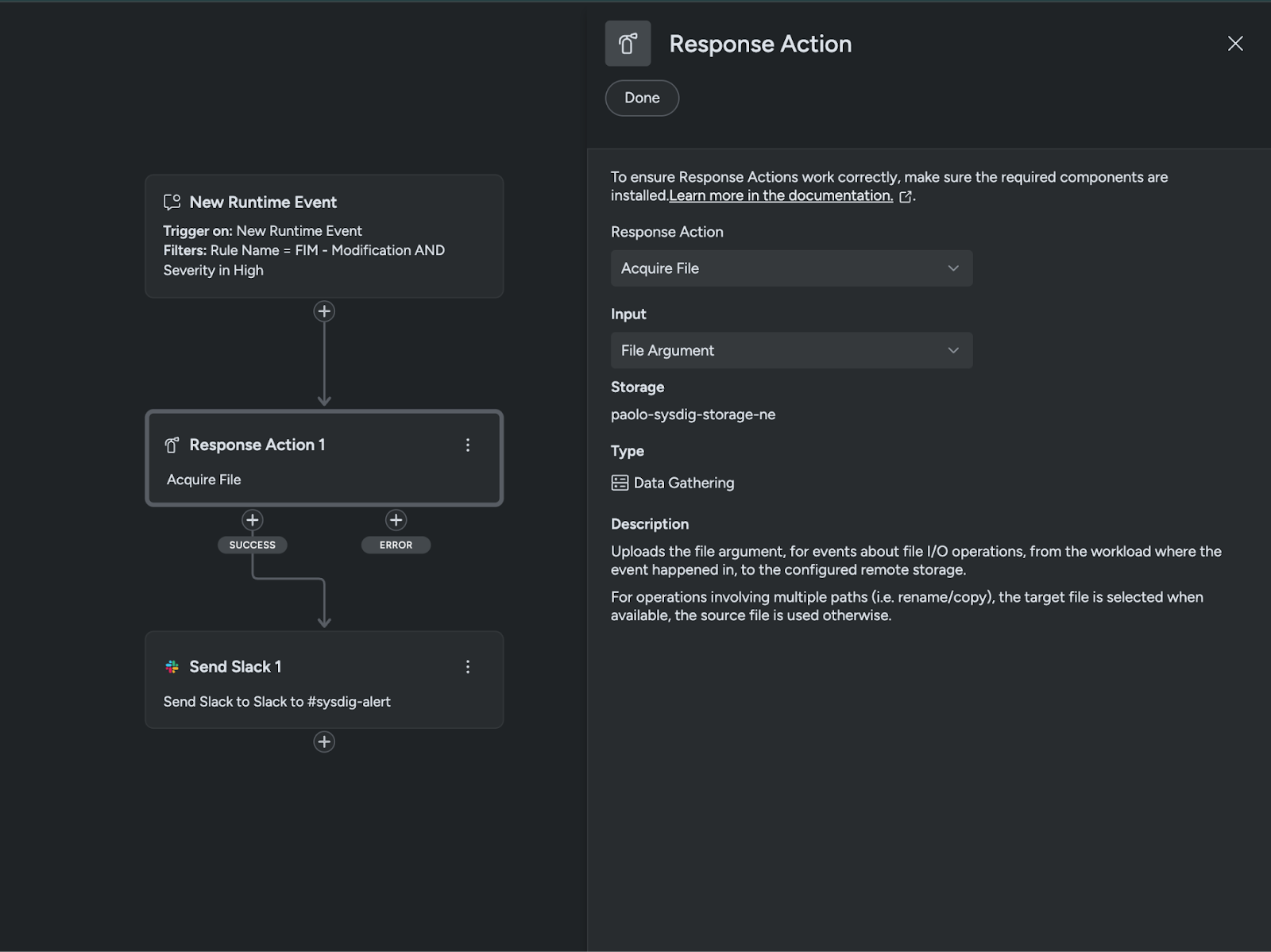
By surfacing this data in real time, Sysdig significantly reduces mean time to contain (MTTC). Analysts can quickly understand the scope and impact of a file-based threat, take corrective action, and limit potential damage before it spreads.

Built for compliance in regulated environments

File integrity monitoring remains a required control for many compliance frameworks, including PCI-DSS, NIST SP 800-53, HIPAA, ISO 27001, and GDPR. However, meeting these requirements in a cloud-native environment can be challenging without the right tools.

Sysdig FIM helps teams comply by allowing them to define flexible policies targeting specific file paths, users, containers, or Kubernetes labels. Because the system detects and responds to changes as they occur, it satisfies not just the letter of compliance controls, but also the intent, providing a reliable, real-time safeguard for production systems.

Why event-driven detection matters

Traditional FIM tools that rely on scheduled scans introduce latency. A malicious change might go undetected for minutes or hours, depending on the scan frequency. That window of time is more than enough for an attacker to cause damage or erase their tracks.

Sysdig FIM closes this gap. It monitors system calls in real time using Falco, the open source engine created by Sysdig, which is now a CNCF-graduated project. When a file write occurs, Falco evaluates whether it matches a defined policy. If so, Sysdig FIM triggers an alert enriched with all the telemetry needed to investigate and respond immediately.

Because alerts are tied directly to actual write events, instead of just access or scheduled checks, security teams only receive a detection notification when meaningful changes occur. This high signal-to-noise ratio makes it easier to focus on true risks and respond with confidence.

Fully integrated with the Sysdig Secure platform

Sysdig FIM is built into the Sysdig Secure CNAPP platform, working alongside runtime threat detection, cloud configuration monitoring, container and Kubernetes security, and vulnerability management. File integrity events are visible in the Threat Management Dashboard and managed using the same rule-based policy model used across Sysdig.

This allows security and platform teams to create unified policies, enforce controls across cloud and hybrid environments, and scale monitoring across multiple clusters without performance trade-offs.

Whether you're monitoring sensitive configuration files, container startup scripts, or application directories, Sysdig FIM gives you the flexibility and control to implement FIM the right way in a cloud-native world.

Conclusion

File integrity monitoring is no longer just a checkbox for audits; it has evolved into a critical control for early threat detection, system integrity, and regulatory compliance. Traditional scan-based tools cannot meet the speed, scale, and complexity of today’s cloud-native environments.

Sysdig FIM delivers a modern solution built for runtime, with low overhead, fewer false positives, and full forensic visibility. By detecting and responding to file-based threats in real time, it helps teams reduce MTTC, minimize risk, and maintain performance at scale.

Ready to modernize your FIM strategy? Request a demo to see Sysdig FIM in action.