



惯性聚合 高效追踪和阅读你感兴趣的博客、新闻、科技资讯
阅读原文 在惯性聚合中打开

推荐订阅源

Cyberwarzone
Cyberwarzone
V
Vulnerabilities – Threatpost
T
Tenable Blog
Forbes - Security
Forbes - Security
Simon Willison's Weblog
AWS News Blog
AWS News Blog
G
GRAHAM CLULEY
Know Your Adversary
Know Your Adversary
S
Securelist
C
Cybersecurity and Infrastructure Security Agency CISA
Project Zero
Project Zero
C
CXSECURITY Database RSS Feed - CXSecurity.com
V
Visual Studio Blog
WordPress大学
WordPress大学
Latest news
Latest news
K
Kaspersky official blog
T
Tailwind CSS Blog
T
Threat Research - Cisco Blogs
B
Blog RSS Feed
C
Cisco Blogs
博客园 - 聂微东
Martin Fowler
Martin Fowler
T
The Blog of Author Tim Ferriss
小众软件
小众软件
L
LangChain Blog
阮一峰的网络日志
阮一峰的网络日志
L
LINUX DO - 热门话题
Stack Overflow Blog
Stack Overflow Blog
罗磊的独立博客
P
Proofpoint News Feed
CTFtime.org: upcoming CTF events
P
Privacy International News Feed
Cyber Security Advisories - MS-ISAC
C
CERT Recently Published Vulnerability Notes
Cisco Talos Blog
Cisco Talos Blog
S
SegmentFault 最新的问题
Security Latest
Security Latest
Y
Y Combinator Blog
爱范儿
爱范儿
aimingoo的专栏
aimingoo的专栏
P
Privacy & Cybersecurity Law Blog
L
LINUX DO - 最新话题
月光博客
月光博客
The GitHub Blog
The GitHub Blog
博客园 - 三生石上(FineUI控件)
S
Security Affairs
P
Proofpoint News Feed
D
DataBreaches.Net
有赞技术团队
有赞技术团队
云风的 BLOG
云风的 BLOG

Sysdig Blog

Masterclass: AI is more than ChatGPT and LLMs CVE-2026-39987 update: How attackers weaponized marimo to deploy a blockchain botnet via HuggingFace Kubernetes 1.36 - New security features 5 steps to securing AI workloads Marimo OSS Python Notebook RCE: From Disclosure to Exploitation in Under 10 Hours Security briefing: March 2026 The Sysdig MCP server is now available in AWS Marketplace Risk isn’t reduced until you take action: How teams resolve issues in the cloud AI infrastructure security: Why it deserves its own category Three pillars for building effective runtime-powered cloud defense, the right way Closing the cloud security gap with runtime security Seeing risk isn’t stopping it: Why visibility alone isn’t enough TeamPCP expands: Supply chain compromise spreads from Trivy to Checkmarx GitHub Actions AI coding agents are running on your machines — Do you know what they're doing? Runtime security for AI coding agents: Protecting AI-assisted development How runtime insights power every cloud security use case CVE-2026-33017: How attackers compromised Langflow AI pipelines in 20 hours Inline Cloud Response: Accelerating AWS threat containment for SOC teams Runtime malware detection for AWS Fargate Detecting CVE-2026-3288 & CVE-2026-24512: Ingress-nginx configuration injection vulnerabilities for Kubernetes Malware detection with Sysdig Security briefing: February 2026 Leveling up Kubernetes Posture: From baselines to risk-aware admission Eliminating runtime blind spots: How CleanStart and Sysdig build continuous trust across the container lifecycle LLMjacking: From Emerging Threat to Black Market Reality Real risks live at runtime: Why CISOs must care about deep telemetry in 2026 Sysdig named a Leader in the Forrester Wave™: Cloud Native Application Protection Solutions, Q1 2026 How to run rootless containers AI-assisted cloud intrusion achieves admin access in 8 minutes Security briefing: January 2026 Securing GPU-accelerated AI workloads in Oracle Kubernetes Engine Bringing OSS runtime security to AWS: Falco integration with AWS Security Hub CSPM Our customers have spoken: Sysdig rated a Strong Performer in Gartner® Voice of the Customer for Cloud-Native Application Protection Platforms Protecting sensitive business data in preparation for the organization's Gen AI VoidLink threat analysis: Sysdig discovers C2-compiled kernel rootkits AI is still a workload: A practical guide to securing AI workloads How threat actors are using self-hosted GitHub Actions runners as backdoors How Sysdig Sage delivers AI-powered, real-world vulnerability management Security briefing: December 2025 Top 10 ways to get breached in 2026 EtherRAT dissected: How a React2Shell implant delivers 5 payloads through blockchain C2 Introducing runtime file integrity monitoring and response with Sysdig FIM How to detect multi-stage attacks with runtime behavioral analytics EtherRAT: DPRK uses novel Ethereum implant in React2Shell attacks Detecting React2Shell: The maximum-severity RCE vulnerability affecting React Server Components and Next.js The rise of AI agents: How autonomous AI Is transforming cloud security Kubernetes 1.35 - New security features The Urgency of Securing AI Workloads for CISOs Security briefing: November 2025 Quantum and the cloud: Science fiction turned security strategy Cloud security, the right way: What the industry should demand (and why "good enough" isn't) Return of the Shai-Hulud worm affects over 25,000 GitHub repositories Detecting CVE-2024-1086: The decade-old Linux kernel vulnerability that’s being actively exploited in ransomware campaigns What’s old is new again: How to demystify AI security with AIBOMs Securing Kubernetes with agentic cloud security How agentic cloud security reduces real risks Hunting reverse shells: How the Sysdig Threat Research Team builds smarter detection rules Shifting left with AI and MCP: Sysdig + Amazon Q Developer How Falco and Stratoshark close the gap between open source runtime detection and deep forensic analysis Investigating security issues with ChatGPT and the GitHub MCP server New runc vulnerabilities allow container escape: CVE-2025-31133, CVE-2025-52565, CVE-2025-52881 Harden your LLM security with OWASP Security briefing: October 2025 Kubernetes Incident Response: Detect, investigate, and contain in under 10 minutes Sysdig recognized as a Cloud Security Leader in Latio Tech Cloud Security Market Report AI echolocation of cloud risks using Sysdig & Snyk MCP servers Sysdig MCP Server: Bridging AI and cloud security insights Understanding CVE-2025-49844: “RediShell” Critical Remote Code Execution in Redis How Sysdig secures your containers and Kubernetes Sysdig Security Briefing: September 2025 Cloud security, the right way: The 3 pillars of real-time defense Open source spotlight: Bringing web application security to Falco with Falcoya's Nginx plugin Malicious NPM packages: Are you exposed? AI for SOC teams: 5 cloud security prompts to start your day with Sysdig Sage™ Shai-Hulud: The novel self-replicating worm infecting hundreds of NPM packages ZynorRAT technical analysis: Reverse engineering a novel, Turkish Go-based RAT Modern vulnerability management, built for the cloud Build your AWS incident response playbook with open source tools 2025 Gartner® CNAPP Market Guide: Runtime visibility is no longer optional Threat hunting with Sysdig: Uncovering “IngressNightmare” Open source spotlight: From alerts to action with AI-powered Falco Vanguard From triage to action: How Sysdig’s agentic cloud security platform slashes noise and accelerates remediation The vision comes to life: Agentic cloud security with Sysdig Sage™ Data security findings: A technical deep dive Connecting runtime to source: Sysdig and Semgrep integration Fix what matters, faster: How Sysdig and Semgrep are unifying security without silos – from code to runtime Defending sensitive data with Sysdig Secure Redefining cloud security, the right way Join the movement: The Sysdig Open Source Community is live A smarter, safer cloud in the age of AI Unifying detection and response: Sysdig + Cortex XSOAR for security at cloud speed The future of security is open, and it needs a unified hub: The Sysdig Open Source Community is here CVE-2025-53104: Command injection via GitHub Actions workflow in gluestack-ui Why MCP server security is critical for AI-driven enterprises What’s new in Sysdig — June 2025 AI-powered CNAPP with Sysdig Sage™ Revolutionizing Cybersecurity Search with Sysdig Sage™ Sysdig Threat Bulletin: Iranian Cyber Threats The end of the prioritization-only era: Vulnerability management needs action Dangerous by default: Insecure GitHub Actions found in MITRE, Splunk, and other open source repositories
How agentic AI is changing cloud security
2025-10-30 · via Sysdig Blog

Keeping up with cloud security has never been harder. That’s why organizations are now looking to modern, agentic AI solutions to relieve the pressure on teams that are stretched thin. There has been tremendous innovation in cloud security over the past few years, however, many tasks remain time-consuming and require a judgment call regarding relevance and risk.

That’s where agentic AI comes in. As models become more capable of reasoning, learning, and acting — almost like humans — a new era is emerging. As a proactive problem-solver, agentic AI can be set on a mission to autonomously plan and execute tasks to achieve goals. Instead of just analyzing or regurgitating information, it can reason over information, interpret context, and make decisions with nuance and speed.

At Sysdig, we believe cloud security is a great use case for agentic AI. With the right direction, it is able to transform how we filter through tons of data, gain valuable context, and protect our cloud estates.

AI – from copilot to teammate

Generative AI assistance, in the form of a chat “copilot,” remains a valuable resource for cybersecurity analysts. Copilots, however, expect a human to prompt AI for assistance when needed. In contrast, agentic AI can be put into action and works around the clock to take initiative independently.

In many ways, it can be like hiring a great analyst – one who is ready to dig right in to whatever is needed. What this means for cloud security is that we can leverage agentic AI in some of the particularly challenging and perhaps tedious areas of cloud security, freeing staff to work on higher-scale problems. In this way, agentic AI is able to augment human analysts and multiply their impact.

The possibilities for agentic AI to assist security teams are wide and varied, including use cases such as:

  • Augment threat detection and response: Monitor behavior in real-time, detect anomalies, and automate response actions to contain and neutralize threats.
  • Assist vulnerability assessment and remediation: scan systems and workloads for weaknesses, assess their impact, and help prioritize and recommend remediation efforts.
  • Automate security operations: Handle routine tasks, allowing human experts to focus on high-level investigations and strategic planning.
  • Enhance posture management: Monitor complex cloud ecosystems, alert on misconfigurations, provide a continuous feedback loop, and adjusting controls in real-time

This list is just scratching the surface. With agentic AI, it seems the only limit is our imagination and willingness to engage the technology.

Connecting the dots across security data and domains

Dealing with all the signals and alerts coming in from security tooling is challenging for security teams, particularly if the tools are siloed. Cloud risks rarely exist in silos. A misconfigured permission here and a vulnerable image there can combine into a real breach pathway. Dynamic clouds keep teams busy sorting through these issues week in and week out.

Agentic AI brings reasoning power that can interpret and understand relationships across a massive volume of cloud security data. By continuously analyzing diverse data to map connections and distill insights into actionable intelligence, agentic AI can help build a useful narrative to better understand weaknesses. By tapping in to all of the latest threat intel and vulnerability information, It can also deliver guided, contextual remediation that helps teams understand how to respond to issues and address root cause(s).

Reasoning over business risk

One of the big jobs security teams must do is to decide what issues should be tackled first. Understanding sensitive assets and the business risks they pose is crucial for prioritizing the right things correctly. If there’s a lack of confidence, teams might focus on the wrong things or move slowly, hoping to gain some clarity along the way.

Organizations spend a lot of time, money, and effort mapping technical assets to the business services they support. It’s one of the key reasons why configuration management databases (CMDBs) exist. However, things move so quickly in the cloud, especially with environments that leverage cloud-native containers and Kubernetes, that the process can be error-prone, time-consuming, manual, and elusive.

Agentic AI helps solve this problem with the ability to analyze your environments to perform semantic analysis, interpreting business context. In cloud security, context is everything—knowing where an issue occurs, who’s involved, and what’s at stake. Help from AI agents move teams beyond technical signals, identifying business-critical assets, production systems, app types, and customer resources. The result is automated filtering and smart prioritization that augments human judgment to accelerate focus on the risks that truly threaten the business.

From insight to action

The true value of AI isn’t what it knows — it’s what it can help teams do. One of the opportunities for agentic AI in cloud security is to shift from a reactive to a proactive model by enabling AI to autonomously deploy countermeasures to contain and neutralize threats before they escalate.

For a moment, let’s acknowledge the elephant in the room - can we trust AI? Certainly, trust is, and will continue to be, an important consideration. What if AI makes the wrong call? What if it disrupts critical infrastructure? At Sysdig, we see it as a trust-building journey. Trust will be built gradually, starting with human-in-the-loop oversight and expanding as we experience outcomes and see a track record of reliability. In the meantime, agentic AI is able to help security teams increase their effectiveness by providing step-by-step, context-aware guidance, notifying relevant teams, and integrating with ticketing and workflow tooling.

Sysdig’s Agentic AI Approach

With Sysdig Sage™, our AI cloud security analyst, Sysdig has helped security teams investigate, respond, and reduce risk across the cloud security lifecycle. We’ve moved now into agentic cloud security, introducing autonomous agents that analyze your environment, understand your business, and take action with minimal human effort – starting with vulnerability management as the first use case.
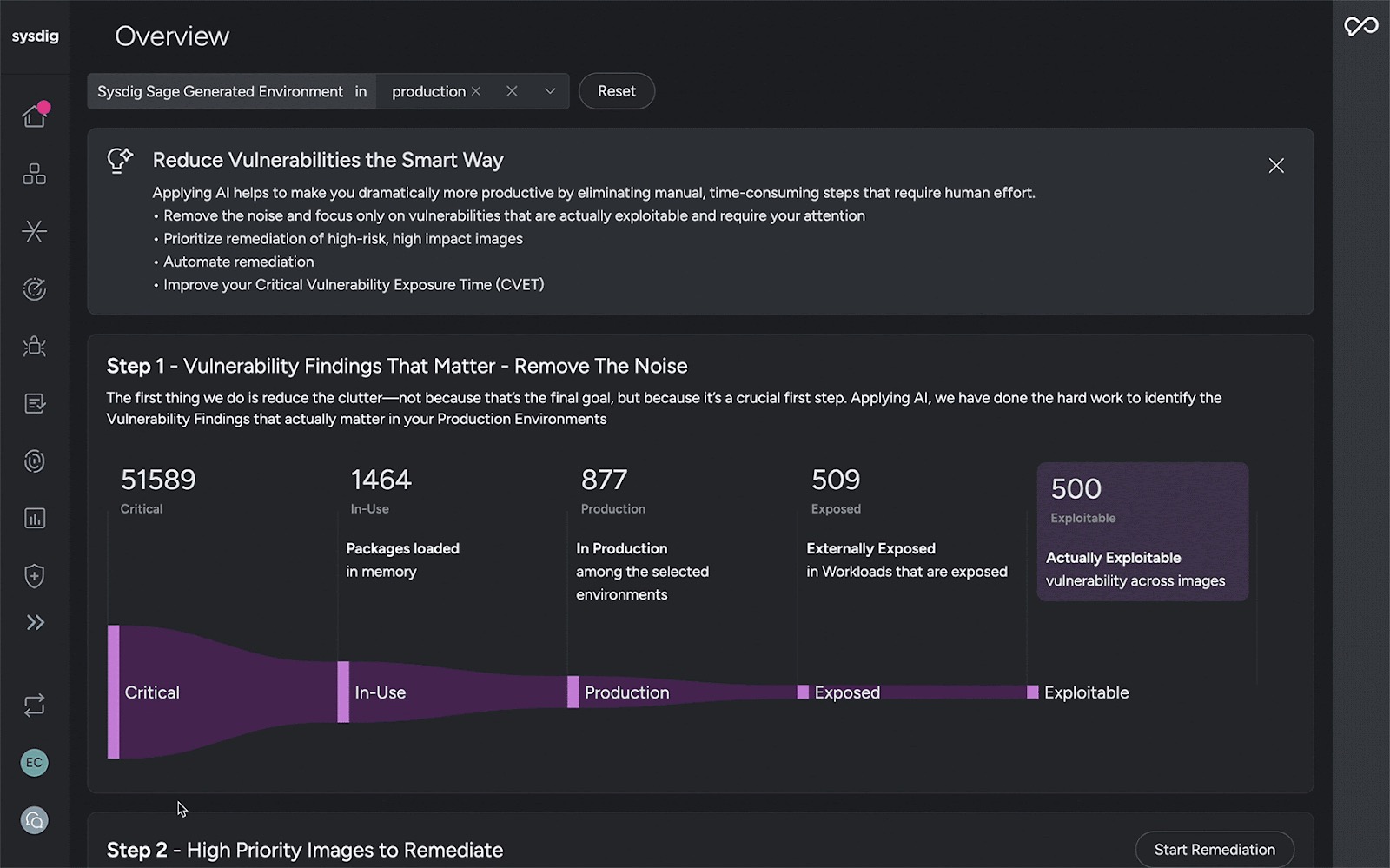
At Sysdig, we believe AI for cloud security must be grounded in the uncompromising truth of runtime. AI is only as good as the signals it sees. Runtime signals provide an accurate view of what’s really happening in your environment. Extending data access with technologies like MCP help broaden the awareness and insights available to AI agents. Combining agentic reasoning, open innovation, and domain expertise helps teams understand, prioritize, and resolve risks faster.

A smarter and faster future for cloud defense

Agentic AI marks a shift from reactive to responsive, from manual to autonomous, from overwhelmed to empowered. It’s the next leap in defending the cloud — a system that doesn’t just alert you to danger but helps you understand and eliminate it.

Security expertise is scarce, and the cloud has only expanded the need for it. The future of security will be built on human-AI teamwork: tireless automation guided by human judgment, with AI that adapts to your environment, your risks, and your goals.

Ready to learn more? Download the Agentic AI For Cloud Security Checklist.