


惯性聚合 高效追踪和阅读你感兴趣的博客、新闻、科技资讯
阅读原文 在惯性聚合中打开

推荐订阅源

Attack and Defense Labs
aimingoo的专栏
aimingoo的专栏
月光博客
月光博客
D
Darknet – Hacking Tools, Hacker News & Cyber Security
K
Kaspersky official blog
Threat Intelligence Blog | Flashpoint
Stack Overflow Blog
Stack Overflow Blog
T
Threatpost
AWS News Blog
AWS News Blog
小众软件
小众软件
美团技术团队
L
Lohrmann on Cybersecurity
Hacker News: Ask HN
Hacker News: Ask HN
Security Latest
Security Latest
Jina AI
Jina AI
Hacker News - Newest:
Hacker News - Newest: "LLM"
宝玉的分享
宝玉的分享
A
Arctic Wolf
M
MIT News - Artificial intelligence
Scott Helme
Scott Helme
爱范儿
爱范儿
The Cloudflare Blog
博客园 - 聂微东
云风的 BLOG
云风的 BLOG
博客园 - 叶小钗
有赞技术团队
有赞技术团队
The GitHub Blog
The GitHub Blog
T
The Blog of Author Tim Ferriss
I
InfoQ
V
Visual Studio Blog
N
Netflix TechBlog - Medium
Latest news
Latest news
C
CERT Recently Published Vulnerability Notes
T
Tenable Blog
H
Heimdal Security Blog
www.infosecurity-magazine.com
Cisco Talos Blog
Cisco Talos Blog
L
LINUX DO - 最新话题
博客园 - 三生石上(FineUI控件)
CTFtime.org: upcoming CTF events
Application and Cybersecurity Blog
T
Threat Research - Cisco Blogs
S
Secure Thoughts
The Hacker News
The Hacker News
S
Schneier on Security
博客园 - 【当耐特】
T
The Exploit Database - CXSecurity.com
博客园_首页
N
News | PayPal Newsroom
cs.CL updates on arXiv.org

Sysdig Blog

Masterclass: AI is more than ChatGPT and LLMs CVE-2026-39987 update: How attackers weaponized marimo to deploy a blockchain botnet via HuggingFace Kubernetes 1.36 - New security features 5 steps to securing AI workloads Marimo OSS Python Notebook RCE: From Disclosure to Exploitation in Under 10 Hours Security briefing: March 2026 The Sysdig MCP server is now available in AWS Marketplace Risk isn’t reduced until you take action: How teams resolve issues in the cloud AI infrastructure security: Why it deserves its own category Three pillars for building effective runtime-powered cloud defense, the right way Closing the cloud security gap with runtime security Seeing risk isn’t stopping it: Why visibility alone isn’t enough TeamPCP expands: Supply chain compromise spreads from Trivy to Checkmarx GitHub Actions AI coding agents are running on your machines — Do you know what they're doing? Runtime security for AI coding agents: Protecting AI-assisted development How runtime insights power every cloud security use case CVE-2026-33017: How attackers compromised Langflow AI pipelines in 20 hours Inline Cloud Response: Accelerating AWS threat containment for SOC teams Runtime malware detection for AWS Fargate Detecting CVE-2026-3288 & CVE-2026-24512: Ingress-nginx configuration injection vulnerabilities for Kubernetes Malware detection with Sysdig Security briefing: February 2026 Leveling up Kubernetes Posture: From baselines to risk-aware admission Eliminating runtime blind spots: How CleanStart and Sysdig build continuous trust across the container lifecycle LLMjacking: From Emerging Threat to Black Market Reality Real risks live at runtime: Why CISOs must care about deep telemetry in 2026 Sysdig named a Leader in the Forrester Wave™: Cloud Native Application Protection Solutions, Q1 2026 How to run rootless containers AI-assisted cloud intrusion achieves admin access in 8 minutes Security briefing: January 2026 Securing GPU-accelerated AI workloads in Oracle Kubernetes Engine Bringing OSS runtime security to AWS: Falco integration with AWS Security Hub CSPM Our customers have spoken: Sysdig rated a Strong Performer in Gartner® Voice of the Customer for Cloud-Native Application Protection Platforms Protecting sensitive business data in preparation for the organization's Gen AI VoidLink threat analysis: Sysdig discovers C2-compiled kernel rootkits AI is still a workload: A practical guide to securing AI workloads How threat actors are using self-hosted GitHub Actions runners as backdoors How Sysdig Sage delivers AI-powered, real-world vulnerability management Security briefing: December 2025 Top 10 ways to get breached in 2026 EtherRAT dissected: How a React2Shell implant delivers 5 payloads through blockchain C2 Introducing runtime file integrity monitoring and response with Sysdig FIM How to detect multi-stage attacks with runtime behavioral analytics EtherRAT: DPRK uses novel Ethereum implant in React2Shell attacks Detecting React2Shell: The maximum-severity RCE vulnerability affecting React Server Components and Next.js The rise of AI agents: How autonomous AI Is transforming cloud security Kubernetes 1.35 - New security features The Urgency of Securing AI Workloads for CISOs Security briefing: November 2025 Quantum and the cloud: Science fiction turned security strategy Cloud security, the right way: What the industry should demand (and why "good enough" isn't) Return of the Shai-Hulud worm affects over 25,000 GitHub repositories Detecting CVE-2024-1086: The decade-old Linux kernel vulnerability that’s being actively exploited in ransomware campaigns What’s old is new again: How to demystify AI security with AIBOMs Securing Kubernetes with agentic cloud security How agentic cloud security reduces real risks Hunting reverse shells: How the Sysdig Threat Research Team builds smarter detection rules Shifting left with AI and MCP: Sysdig + Amazon Q Developer How Falco and Stratoshark close the gap between open source runtime detection and deep forensic analysis Investigating security issues with ChatGPT and the GitHub MCP server New runc vulnerabilities allow container escape: CVE-2025-31133, CVE-2025-52565, CVE-2025-52881 Harden your LLM security with OWASP Security briefing: October 2025 How agentic AI is changing cloud security Sysdig recognized as a Cloud Security Leader in Latio Tech Cloud Security Market Report AI echolocation of cloud risks using Sysdig & Snyk MCP servers Sysdig MCP Server: Bridging AI and cloud security insights Understanding CVE-2025-49844: “RediShell” Critical Remote Code Execution in Redis How Sysdig secures your containers and Kubernetes Sysdig Security Briefing: September 2025 Cloud security, the right way: The 3 pillars of real-time defense Open source spotlight: Bringing web application security to Falco with Falcoya's Nginx plugin Malicious NPM packages: Are you exposed? AI for SOC teams: 5 cloud security prompts to start your day with Sysdig Sage™ Shai-Hulud: The novel self-replicating worm infecting hundreds of NPM packages ZynorRAT technical analysis: Reverse engineering a novel, Turkish Go-based RAT Modern vulnerability management, built for the cloud Build your AWS incident response playbook with open source tools 2025 Gartner® CNAPP Market Guide: Runtime visibility is no longer optional Threat hunting with Sysdig: Uncovering “IngressNightmare” Open source spotlight: From alerts to action with AI-powered Falco Vanguard From triage to action: How Sysdig’s agentic cloud security platform slashes noise and accelerates remediation The vision comes to life: Agentic cloud security with Sysdig Sage™ Data security findings: A technical deep dive Connecting runtime to source: Sysdig and Semgrep integration Fix what matters, faster: How Sysdig and Semgrep are unifying security without silos – from code to runtime Defending sensitive data with Sysdig Secure Redefining cloud security, the right way Join the movement: The Sysdig Open Source Community is live A smarter, safer cloud in the age of AI Unifying detection and response: Sysdig + Cortex XSOAR for security at cloud speed The future of security is open, and it needs a unified hub: The Sysdig Open Source Community is here CVE-2025-53104: Command injection via GitHub Actions workflow in gluestack-ui Why MCP server security is critical for AI-driven enterprises What’s new in Sysdig — June 2025 AI-powered CNAPP with Sysdig Sage™ Revolutionizing Cybersecurity Search with Sysdig Sage™ Sysdig Threat Bulletin: Iranian Cyber Threats The end of the prioritization-only era: Vulnerability management needs action Dangerous by default: Insecure GitHub Actions found in MITRE, Splunk, and other open source repositories
Kubernetes Incident Response: Detect, investigate, and contain in under 10 minutes
Paolo Polidori · 2025-10-23 · via Sysdig Blog

Why response matters in Kubernetes

In modern Kubernetes environments, detecting threats is only half the battle. What truly matters is how quickly and effectively you can respond, should a threat be detected. With workloads spinning up and down in seconds, and containers often leaving behind little trace, the window for meaningful action is narrow. Sysdig’s 555 Benchmark for Cloud Detection and Response shows that fast detection alone isn’t enough. You need to detect, investigate, and respond in under 10 minutes.  In this blog, we will take you through a Kubernetes detection and response workflow to show how Sysdig’s inline response actions deliver better outcomes with speed and confidence.

Faster response times have a direct impact on Mean Time to Contain (MTTC), reducing the window in which attackers can move laterally or exfiltrate data. By shortening MTTC, teams minimize risk exposure and limit the blast radius of an incident.

We recently published a blog on inline response actions for host environments. In this blog, we will explore a Kubernetes-specific response workflow using Sysdig’s latest inline capabilities.

Introducing inline Kubernetes actions

Inline response actions enable you to take immediate, context-aware action directly from a Sysdig event, so you can respond to threats or issues without switching tools. From taking a volume snapshot to isolating the network, automated and precise response actions are essential to reduce dwell time, contain incidents, and keep Kubernetes environments secure.

Accessing workloads to investigate and respond to security incidents often requires help from other teams with different skill sets. This dependency slows down response efforts and adds unnecessary complexity for security teams. Kubernetes makes the challenge even harder by introducing additional layers of abstraction and operational intricacy.

Responding to incidents typically requires:

  • Having the right access to target resources
  • Knowing how to locate and connect to those resources
  • Understanding Kubernetes specifics, such as which commands to run and how
  • Navigating the risk of unintentionally impacting production environments

Sysdig addresses this by expanding response capabilities directly to the areas where security teams struggle most. With Sysdig, access and connectivity are handled automatically, and the need for deep Kubernetes expertise is greatly reduced. This minimizes the risk of mistakes and accelerates your ability to respond effectively across your managed on-prem and cloud Kubernetes environments (e.g., GCP, AZURE, AWS, Oracle, etc.).

Let’s walk through a real-world incident response scenario using the Sysdig Threat Management Dashboard. We’ll show how contextual insights and inline actions streamline investigation and remediation, putting your team on their way to meeting the 555 benchmark.

Walkthrough: Real-world high-severity Kubernetes threat

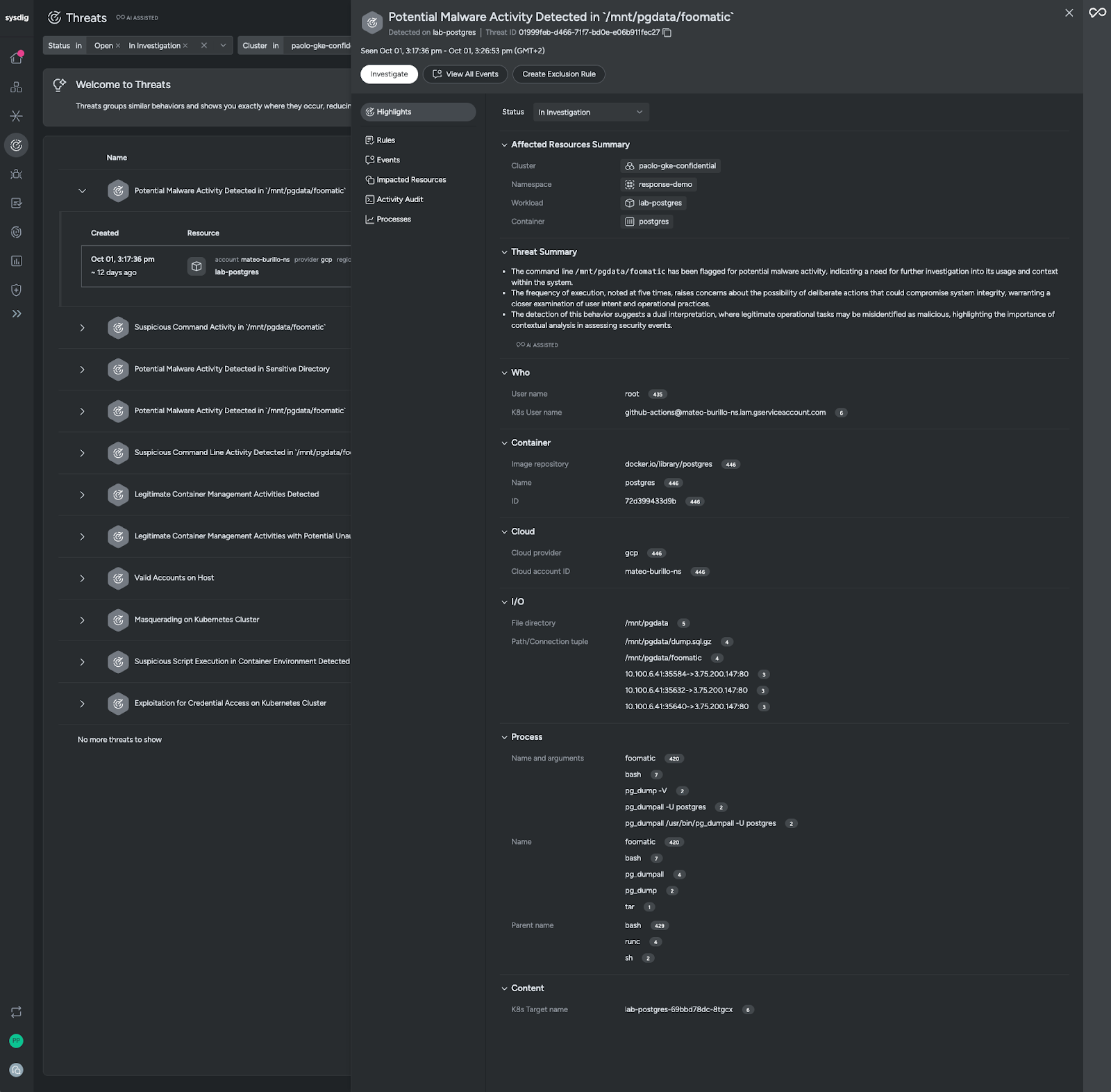
As we review the Sysdig Threat Management dashboard, our attention is grabbed by a high severity Kubernetes threat being detected on a workload labeled “Potential Malware Activity.”
Critical context at your fingertips

Clicking into the threat detection, we rapidly gain critical context via the threat summary provided by Sysdig Sage™. We learn:

  • The command line /mnt/pgdata/foomatic has been flagged for potential malware activity, indicating a need for further investigation into its usage and context within the system.
  • The frequency of execution, noted at five times, raises concerns about the possibility of deliberate actions that could compromise system integrity. This warrants a closer examination of user intent and operational practices.
  • The detection of this behavior suggests a dual interpretation, where legitimate operational tasks may be misidentified as malicious, highlighting the importance of contextual analysis in assessing security events.

Drilling deeper

Context below the threat summary will give us additional clues to understand the who, what, where, when, and how of this potential threat:

  • The github-action service account executed something.
  • Some connections were made to the HTTP port.
  • pg_dumpall was executed along with tar and a suspicious foomatic utilization.

Defining the scope of impact

As we dig in, we will look to understand the scope of impact, and especially the specific resources involved. In this example, we note that the impacted resource is a Kubernetes Deployment of Postgres in GKE.

Evaluating correlated events

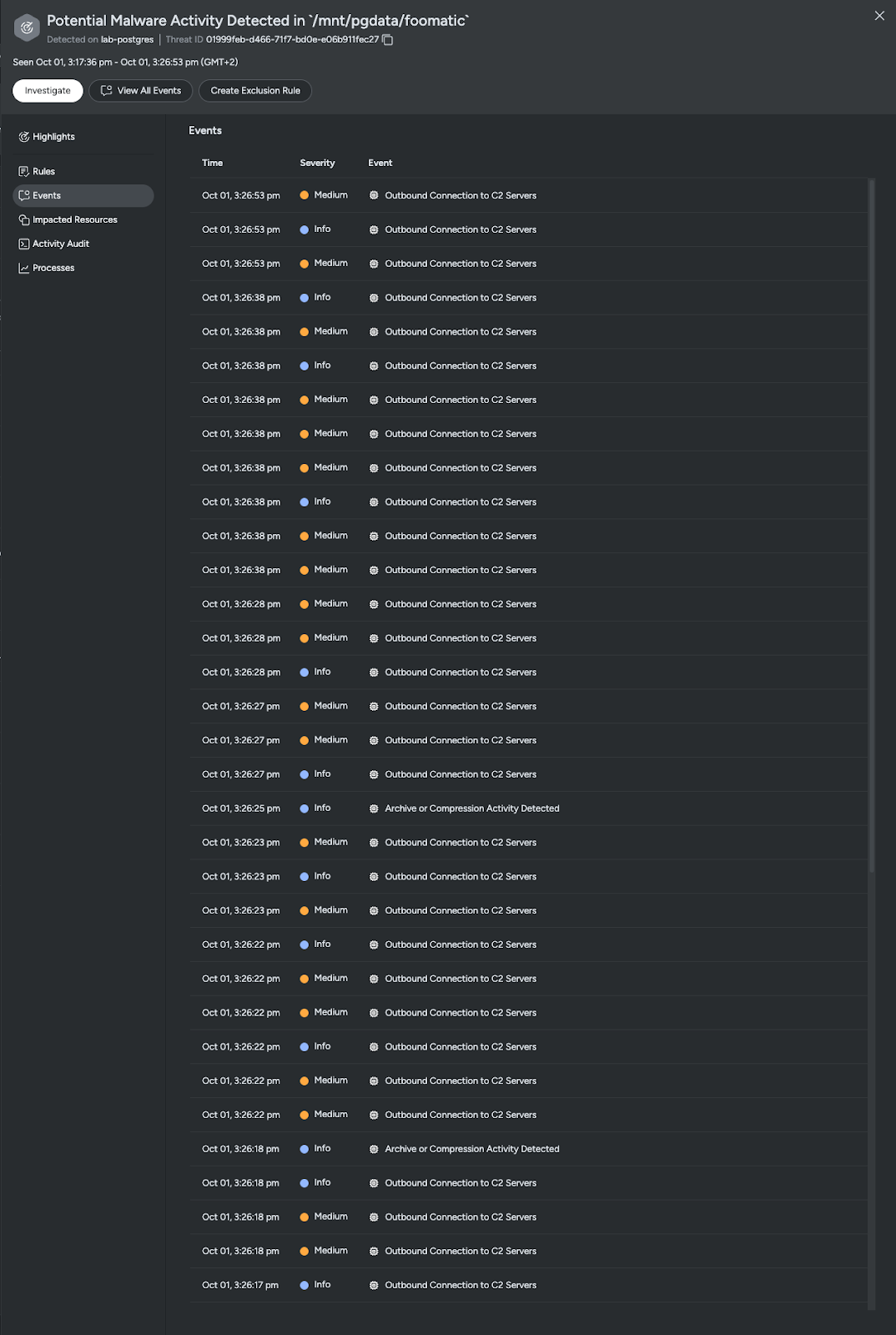
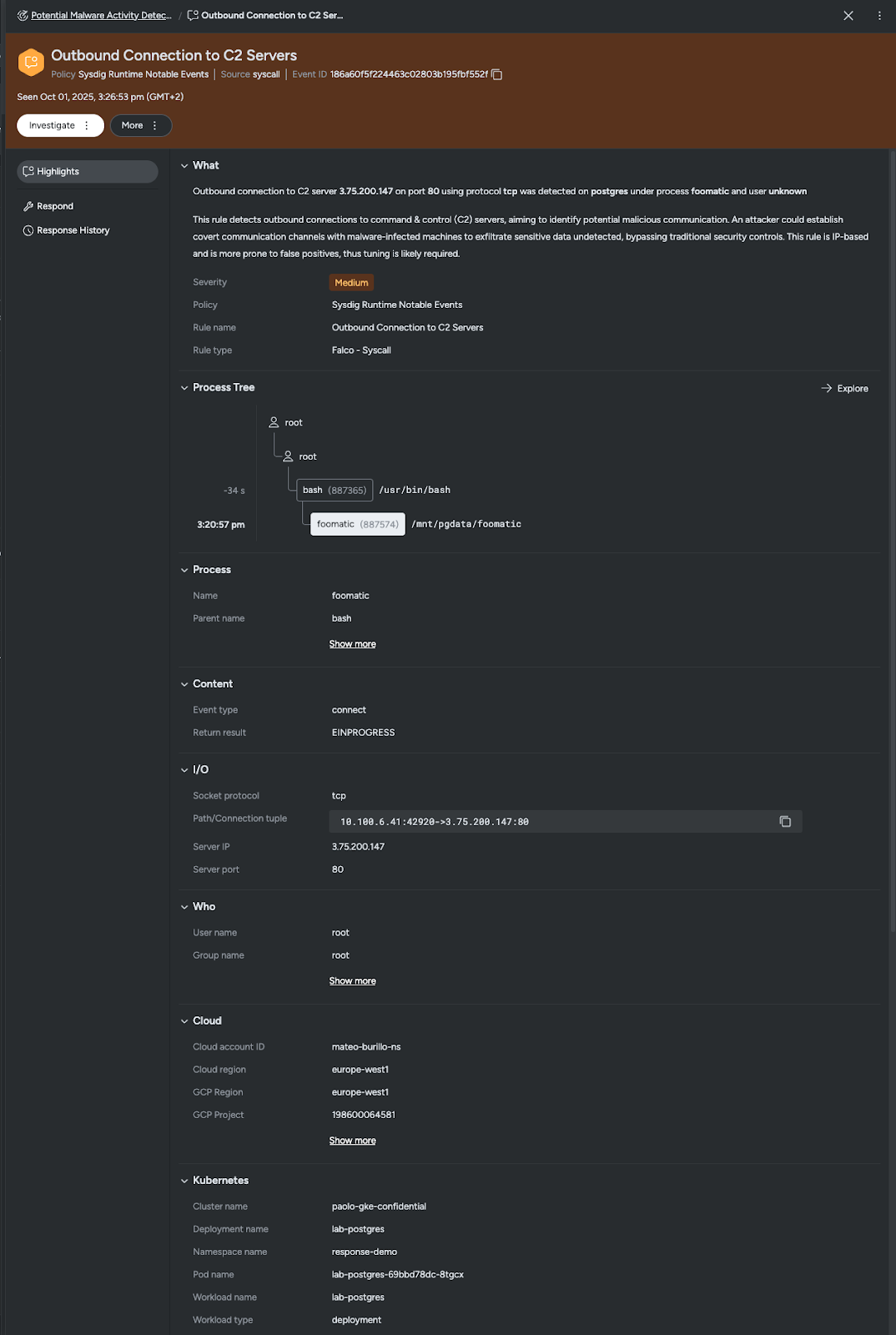
After understanding what resources were impacted, we pivot into the individual but related events that made up the threat. Our detections show a flurry of outbound connections to C2 servers, performed by foomatic, the same unknown potentially malicious executable shown in the Threat Summary.
Evaluating potentially explosive combos

Checking into further events in the C2 connections, we see the potential correlation between postgresql deployment in alignment with behaviors where `foomatic` was leveraged. This is alarming, as other events have triggered for `foomatic` as the result of its malware designation.

With the observed information, we can say with high confidence that this is not a benign action or a false positive.

Collecting Kubernetes forensic data with Sysdig

Our next workflow step is to collect forensic data, so that after we remediate the threat we have sufficient artifacts to perform an accurate post-mortem analysis. The new Kubernetes response capabilities broaden the available actions you can execute inline with just a few clicks. For impactful collections, Sysdig has new capabilities:
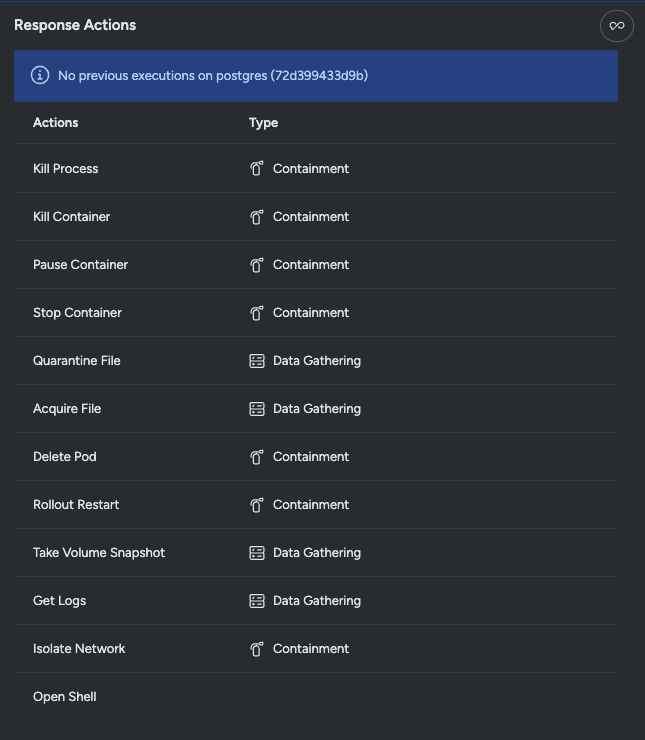
  • Volume snapshot: Capture the content of a volume that can later be mounted and analyzed, allowing you to perform cleanup activities. A secondary use case is to collect the volumes without the attacker knowing so they cannot just delete their tracks, further compromising forensic analysis.
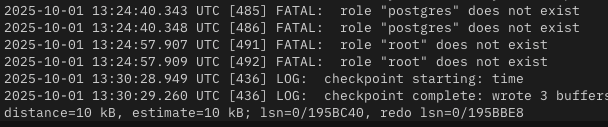
  • Get logs: Access the Kubernetes logs from applications, showing authentications and other behaviors that can be used to better understand the course of action during an attack.

Knowing that malware from inside a workload was executed, we should immediately take a snapshot of the volume from the postgresql victim workload.
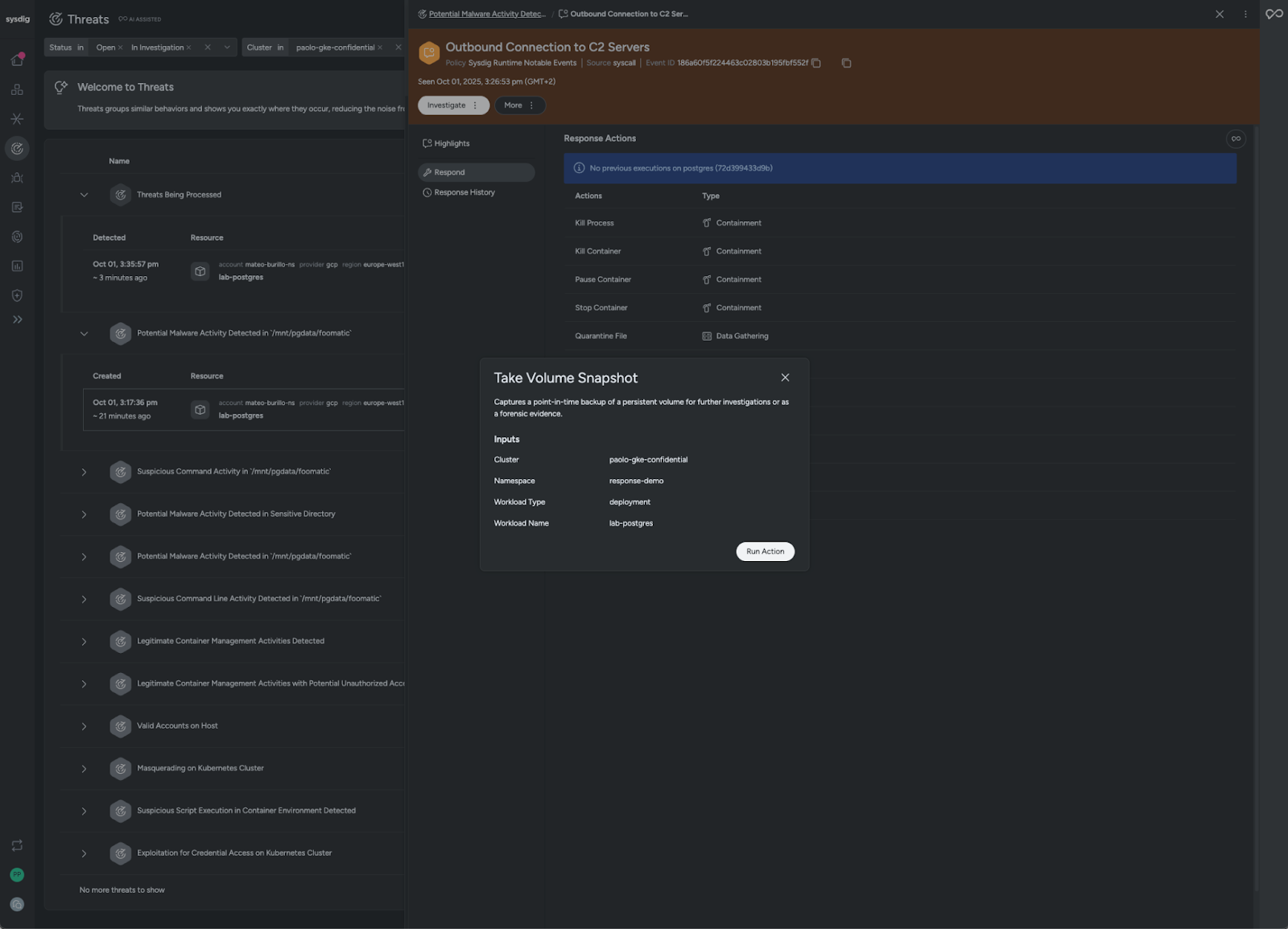
This snapshot allows us to reconstruct the attack, assess its impact, and improve defenses to prevent recurrence.
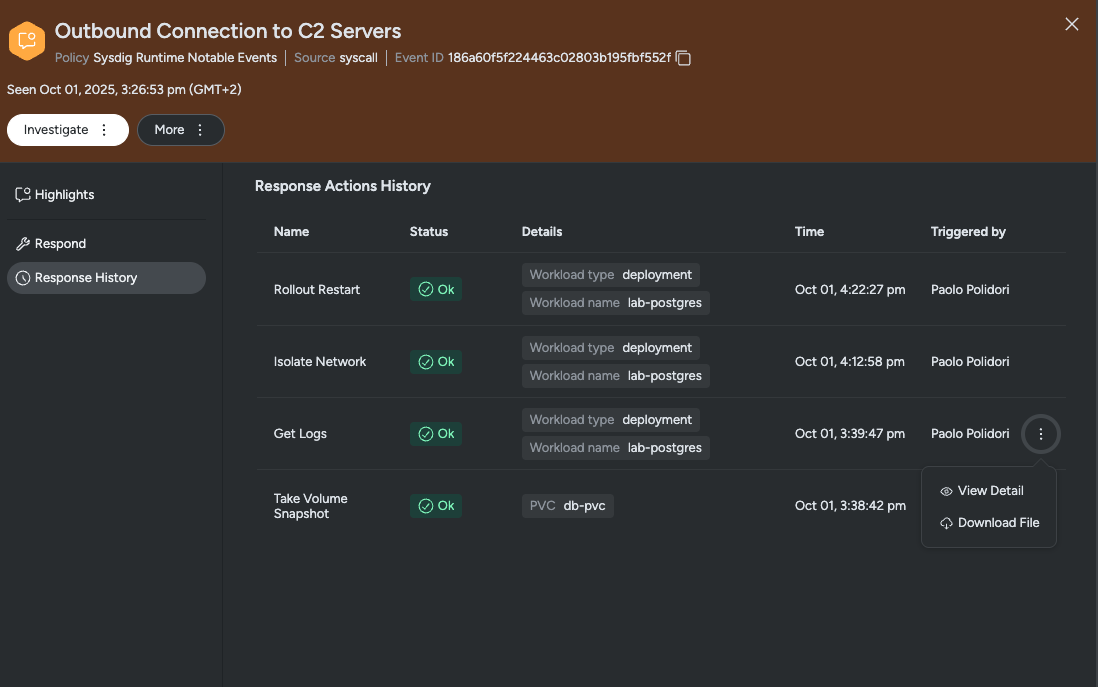
Digging deeper, we will use Get Logs to see how the attacker interacted with the deployment. During this analysis, we see multiple failed authentication attempts. This likely indicates attempted data exfiltration.
Threat containment and recovery: How Sysdig accelerates response actions

Regardless of whether data was exfiltrated or not, this behavior needs to be stopped. Previously, this would have required teams to have extensive domain expertise capabilities, including:

  • Kubernetes knowledge, to execute the right commands with the right syntax without risking unwanted disruptions
  • Infrastructure knowledge, i.e., where things are located and how to access a cluster

Teams also needed to either have the right permissions, or involve people who have those permissions.

How Sysdig streamlines the containment

Sysdig’s new Kubernetes actions make this process faster and simpler with some powerful containment actions:

  • Rollout restart: Clean up the pods of a workload, forcing them to be recreated from a fresh state without disrupting normal operations.
  • Delete pod: Eliminate a compromised workload. This is useful in case of non-critical standalone pods that can be eliminated without impacting production environments, as well as pods that are not part of a workload, like in CronJobs. This is also helpful when you want to enact a more precise workload cleanup on single pods.
  • Isolate network: Block connections, incoming or outgoing, broadly to all connections or more narrowly to specific ports/IPs.

Real-world containment example

In this scenario, we wouldn't expect a database to perform HTTP connections, so we can safely stop the connection to the C2 IP, since we’re now sure it’s an undesired connection. To take a bolder approach, we could block all connections to port 80, or even block all outgoing connections, as a database hardly needs them. In this scenario, we wanted to take a safe and conservative approach, so we decided to stop connections to the exact IP and port.
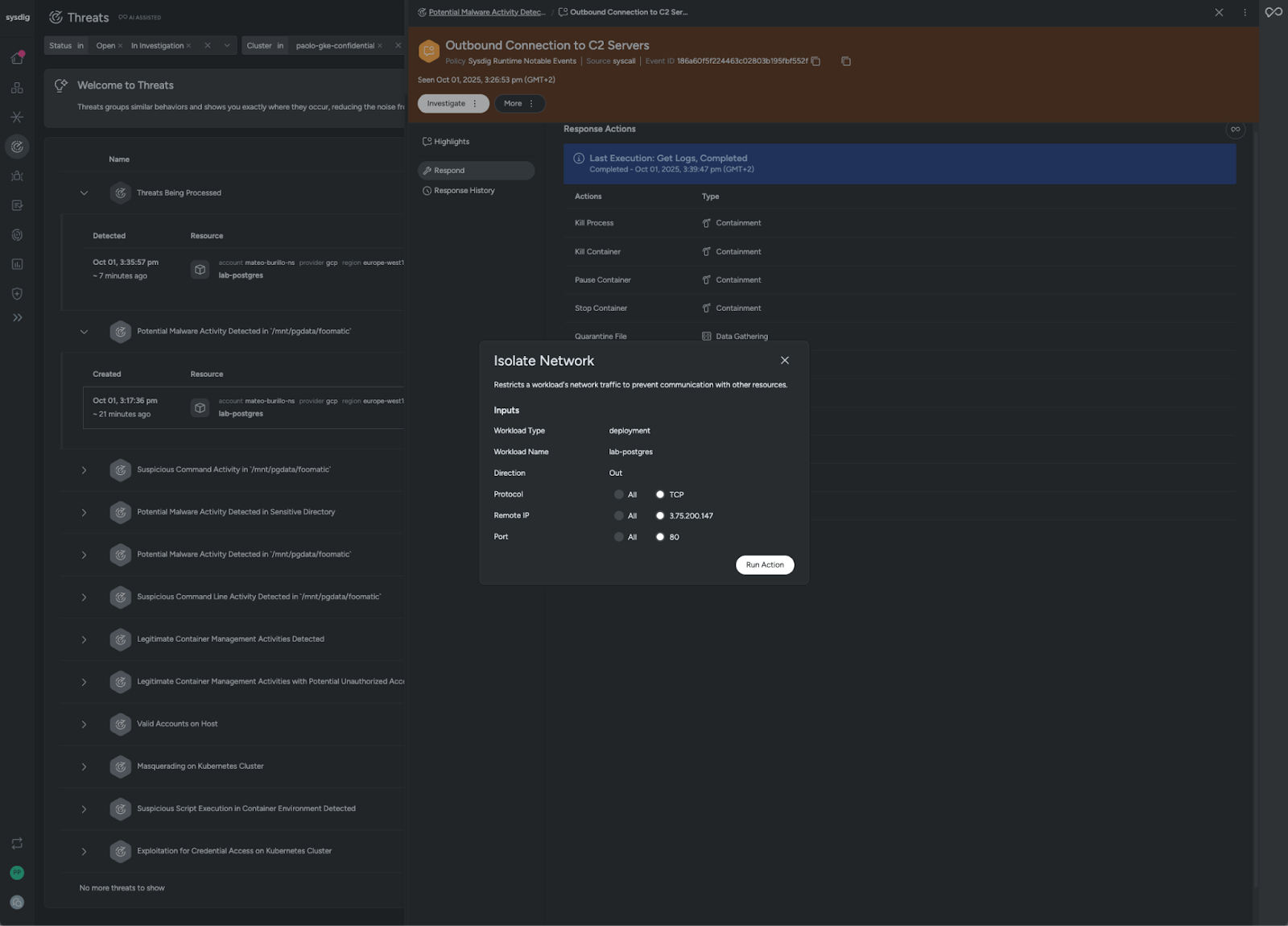
Stopping the connections to the exact IP and port should be more than adequate to stop the threat. However, because we already collected the necessary forensic data, we can restart the workload to remove any persistence and reduce the risk of repeat attacks. Using these new features, teams can shorten the time between detection and resolution, enabling security teams to act with precision and confidence at cloud-native speed.

Final thoughts

Responding quickly and confidently to Kubernetes threats requires more than just detection; it demands fast, contextually informed action. With workloads changing constantly and threats hiding in ephemeral environments, traditional incident response approaches can no longer keep up.

Sysdig’s new inline Kubernetes response capabilities extend detection with powerful, targeted actions that help teams investigate, contain, and remediate threats, without requiring deep Kubernetes expertise or cumbersome cross-team dependencies.

These capabilities slash mean time to contain (MTTC) by enabling instant, in-context action. Teams can stop threats faster, limit damage, and reduce risk before it spreads.

By providing automated tools like volume snapshots, log retrieval, and network isolation, Sysdig empowers security and platform teams to reduce dwell time, prevent attacker persistence, and strengthen defenses against future attacks.