


惯性聚合 高效追踪和阅读你感兴趣的博客、新闻、科技资讯
阅读原文 在惯性聚合中打开

推荐订阅源

V
Vulnerabilities – Threatpost
Google DeepMind News
T
Threatpost
AWS News Blog
AWS News Blog
NISL@THU
NISL@THU
Security Latest
Security Latest
C
Cisco Blogs
Spread Privacy
Spread Privacy
Simon Willison's Weblog
L
LINUX DO - 热门话题
Know Your Adversary
Know Your Adversary
L
LINUX DO - 最新话题
P
Privacy & Cybersecurity Law Blog
SecWiki News
SecWiki News
O
OpenAI News
Threat Intelligence Blog | Flashpoint
H
Hacker News: Front Page
Scott Helme
Scott Helme
C
Check Point Blog
WordPress大学
WordPress大学
钛媒体:引领未来商业与生活新知
钛媒体:引领未来商业与生活新知
爱范儿
爱范儿
博客园 - 【当耐特】
H
Heimdal Security Blog
The Hacker News
The Hacker News
罗磊的独立博客
C
CERT Recently Published Vulnerability Notes
美团技术团队
Application and Cybersecurity Blog
S
SegmentFault 最新的问题
Last Week in AI
Last Week in AI
Project Zero
Project Zero
OSCHINA 社区最新新闻
OSCHINA 社区最新新闻
宝玉的分享
宝玉的分享
The Register - Security
A
Arctic Wolf
酷 壳 – CoolShell
酷 壳 – CoolShell
G
GRAHAM CLULEY
L
Lohrmann on Cybersecurity
T
The Blog of Author Tim Ferriss
G
Google Developers Blog
Attack and Defense Labs
博客园 - 叶小钗
大猫的无限游戏
大猫的无限游戏
Latest news
Latest news
I
InfoQ
K
KPMG report finds enterprise disconnect between AI and its ROI | CIO
Y
Y Combinator Blog
J
Java Code Geeks
S
Security @ Cisco Blogs

Sysdig Blog

Masterclass: AI is more than ChatGPT and LLMs CVE-2026-39987 update: How attackers weaponized marimo to deploy a blockchain botnet via HuggingFace Kubernetes 1.36 - New security features 5 steps to securing AI workloads Marimo OSS Python Notebook RCE: From Disclosure to Exploitation in Under 10 Hours Security briefing: March 2026 The Sysdig MCP server is now available in AWS Marketplace Risk isn’t reduced until you take action: How teams resolve issues in the cloud AI infrastructure security: Why it deserves its own category Three pillars for building effective runtime-powered cloud defense, the right way Closing the cloud security gap with runtime security Seeing risk isn’t stopping it: Why visibility alone isn’t enough TeamPCP expands: Supply chain compromise spreads from Trivy to Checkmarx GitHub Actions AI coding agents are running on your machines — Do you know what they're doing? Runtime security for AI coding agents: Protecting AI-assisted development How runtime insights power every cloud security use case CVE-2026-33017: How attackers compromised Langflow AI pipelines in 20 hours Inline Cloud Response: Accelerating AWS threat containment for SOC teams Runtime malware detection for AWS Fargate Detecting CVE-2026-3288 & CVE-2026-24512: Ingress-nginx configuration injection vulnerabilities for Kubernetes Malware detection with Sysdig Security briefing: February 2026 Leveling up Kubernetes Posture: From baselines to risk-aware admission Eliminating runtime blind spots: How CleanStart and Sysdig build continuous trust across the container lifecycle LLMjacking: From Emerging Threat to Black Market Reality Real risks live at runtime: Why CISOs must care about deep telemetry in 2026 Sysdig named a Leader in the Forrester Wave™: Cloud Native Application Protection Solutions, Q1 2026 How to run rootless containers AI-assisted cloud intrusion achieves admin access in 8 minutes Security briefing: January 2026 Securing GPU-accelerated AI workloads in Oracle Kubernetes Engine Bringing OSS runtime security to AWS: Falco integration with AWS Security Hub CSPM Our customers have spoken: Sysdig rated a Strong Performer in Gartner® Voice of the Customer for Cloud-Native Application Protection Platforms Protecting sensitive business data in preparation for the organization's Gen AI VoidLink threat analysis: Sysdig discovers C2-compiled kernel rootkits AI is still a workload: A practical guide to securing AI workloads How threat actors are using self-hosted GitHub Actions runners as backdoors How Sysdig Sage delivers AI-powered, real-world vulnerability management Security briefing: December 2025 Top 10 ways to get breached in 2026 EtherRAT dissected: How a React2Shell implant delivers 5 payloads through blockchain C2 Introducing runtime file integrity monitoring and response with Sysdig FIM How to detect multi-stage attacks with runtime behavioral analytics EtherRAT: DPRK uses novel Ethereum implant in React2Shell attacks Detecting React2Shell: The maximum-severity RCE vulnerability affecting React Server Components and Next.js The rise of AI agents: How autonomous AI Is transforming cloud security Kubernetes 1.35 - New security features The Urgency of Securing AI Workloads for CISOs Security briefing: November 2025 Quantum and the cloud: Science fiction turned security strategy Cloud security, the right way: What the industry should demand (and why "good enough" isn't) Return of the Shai-Hulud worm affects over 25,000 GitHub repositories Detecting CVE-2024-1086: The decade-old Linux kernel vulnerability that’s being actively exploited in ransomware campaigns What’s old is new again: How to demystify AI security with AIBOMs Securing Kubernetes with agentic cloud security How agentic cloud security reduces real risks Hunting reverse shells: How the Sysdig Threat Research Team builds smarter detection rules Shifting left with AI and MCP: Sysdig + Amazon Q Developer How Falco and Stratoshark close the gap between open source runtime detection and deep forensic analysis Investigating security issues with ChatGPT and the GitHub MCP server New runc vulnerabilities allow container escape: CVE-2025-31133, CVE-2025-52565, CVE-2025-52881 Harden your LLM security with OWASP Security briefing: October 2025 How agentic AI is changing cloud security Kubernetes Incident Response: Detect, investigate, and contain in under 10 minutes Sysdig recognized as a Cloud Security Leader in Latio Tech Cloud Security Market Report AI echolocation of cloud risks using Sysdig & Snyk MCP servers Sysdig MCP Server: Bridging AI and cloud security insights Understanding CVE-2025-49844: “RediShell” Critical Remote Code Execution in Redis How Sysdig secures your containers and Kubernetes Sysdig Security Briefing: September 2025 Cloud security, the right way: The 3 pillars of real-time defense Open source spotlight: Bringing web application security to Falco with Falcoya's Nginx plugin Malicious NPM packages: Are you exposed? AI for SOC teams: 5 cloud security prompts to start your day with Sysdig Sage™ Shai-Hulud: The novel self-replicating worm infecting hundreds of NPM packages ZynorRAT technical analysis: Reverse engineering a novel, Turkish Go-based RAT Modern vulnerability management, built for the cloud Build your AWS incident response playbook with open source tools Threat hunting with Sysdig: Uncovering “IngressNightmare” Open source spotlight: From alerts to action with AI-powered Falco Vanguard From triage to action: How Sysdig’s agentic cloud security platform slashes noise and accelerates remediation The vision comes to life: Agentic cloud security with Sysdig Sage™ Data security findings: A technical deep dive Connecting runtime to source: Sysdig and Semgrep integration Fix what matters, faster: How Sysdig and Semgrep are unifying security without silos – from code to runtime Defending sensitive data with Sysdig Secure Redefining cloud security, the right way Join the movement: The Sysdig Open Source Community is live A smarter, safer cloud in the age of AI Unifying detection and response: Sysdig + Cortex XSOAR for security at cloud speed The future of security is open, and it needs a unified hub: The Sysdig Open Source Community is here CVE-2025-53104: Command injection via GitHub Actions workflow in gluestack-ui Why MCP server security is critical for AI-driven enterprises What’s new in Sysdig — June 2025 AI-powered CNAPP with Sysdig Sage™ Revolutionizing Cybersecurity Search with Sysdig Sage™ Sysdig Threat Bulletin: Iranian Cyber Threats The end of the prioritization-only era: Vulnerability management needs action Dangerous by default: Insecure GitHub Actions found in MITRE, Splunk, and other open source repositories
2025 Gartner® CNAPP Market Guide: Runtime visibility is no longer optional
2025-08-07 · via Sysdig Blog

Over the past 12 months, the cloud-native application protection platform (CNAPP) market has seen an enormous amount of change with no signs of slowing down — and customers are taking notice.

We believe the latest Gartner Market Guide for Cloud-Native Application Protection Platforms is an incredibly helpful resource in understanding the value CNAPP solutions provide, their key capabilities, and future planning assumptions. Read on to find out what our most important takeaways are from this year’s report.

Read the 2025 Gartner Market Guide for Cloud-Native Application Protection Platforms now.

Benefits of a CNAPP platform

Gartner’s definition of CNAPP has remained largely unchanged:

“Cloud-native application protection platforms (CNAPPs) are a unified and tightly integrated set of security and compliance capabilities, designed to protect cloud-native infrastructure and applications. CNAPPs incorporate an integrated set of proactive and reactive security capabilities, including artifact scanning, security guardrails, configuration and compliance management, risk detection and prioritization, and behavioral analytics, providing visibility, governance and control from code creation to production runtime.”

We believe CNAPP platforms help teams by providing:

  • Increased efficiency
    CNAPPs simplify security operations by replacing multiple point products and providing a unified view of risk. This streamlines processes, freeing teams from the burden of mastering various tools and managing alerts from different sources. 
  • Comprehensive visibility
    CNAPPs provide a unified view for teams to swiftly pinpoint issues, events, and potential attack paths. Through user-friendly visual layouts, alerts, suggestions, and guidance for remedial actions, you can make informed decisions and proactively safeguard against threats.
  • Enhanced detection of cloud threats
    CNAPPs offer an end-to-end solution, ensuring consistent threat detection and visibility across any workload, cloud, or service. By leveraging techniques such as machine learning and threat feeds, CNAPPs enable organizations to effectively identify and respond to threats, reducing the attack surface in cloud-native environments.

As the category continues to expand rapidly, the sheer number of capabilities that can be considered under the CNAPP umbrella has made it difficult for customers to understand what they need to have versus what is nice to have. Gartner has brought some clarity to this question:
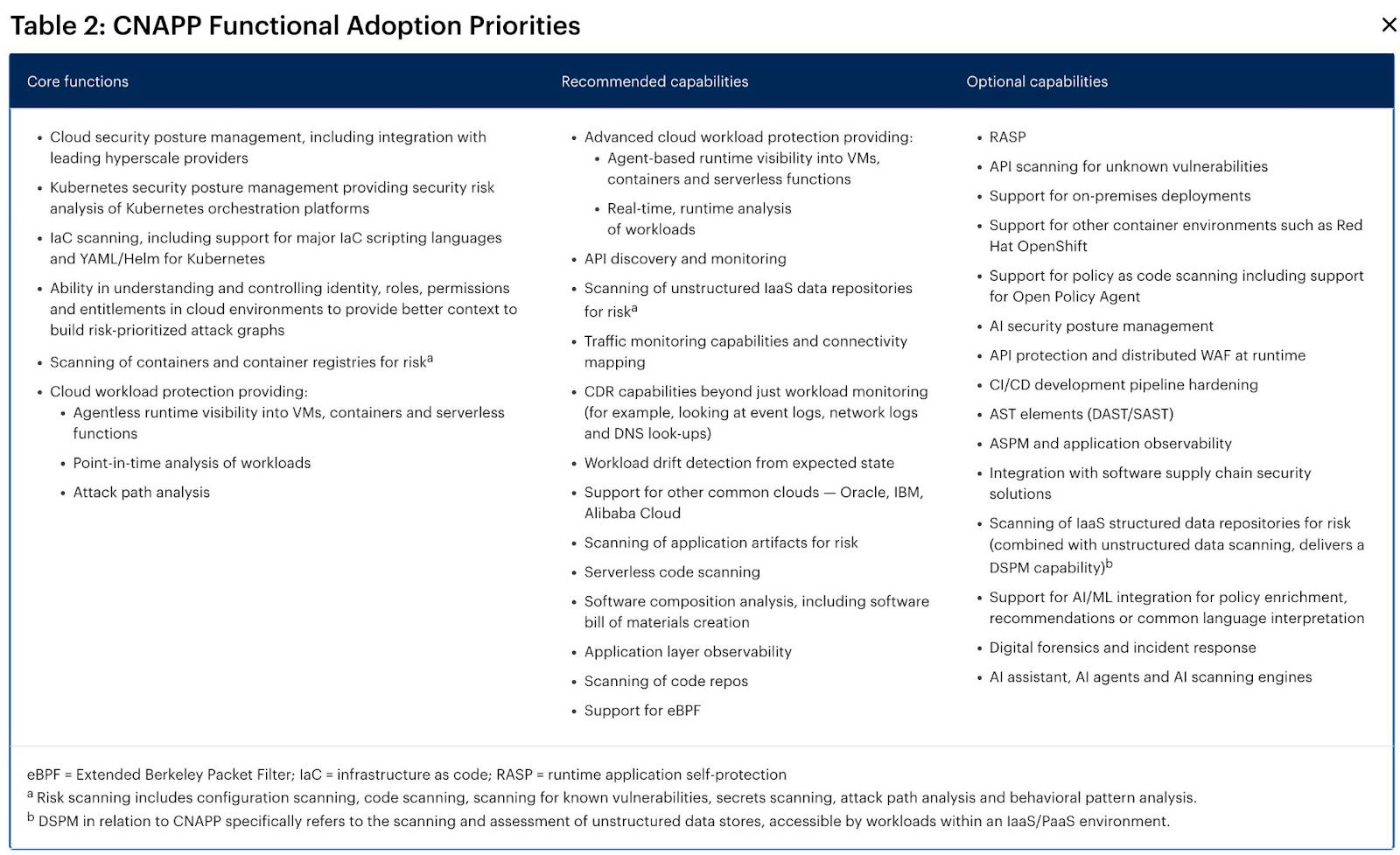
Notable additions to Optional Capabilities include “AI assistant, AI agents, and AI scanning engines.” As Gartner notes, “CNAPP solutions are increasingly incorporating generative AI (GenAI), common language interpreters, machine learning (ML) and large language models (LLMs) to reduce management overhead, offer policy recommendations, and enhance pattern analysis for threat detection and response.” In our view, it’s clear that Gartner recognizes the key role AI will play in moving the CNAPP market forward.

Sysdig announced our own AI cloud security analyst, Sysdig Sage, in 2023, and recently completed the full integration into Sysdig Secure. Sysdig Sage uses multi-step reasoning to analyze complex attack patterns and understand how seemingly unrelated events are connected. It correlates signals across multiple domains to identify hidden or emerging threats that traditional tools may miss.

Runtime visibility lets you fix what matters faster

At Sysdig, we believe true cloud security starts at runtime. Runtime is the highest fidelity signal in cloud security. Most tools miss what’s running right now, creating blind spots during both prevention and response. By rooting all decisions in what’s actually in use at runtime — along with real context — security teams can make better risk decisions and prioritize their day. This extends to security operations teams, who use runtime context as a key input in identifying and prioritizing threats:

“They need the capabilities to pull contextual runtime data on behavior and threats while feeding this context into SIEM and SOC services for event correlation. Without this context, security operations (SecOps) finds it challenging to manage runtime vulnerabilities discovered within published workloads and identify abnormal workload co-pilots resulting from exploiting vulnerabilities or excessive privileges.”

With help from runtime insights, SecOps teams are able to stop drawing in false positives and enable faster, more accurate responses to cloud threats.

Enhanced prioritization helps connect dev and security 

Prioritizing risk is one of the key use cases for a CNAPP. This is especially important during development to ensure that risks are not introduced into production. Assigning ownership, notifying the right teams, and tracking remediation progress can be surprisingly difficult, especially when there’s a disconnect between security and development teams. Security teams might flag a critical vulnerability, but that doesn’t mean it will get addressed anytime soon. Developers are under pressure to deliver features fast, and security tasks often land as unexpected, low-context interruptions. Without a shared view of risk and clear accountability, even critical vulnerabilities can linger unresolved for weeks or months.
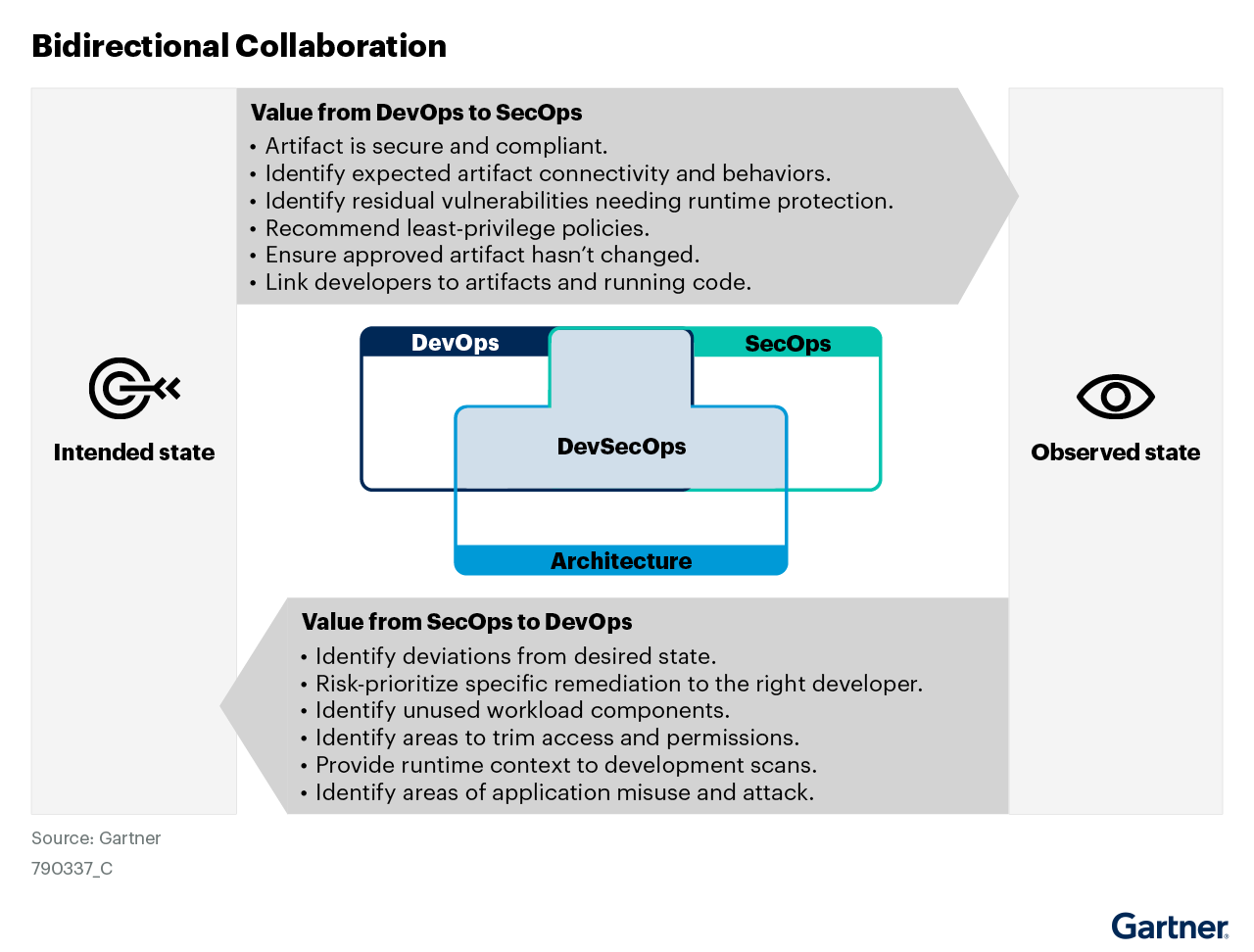
According to Gartner, one of the characteristics a single vendor CNAPP needs to have is:

“An understanding of the relationship between development artifacts (custom code, libraries, container images, VMs and IaC scripts), who created them and when they were created, who deployed them and when they were deployed, and who changed them and when they were changed. Mapping of accountability and responsibility to code and artifacts is critical.”

To address this, we’ve recently announced our partnership with Semgrep, which helps enterprises reduce risk surface area through improved prioritization and streamlined find/fix cycles. One of the benefits of this partnership is improved identification of ownership - customers are able to map vulnerabilities discovered at runtime back to the originating application teams or service owners (derived from source control/SCA data), which enables clearer, more direct ticket assignment and accountability.

The role of AI within CNAPP

One of the biggest issues for cloud security and developer teams is that they spend thousands of hours each year triaging alerts, often taking more time deciding what to fix than actually addressing and resolving their issues. Risk prioritization in current tools often falls short due to a lack of business context. This causes delays in response, which prolong exposure to business-critical threats that could disrupt key functions and compromise sensitive data.

We believe AI can help by redefining risk prioritization and remediation strategies, allowing teams to enhance productivity, shorten time to resolution, and significantly reduce business risk. According to Gartner:

“The expectation is that these new AI capabilities will significantly improve risk management and reduce mean time to resolution (MTTR), resulting in quicker detection and response to cloud infrastructure and application risks both proactively and reactively.” 

Summary

It’s clear that the need for CNAPP solutions is only increasing. In fact, Gartner believes that “By 2029, 50% of all enterprise applications are expected to operate in containers, necessitating enhanced and unified security controls for cloud and applications.”

Security strategies that rely on disconnected point solutions — even if those solutions are considered “best of breed” — will increasingly struggle to meet the demands of the current threat landscape. 

The time has come for a unified approach. And for truly comprehensive, end-to-end security, organizations should look for a CNAPP that: 

  • Prioritizes active risk through the use of runtime insights to help zero in on the most urgent security issues.
  • Provides real-time detection so teams can investigate and respond to threats within minutes.
  • Enables a unified view of all cloud risks and threats, no matter what kind of environment you have.

Ready to start consolidating your cloud security? Check out Sysdig’s runtime-powered CNAPP solution, or read the full report from Gartner today!

Gartner® Market Guide for Cloud-Native Application Protection Platforms

DOWNLOAD NOW

Gartner, Market Guide for Cloud-Native Application Protection Platforms, Dale Koeppen, Esraa ElTahawy, Neil MacDonald, 6 August 2025.

GARTNER is a registered trademark and service mark of Gartner, Inc. and/or its affiliates in the U.S. and internationally and is used herein with permission. All rights reserved.

Gartner does not endorse any vendor, product or service depicted in its research publications, and does not advise technology users to select only those vendors with the highest ratings or other designation. Gartner research publications consist of the opinions of Gartner’s research organization and should not be construed as statements of fact. Gartner disclaims all warranties, expressed or implied, with respect to this research, including any warranties of merchantability or fitness for a particular purpose.