


惯性聚合 高效追踪和阅读你感兴趣的博客、新闻、科技资讯
阅读原文 在惯性聚合中打开

推荐订阅源

The GitHub Blog
The GitHub Blog
K
Kaspersky official blog
Stack Overflow Blog
Stack Overflow Blog
Blog — PlanetScale
Blog — PlanetScale
Recorded Future
Recorded Future
Engineering at Meta
Engineering at Meta
U
Unit 42
D
Docker
I
InfoQ
D
DataBreaches.Net
Google DeepMind News
N
Netflix TechBlog - Medium
C
Check Point Blog
The Cloudflare Blog
美团技术团队
V
Vulnerabilities – Threatpost
博客园_首页
T
Threat Research - Cisco Blogs
Google DeepMind News
Attack and Defense Labs
A
Arctic Wolf
IT之家
IT之家
让小产品的独立变现更简单 - ezindie.com
Exploit-DB.com RSS Feed
T
Troy Hunt's Blog
cs.CL updates on arXiv.org
人人都是产品经理
人人都是产品经理
C
Cyber Attacks, Cyber Crime and Cyber Security
钛媒体:引领未来商业与生活新知
钛媒体:引领未来商业与生活新知
Security Archives - TechRepublic
S
Schneier on Security
Apple Machine Learning Research
MyScale Blog
MyScale Blog
P
Privacy International News Feed
云风的 BLOG
云风的 BLOG
Recent Commits to openclaw:main
T
The Blog of Author Tim Ferriss
GbyAI
GbyAI
The Last Watchdog
The Last Watchdog
D
Darknet – Hacking Tools, Hacker News & Cyber Security
aimingoo的专栏
aimingoo的专栏
P
Proofpoint News Feed
The Register - Security
博客园 - 三生石上(FineUI控件)
Forbes - Security
Forbes - Security
NISL@THU
NISL@THU
Y
Y Combinator Blog
T
Threatpost
Microsoft Azure Blog
L
Lohrmann on Cybersecurity

Sysdig Blog

Masterclass: AI is more than ChatGPT and LLMs CVE-2026-39987 update: How attackers weaponized marimo to deploy a blockchain botnet via HuggingFace Kubernetes 1.36 - New security features 5 steps to securing AI workloads Marimo OSS Python Notebook RCE: From Disclosure to Exploitation in Under 10 Hours Security briefing: March 2026 The Sysdig MCP server is now available in AWS Marketplace Risk isn’t reduced until you take action: How teams resolve issues in the cloud AI infrastructure security: Why it deserves its own category Three pillars for building effective runtime-powered cloud defense, the right way Closing the cloud security gap with runtime security Seeing risk isn’t stopping it: Why visibility alone isn’t enough TeamPCP expands: Supply chain compromise spreads from Trivy to Checkmarx GitHub Actions AI coding agents are running on your machines — Do you know what they're doing? Runtime security for AI coding agents: Protecting AI-assisted development How runtime insights power every cloud security use case CVE-2026-33017: How attackers compromised Langflow AI pipelines in 20 hours Inline Cloud Response: Accelerating AWS threat containment for SOC teams Runtime malware detection for AWS Fargate Detecting CVE-2026-3288 & CVE-2026-24512: Ingress-nginx configuration injection vulnerabilities for Kubernetes Malware detection with Sysdig Security briefing: February 2026 Leveling up Kubernetes Posture: From baselines to risk-aware admission Eliminating runtime blind spots: How CleanStart and Sysdig build continuous trust across the container lifecycle LLMjacking: From Emerging Threat to Black Market Reality Real risks live at runtime: Why CISOs must care about deep telemetry in 2026 Sysdig named a Leader in the Forrester Wave™: Cloud Native Application Protection Solutions, Q1 2026 How to run rootless containers AI-assisted cloud intrusion achieves admin access in 8 minutes Security briefing: January 2026 Securing GPU-accelerated AI workloads in Oracle Kubernetes Engine Bringing OSS runtime security to AWS: Falco integration with AWS Security Hub CSPM Our customers have spoken: Sysdig rated a Strong Performer in Gartner® Voice of the Customer for Cloud-Native Application Protection Platforms Protecting sensitive business data in preparation for the organization's Gen AI VoidLink threat analysis: Sysdig discovers C2-compiled kernel rootkits AI is still a workload: A practical guide to securing AI workloads How threat actors are using self-hosted GitHub Actions runners as backdoors How Sysdig Sage delivers AI-powered, real-world vulnerability management Security briefing: December 2025 Top 10 ways to get breached in 2026 EtherRAT dissected: How a React2Shell implant delivers 5 payloads through blockchain C2 Introducing runtime file integrity monitoring and response with Sysdig FIM How to detect multi-stage attacks with runtime behavioral analytics EtherRAT: DPRK uses novel Ethereum implant in React2Shell attacks Detecting React2Shell: The maximum-severity RCE vulnerability affecting React Server Components and Next.js The rise of AI agents: How autonomous AI Is transforming cloud security Kubernetes 1.35 - New security features The Urgency of Securing AI Workloads for CISOs Security briefing: November 2025 Quantum and the cloud: Science fiction turned security strategy Cloud security, the right way: What the industry should demand (and why "good enough" isn't) Return of the Shai-Hulud worm affects over 25,000 GitHub repositories Detecting CVE-2024-1086: The decade-old Linux kernel vulnerability that’s being actively exploited in ransomware campaigns What’s old is new again: How to demystify AI security with AIBOMs Securing Kubernetes with agentic cloud security How agentic cloud security reduces real risks Hunting reverse shells: How the Sysdig Threat Research Team builds smarter detection rules Shifting left with AI and MCP: Sysdig + Amazon Q Developer How Falco and Stratoshark close the gap between open source runtime detection and deep forensic analysis Investigating security issues with ChatGPT and the GitHub MCP server New runc vulnerabilities allow container escape: CVE-2025-31133, CVE-2025-52565, CVE-2025-52881 Harden your LLM security with OWASP Security briefing: October 2025 How agentic AI is changing cloud security Kubernetes Incident Response: Detect, investigate, and contain in under 10 minutes Sysdig recognized as a Cloud Security Leader in Latio Tech Cloud Security Market Report AI echolocation of cloud risks using Sysdig & Snyk MCP servers Understanding CVE-2025-49844: “RediShell” Critical Remote Code Execution in Redis How Sysdig secures your containers and Kubernetes Sysdig Security Briefing: September 2025 Cloud security, the right way: The 3 pillars of real-time defense Open source spotlight: Bringing web application security to Falco with Falcoya's Nginx plugin Malicious NPM packages: Are you exposed? AI for SOC teams: 5 cloud security prompts to start your day with Sysdig Sage™ Shai-Hulud: The novel self-replicating worm infecting hundreds of NPM packages ZynorRAT technical analysis: Reverse engineering a novel, Turkish Go-based RAT Modern vulnerability management, built for the cloud Build your AWS incident response playbook with open source tools 2025 Gartner® CNAPP Market Guide: Runtime visibility is no longer optional Threat hunting with Sysdig: Uncovering “IngressNightmare” Open source spotlight: From alerts to action with AI-powered Falco Vanguard From triage to action: How Sysdig’s agentic cloud security platform slashes noise and accelerates remediation The vision comes to life: Agentic cloud security with Sysdig Sage™ Data security findings: A technical deep dive Connecting runtime to source: Sysdig and Semgrep integration Fix what matters, faster: How Sysdig and Semgrep are unifying security without silos – from code to runtime Defending sensitive data with Sysdig Secure Redefining cloud security, the right way Join the movement: The Sysdig Open Source Community is live A smarter, safer cloud in the age of AI Unifying detection and response: Sysdig + Cortex XSOAR for security at cloud speed The future of security is open, and it needs a unified hub: The Sysdig Open Source Community is here CVE-2025-53104: Command injection via GitHub Actions workflow in gluestack-ui Why MCP server security is critical for AI-driven enterprises What’s new in Sysdig — June 2025 AI-powered CNAPP with Sysdig Sage™ Revolutionizing Cybersecurity Search with Sysdig Sage™ Sysdig Threat Bulletin: Iranian Cyber Threats The end of the prioritization-only era: Vulnerability management needs action Dangerous by default: Insecure GitHub Actions found in MITRE, Splunk, and other open source repositories
Sysdig MCP Server: Bridging AI and cloud security insights
2025-10-15 · via Sysdig Blog

What if you could connect most of the tools available in your digital toolbox? Business applications, messaging, cloud services — whatever you can imagine — all working together without a single line of code? 

Even better than no-code: linking apps and services without manually drawing lines, dragging a trigger, or defining a workflow?

Workflow automations typically involve defining behavior programmatically or building step-by-step processes with decision trees. You may have experimented with traditional automation platforms to link and connect the critical apps, only to find yourself tangled in a web of rules and routines that cannot keep up with an ecosystem that is constantly changing.

What if there was a more innovative way? What if your workflows could build themselves? Imagine a world where your tools understand what you need, anticipate your next step, and connect seamlessly in the background... without you ever lifting a finger.

Welcome to the next generation of intelligent connectivity. Welcome to MCP: Model Context Protocol. Or, as you’ll likely come to call it: the Magic Connection Protocol.

What is MCP? A brief history of agentic AI

Artificial Intelligence (AI) and, in particular, Large Language Models (LLMs), have exploded in capability in recent years. While initially limited to narrow use-cases and bound by their training data, the latest models have evolved to acquire reasoning capabilities (always rooted in language), as well as the ability to create and run scripts or programs, and interact with the outside world (e.g., searching the web).

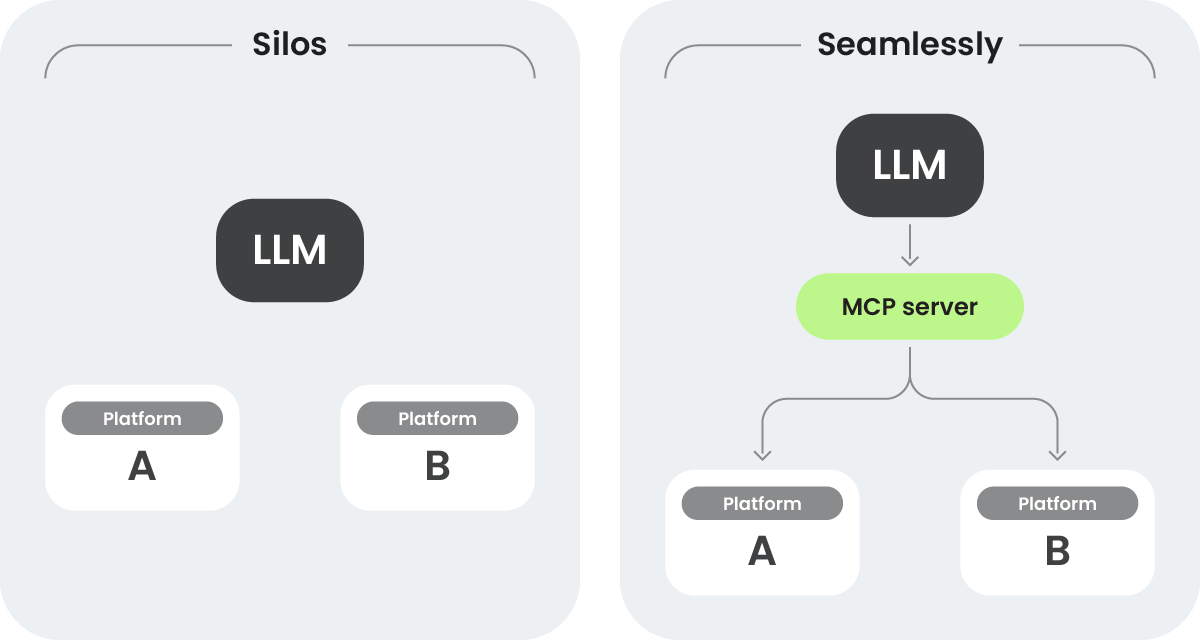
But these external interactions are quite limited by the mechanisms needed to discover and understand available services (such as APIs that can be invoked).

Introduced by Anthropic in November 2024, MCP was born to fill this gap. It aims to "standardize the way artificial intelligence (AI) systems like large language models (LLMs) integrate and share data with external tools, systems, and data sources."

Major AI providers, including OpenAI and Google DeepMind have adopted MCP. This allows leading AI models to discover and interact with other tools as part of the reasoning and generation process. The AI models that use MCP are called MCP clients. On the other side, an ever-growing collection of MCP servers1, 2 is being provided by service providers, like Gmail, GitHub2, and Jira, just to name a few. And now also Sysdig MCP Server.

And this is just the beginning. AI is expanding beyond the typical question-answer flow towards a more autonomous, agent-based approach. You can request a task to be completed, and AI agents will relentlessly work for you, collaborating with other agents and tools to get the job done!
Sysdig MCP Server

Don't confuse Sysdig MCP Server with Sysdig Sage™, our integrated AI Security Analyst, which offers contextualized insights and guidance directly within the Sysdig UI.

What exactly is Sysdig MCP Server? It enables your already existing AI model (like ChatGPT, Claude, and others) to be fully aware of Sysdig services and APIs, and use them as part of the reasoning and response process.

With Sysdig MCP Server, you can ask your favorite LLM about security findings in your Kubernetes clusters, the most critical vulnerabilities in your container images, or suspicious behaviors detected by Falco threat detection rules. The LLM will retrieve that information and include it in its response.

But it’s not just about getting data from an external service. What if the AI assistant could also act on that data, filter it, identify urgent actions, dispatch alerts to Slack or a pager, or take the worst vulnerabilities and create tickets assigned to the responsible teams? Enabling multiple MCP servers and having them work together opens up an infinite world of possibilities!

To install and get started with Sysdig MCP Server, please check the README in our GitHub repository.

Usage examples

Disclaimer: Please note that all examples provided below are examples or proof-of-concepts to demonstrate the potential of the technology, but are not officially supported by Sysdig, and your experience might severely vary depending on the availability and configuration of other MCP servers, the AI model, and the prompt and context of the LLM.

IngressNightmare investigation with ChatGPT and Sysdig MCP Server

This is an example conversation:

  • Search for threat events related to the IngressNightmare exploit in the last 2 days.
  • What were the processes involved in the event?
  • I want detailed info on that event and the vulnerabilities that could be affecting that Kubernetes workload resource.
  • And what are the running vulnerabilities in the Kubernetes deployment?
  • Now give me a full scan of the last 'resultId' to see if we are passing the "IngressNightmare Detection" vuln policy, and show me the rule bundle names failing.
  • Using Sage, give me a query to identify all the Kubernetes workloads affected by the CVE = CVE-2025-1974, and give me a table view of the affected resources in my environment.
  • Give me the SySQL query used.
  • Create a PDF report with tables and dashboards, with the conversation investigation highlights.

Local image scanning and impact analysis

Sysdig provides a Command Line Interface (CLI) Scanner tool that allows developers to scan container images for vulnerabilities directly on their local machines. While powerful for CI/CD pipelines, this traditionally provides a static, point-in-time view of an image's security.

This use case transforms the static check into a dynamic risk assessment by leveraging the Sysdig MCP Server. An external AI assistant, acting as an MCP client, can be prompted to not only perform the scan via the MCP server but also to cross-reference the findings with your live cloud environment immediately. The LLM can query Sysdig for the runtime impact of any discovered vulnerabilities, asking for a comprehensive security context, like threats and existing exposures. By checking for related threat activity in your running infrastructure, the AI can provide a holistic "go/no-go" recommendation before a single line of code is deployed.

On-demand personalized reporting

Instead of relying on rigid, pre-defined templates or interfaces, the Sysdig MCP Server allows an AI assistant to act as a custom report generator, creating outputs tailored to any user's needs in response to a simple question.

This capability moves beyond live HTML dashboards to include a variety of formats for different audiences. A user can request formal PDF reports for audits, concise markdown summaries for Jira or Slack tickets, or even raw data exports like a CSV for deeper analysis. The AI can also tailor the narrative, translating the same technical data into a high-level business risk summary for an executive or a detailed remediation guide for a developer. This transforms reporting from a static process into a dynamic conversation, ensuring any stakeholder gets the exact data they need, in the format they require, on demand.

Automated vulnerability remediation workflow

This example uses multiple MCP servers:

Sample prompt:

Check if Sysdig has discovered any new critical vulnerability in a container running in Kubernetes clusters and open a Jira ticket with details, assigning it to the owning development team. Also, send a message to the team's Slack channel, and if the severity is High or greater, page the on-call engineer via PagerDuty.

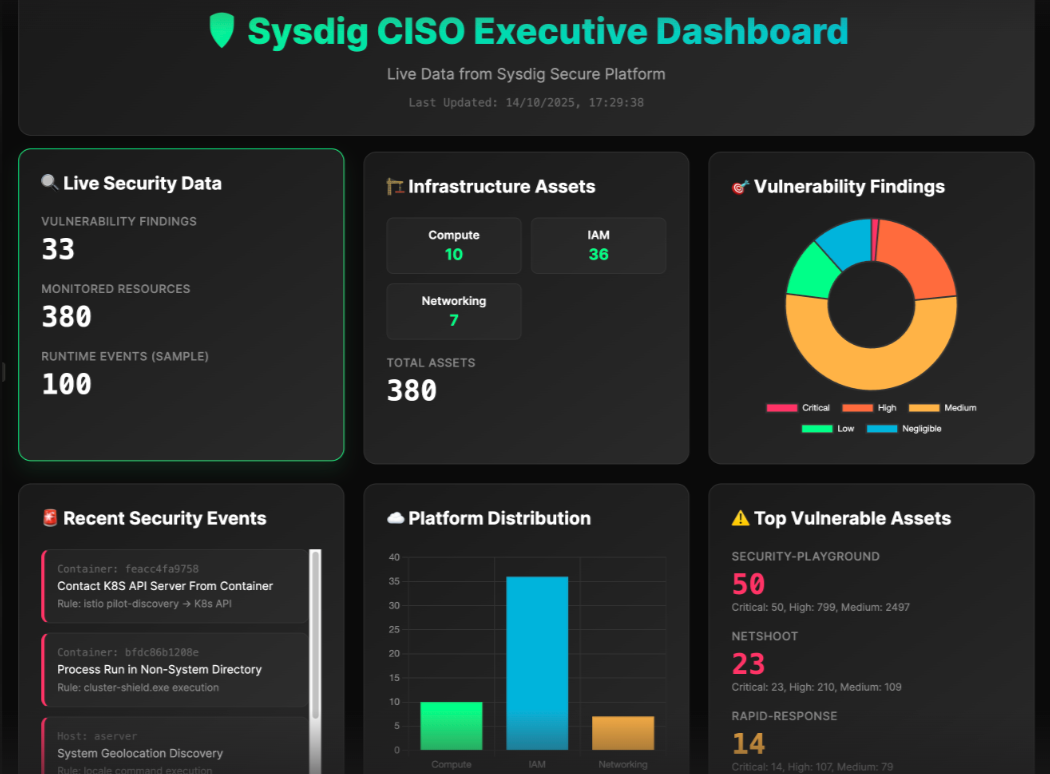
Automated CISO executive dashboard in seconds

The MCP server opens up powerful possibilities for automation and visualization. One compelling use case is creating a CISO dashboard, a visual interface that displays updated information.

Sample prompt:

I am a CISO, create me an interactive dashboard out of sysdig data showing asset topology, progress, risk, and current events. Please make use only of Sysdig data and don’t come up with any made up data. Give me strategic recommendations and what my team should focus on today.
In closing

The future of security automation isn’t about manually building ever more complex workflows. It’s about letting your tools autonomously collaborate and adapt in real time, powered by AI and the MCP ecosystem.

With Sysdig MCP Server, you’re not just integrating services; you’re unleashing a new era of autonomous security agents working tirelessly to protect what matters most.

Ready to experience the future right now? Try Sysdig MCP Server today. Contribute your ideas, and join the movement redefining how security and AI connect.

1 https://mcpservers.org/

2 https://mcp.so/

3 https://github.com/modelcontextprotocol/servers