



惯性聚合 高效追踪和阅读你感兴趣的博客、新闻、科技资讯
阅读原文 在惯性聚合中打开

推荐订阅源

G
GRAHAM CLULEY
T
Tenable Blog
Know Your Adversary
Know Your Adversary
C
CXSECURITY Database RSS Feed - CXSecurity.com
P
Privacy International News Feed
S
Security Affairs
NISL@THU
NISL@THU
O
OpenAI News
Attack and Defense Labs
Application and Cybersecurity Blog
Hacker News: Ask HN
Hacker News: Ask HN
Webroot Blog
Webroot Blog
Schneier on Security
S
SegmentFault 最新的问题
S
Schneier on Security
G
Google Developers Blog
V
V2EX
C
Check Point Blog
U
Unit 42
Google DeepMind News
T
Threatpost
阮一峰的网络日志
阮一峰的网络日志
T
The Exploit Database - CXSecurity.com
Recent Announcements
M
MIT News - Artificial intelligence
S
Secure Thoughts
博客园 - 司徒正美
Recorded Future
Recorded Future
P
Proofpoint News Feed
Spread Privacy
Spread Privacy
K
Kaspersky official blog
Cyber Security Advisories - MS-ISAC
AI
AI
博客园 - 聂微东
N
News and Events Feed by Topic
SecWiki News
SecWiki News
钛媒体:引领未来商业与生活新知
钛媒体:引领未来商业与生活新知
V
Vulnerabilities – Threatpost
P
Palo Alto Networks Blog
OSCHINA 社区最新新闻
OSCHINA 社区最新新闻
Engineering at Meta
Engineering at Meta
Recent Commits to openclaw:main
奇客Solidot–传递最新科技情报
奇客Solidot–传递最新科技情报
酷 壳 – CoolShell
酷 壳 – CoolShell
WordPress大学
WordPress大学
The Hacker News
The Hacker News
The Last Watchdog
The Last Watchdog
Project Zero
Project Zero
W
WeLiveSecurity
博客园 - Franky

Sysdig Blog

Masterclass: AI is more than ChatGPT and LLMs CVE-2026-39987 update: How attackers weaponized marimo to deploy a blockchain botnet via HuggingFace Kubernetes 1.36 - New security features 5 steps to securing AI workloads Marimo OSS Python Notebook RCE: From Disclosure to Exploitation in Under 10 Hours Security briefing: March 2026 The Sysdig MCP server is now available in AWS Marketplace Risk isn’t reduced until you take action: How teams resolve issues in the cloud AI infrastructure security: Why it deserves its own category Three pillars for building effective runtime-powered cloud defense, the right way Closing the cloud security gap with runtime security Seeing risk isn’t stopping it: Why visibility alone isn’t enough TeamPCP expands: Supply chain compromise spreads from Trivy to Checkmarx GitHub Actions AI coding agents are running on your machines — Do you know what they're doing? Runtime security for AI coding agents: Protecting AI-assisted development How runtime insights power every cloud security use case CVE-2026-33017: How attackers compromised Langflow AI pipelines in 20 hours Inline Cloud Response: Accelerating AWS threat containment for SOC teams Runtime malware detection for AWS Fargate Detecting CVE-2026-3288 & CVE-2026-24512: Ingress-nginx configuration injection vulnerabilities for Kubernetes Malware detection with Sysdig Security briefing: February 2026 Leveling up Kubernetes Posture: From baselines to risk-aware admission Eliminating runtime blind spots: How CleanStart and Sysdig build continuous trust across the container lifecycle LLMjacking: From Emerging Threat to Black Market Reality Real risks live at runtime: Why CISOs must care about deep telemetry in 2026 Sysdig named a Leader in the Forrester Wave™: Cloud Native Application Protection Solutions, Q1 2026 How to run rootless containers AI-assisted cloud intrusion achieves admin access in 8 minutes Security briefing: January 2026 Securing GPU-accelerated AI workloads in Oracle Kubernetes Engine Bringing OSS runtime security to AWS: Falco integration with AWS Security Hub CSPM Our customers have spoken: Sysdig rated a Strong Performer in Gartner® Voice of the Customer for Cloud-Native Application Protection Platforms Protecting sensitive business data in preparation for the organization's Gen AI VoidLink threat analysis: Sysdig discovers C2-compiled kernel rootkits AI is still a workload: A practical guide to securing AI workloads How threat actors are using self-hosted GitHub Actions runners as backdoors How Sysdig Sage delivers AI-powered, real-world vulnerability management Security briefing: December 2025 Top 10 ways to get breached in 2026 EtherRAT dissected: How a React2Shell implant delivers 5 payloads through blockchain C2 Introducing runtime file integrity monitoring and response with Sysdig FIM How to detect multi-stage attacks with runtime behavioral analytics EtherRAT: DPRK uses novel Ethereum implant in React2Shell attacks The rise of AI agents: How autonomous AI Is transforming cloud security Kubernetes 1.35 - New security features The Urgency of Securing AI Workloads for CISOs Security briefing: November 2025 Quantum and the cloud: Science fiction turned security strategy Cloud security, the right way: What the industry should demand (and why "good enough" isn't) Return of the Shai-Hulud worm affects over 25,000 GitHub repositories Detecting CVE-2024-1086: The decade-old Linux kernel vulnerability that’s being actively exploited in ransomware campaigns What’s old is new again: How to demystify AI security with AIBOMs Securing Kubernetes with agentic cloud security How agentic cloud security reduces real risks Hunting reverse shells: How the Sysdig Threat Research Team builds smarter detection rules Shifting left with AI and MCP: Sysdig + Amazon Q Developer How Falco and Stratoshark close the gap between open source runtime detection and deep forensic analysis Investigating security issues with ChatGPT and the GitHub MCP server New runc vulnerabilities allow container escape: CVE-2025-31133, CVE-2025-52565, CVE-2025-52881 Harden your LLM security with OWASP Security briefing: October 2025 How agentic AI is changing cloud security Kubernetes Incident Response: Detect, investigate, and contain in under 10 minutes Sysdig recognized as a Cloud Security Leader in Latio Tech Cloud Security Market Report AI echolocation of cloud risks using Sysdig & Snyk MCP servers Sysdig MCP Server: Bridging AI and cloud security insights Understanding CVE-2025-49844: “RediShell” Critical Remote Code Execution in Redis How Sysdig secures your containers and Kubernetes Sysdig Security Briefing: September 2025 Cloud security, the right way: The 3 pillars of real-time defense Open source spotlight: Bringing web application security to Falco with Falcoya's Nginx plugin Malicious NPM packages: Are you exposed? AI for SOC teams: 5 cloud security prompts to start your day with Sysdig Sage™ Shai-Hulud: The novel self-replicating worm infecting hundreds of NPM packages ZynorRAT technical analysis: Reverse engineering a novel, Turkish Go-based RAT Modern vulnerability management, built for the cloud Build your AWS incident response playbook with open source tools 2025 Gartner® CNAPP Market Guide: Runtime visibility is no longer optional Threat hunting with Sysdig: Uncovering “IngressNightmare” Open source spotlight: From alerts to action with AI-powered Falco Vanguard From triage to action: How Sysdig’s agentic cloud security platform slashes noise and accelerates remediation The vision comes to life: Agentic cloud security with Sysdig Sage™ Data security findings: A technical deep dive Connecting runtime to source: Sysdig and Semgrep integration Fix what matters, faster: How Sysdig and Semgrep are unifying security without silos – from code to runtime Defending sensitive data with Sysdig Secure Redefining cloud security, the right way Join the movement: The Sysdig Open Source Community is live A smarter, safer cloud in the age of AI Unifying detection and response: Sysdig + Cortex XSOAR for security at cloud speed The future of security is open, and it needs a unified hub: The Sysdig Open Source Community is here CVE-2025-53104: Command injection via GitHub Actions workflow in gluestack-ui Why MCP server security is critical for AI-driven enterprises What’s new in Sysdig — June 2025 AI-powered CNAPP with Sysdig Sage™ Revolutionizing Cybersecurity Search with Sysdig Sage™ Sysdig Threat Bulletin: Iranian Cyber Threats The end of the prioritization-only era: Vulnerability management needs action Dangerous by default: Insecure GitHub Actions found in MITRE, Splunk, and other open source repositories
Detecting React2Shell: The maximum-severity RCE vulnerability affecting React Server Components and Next.js
Sysdig Threat Research Team · 2025-12-05 · via Sysdig Blog

On December 3, 2025, the React Team disclosed CVE-2025-55182, a critical unauthenticated remote code execution (RCE) vulnerability in React Server Components (RSCs). Dubbed "React2Shell", this maximum-severity flaw (CVSS 10.0) allows for potentially malicious code execution with a single crafted HTTP request. Next.js, which can be impacted downstream by React2Shell, has assigned CVE-2025-66478 to track its exposure.

For threat actors, React2Shell enables arbitrary server-side code execution upon exploitation, opening the door to data theft, lateral movement, and/or malware deployment. At the time of this writing, a public proof-of-concept (PoC) exploit has been released. Researchers report roughly 100% exploitation success rates against default configurations, which positions React2Shell as highly likely to be mass-exploited.

Following a detailed analysis, the Sysdig Threat Research Team (TRT) has developed a Falco detection rule for React2Shell, now available directly within Sysdig Secure. The Sysdig TRT recommends that all organizations running React 19 with Server Components take immediate action. Below, we provide detailed steps for remediation, along with a technical analysis of the vulnerability and its exploitation implications.

For a quick breakdown, look at our React2Shell video.

Technical analysis of React2Shell

Vulnerability details

CVE-2025-55182 resides in the RSC "Flight" protocol, specifically in how a react-server handles HTTP requests for Server Function endpoints. This deserialization flaw allows attacker-controlled data to influence server-side execution when processing crafted payloads.

React Server Functions allow clients to invoke server functions, with React providing integration points for frameworks. The vulnerable code deserialises HTTP payloads unsafely, enabling unauthenticated RCE.

Affected packages (versions 19.0.0, 19.1.0, 19.1.1, 19.2.0):

  • react-server-dom-parcel
  • react-server-dom-turbopack
  • react-server-dom-webpack

Applications are vulnerable even without explicit Server Function endpoints. The flaw is exploitable wherever RSC is supported.

Frameworks affected by React2Shell

  • Next.js (15.0.4 through 16.0.6, plus canaries from 14.3.0-canary.77)
  • React Router (RSC mode)
  • Waku
  • Parcel RSC (@parcel/rsc)
  • Vite RSC (@vitejs/plugin-rsc)
  • RedwoodSDK (rwsdk)

A standard create-next-app production build is vulnerable without modifications. Default configurations are exploitable out of the box.

What attackers can do

Unauthenticated access, remote exploitability, and React's ubiquity create extreme risk, as the maximum-severity CVSS score suggests. After achieving code execution, attackers can:

  • Exfiltrate data by accessing secrets, credentials, and user information.
  • Establish persistence by deploying backdoors or web shells.
  • Move laterally by pivoting to internal systems.
  • Deploy ransomware by encrypting data for extortion.

Unauthenticated RCE in a massively deployed framework suggests significant potential for abuse. This type of exploit can be easily automated and sweep the internet for vulnerable servers.

Detection and mitigation

Runtime detection

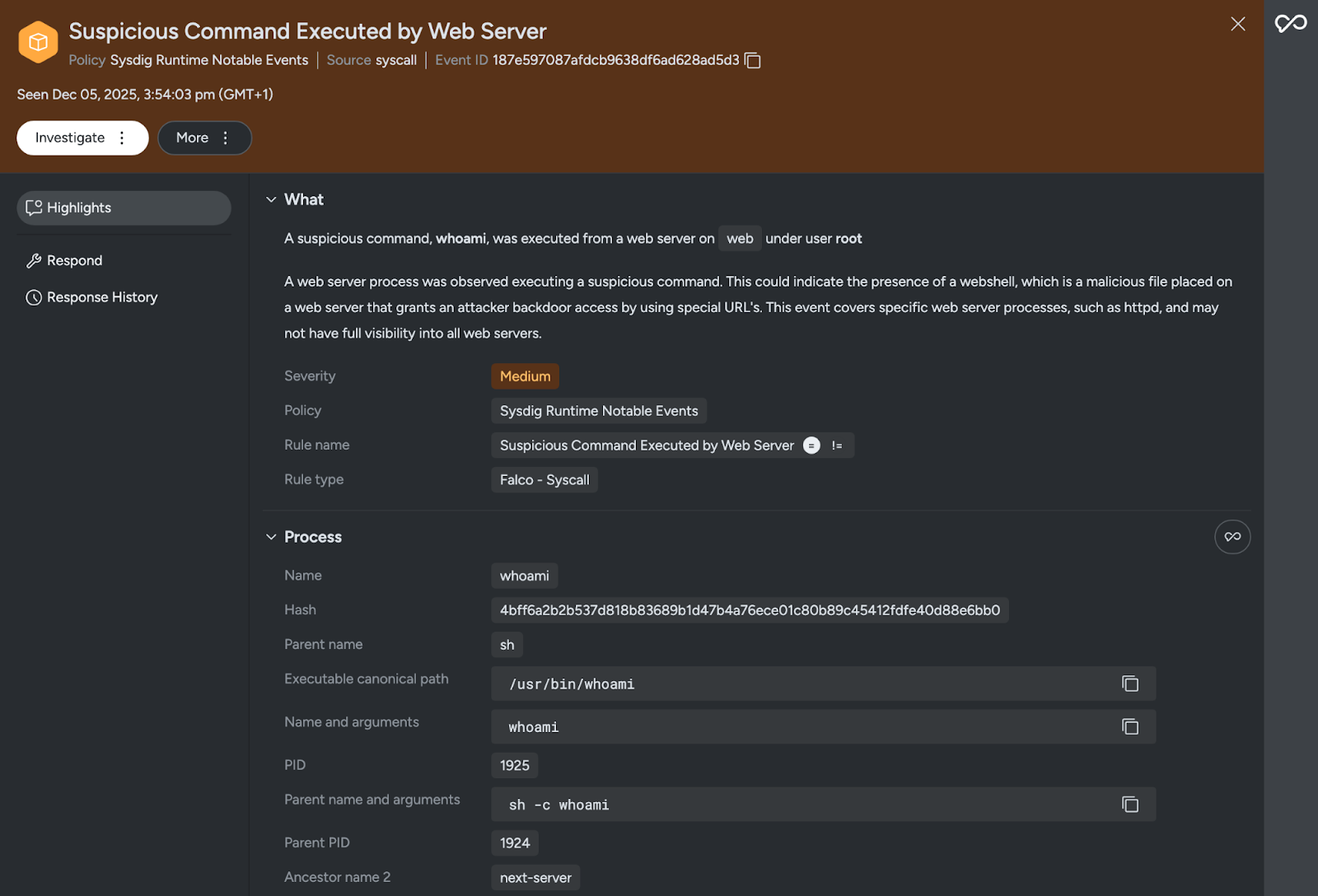
The Sysdig TRT has reinforced the “Suspicious Command Executed by Web Server” rule. This detection catches most unexpected, arbitrary commands spawned by web servers, raising alerts for Remote Command Execution in such applications. The following Falco rule can be used to detect suspicious commands. (Please note that the “proc.aname” fields may need to be adjusted for your environment. Additional commands can also be added to the minimal_unix_commands macro.)

- list: minimal_unix_commands
  items: [ls, cp, mv, rm, mkdir, rmdir, find, touch, cat, less, head, tail, nano, vi, chmod … ]


- list: shell_binaries
 items: [ash, bash, csh, ksh, sh, tcsh, zsh, dash]
	
- macro: spawned_process
  condition: (evt.type in (execve, execveat) and evt.dir=< and evt.arg.res=0)


- rule: Detecting React2Shell Remote Code Execution
  desc: This rule detects exploitation attempts of the React2shell vulnerability. Leveraging it, attackers can execute arbitrary commands in React applications. 
  condition: >
    ( spawned_process and 
    proc.name in (minimal_unix_commands) and 
    proc.pname in (shell_binaries) and 
    ( proc.aname startswith 'next-server' or proc.aname startswith 'react-router' or proc.aname in (waku,vite))
    )
  output: Possible React2shell exploitation attempts detected with %proc.cmdline and parent name %proc.pname in %container.name under user %user.name (proc.name=%proc.name proc.exepath=%proc.exepath proc.pname=%proc.pname gparent=%proc.aname[2] ggparent=%proc.aname[3] gggparent=%proc.aname[4] user.name=%user.name image=%container.image.repository proc.cmdline=%proc.cmdline proc.pcmdline=%proc.pcmdline container.id=%container.id evt.type=%evt.type evt.res=%evt.res gcmdline=%proc.acmdline[2] ggcmdline=%proc.acmdline[3] proc.cwd=%proc.cwd proc.pid=%proc.pid proc.cwd=%proc.cwd proc.ppid=%proc.ppid proc.sid=%proc.sid user.uid=%user.uid user.loginuid=%user.loginuid user.loginname=%user.loginname group.gid=%group.gid group.name=%group.name container.name=%container.name)
  priority: WARNING
  tags: [host, container, network, MITRE, MITRE_TA0002_execution, MITRE_T1059_command_and_scripting_interpreter, MITRE_T1104_multi_stage_channels]

Sysdig Secure customers can find this rule in the Sysdig Runtime Notable Events policy. Other Sysdig rules have been seen triggering when this vulnerability is exploited, including Reverse Shell Detected and Reverse Shell Redirects STDIN/STDOUT Using UNIX Socket. Suspicious Command by Web Server offers more generic protection.
WAF protections

In response to CVE-2025-55182, cloud providers have deployed web application firewall (WAF) rules to block potential exploitation:

  • Cloudflare deployed rules detecting unsafe deserialization in POST requests.
  • Google Cloud Armor added a cve-canary rule.
  • Vercel deployed platform-level protections.
  • Firebase Hosting/App Hosting is enforcing exploitation-limiting rules.

WAF rules provide defense-in-depth, but can be bypassed. Therefore, vulnerable organizations must patch the underlying code in order to comprehensively secure their environments.

Vulnerability scanning

Many PoCs on GitHub misdiagnose the root cause or fail to confirm React2Shell’s exploitability. Some even appear to be AI-generated: plausible-looking but broken. The original researcher confirmed that public PoCs differ from the actual exploit.

One organization, Assetnote, released a scanner that differentiates vulnerable from patched hosts. Their writeup details the mechanism, which sends ["$1:a:a"] against an empty object and causes vulnerable servers to return 500 with E{"digest": ...}. Patched versions, on the other hand, prevent this crash.

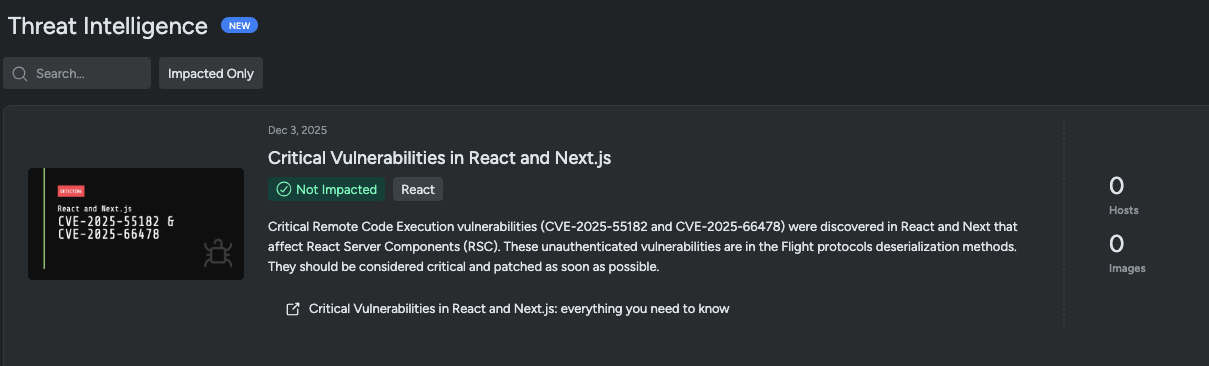
Vulnerability management in Sysdig Secure currently identifies packages affected by React2Shell. Also, the Threat Intelligence Feed within Sysdig Secure also provides immediate visibility into affected packages based on your inventory.
Remediation

Patching is the only fix for affected versions of React.

Fixed versions include:

  • React Server Components: 19.0.1, 19.1.2, 19.2.1
  • Next.js: 15.0.5, 15.1.9, 15.2.6, 15.3.6, 15.4.8, 15.5.7, 16.0.7

Required actions:

  • Update RSC packages.
  • Update Next.js to the patched version for your minor release.
  • Downgrade Next.js canaries (14.3.0-canary.77+) to stable 14.x.
  • Update other frameworks to the latest versions.
  • Deploy runtime detections with Falco or Sysdig Secure.
  • Enable WAF protections as a temporary mitigation.

Conclusion

CVE-2025-55182 and CVE-2025-66478 expose RSC applications to unauthenticated RCE. Maximum severity, default-configuration exploitability, and widespread adoption create urgent risk.

All organizations running the affected versions of React should patch them immediately. Runtime threat detections should also be deployed to detect the active exploitation of React2Shell. WAF rules can be used as temporary mitigations, but updating systems to fixed versions eliminates the risk. Teams should deploy runtime detection for environments where immediate patching isn't possible.