
惯性聚合 高效追踪和阅读你感兴趣的博客、新闻、科技资讯
阅读原文 在惯性聚合中打开

推荐订阅源

酷 壳 – CoolShell
酷 壳 – CoolShell
H
Hacker News: Front Page
P
Palo Alto Networks Blog
T
ThreatConnect
Apple Machine Learning Research
博客园_首页
T
True Tiger Recordings
P
Privacy & Cybersecurity Law Blog
B
Blog
IT之家
IT之家
Last Week in AI
Last Week in AI
F
Full Disclosure
Hacker News: Ask HN
Hacker News: Ask HN
C
Comments on: Blog
Microsoft Azure Blog
C
Cybersecurity and Infrastructure Security Agency CISA
Microsoft Security Blog
博客园 - 【当耐特】
N
News and Events Feed by Topic
NISL@THU
NISL@THU
腾讯CDC
雷峰网
雷峰网
Security Latest
Security Latest
李成银的技术随笔
M
Microsoft Research Blog - Microsoft Research
L
LangChain Blog
L
Lohrmann on Cybersecurity
cs.CL updates on arXiv.org
C
Check Point Blog
Y
Y Combinator Blog
Recent Announcements
博客园 - Franky
N
News | PayPal Newsroom
V
V2EX
A
About on SuperTechFans
The Register - Security
月光博客
月光博客
奇客Solidot–传递最新科技情报
奇客Solidot–传递最新科技情报
Google Online Security Blog
MyScale Blog
MyScale Blog
Cisco Talos Blog
Cisco Talos Blog
Vercel News
Vercel News
WordPress大学
WordPress大学
C
Cyber Attacks, Cyber Crime and Cyber Security
The Hacker News
The Hacker News
IntelliJ IDEA : IntelliJ IDEA – the Leading IDE for Professional Development in Java and Kotlin | The JetBrains Blog
爱范儿
爱范儿
A
Arctic Wolf
L
LINUX DO - 最新话题
freeCodeCamp Programming Tutorials: Python, JavaScript, Git & More

Sysdig Blog

Introducing the Runtime Investigation Skill for headless cloud security Streamline vulnerability remediation with Headless Cloud Security The expendable extension name: Azure VMAccess naming chaos, password resets, and a detection gap Agentic AI Tooling: Why Runtime Security Is the Missing Layer How to create custom cloud security controls faster with headless cloud security NATS-as-C2: Inside a new technique attackers are using to harvest cloud credentials and AI API keys Falco turns 10. Congratulations from Sysdig! Securing AI in the cloud starts at runtime Introducing Prempti: Runtime security for AI coding agents, powered by Falco CVE-2026-44338: PraisonAI authentication bypass in under 4 hours and the growing trend of rapid exploitation Dirty Frag (CVE-2026-43284 and CVE-2026-43500): Detecting unpatched local privilege escalation via Linux Kernel ESP and RxRPC Welcome to headless cloud security Introducing headless cloud security: Run Sysdig inside your AI coding agents Security briefing: April 2026 CVE-2026-31431: “Copy Fail” Linux kernel flaw lets local users gain root in seconds AI is the present of security PCI DSS v4.0.1 Compliance in the cloud and Kubernetes with Sysdig How to secure workloads, containers, and Kubernetes the right way CVE-2026-42208: Targeted SQL injection against LiteLLM's authentication path discovered 36 hours following vulnerability disclosure Sysdig named a Leader in GigaOm Radar for Cloud Workload Security CVE-2026-33626: How attackers exploited LMDeploy LLM Inference Engines in 12 hours Why runtime security matters for PCI DSS compliance Anthropic Mythos just broke the four-minute mile in cyber offense From air-gapped to private cloud: Security that adapts to your environment Cloud security has hit its human limits: Key takeaways from the 2026 Cloud-Native Security and Usage Report CVE-2026-39987 update: How attackers weaponized marimo to deploy a blockchain botnet via HuggingFace Kubernetes 1.36 - New security features How Financial Services Organizations Can Stay Compliant Without Sacrificing Security Sysdig Automations: Streamlining detection to response into a unified workflow Use in-use vulnerability prioritization to focus on critical risks Next-gen container security: Why cloud context matters Guidance for compliance with NIS2, DORA, & other regulations Marimo OSS Python Notebook RCE: From Disclosure to Exploitation in Under 10 Hours How to use AI to manage cloud security threats How to use AI to manage cloud security threats Security briefing: March 2026 Risk isn’t reduced until you take action: How teams resolve issues in the cloud AI infrastructure security: Why it deserves its own category Three pillars for building effective runtime-powered cloud defense, the right way Closing the cloud security gap with runtime security Seeing risk isn’t stopping it: Why visibility alone isn’t enough El ENS no es un freno para tu estrategia en Oracle Cloud TeamPCP expands: Supply chain compromise spreads from Trivy to Checkmarx GitHub Actions AI coding agents are running on your machines — Do you know what they're doing? Runtime security for AI coding agents: Protecting AI-assisted development How runtime insights power every cloud security use case CVE-2026-33017: How attackers compromised Langflow AI pipelines in 20 hours Inline Cloud Response: Accelerating AWS threat containment for SOC teams Runtime malware detection for AWS Fargate Detecting CVE-2026-3288 & CVE-2026-24512: Ingress-nginx configuration injection vulnerabilities for Kubernetes Malware detection with Sysdig Masterclass: AI is more than ChatGPT and LLMs Security briefing: February 2026 Leveling up Kubernetes Posture: From baselines to risk-aware admission Eliminating runtime blind spots: How CleanStart and Sysdig build continuous trust across the container lifecycle LLMjacking: From Emerging Threat to Black Market Reality Real risks live at runtime: Why CISOs must care about deep telemetry in 2026 Sysdig named a Leader in the Forrester Wave™: Cloud Native Application Protection Solutions, Q1 2026 How to run rootless containers AI-assisted cloud intrusion achieves admin access in 8 minutes Security briefing: January 2026 Securing GPU-accelerated AI workloads in Oracle Kubernetes Engine Bringing OSS runtime security to AWS: Falco integration with AWS Security Hub CSPM Our customers have spoken: Sysdig rated a Strong Performer in Gartner® Voice of the Customer for Cloud-Native Application Protection Platforms Protecting sensitive business data in preparation for the organization's Gen AI VoidLink threat analysis: Sysdig discovers C2-compiled kernel rootkits AI is still a workload: A practical guide to securing AI workloads How threat actors are using self-hosted GitHub Actions runners as backdoors How Sysdig Sage delivers AI-powered, real-world vulnerability management Security briefing: December 2025 Top 10 ways to get breached in 2026 EtherRAT dissected: How a React2Shell implant delivers 5 payloads through blockchain C2 Introducing runtime file integrity monitoring and response with Sysdig FIM How to detect multi-stage attacks with runtime behavioral analytics EtherRAT: DPRK uses novel Ethereum implant in React2Shell attacks 5 steps to securing AI workloads Detecting React2Shell: The maximum-severity RCE vulnerability affecting React Server Components and Next.js The rise of AI agents: How autonomous AI Is transforming cloud security Kubernetes 1.35 - New security features The Urgency of Securing AI Workloads for CISOs Security briefing: November 2025 Sysdig Inspect: Cloud-native forensics for runtime threat investigation Quantum and the cloud: Science fiction turned security strategy Cloud security, the right way: What the industry should demand (and why "good enough" isn't) Return of the Shai-Hulud worm affects over 25,000 GitHub repositories Detecting CVE-2024-1086: The decade-old Linux kernel vulnerability that’s being actively exploited in ransomware campaigns What’s old is new again: How to demystify AI security with AIBOMs Securing Kubernetes with agentic cloud security How agentic cloud security reduces real risks Hunting reverse shells: How the Sysdig Threat Research Team builds smarter detection rules Shifting left with AI and MCP: Sysdig + Amazon Q Developer How Falco and Stratoshark close the gap between open source runtime detection and deep forensic analysis Investigating security issues with ChatGPT and the GitHub MCP server New runc vulnerabilities allow container escape: CVE-2025-31133, CVE-2025-52565, CVE-2025-52881 Harden your LLM security with OWASP Security briefing: October 2025 How agentic AI is changing cloud security Kubernetes Incident Response: Detect, investigate, and contain in under 10 minutes Sysdig recognized as a Cloud Security Leader in Latio Tech Cloud Security Market Report AI echolocation of cloud risks using Sysdig & Snyk MCP servers
The Sysdig MCP server is now available in AWS Marketplace
2026-04-02 · via Sysdig Blog

Correlating security signals from cloud services, container registries, and runtime environments is an important component of maintaining secure cloud deployments. But making this a seamless process, without the need for complex, manual integrations, is often challenging.

Traditional workflow automations typically involve defining behavior programmatically or building step-by-step processes with decision trees. Currently, automation platforms are used to connect critical apps, but this often results in a web of rules and routines that don’t keep up with an ecosystem that is constantly changing.

To help you with deployments on AWS that take advantage of AI and automation for signal correlation, we are thrilled to announce that the Sysdig Model Context Protocol (MCP) Server is officially available in the AWS Marketplace. As part of the new "AI Agents and Tools" category, Sysdig is making it easier than ever for you to bridge the gap between your security data and AI-powered workflows.

Frictionless MCP server deployment via Amazon Bedrock

The most exciting part of this launch is how it integrates with the Amazon Bedrock AgentCore Runtime. Because the Sysdig MCP server is hosted and available via the AWS Marketplace, deployment takes just a few steps.

With the Sysdig MCP server and Amazon Bedrock AgentCore Runtime, you gain:

  1. Fast deployment: Spin up the Sysdig MCP server directly within an AWS environment in minutes.
  2. Seamless integration: Connect the Sysdig MCP server to Amazon Bedrock Agents to provide a "security-aware" brain for custom LLMs.
  3. Unified governance: Manage the subscription and permissions through familiar AWS billing and IAM roles.

How Sysdig MCP Server revolutionizes the security workflow

By bringing Sysdig’s deep runtime insights into the MCP ecosystem, this integration provides SecOps teams with the speed, scale, and AI-enhanced automation they need to defend their cloud estate.
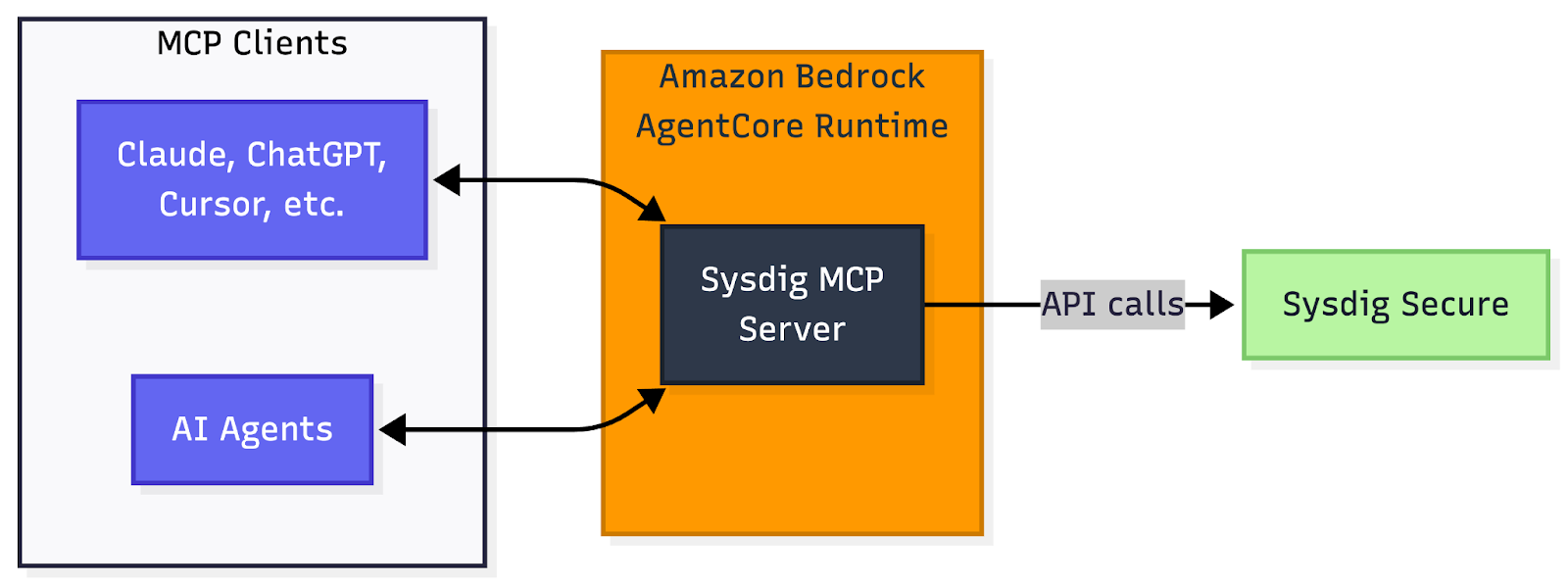
Sysdig’s MCP server is an open, pre-built Docker image that provides data from Sysdig’s cloud native application protection platform (CNAPP). With it, external LLMs and AI agents can access Sysdig security insights via a standard interface rather than through custom integrations. Some use cases where it can be used are:

Automated remediation with human oversight

We believe in the "human-in-the-loop" model. The Sysdig MCP server allows AI agents to draft remediation scripts, such as updating a Runtime policy or modifying a Kubernetes Network Policy, based on real-time threat data. These suggestions are then presented to a human operator for final approval, drastically reducing mean time to respond (MTTR) while ensuring that the action is appropriate and aligns with your internal policies.

Natural language forensics

Traditionally, security teams were often forced to learn different query languages for different tools. Or, they needed to craft queries that could correlate data from disparate dashboards during an investigation. This workflow wasted time and effort.

With this integration, instead of navigating complex dashboards during an incident, an analyst can ask a Bedrock-powered AI agent: "Show me all suspicious activity in the 'payments' namespace over the last hour." The agent uses the MCP server to query Sysdig’s activity logs and presents a summarized timeline of the event.

Predictive posture management

Shifting left is no longer a future state for organizations - it’s table stakes. This integration enables you to introduce security-aware AI into your existing CI/CD pipelines, which helps ensure that what goes into production meets your standards. Agents can automatically review pull requests or infrastructure-as-code (IaC) templates, using Sysdig’s real-time data to predict potential security regressions before they are deployed. This added layer of baked-in review helps eliminate risks without adding complexity or slowing down timelines.

Empowering SecOps teams with AI-driven context

The availability of the Sysdig MCP server in the AWS Marketplace simplifies how security teams leverage Generative AI. By providing a standardized way to connect Sysdig’s deep runtime insights with Amazon Bedrock, organizations can move past "chatting with data" and start building autonomous, context-aware security workflows.

Benefits of integrating the Sysdig MCP server into your AWS environment include:

  • Accelerated AI adoption: Deploy the Sysdig MCP server in minutes within the Amazon Bedrock AgentCore Runtime. This eliminates the need for custom "glue code," allowing you to point your AI agents directly at your security data via a native AWS experience.
  • Real-time runtime context: Give your AI agents the "eyes" they need. By bridging the gap between static vulnerability lists and live runtime reality, your agents can prioritize risks based on what is actually happening in your clusters right now.
  • Unified agentic workflows: Combine Sysdig security context with other MCP servers (AWS API, documentation, cost analysis) in a single agent session. Investigate a runtime alert, check the affected workload's configuration, and review IAM permissions-all through one conversational interface.

Conclusion

The availability of the Sysdig MCP Server in the AWS Marketplace simplifies integration with Amazon Bedrock AgentCore Runtime and helps you connect your security data with AI-powered workflows. Providing real-time runtime context to your AI agents accelerates AI adoption and enables AI-assisted remediation with human oversight.
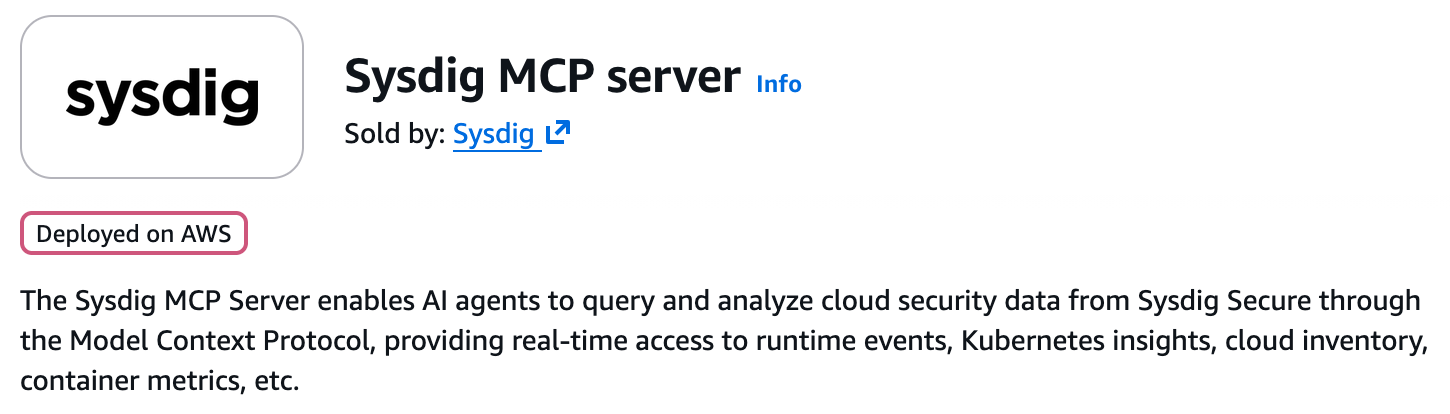
Ready to leverage these capabilities? Empower your AI agents with real-time security context by finding Sysdig in the AWS Marketplace AI Agents and Tools Category.