
惯性聚合 高效追踪和阅读你感兴趣的博客、新闻、科技资讯
阅读原文 在惯性聚合中打开

推荐订阅源

Martin Fowler
Martin Fowler
L
LINUX DO - 最新话题
P
Proofpoint News Feed
Cyberwarzone
Cyberwarzone
Know Your Adversary
Know Your Adversary
cs.CL updates on arXiv.org
L
Lohrmann on Cybersecurity
D
Darknet – Hacking Tools, Hacker News & Cyber Security
Security Latest
Security Latest
T
The Exploit Database - CXSecurity.com
Exploit-DB.com RSS Feed
P
Privacy & Cybersecurity Law Blog
K
Kaspersky official blog
The Last Watchdog
The Last Watchdog
Webroot Blog
Webroot Blog
Scott Helme
Scott Helme
T
Threat Research - Cisco Blogs
C
Cyber Attacks, Cyber Crime and Cyber Security
WordPress大学
WordPress大学
L
LINUX DO - 热门话题
OSCHINA 社区最新新闻
OSCHINA 社区最新新闻
博客园 - Franky
V
Visual Studio Blog
O
OpenAI News
AI
AI
Hacker News: Ask HN
Hacker News: Ask HN
V2EX - 技术
V2EX - 技术
GbyAI
GbyAI
Recent Commits to openclaw:main
Simon Willison's Weblog
S
Schneier on Security
Spread Privacy
Spread Privacy
Y
Y Combinator Blog
I
InfoQ
H
Hackread – Cybersecurity News, Data Breaches, AI and More
T
Threatpost
C
Cybersecurity and Infrastructure Security Agency CISA
F
Fortinet All Blogs
C
CERT Recently Published Vulnerability Notes
T
The Blog of Author Tim Ferriss
C
Check Point Blog
Apple Machine Learning Research
有赞技术团队
有赞技术团队
人人都是产品经理
人人都是产品经理
N
News and Events Feed by Topic
Project Zero
Project Zero
小众软件
小众软件
让小产品的独立变现更简单 - ezindie.com
B
Blog
G
Google Developers Blog

Bryan Robinson's Blog

Does our technology still work for us? Product pricing, dev bad habits, and the role of the pit of success Astro Server Island for latest Bluesky post (heavily cached!) Type-safe environment variables in Astro 5.0 New Website, but really is it? Netlify Durable Cache: Caching for a third-party world Introducing the Hygraph Astro Content Loader Integrating Astro.js Starlight Documentation into a Next.js Project Using Proxies Jamstack is meaningless 😱 Book Release: Eleventy by Example – Learn 11ty with 5 in-depth projects 11ty Second 11ty: Creating Template Filters 11ty Second 11ty: Global Data files (JS and JSON) 11ty second 11ty: The Render Plugin Part 1 Help needed: Netlify Frontend environment variables with Astro.js Quick experiment with the Slinkity 11ty plugin Creating a dynamic color converter with 11ty Serverless Using 11ty JavaScript Data files to mix Markdown and CMS content into one collection How to show your template code in 11ty blog posts New City, New Job, New Content Using Nunjucks Climbing the 11ty Performance leaderboard with Cloudinary, critical CSS and more Three JAMstack movements to watch in 2020 Create a Codepen promo watermark with no additional HTML, CSS or JS 3 underused CSS features to learn for 2020 Use CSS Subgrid to layout full-width content stripes in an article template Adapt client-side JavaScript for use in 11ty (Eleventy) data files CSS Gap creates a bright future for margins in Flex as well as Grid Create your first CSS Custom Properties (Variables) Use CSS Grid to create a self-centering full-width element Creating an 11ty Plugin - SVG Embed Tool Now offering design and code reviews at PeerReviews.dev Routing contact-form emails to different addresses with Netlify, Zapier and SendGrid Create an Eleventy (11ty) theme based on a free HTML template Client work and the JAMstack Grid vs. Flex: A Tale of a "Simple" Promo Space Using Eleventy The Tech Barrier to Entry What Can We Learn from CERN Let Practical CSS Grid - Launching My First Course Build Trust on the Web incorporating User Worries with your User Stories 2019 The Year of Markup-First Development Refactoring CSS into a Sass mixin Starting a new journey with Code Contemporary Dynamic Static Sites with Netlify and iOS Shortcuts Top 3 uses for the ::before and ::after CSS pseudo elements How To: Use CSS Grid to Mix and Match Design Patterns Use CSS ::before and ::after for simple, spicy image overlays Modern CSS: Four Things Every Developer and Designer Should Know About CSS 3 Strategies for Getting Started with CSS Grid CSS Tip: Use rotate() and skew() together to introduce some clean punk rock to your CSS The 5 Stages of Grid Love How To: A CSS-Only Mobile Off Canvas Navigation How To: Use CSS Grid Layout to Make a Simple, Fluid Card Grid Make a More Flexible Cover Screen with CSS Grid Can CSS Grid open up interesting CMS Layout options? Firefox 52 to Introduce New Box-Alignment Values Falling Forward — Rethinking Progressive Enhancement, Graceful Degradation and Developer Morality Start Exploring the Magic of CSS Grid Layout I Converted My Blog to CSS Grid Layout and Regret Nothing Feature Queries are on the Rise CSS Shapes — Let the Text Flow Around You Flexbox -- Let Memorializing Prince and Print vs. The Web How to Get Designers to Contribute in Open Source The True Gift of Your Former Code
I went to Italy and noticed UX fails
2015-06-22 · via Bryan Robinson's Blog

Ciao friends! I’m just arriving back in the States from a trip to Italy. I’m not exactly much of a world traveller, but a good time was had. While I enjoyed the majority of what I saw, I also observed a few major usability fails that I wanted to bring up. Give the blog a little international flair.

Optimal viewing for artwork

The Uffizzi Gallery in Florence is home to amazing works of art. The main point of interest for me was Botticelli’s The Birth of Venus. It lived up to the hype.

However, going through some of the other galleries, I observed this.
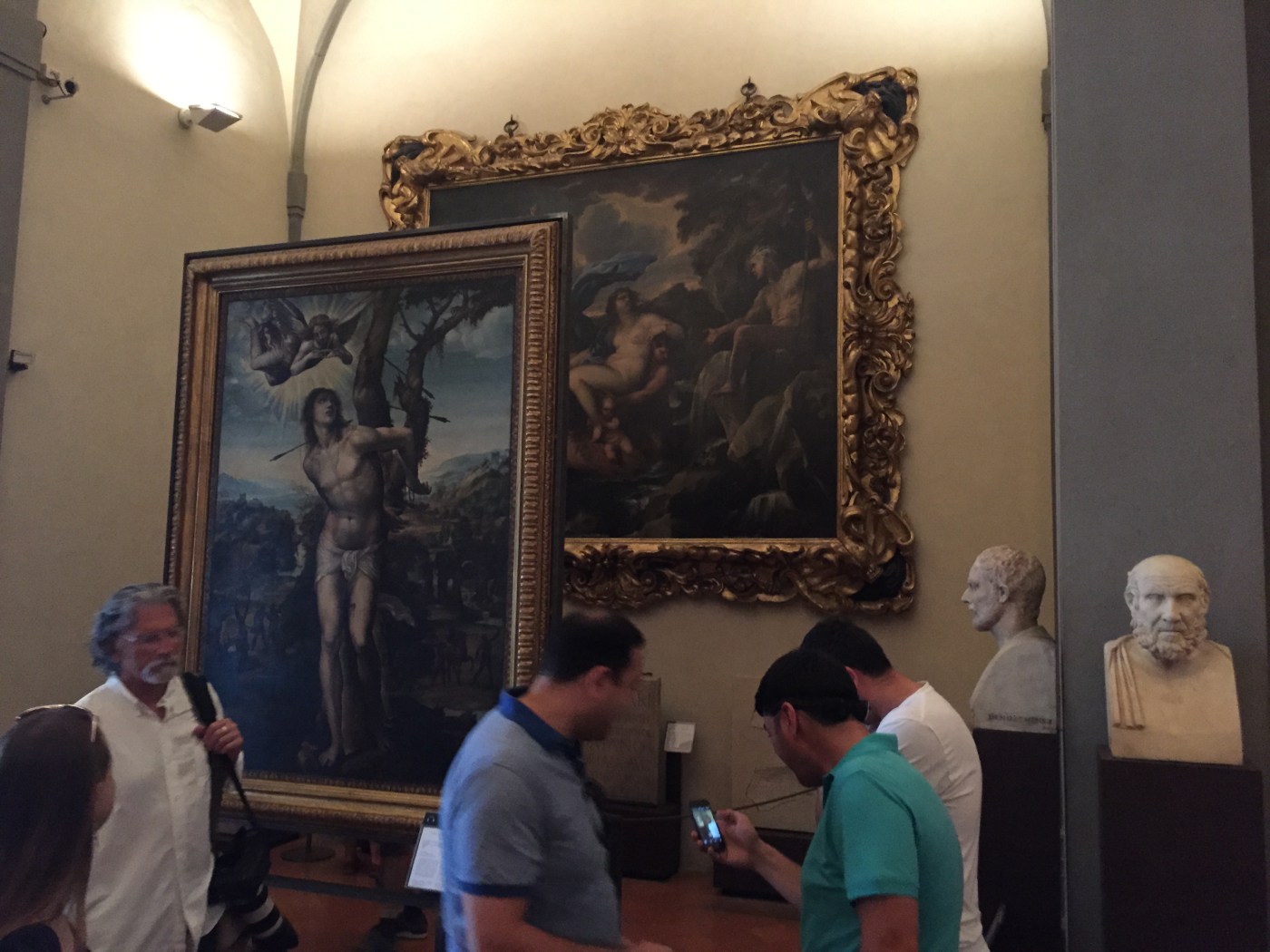
The Gallery setup in the Uffizzi gallery

These are two pieces of art basically stacked on top of one another. There was a similar display on the other side of the room. It may not seem like a big deal, but these are large works that need to be observed not just up close, but also from a distance to truly take them in.

The work in the back — the name of which I can’t remember — is nearly impossible to observe at the proper distance to appreciate it. You have to walk behind the piece in front. I’m by no means an art aficionado, but this seems to be a large fail by the gallery.

The Road Ways

There’s a feeling you get walking around the roads of Italy, a feeling that your life is no longer in your hands. Roads lead to piazzas — open air plazas — which often times have no demarcation between pedestrian areas, car areas and even lanes. These leads to some very awkward situations and the occasional harrowing journey to the other side.

The other issue we ran into with the roadways in Italy (mainly Rome and Florence) was navigation. The street signs, when they existed, were cement signs put on the sides of buildings. This definitely looked nice, but was very hard to see.

Street sign in Italy by Shauna Panczyszyn

by Shauna Panczyszyn on https://nikkivillagomez.wordpress.com/2013/07/30/wayfinding-madness/

These signs fade into the background of most buildings on which they reside. It took us a couple days to get used to it, and even then it made finding our way around incredibly difficult.

Overall, the trip was awesome, just found it interesting to see some UX fails from the real world overseas.

Bonus UX Win

We took an amazing tour of Pompeii and saw the city that was destroyed by Mount Vesuvius. One great accomplishment was on the main road through town. It acted as a road for chariots AND for the sewage to run down.

This required a way for pedestrians to get across without walking through the refuse, but also needed a way to slow the chariots down as they came into the populated areas of town. Enter an amazing Roman-designed speed bump. It has channels through which chariot wheels and sewage can pass easily and acts as stepping stones for pedestrians to cross the street without needing to bury their feet in some nasty liquids.

Truly amazing engineering from the past. Have a photo
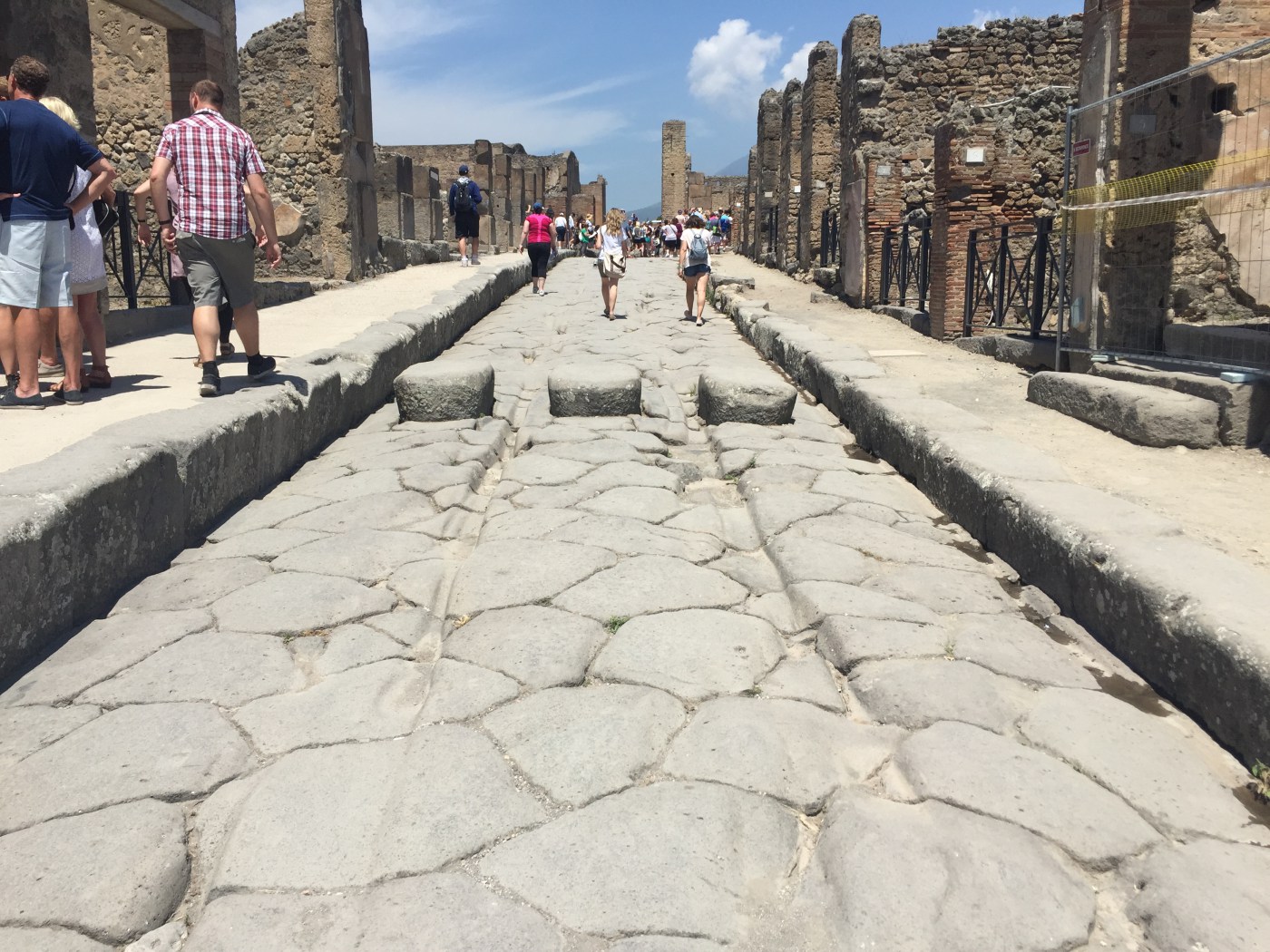
Speed bumps in ancient Pompeii