
惯性聚合 高效追踪和阅读你感兴趣的博客、新闻、科技资讯
阅读原文 在惯性聚合中打开

推荐订阅源

K
Kaspersky official blog
小众软件
小众软件
Engineering at Meta
Engineering at Meta
博客园 - 三生石上(FineUI控件)
WordPress大学
WordPress大学
G
Google Developers Blog
Cyber Security Advisories - MS-ISAC
V
V2EX
freeCodeCamp Programming Tutorials: Python, JavaScript, Git & More
Google DeepMind News
Security Archives - TechRepublic
CTFtime.org: upcoming CTF events
C
Check Point Blog
aimingoo的专栏
aimingoo的专栏
罗磊的独立博客
钛媒体:引领未来商业与生活新知
钛媒体:引领未来商业与生活新知
MongoDB | Blog
MongoDB | Blog
L
LINUX DO - 热门话题
酷 壳 – CoolShell
酷 壳 – CoolShell
奇客Solidot–传递最新科技情报
奇客Solidot–传递最新科技情报
H
Help Net Security
Martin Fowler
Martin Fowler
G
GRAHAM CLULEY
Simon Willison's Weblog
OSCHINA 社区最新新闻
OSCHINA 社区最新新闻
博客园 - Franky
V
Vulnerabilities – Threatpost
云风的 BLOG
云风的 BLOG
博客园_首页
C
Cybersecurity and Infrastructure Security Agency CISA
量子位
Stack Overflow Blog
Stack Overflow Blog
Recent Announcements
让小产品的独立变现更简单 - ezindie.com
I
Intezer
Scott Helme
Scott Helme
A
About on SuperTechFans
博客园 - 司徒正美
Hacker News: Ask HN
Hacker News: Ask HN
The GitHub Blog
The GitHub Blog
Forbes - Security
Forbes - Security
Threat Intelligence Blog | Flashpoint
博客园 - 聂微东
人人都是产品经理
人人都是产品经理
The Cloudflare Blog
cs.CV updates on arXiv.org
Spread Privacy
Spread Privacy
T
Tailwind CSS Blog
S
Security Affairs
宝玉的分享
宝玉的分享

Ahmad Shadeed

Better fluid sizing with round() Use Cases for Field Sizing The Basics of Anchor Positioning Item Flow CSS Relative Colors Balancing Text In CSS Should masonry be part of CSS grid? CSS display contents CSS Grid Areas CSS Cap Unit An Interactive Guide to CSS Container Queries CSS :has() Interactive Guide CSS Nesting UX in DevTools CSS Nesting Future CSS: State Container Queries Rebuilding a comment component with modern CSS Conditional CSS with :has and :nth-last-child CSS Text balancing with text-wrap:balance CSS Masking Do we need CSS flex-wrap detection? My CSS Wishlist Conditional CSS CSS Style Queries Inside the mind of a frontend developer: Article layout Inside the mind of a frontend developer: Hero section CSS container queries are finally here The CSS behind Figma First Look At The CSS object-view-box Property Learn CSS Subgrid CSS :has Parent Selector Aligning Content In Different Wrappers Flexbox Dynamic Line Separator Hello, CSS Cascade Layers Building UI Components With SVG and CSS A Deep CSS Dive Into Radial And Conic Gradients Defensive CSS Building Real-life Components: Facebook Messenger Conditional Border Radius In CSS CSS Container Query Units Less Absolute Positioning With Modern CSS Aligning a Button Label Vertically Comparing Design Mockups To Code Result Using HSL Colors In CSS Custom Scrollbars In CSS Let CSS Container Queries For Designers The State of CSS Cross-Browser Development Overflow Issues In CSS Inspect Element As A Way To Increase Your Curiosity Handling Text Over Images in CSS Digging Into CSS Logical Properties Clipping Scrollable Areas On The inline-start Side Understanding Clip Path in CSS The Art of Building Real-life Components Handling Short And Long Content In CSS CSS Scroll Snap A Deep Dive Into CSS Grid minmax() CSS Variables 101 Finding The Root Cause of a CSS Bug Learn CSS centering How to detect browser support for Flexbox Gap CSS Mistakes While On Autopilot Digging Into the Flex Property Understanding CSS Multiple Backgrounds Aligning Logo Images in CSS Grid for layout, Flexbox for components Colors in CSS Thinking About The In-between Design Cases min(), max(), and clamp() CSS Functions Image Techniques On The Web Everything About Auto in CSS Learn Box Alignment Learn CSS Positioning Intrinsic Sizing In CSS CSS Grid Template Areas In Action Hiding Elements On The Web Creating a Variable Color Font From Scratch Building a Football Ticket With CSS and SVG Blending Modes in CSS CSS Variables With Inline Styles Implementing Dark Mode For My Website Rebuilding Apple Music Header in HTML & CSS Accessible Checkbox Layout Flickering On Browser Resize Enhancing The Clickable Area Size Custom Underlines with SVG Part 3: The Process of Implementing A UI Design From Scratch Part 2: The Process of Implementing A UI Design From Scratch Building An Old Nav Design CSS Flexbox: 5 Real World Use Cases I Used CSS Inline Flex For The First Time The Process of Implementing A UI Design From Scratch Common CSS Issues For Front-End Projects Handling Long and Unexpected Content in CSS How to Build Web Form Layouts With CSS Grid Grid Layout Ah-ha Moment Enhancing Our Components with CSS :empty Building Resizeable Components with Relative CSS Units CSS Writing Mode The Journey of Learning Front End Web Development on a Daily Basis
Let
Ahmad Shadeed · 2020-02-26 · via Ahmad Shadeed

The Layout Maestro

I spent years teaching CSS layout on this blog. I put everything I know into The Layout Maestro course: 70+ lessons and 150+ interactive examples that teach you how to think CSS layouts, not just memorize syntax.

Get the course

From what I see, CSS counters are underused on the web, even though their support is really good (IE8+)!. In this article, I will explain how you can use CSS counters in your projects, along with some use-cases.

What are CSS Counters?

They provide us with a way to add generated content as numbers for elements, based on their location in the document.

The Three C’s

There are three properties needed for CSS counters to work. Here are they:

  • counter-reset
  • counter-increment
  • counter()

How To Add a Counter

1. Pick a name for the counter

Let’s suppose that we have the below HTML:

<div class="content">
  <h2>Section</h2>
  <p><!-- Description --></p>

  <h2>Section</h2>
  <p><!-- Description --></p>

  <h2>Section</h2>
  <p><!-- Description --></p>
</div>

I want to add a number to each title element. To do so, I will define a counter on the parent element.

.content {
  counter-reset: section;
}

2. Increment The Counter

This step is very important for the counter to work. On the <h2> element, I will create a before pseudo-element that will be used to generate the show the counter value.

h2:before {
  counter-increment: section;
}

3. Assign The Counter

The final step is to use the counter() function as a value for the content property. We have a lot of flexibility here which I will explain in the upcoming examples. For now, I added the following:

h2:before {
  counter-increment: section;
  content: counter(section);
}

With some styling for the before pseudo-element, the result can look quite good. We have a dynamic numbering in CSS!
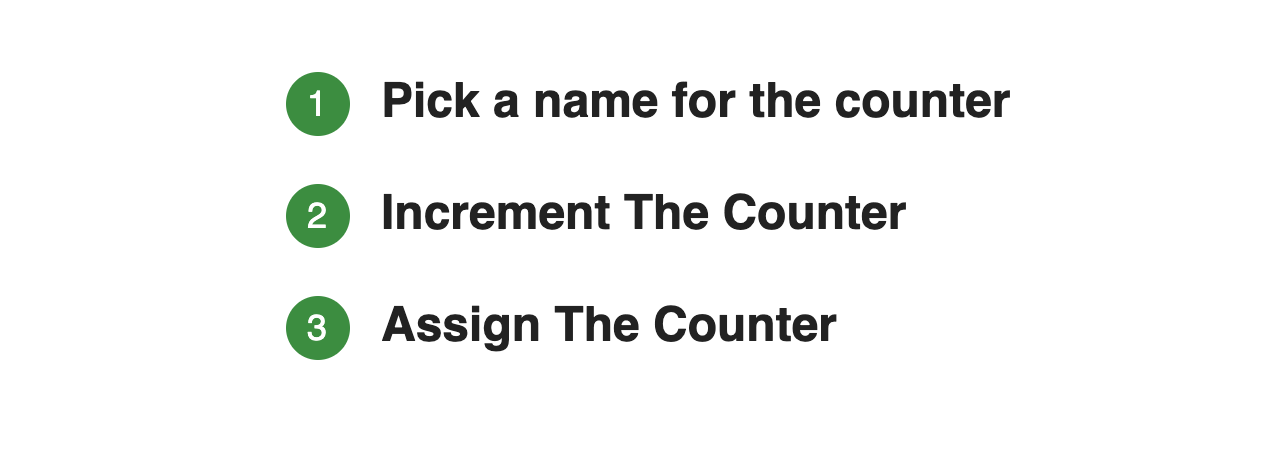
Demo

Use Cases

Dynamic Section Titles

Based on the previous example, we can edit the before pseudo-element as below:

h2:before {
  counter-increment: section;
  content: "Section " counter(section);
  display: block;
  max-width: 80px;
  font-size: 14px;
  font-weight: normal;
  background-color: rgba(#0277bd, 0.2);
  border-radius: 20px;
  text-align: center;
  padding: 6px 8px;
  margin-bottom: 0.75rem;
}
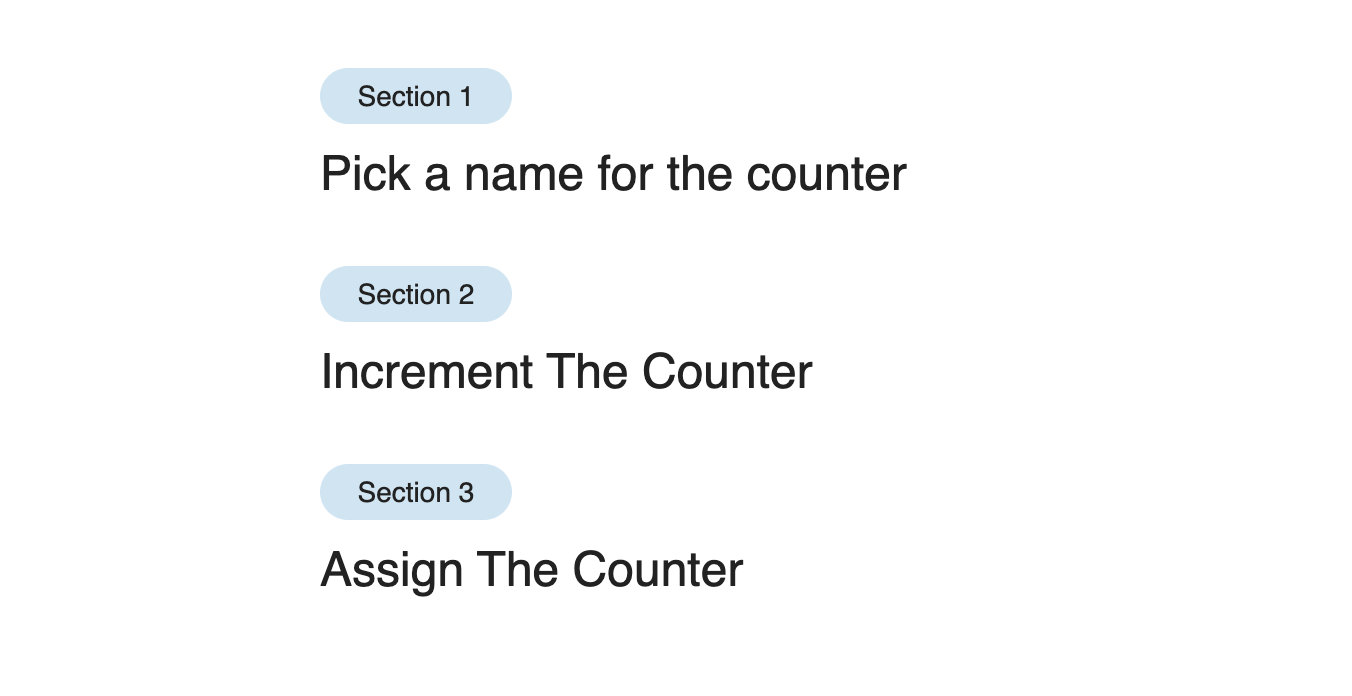
Demo

Nested Counters

Let’s say that we have the following list:

<ul class="services">
  <li class="services__item">
    Design
    <ul>
      <li>Web</li>
      <li>Mobile</li>
      <li>Graphic</li>
    </ul>
  </li>
  <li class="services__item">Web Development</li>
  <li class="services__item">
    Mobile Development
    <ul>
      <li>iOS</li>
      <li>Android</li>
      <li>Windows Phone</li>
    </ul>
  </li>
</ul>

We have nested lists, and our goal is to have the numbering be like “1.” and then “1.1” for the sub list. To accomplish that, we should do the following:

/* Defining a counter for the main list items */
.services {
  counter-reset: services;
}

.services__item:before {
  counter-increment: services;
  content: counter(services) ".";
}

/* Defining a counter for the sub lists */
.services__item ul {
  counter-reset: sub-services;
}

.services__item li:before {
  counter-increment: sub-services;
  content: counter(services) "." counter(sub-services);
}

See the Pen CSS Counters - Example 3 by Ahmad Shadeed (@shadeed) on CodePen.

The End

That’s a wrap. Do you have a comment or a suggestion? Please feel free to ping me on @shadeed9.