


Today the Ember project is releasing version 2.14.0 of Ember.js, Ember Data, and Ember CLI. You may have noticed we're a few weeks late on this release, as the start of summer may have left us a little distracted 😅.
This release kicks off the 2.15 beta cycle for all sub-projects. We encourage our community (especially addon authors) to help test these beta builds and report any bugs before they are published as a final release in six weeks' time. The ember-try addon is a great way to continuously test your projects against the latest Ember releases.
You can read more about our general release process here:
Ember.js is the core framework for building ambitious web applications.
Ember.js 2.14.0 is an incremental, backwards compatible release of Ember with bug-fixes, performance improvements, and minor deprecations.
A notable change that began in Ember 2.13.0 and continues in 2.14.0 is improved packaging of the framework itself. This includes adoption of Babel 6 and using Rollup on internal Ember packages.
The 2.14.0 release of Ember.js comes in as 7k smaller than 2.13.3 (minified and gzipped). Additionally, initial render time of real world apps continues to improve. This benchmark shows time-to-initial render of emberaddons.com measured using ember-macro-benchmark:
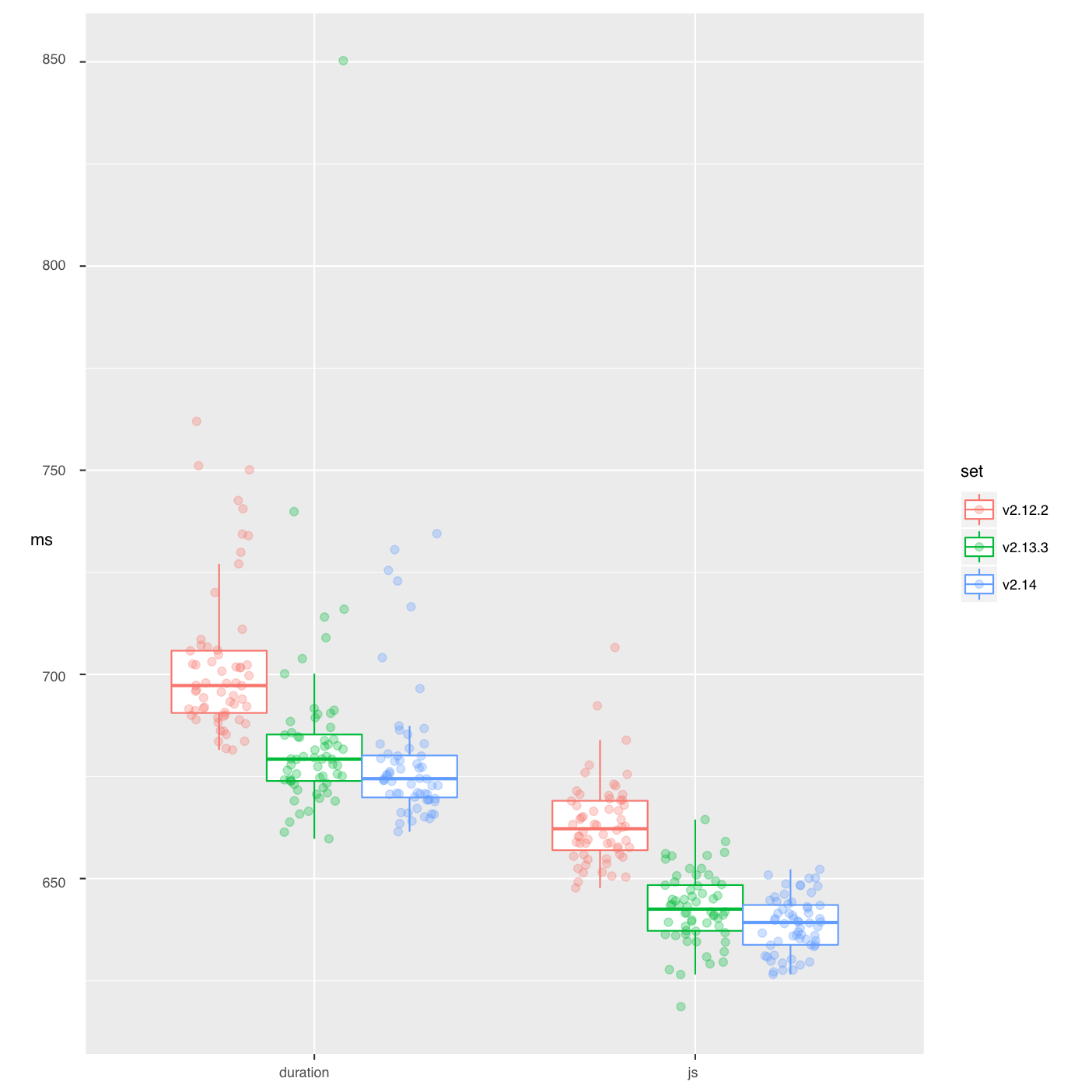
We're continuing to make similar improvements across the Ember project libraries. By measuring the impact of these changes as we make them, we will ensure complicated build changes avoid unintended regressions.
Deprecations are added to Ember.js when an API will be removed at a later date.
Each deprecation has an entry in the deprecation guide describing the migration path to more stable API. Deprecated public APIs are not removed until a major release of the framework.
Consider using the ember-cli-deprecation-workflow addon if you would like to upgrade your application without immediately addressing deprecations.
Two new deprecations are introduces in Ember 2.14.0:
Ember.MODEL_FACTORY_INJECTIONS is deprecated. This flag enabled DI behavior
required by Ember Data prior to changes landed in Ember 2.11. It is intimate
API scheduled for removal in Ember 2.17.0. If your application sets this
flag you can safely remove it. See the deprecation guide
entry and the implementation PR
for more details.eventManager property on components and the canDispatchToEventManager
property on EventManagers has been deprecated. These rarely used and
undocumented parts of the already obscure event manager API where designed for
touch-event use cases that now have other and better solutions. See the
deprecation
guide
and
deprecation PR for more
details.For more details on changes in Ember.js 2.14.0, please review the Ember.js 2.14.0 release page.
Ember.js 2.15.0 will introduce two new features:
model to the {{mount}} engine helper. For example {{mount 'admin'
model=(hash user=user)}} would provide the object with {user} as a model
property on the engine's application route. See the implementation
PR and
followup PR for more
details.RouteInfo
objects. See the
major implementation
pull
requests for more details.For more details on the upcoming changes in Ember.js 2.15, please review the Ember.js 2.15.0-beta.1 release page.
Ember Data is the official data persistence library for Ember.js applications.
Ember Data 2.14 brings with it a number of performance related optimizations. Ember Data 2.14.0 was released on June 18th, and the current released version is 2.14.3.
In addition to a large number of minor tweaks, three changes stand out:
Starting in Ember Data 2.14.0, builds of Ember Data use Rollup to produce a single micro-lib module. This helps with parse/eval time at boot and reduces both the pre and post-gzip sizes by ~23Kb and ~3Kb respectively. We also used Babel 6 and some manual tuning to further reduce the transpiled size.
Previously, Ember Data would immediately create the connections between records necessary for relationships. This is unnecessary overhead if these relationships aren't immediately accessed. In Ember Data 2.14.0 relationship connections are established only upon access to the relationship.
Previously, Ember Data would lookup the serializer for a requested data type immediately after making the network request. This strategy allowed the cost of serializer instantiation to be paid while waiting for the network to resolve. However, this strategy essentially traded initial render performance for a faster load of non-critical data. In this release, we're re-tuned this part of the system to be more friendly to initial rendering by deferring serializer lookup until data returns from the network.
Unfortunately, changes in Ember Data 2.14 appear to have introduced a number of regressions in less well defined areas of Ember Data's usage. If you experience trouble after upgrading to 2.14, we suggest locking to 2.13 and either commenting on an existing issue or opening a new issue as appropriate.
See the Ember Data issues for more information.
Several private but non-underscored methods ("intimate" API) have been
deprecated in favor of underscored variants. didUpdateAll is now
_didUpdateAll. buildInternalModel is now _buildInternalModel. These
APIs will be removed in Ember Data 2.15.0. See PR #4949
for more details.
For more details on the changes in Ember Data 2.14, please review the Ember Data release changelog
For more details on the upcoming changes in Ember Data 2.15, please review the Ember Data 2.15.0-beta.1 release page.
Ember CLI is the command line interface for managing and packaging Ember.js applications.
You may upgrade Ember CLI separately from Ember.js and Ember Data. To upgrade
your projects using yarn run:
yarn upgrade ember-cliTo upgrade your projects using npm run:
npm install --save-dev ember-cliAfter running the
upgrade command run ember init inside of the project directory to apply the
blueprint changes. You can preview those changes for applications
and addons.
Majority of the changes in this release happened under the hood to improve documentation as well as code cleanup and better integration with yarn.
Ember CLI now supports Node 8 and npm 5 out of the box, make sure to try it out! Some developers reported issues with node@8.1.0 where Ember CLI would be unresponsive. After upgrading to version node@8.1.2+ this issue no longer appeared.
Ember CLI 2.14.0 brings support for initial blueprint packages as an argument to
ember new. This empowers other projects to better utilize Ember CLI as a part
of their own ecosystem. In addition it permits experimentation with non-default
Ember application setups.
For example to generate an ember-cli-deploy
plugin use the @ember-cli-deploy/plugin-blueprint package (repo on
GitHub):
ember new my-new-deploy-plugin -b @ember-cli-deploy/plugin-blueprintThe package will be downloaded from NPM and used to provide the initial blueprint for your Ember CLI app.
Two other examples of this feature being used in the wild are:
--no-welcome has been added for ember new and ember init. Use
this flag to skip the inclusion of ember-welcome-page as a dependency in
newly created projects.For more details on the changes in Ember CLI 2.14.0 and detailed upgrade instructions, please review the Ember CLI 2.14.0 release page.
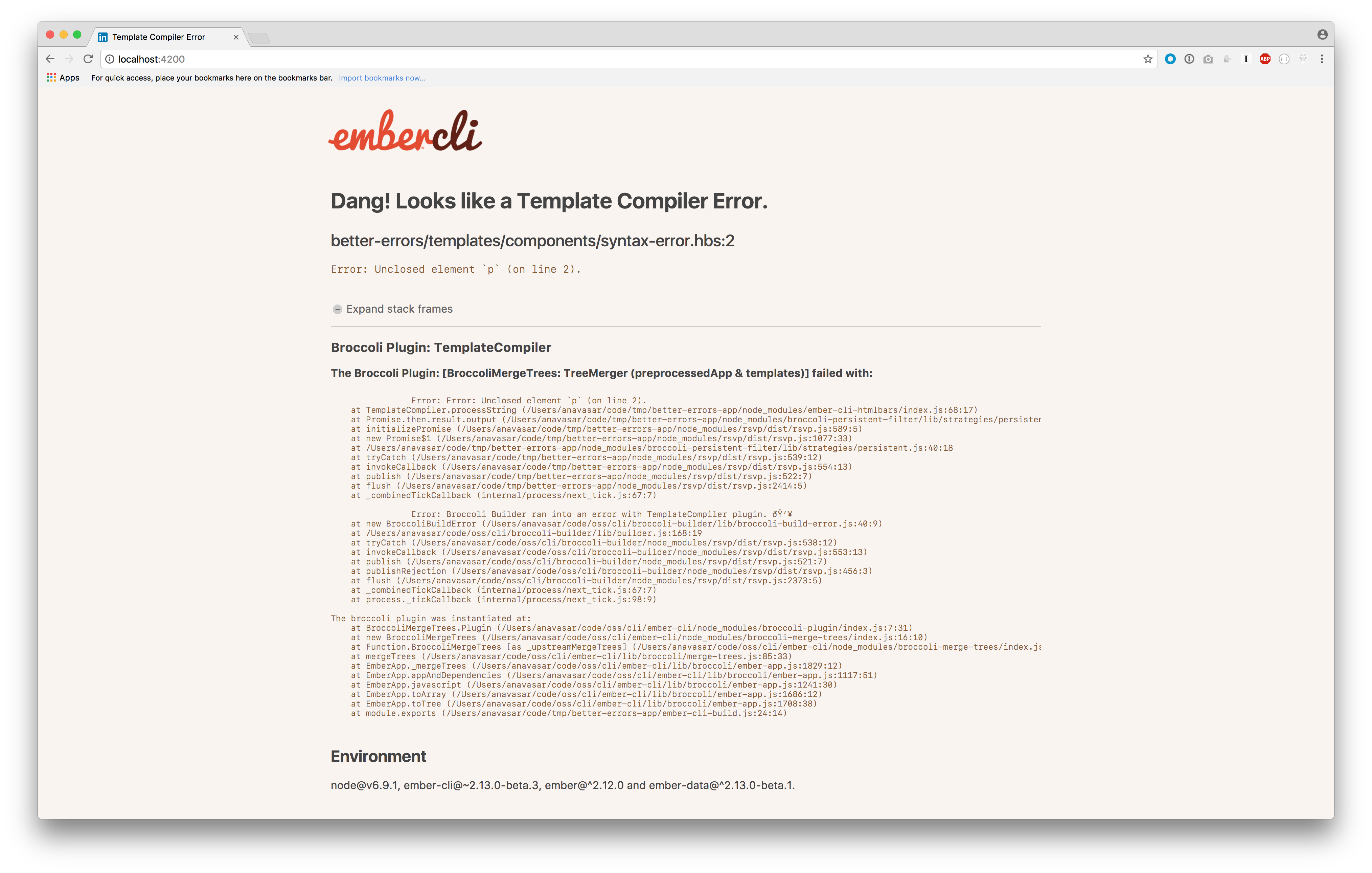
Ember CLI 2.15.0 will introduce improved error messages that appear in your browser. This change means less checking of the console for build errors. For example:
For more details on the changes in Ember CLI 2.15.0-beta.1 and detailed upgrade instructions, please review the Ember CLI 2.15.0-beta.1 release page.
As a community-driven open-source project with an ambitious scope, each of these releases serve as a reminder that the Ember project would not have been possible without your continued support. We are extremely grateful to our contributors for their efforts.
此内容由惯性聚合(RSS阅读器)自动聚合整理,仅供阅读参考。 原文来自 — 版权归原作者所有。