


With Ember 1.0 RC8, we have reached the final RC before 1.0 final, which we hope to release this weekend if all goes well.
This final release candidate comes with a couple of small breaking changes that we are making before 1.0 because they should have a small impact on application code but a large impact on performance.
We normally would not make changes of this nature this close to the 1.0 final release date. However, the performance improvements were so dramatic we did not want to wait until Ember.js 2.0 to introduce the change, and we are serious in our commitment to not breaking the API post-1.0. This was our last chance to get these changes in before putting the final stamp on the 1.0.
Both of the changes are related to observers. If you find yourself writing code with lots of observers, you may be writing non-idiomatic code. In general, you should only need to use observers when you are bridging Ember code to other libraries that do not support bindings or computed properties.
For example, if you were writing a component that wrapped a jQuery UI widget, you might use an observer to watch for changes on the component and reflect them on to the widget.
In your application code, however, you should be relying almost entirely on computed properties.
If you are having trouble upgrading your application, please join us in the IRC channel or post on StackOverflow for help.
There is now a way to declaratively add event listeners to Ember
classes. This is easier than manually setting up the listeners in
init.
Instead of:
App.Person = DS.Model.extend({
  init: function() {
    this.on('didLoad', this, function() {
      this.finishedLoading();
    });
  },

  finishedLoading: function() {
    // do stuff
  }
});
You can just do this:
App.Person = DS.Model.extend({
  finishedLoading: function() {
    // do stuff
  }.on('didLoad')
});Thanks to the tremendous work of David Hamilton, there is now a convenient and robust way to build a computed property based on an array that will only perform calculations on the updated portion.
For example, say that you have an array of people, and you want to create a computed property that returns an Array of their ages.
Currently, the easiest way to do that is:
App.Person = Ember.Object.extend({
  childAges: function() {
    return this.get('children').mapBy('age');
  }.property('children.@each.age')
});
This is pretty terse, but it must recalculate the entire array any time a single element is added or removed. This works OK for small arrays, but for larger arrays, or when these kinds of computed properties are chained or doing expensive work, it can add up.
Enter Array Computed properties:
App.Person = Ember.Object.extend({
  childAges: Ember.computed.mapBy('children', 'age')
});
You can also chain these Array computed properties together:
App.Person = Ember.Object.extend({
  childAges: Ember.computed.mapBy('children', 'age'),
  maxChildAge: Ember.computed.max('childAges')
});
When an element is added or removed, the computation is only done once.
In this example, if a child is added, their age is appended to
childAges, and if that age is larger than the maxChildAge, that
property is updated.
These computed properties are always up to date, efficient, and completely managed by Ember.
After months of testing, and tons of work by Teddy Zeenny, we're finally ready to put the Ember Inspector in the Chrome Web Store.
Most recently, Teddy added support for loaded data. It already has support for Ember Data, and Ember Model is actively working on adding support.
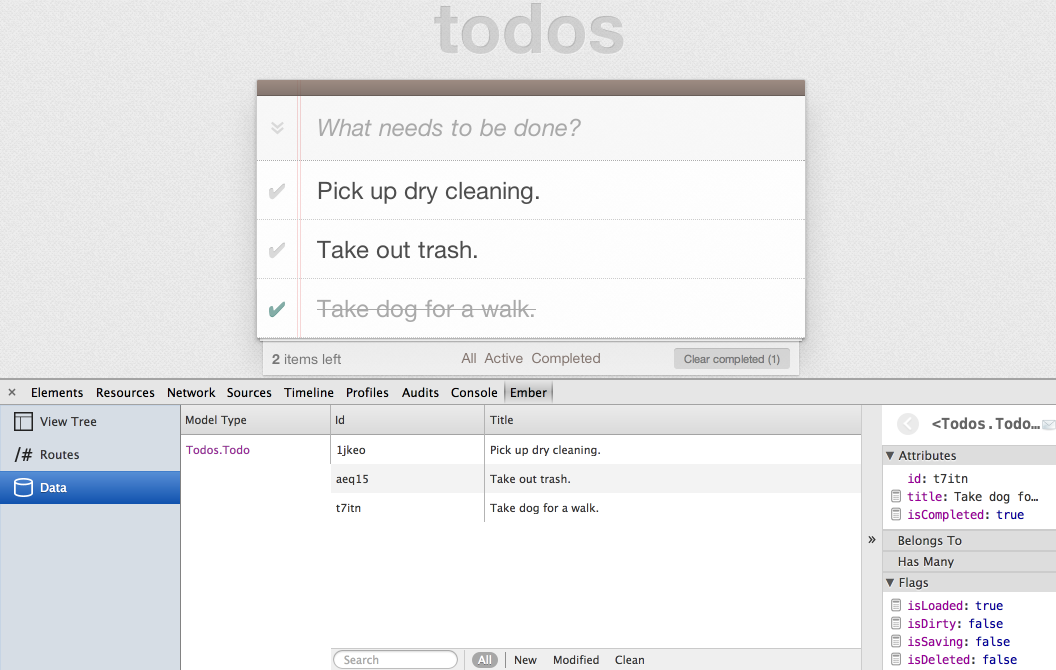
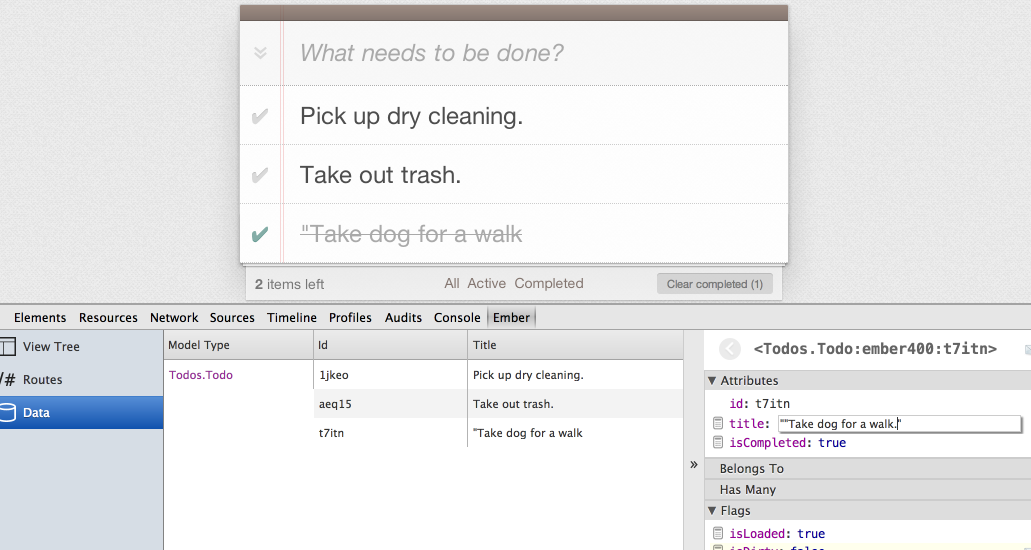
Teddy has also significantly improved the object inspector, adding support for objects to group properties as they wish (e.g. attributes, has many, belongs to in Ember Data) and editing records in the inspector itself.
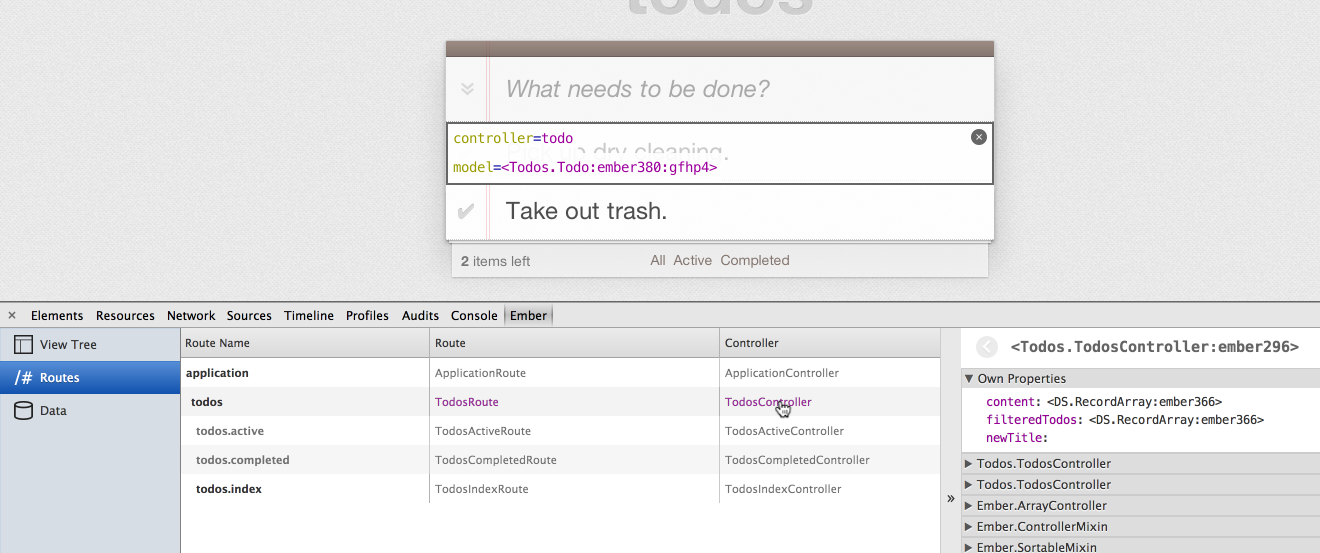
You can also see a list of all routes in your app, along with the naming you should use for associated objects. This should make remembering the naming conventions a lot easier.
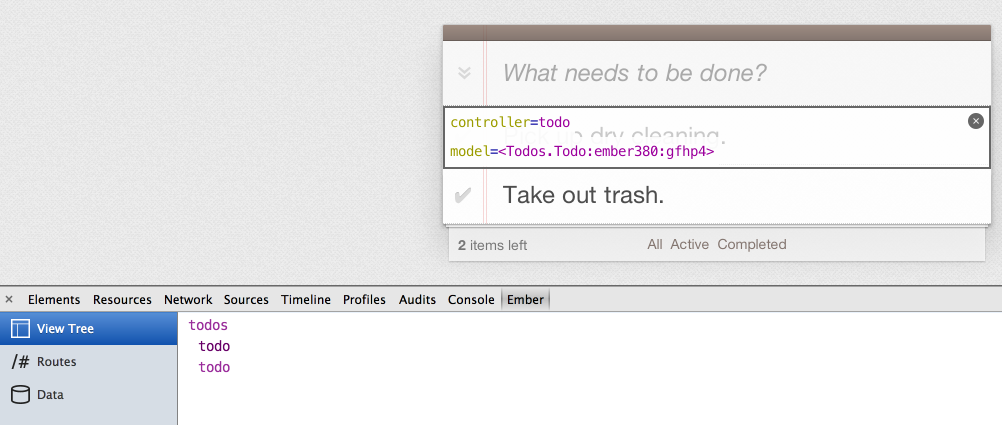
And finally, a view tree that shows an overlay in your app with the associated controller and model for your application's templates.
It should be in the web store in the next day or so, so keep an eye out. Follow @emberjs on Twitter to get the latest!
We know that the Ember 1.0 RC cycle was a bit long. In truth, we released RC1 too early. We're sorry if the release names caused confusion.
Going forward, we plan to seriously tighten up our release process. We will have a blog post outlining the new process together with the final Ember 1.0 release.
yield to make sure it always yields back to
the calling context [@kselden]<script> tags [@locks]currentRouteName to ApplicationController, which you can use
in link-to, transitionTo, etc. [@machty]linkTo to link-to and bindAttr to bind-attr for
consistency with HTML naming. Old names remain but are soft-deprecated
[@ebryn]Previously, observers would not fire for properties passed into
create or specified on the prototype, but they would fire if you set
a property in init.
Now, observers never fire until after init.
If you need an observer to fire as part of the initialization process,
you can no longer rely on the side effect of set. Instead, specify
that the observer should also run after init by using
.on('init').
App.Person = Ember.Object.extend({
  init: function() {
    this.set('salutation', "Mr/Ms");
  },

  salutationDidChange: function() {
    // some side effect of salutation changing
  }.observes('salutation').on('init')
});If you never get a computed property, its observers will not fire even
if its dependent keys change. You can think of the value changing from
one unknown value to another.
This doesn't usually affect application code because computed properties are almost always observed at the same time as they are fetched. For example, you get the value of a computed property, put it in DOM (or draw it with D3), and then observe it so you can update the DOM once the property changes.
If you need to observe a computed property but aren't currently
retrieving it, just get it in your init method.
Previously, you could define actions for your routes in their events hash. In controllers and views however, actions were defined directly as methods on the instance. Not only was this inconsistent, it also lead to awkward naming conflicts. For instance, attempting to name your action destroy would conflict with the built-in destroy method and very bad things would happen.
To make things consistent and give more flexibility in action naming, we've standardized around using a hash called actions. When extending a class with actions defined, we'll merge the actions defined on the subclass or instance with those on the parent. We also support _super so you won't lose any flexibility with this approach.
The old behavior will continue to work for the time being but is now deprecated. In the event that you had a controller that was proxying to a model with an existing actions property, we internally rename the property to _actions to avoid any conflicts.
In the past, we were loose with our requirements for quoting strings in Handlebars helpers. Unfortunately, this meant we were unable to distinguish between string values and property paths. We are now strictly enforcing quoting if you want the value to be treated as a string. This means that for link-to the route names must be quotes. In the reverse direction, if you had custom bound helpers and were passing a property path as a quoted string, this will no longer work. Again, quotes for strings, no quotes for paths.
initCurrently, there is an inconsistency between properties set when passing
a hash to create and setting those same properties in init.
App.Person = Ember.Object.extend({
  firstNameDidChange: function() {
    // this observer does not fire
  }.observes('firstName')
});

App.Person.create({ firstName: "Tom", lastName: "Dale" });
In this case, because the properties were set by passing a hash to
create, the observers are not fired.
But let's look at what happens in RC7 when the same initialization is
done via the init method:
// WARNING: OLD BEHAVIOR

App.Person = Ember.Object.extend({
  init: function() {
    if (!this.get('firstName')) {
      this.set('firstName', "Tom");
    }
  },
  firstNameDidChange: function() {
    // this observer fires
  }.observes('firstName')
});

App.Person.create({ lastName: "Dale" });
In this case, the old behavior would trigger the observers if
firstName was not provided.
We intended the design of the object model to trigger observers only
after construction, which is why create behaves the way it does.
Also, because the only way to define initial properties that have arrays
or objects as values is in init, there is a further inconsistency:
// WARNING: OLD BEHAVIOR

App.Person = Ember.Object.extend({
  // initial property value, does not trigger an initialization observer
  salutation: "Mr.",

  init: function() {
    // also initial property value, triggers an observer on
    // initialization
    this.set('children', []);
  }
});
In short, properties that get set during initialization, whether they
were already set on the prototype, passed as a hash to create, or set
in init, do not trigger observers.
If you have some code that you want to run both on initialization and
when a property changes, just mark it as a method that should also run
when initialization is done by using .on('init'). This will also be
more resiliant to refactoring, and not rely on a side effect of an
init-time set.
App.Person = Ember.Object.extend({
  firstNameDidChange: function() {
    // some side effect that happens when first name changes
  }.observes('firstName').on('init')
});The latest release of Ember.js contains a change to the way observers and computed properties interact. This may be a breaking change in apps that relied on the previous behavior.
To understand the change, let's first look at an example of a computed property. Imagine we are trying to model Schrödinger's famous cat using an Ember.js object.
App.Cat = Ember.Object.extend({
  isDead: function() {
    return Math.rand() > 0.5;
  }.property()
});

var cat = App.Cat.create();
Given this cat object, is it alive or is it dead? Well, that's determined at random. Before observing the cat, we might say that it's both alive and dead, or perhaps neither.
In reality, whether or not our cat has shuffled off this mortal coil is only determined the first time we ask for it:
cat.get('isDead');
// true
// …or false, half the time
After we have asked the cat object for its isDead property, we can
categorically say which it is. But before we ask, the value of the
computed property doesn't really exist.
Now, let's introduce observers into the mix. If the value of a computed property doesn't exist yet, should observers fire if one of its dependent keys changes?
In previous versions of Ember.js, the answer was "yes." For example, given this class:
App.Person = Ember.Object.extend({
  observerCount: 0,

  fullName: function() {
    return this.get('firstName') + ' ' + this.get('lastName');
  }.property('firstName', 'lastName'),

  fullNameDidChange: function() {
    this.incrementProperty('observerCount');
  }.observes('fullName')
});
Changing any of the dependent keys would trigger the observer:
// WARNING: OLD BEHAVIOR DO NOT RELY ON THIS

var person = App.Person.create({
  firstName: "Yehuda",
  lastName: "Katz"
});

person.get('observerCount'); // => 0

person.set('firstName', "Tomhuda");
person.get('observerCount'); // => 1

person.set('lastName', "Katzdale");
person.get('observerCount'); // => 2
However, because the fullName property doesn't really "exist" until
it's requested, it is unclear if firing an observer is the correct
behavior.
A related problem affects computed properties if their dependent
keys contain a path. (Remember that dependent keys are just the property
names you pass to .property() when defining a CP.)
For example, imagine we are building a model to represent a blog post that lazily loads the post's comments if they are used (in a template, for instance).
App.BlogPost = Ember.Object.extend({
  comments: function() {
    var comments = [];
    var url = '/post/' + this.get('id') + '/comments.json');

    $.getJSON(url).then(function(data) {
      data.forEach(function(comment) {
        comments.pushObject(comment);
      });
    });

    return comments;
  }.property()
});
Awesome! This will work as expected—a post's comments will only be loaded
over the network the first time we do post.get('comments') or use it
in a template:
<ul>
{{#each comments}}
  <li>{{title}}</li>
{{/each}}
</ul>
However, now we want to add a computed property that selects the first comment from the array of loaded comments:
App.BlogPost = Ember.Object.extend({
  comments: function() {
    var comments = [];
    var url = '/post/' + this.get('id') + '/comments.json';

    $.getJSON(url).then(function(data) {
      data.forEach(function(comment) {
        comments.pushObject(comment);
      });
    });

    return comments;
  }.property(),

  firstComment: function() {
    return this.get('comments.firstObject');
  }.property('comments.firstObject')
});
Now we have a problem! Because the firstComment computed property has
a dependency on comments.firstObject, it will get() the comments
property in order to set up an observer on firstObject.
As you can see, just adding this computed property now means that the comments are loaded for all blog posts in the app—whether their comments are ever used or not!
To determine what to do, we spent some time looking at real-world Ember.js apps. What we discovered is that this behavior carried with it signficant performance penalties.
To fix these issues, RC8 makes the following changes:
"foo.bar.baz"), or using a path as a dependent key,
will not cause any parts of the path that are uncomputed to become
computed.The majority of Ember.js applications should not be affected by this change, since:
get() those
properties at object initialization time, thus triggering the correct
behavior.If your applications are affected by this change, the fix is
straightforward: just get() the computed property in your class's
init method.
For example, to update the observer example above, we can retain the
pre-RC8 behavior by "precomputing" the fullName property:
App.Person = Ember.Object.extend({
  init: function() {
    this.get('fullName');
    this._super();
  },

  observerCount: 0,

  fullName: function() {
    return this.get('firstName') + ' ' + this.get('lastName');
  }.property('firstName', 'lastName'),

  fullNameDidChange: function() {
    this.incrementProperty('observerCount');
  }.observes('fullName')
});
link-to Bound ParametersThe link-to helper (formerly linkTo, see above) now treats
all unquoted parameters (and non-numeric parameters)
as bound property paths, which means that when a property passed to
link-to changes, the href of the link will change. This includes
the first parameter (the destination route name) and any of the context
parameters that follow.
The following example template will look up the destinationRoute on the
current context (usually a controller) and use it to determine the
href of the link and the route that will be transitioned to when
the link is clicked.
{{#link-to destinationRoute}}Link Text{{/link-to}}The following example template will always point to the articles.show
route (since the route name parameter is in quotes), but when the value
of article changes, the link's href will update to the URL that
corresponds to the new value of article.
{{#link-to 'articles.show' article}}Read More...{{/link-to}}This might cause a few surprises in your app if you haven't been
distinguishing between quoted strings and property paths, so make sure
that any static string link-to parameters (such as route names) are
properly quoted in your templates when you upgrade to RC8.
Invoking a custom bound helper (e.g. one defined via Ember.Handlebars.helper)
with quoted strings or raw numbers will pass that raw value directly
into the helper function you've defined, rather than treating everything
like a bound property path that will re-render the helper when changed.
Pass the string 'hello' to myHelper:
{{myHelper 'hello'}}

Pass the property pointed-to by the path 'hello' to myHelper:
{{myHelper hello}}
This might cause a few surprises in your app if you've been invoking bound helpers with quoted strings and expecting them to be treated as bound property paths, so make sure that the only time you're passing quoted strings to custom helpers is when you really intend to pass raw strings (rather than the values of properties) to the helper.
此内容由惯性聚合(RSS阅读器)自动聚合整理,仅供阅读参考。 原文来自 — 版权归原作者所有。