
惯性聚合 高效追踪和阅读你感兴趣的博客、新闻、科技资讯
阅读原文 在惯性聚合中打开

推荐订阅源

Cisco Talos Blog
Cisco Talos Blog
freeCodeCamp Programming Tutorials: Python, JavaScript, Git & More
爱范儿
爱范儿
奇客Solidot–传递最新科技情报
奇客Solidot–传递最新科技情报
Jina AI
Jina AI
雷峰网
雷峰网
The Register - Security
The Cloudflare Blog
博客园 - 【当耐特】
M
MIT News - Artificial intelligence
I
InfoQ
博客园 - 三生石上(FineUI控件)
H
Help Net Security
博客园 - 司徒正美
Vercel News
Vercel News
WordPress大学
WordPress大学
S
SegmentFault 最新的问题
云风的 BLOG
云风的 BLOG
B
Blog
Google DeepMind News
B
Blog RSS Feed
L
LangChain Blog
人人都是产品经理
人人都是产品经理
GbyAI
GbyAI
T
The Blog of Author Tim Ferriss
T
Tailwind CSS Blog
aimingoo的专栏
aimingoo的专栏
让小产品的独立变现更简单 - ezindie.com
Recorded Future
Recorded Future
小众软件
小众软件
Martin Fowler
Martin Fowler
罗磊的独立博客
Stack Overflow Blog
Stack Overflow Blog
钛媒体:引领未来商业与生活新知
钛媒体:引领未来商业与生活新知
酷 壳 – CoolShell
酷 壳 – CoolShell
腾讯CDC
CTFtime.org: upcoming CTF events
Apple Machine Learning Research
Cyber Security Advisories - MS-ISAC
博客园 - Franky
Hugging Face - Blog
Hugging Face - Blog
Y
Y Combinator Blog
V
Visual Studio Blog
F
Fortinet All Blogs
Microsoft Azure Blog
大猫的无限游戏
大猫的无限游戏
Engineering at Meta
Engineering at Meta
N
Netflix TechBlog - Medium
V
V2EX
Blog — PlanetScale
Blog — PlanetScale

Maxime Heckel's Blog

On Rendering the Sky, Sunsets, and Planets - The Blog of Maxime Heckel Shades of Halftone - The Blog of Maxime Heckel Field Guide to TSL and WebGPU - The Blog of Maxime Heckel On Shaping Light: Real-Time Volumetric Lighting with Post-Processing and Raymarching for the Web - The Blog of Maxime Heckel Speaking at Figma Config 2025 - The Blog of Maxime Heckel Post-Processing Shaders as a Creative Medium - The Blog of Maxime Heckel On Crafting Painterly Shaders - The Blog of Maxime Heckel The Art of Dithering and Retro Shading for the Web - The Blog of Maxime Heckel Moebius-style post-processing and other stylized shaders - The Blog of Maxime Heckel Shining a light on Caustics with Shaders and React Three Fiber - The Blog of Maxime Heckel Real-time dreamy Cloudscapes with Volumetric Raymarching - The Blog of Maxime Heckel Painting with Math: A Gentle Study of Raymarching - The Blog of Maxime Heckel Building a magical AI-powered semantic search from scratch - The Blog of Maxime Heckel Beautiful and mind-bending effects with WebGL Render Targets - The Blog of Maxime Heckel Refraction, dispersion, and other shader light effects - The Blog of Maxime Heckel The magical world of Particles with React Three Fiber and Shaders - The Blog of Maxime Heckel The Study of Shaders with React Three Fiber - The Blog of Maxime Heckel Building a Design System from scratch - The Blog of Maxime Heckel Everything about Framer Motion layout animations - The Blog of Maxime Heckel Building a Vaporwave scene with Three.js - The Blog of Maxime Heckel Cubic Bézier: from math to motion - The Blog of Maxime Heckel First steps with GPT-3 for frontend developers - The Blog of Maxime Heckel Building the perfect GitHub CI workflow for your frontend team - The Blog of Maxime Heckel Migrating to Next.js - The Blog of Maxime Heckel Static Tweets with MDX and Next.js - The Blog of Maxime Heckel Advanced animation patterns with Framer Motion - The Blog of Maxime Heckel Scrollspy demystified - The Blog of Maxime Heckel The Power of Composition with CSS Variables - The Blog of Maxime Heckel My first failed SwiftUI project - The Blog of Maxime Heckel Guide to creating animations that spark joy with Framer Motion - The Blog of Maxime Heckel Using Shortcuts and serverless to build a personal Apple Health API - The Blog of Maxime Heckel SEO mistakes I've made and how I fixed them - The Blog of Maxime Heckel Going native: SwiftUI from the perspective of a React developer - The Blog of Maxime Heckel Build your own preview deployment service - The Blog of Maxime Heckel The little guide to CI/CD for frontend developers - The Blog of Maxime Heckel Immigrating to the US - The Blog of Maxime Heckel The physics behind spring animations - The Blog of Maxime Heckel Generate screenshots of your code with a serverless function - The Blog of Maxime Heckel How to use Framer Motion with Emotion styled-components - The Blog of Maxime Heckel Data Fetching with NextJS: What I learned - The Blog of Maxime Heckel Learning in public - The Blog of Maxime Heckel Fixing the dark mode flash issue on server rendered websites - The Blog of Maxime Heckel How to fix NPM link duplicate dependencies issues - The Blog of Maxime Heckel Running scheduled cross-browser end-to-end tests on Github CI - The Blog of Maxime Heckel How I built my first custom ESLint rule - The Blog of Maxime Heckel React Lazy: a take on preloading views - The Blog of Maxime Heckel Automated UI accessibility testing with Cypress - The Blog of Maxime Heckel Building a GraphQL wrapper for the Docker API - The Blog of Maxime Heckel Switching off the lights - Adding dark mode to your React app - The Blog of Maxime Heckel Getting started with Typescript on Gatsby - The Blog of Maxime Heckel Rebuilding Redux with Hooks and Context - The Blog of Maxime Heckel Asynchronous rendering with React - The Blog of Maxime Heckel How to efficiently type your styled-components with Flow - The Blog of Maxime Heckel How I got started with Kubernetes on GKE - The Blog of Maxime Heckel React sub-components Part 3: Whitelisting sub-components with flow - The Blog of Maxime Heckel React sub-components Part 2: Using the new Context API - The Blog of Maxime Heckel React sub-components - The Blog of Maxime Heckel Running Golang tests with Jest - The Blog of Maxime Heckel No title No title
Using Flow generics to type generic React components - The Blog of Maxime Heckel
Maxime Heckel · 2018-10-17 · via Maxime Heckel's Blog

This post is part of an informal series of small articles focusing on Flow types usages that I’ve discovered and found useful over the past few months. The first article of this series can be found here.

Building generic React components can be a great way to simplify the codebase of a project. By combining overlapping functionalities into a single component, we reduce the entropy of components and thus reduce the amount of testing needed. However, typing generic React components can be a bit of hassle at first, especially when you‘re just getting started with Flow. This post will focus on one example of a generic React component that I was struggling to type a few months ago, and how Flow generics helped me to not only overcome the typing issues but also to build a scalable type for this component.

From multiple typed components to one

In the project I was working on, I had to handle multiple resources (named here Resource1, Resource2, Resource3, … for simplicity). Each resource had its own associatedList component (Resource1List, Resource2List, …), each of which was pretty similar to the others in terms of implementation, as the resources themselves were quite the same outside of a few differences. Below, you can see the types of Resource1 and Resource2 :

Example resource Flow types

So given these specs, I wanted to build a single ResourceList component to display items of a given resource. Its props would include an onItemClick callback function, which takes a variable of that resource type as an argument. Here’s the first type that I wrote for the props of the ResourceList component:

The first iteration of the “Props” Flow type for ResourceList

Now that the component is typed, the next step consists of trying to use it with one of our Resources. Here’s how ResourceList can be used for Resource1 for example:

Resource1List React component using ResourceList

1

import React from 'react';

2

import ResourceList from 'components/ResourceList';

3

import type { Resource1 } from 'core/types';

6

class Resource1List extends React.Component {

7

onResource1Click = (item: Resource1) => {

8

const { name, id } = item;

15

return <ResourceList onItemClick={this.onResource1Click(item)} />;

This is the moment when I ran into the main problem. Given the way I typed this component, running Flow against the code in the example above outputs an error:
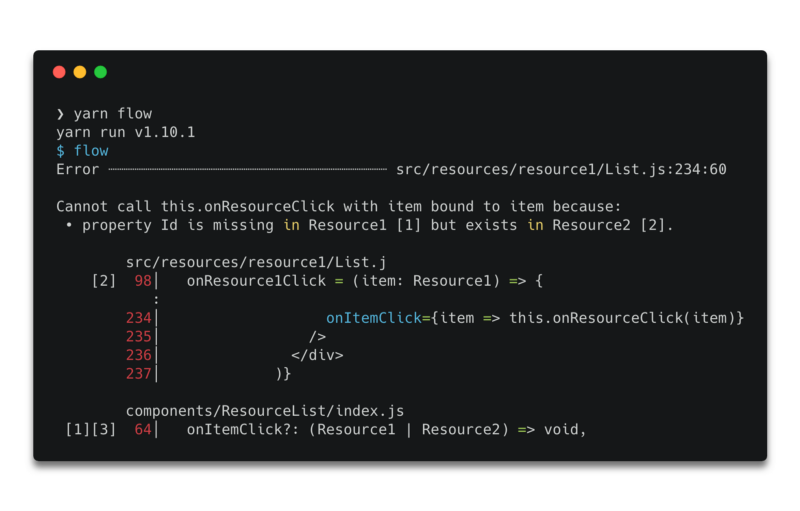
Flow error output with the first iteration of the “Props” Flow type for ResourceList

Flow error output with the first iteration of the “Props” Flow type for ResourceList

In the Resource types we declared above ( Resource1, Resource2 , …), you can see that the key of the “id” field of each Resource doesn’t match. Thus, whenever we will use this component and write an onItemClick function for a resource, Flow will give you an error telling us the properties of the other resources are missing.

How to use generics

To overcome this kind of situation, generics can be very practical. This is how we can end up typing this component and fix this issue:

  • we can provide a generic BaseProps type which takes a generic type T

  • use T inside BaseProps for ouronItemClick function which will take an item of type T as argument and thus be of type T => void

  • declare Resource1Props , Resource2Props , etc, based on BaseProps

  • write the type Props as an enum of Resource1Props, Resource2Props, etc.

The resulting code looks like this:

ResourceList “Props” Flow type using a generic BaseProps Flow type

3

onItemSelect = T => void,

6

type Resource1Props = BaseProps<Resource1>;

7

type Resource2Props = BaseProps<Resource2>;

9

type Props = Resource1Props | Resource2Props;

Running Flow with this type should output the following:
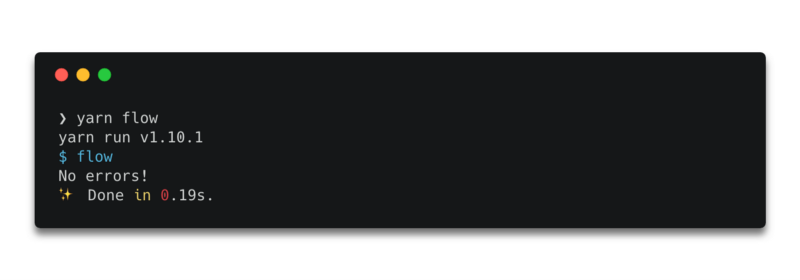
Flow output with no errors thanks to the new ResourceList “Props” Flow type!

Flow output with no errors thanks to the new ResourceList “Props” Flow type!

We have now typed our generic list component properly thanks to Flow. We can see that using generics not only brings flexibility to our type, but also will help in the future when we want to scale up the usage of this component, so it can be used with even more resources.