


The short answer to the title is: Accessibility is not an average.
For a longer answer, read on.
When I run training a common refrain is: Computers don’t know what is appropriate. I illustrate that with a picture of a dog, and showing an alt text of “cat”.
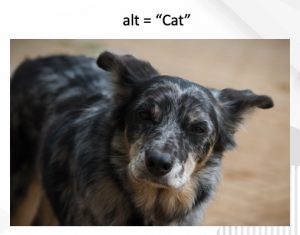
Historically accessibility testing tools would not pick that up. The image has an alternative text, it isn’t the same as the file name, so by an automated test that’s ok.
With machine learning (ML) you could, at least in theory, feed images with good alt text into a model and use that to test whether the alt-text of “cat” is good. Hopefully it would say no. I haven’t seen that work in practice, but I can accept it is possible.
Now there are tools for producing (or co-producing) code, e.g. Co-Pilot. There are even some that claim to output accessible code.
I won’t claim to be an expert in Artificial Intelligence, ML, or Large Language Models (LLMs), but there is a fairly understandable way to explain why it won’t work for accessibility. The process for generating the code is something like:
There are two reasons such a model would not output accessible code:
I don’t think anyone will doubt the first reason. The WebAim analysis of a million homepages is pretty good evidence that most code is not accessible. Nomensa’s experience with running audits aligns with that.
Wherever you take an average, or a ‘most likely next thing’ based on the average webpage, it will not output accessible code because the average is not accessible.
The second reason I’m less confident of, but I’m thinking of examples where you might take different approach to a particular component, and a model might merge them together creating a very confusing experience. For example, it might include a smattering of ARIA attributes because they are used by some sites, but they are unlikely to be appropriately used.
I’m not sure these are solvable problems. For example, if you took a smaller corpus of known-accessible examples to feed the model, would it be large enough to work? Also, would it be better than using a decision tree and a component library? I’m sceptical.
Accessibility is by definition non-typical usage, therefore applying an average does not work.
For further reading, I’d recommend Adrian’s articles on AI fixing accessibility, and AI generated alt text.
此内容由惯性聚合(RSS阅读器)自动聚合整理,仅供阅读参考。 原文来自 — 版权归原作者所有。