惯性聚合 高效追踪和阅读你感兴趣的博客、新闻、科技资讯
阅读原文 在惯性聚合中打开

推荐订阅源

Spread Privacy
Spread Privacy
V
Visual Studio Blog
Cyber Security Advisories - MS-ISAC
Recorded Future
Recorded Future
云风的 BLOG
云风的 BLOG
Microsoft Azure Blog
I
InfoQ
Apple Machine Learning Research
MyScale Blog
MyScale Blog
M
MIT News - Artificial intelligence
WordPress大学
WordPress大学
Recent Announcements
V
V2EX
The GitHub Blog
The GitHub Blog
奇客Solidot–传递最新科技情报
奇客Solidot–传递最新科技情报
Jina AI
Jina AI
小众软件
小众软件
aimingoo的专栏
aimingoo的专栏
V
Vulnerabilities – Threatpost
C
Check Point Blog
C
Cyber Attacks, Cyber Crime and Cyber Security
AI
AI
宝玉的分享
宝玉的分享
P
Proofpoint News Feed
量子位
Attack and Defense Labs
H
Hackread – Cybersecurity News, Data Breaches, AI and More
P
Privacy International News Feed
Google DeepMind News
CTFtime.org: upcoming CTF events
C
CERT Recently Published Vulnerability Notes
腾讯CDC
Latest news
Latest news
Google DeepMind News
The Register - Security
cs.CV updates on arXiv.org
cs.AI updates on arXiv.org
G
GRAHAM CLULEY
Blog — PlanetScale
Blog — PlanetScale
博客园_首页
美团技术团队
The Cloudflare Blog
T
Tenable Blog
cs.CL updates on arXiv.org
J
Java Code Geeks
SecWiki News
SecWiki News
Webroot Blog
Webroot Blog
N
News | PayPal Newsroom
博客园 - 叶小钗
博客园 - Franky

oida.dev | TypeScript, Rust

TypeScript's `erasableSyntaxOnly` Flag Unsafe for work Tokio: Macros Tokio: Channels Tokio: Getting Started Network Applications on the Tokio Stack Remake, Remodel, Reduce. The `never` type and error handling in TypeScript 5 Inconvenient Truths about TypeScript Refactoring in Rust: Introducing Traits Refactoring in Rust: Abstraction with the Newtype Pattern Announcing the TypeScript Cookbook TypeScript: Iterating over objects The road to universal JavaScript 10 years of oida.dev Rust: Tiny little traits The TypeScript converging point How not to learn TypeScript Getting started with Rust Introducing Slides and Coverage TypeScript: The humble function overload TypeScript + React: Children types are broken TypeScript: In defense of any Rust: Enums to wrap multiple errors Dissecting Deno Error handling in Rust TypeScript: Unexpected intersections Upgrading Node.js dependencies after a yarn audit TypeScript: Array.includes on narrow types TypeScript + React: Typing Generic forwardRefs shared, util, core: Schroedinger's module names Learning Rust and Go TypeScript: Narrow types in catch clauses TypeScript: Low maintenance types Tidy TypeScript: Name your generics Tidy TypeScript: Avoid traditional OOP patterns Tidy TypeScript: Prefer type aliases over interfaces Tidy TypeScript: Prefer union types over enums My new book: TypeScript in 50 Lessons Go Preact! ❤️ this in JavaScript and TypeScript TypeScript and ECMAScript Modules TypeScript + React: Why I don't use React.FC TypeScript + React: Component patterns TypeScript: Augmenting global and lib.dom.d.ts Vite with Preact and TypeScript TypeScript: Union to intersection type 11ty: Generate Twitter cards automatically Are large node module dependencies an issue? TypeScript: Variadic Tuple Types Preview TypeScript: Improving Object.keys Remake, Remodel. Part 4. TypeScript + React: Typing custom hooks with tuple types TypeScript: Assertion signatures and Object.defineProperty TypeScript: Check for object properties and narrow down type Boolean in JavaScript and TypeScript void in JavaScript and TypeScript Symbols in JavaScript and TypeScript Why I use TypeScript TypeScript + React: Extending JSX Elements TypeScript: Validate mapped types and const context TypeScript: Match the exact object shape TypeScript: The constructor interface pattern Streaming your Meetup - Part 4: Directing and Streaming with OBS Streaming your Meetup - Part 3: Speaker audio Streaming your Meetup - Part 2: Speaker video Streaming your Meetup - Part 1: Basics and Projector TypeScript and React Guide: Added a new styles chapter TypeScript and React Guide: Added a new render props chapter TypeScript and React: Styles and CSS TypeScript and React TypeScript and React Guide: Added a new prop types chapter TypeScript without TypeScript -- JSDoc superpowers TypeScript: Mapped types for type maps JAMStack vs serverless web apps The Unsung Benefits of JAMStack Sites TypeScript: Ambient modules for Webpack loaders My most favourite talks in 2018 TypeScript and React Guide: Added a new context chapter TypeScript: Built-in generic types TypeScript: Type predicates JSX is syntactic sugar TypeScript and React Guide: Added a new hooks chapter Getting your CfP application right FAQ on our Angular Connect Talk: Automating UI development TypeScript and Substitutability Debugging Node.js apps in TypeScript with Visual Studio Code From Medium: Deconfusing Pre- and Post-processing From Medium: PostCSS misconceptions Saving and scraping a website with Puppeteer Cutting the mustard - 2018 edition Wordpress as CMS for your JAMStack sites My most favourite podcast episodes in 2017 My most favourite talks in 2017 My most favourite books in 2017 The Best Request Is No Request, Revisited Not so hidden figures - Organizing ScriptConf My podcast journey to ScriptCast Grid layout, grid layout everywhere! #scriptconf and #devone
Gulp, Sass, Autoprefixer, Sourcemaps!
2014-04-10 · via oida.dev | TypeScript, Rust

Update 2016/02: This is old. This might not be up to date anymore!

Update 2015/03: There has been a breaking change with gulp-ruby-sass v1.0. The files have been updated.

Update 2015/12: There have been some updates with gulp-sourcemaps and the way sourcemaps are treated with gulp-ruby-sass. The code snippet has been updated

Having Sourcemaps is one of the new big things in Sass 3.3. And rightfully so: The opportunity to fully track selectors and rules back to its very origin in your debugger is really, really helpful! And also, it’s rather easy to set up. Just add the --sourcemaps flag and you are done.

Things can be complicated if you’re using a more complex chain of build processes and tools. Like booting up gulp or grunt, processing your Sass files and post-processing it afterwards with autoprefixer or similar.

TL;DR: Use Sass’s compact mode

It’s a sensible approach do to so; prefixing (whether you like it or not) is something that is really tedious when done manually, and obfuscates your code when you rely too much on mixins. Plus, you have to think about what needs to be prefixed, and what can be left how it is. Actually using prefix mixins might double your work if you really care about a clean and sensible output. autoprefixer helps by knowing what needs to be done. This is what automation is all about.

Anyhow, if you want to have both benefits – kick-ass sourcemaps and some help by automation tools – you might easily end up in the same problem as my friend Gerrit did just a few days ago. Sourcemaps define a map of which line of code in the output is connected to which file and line of code in the original. If you’re postprocessing your output and adding new lines (or removing them, depending on how you configured your autoprefixer), the map gets all mangled up. autoprefixer itself is able to create sourcemaps, but still, you would have to rewrite the old one, and that’s kinda tedious.

But there is an easy trick how you can achieve both with minimal effort. Just don’t allow new lines to be created. Both Sass and autoprefixer care a lot about your style of coding. Which means that they don’t f**k up your code once you’ve decided how the output is created. So, if you tell Sass to write each rule into one single line (output style compact), autoprefixer will add the new rules in exact the same line, thus keeping the sourcemap information intact.

When you’re using gulp, be sure to use the ruby version of the plugin, and also make sure that you’ve Sass 3.3 installed.

gem install sass

Initialize your gulp setup:

npm init && npm install --save-dev gulp gulp-autoprefixer gulp-ruby-sass gulp-sourcemaps

The interface of gulp-sass (which uses a much faster native implementation) and the one of gulp-ruby-sass are not identical. So once gulp-sass is based on Sass 3.3, you not only have to switch plugins, but also adapt their parameters.

Update 2014/6/3: Apparently gulp-sass does not allow to use outputStyle: compressed, so you have to stick with the Ruby version for now.

Update 2015/3/25: With Sass 3.4. and gulp-ruby-sass 1.0 the interface has changed again. It now has been adapted to realise that’s just a wrapper for the original Sass and not a piped through task, and also requires Gulp’s sourcemap module to work properly. This might also change the behaviour with Autoprefixer and Sourcemaps in general.

Your gulpfile.js

var gulp = require('gulp');
var sass = require('gulp-ruby-sass');
var sourcemaps = require('gulp-sourcemaps');
var prefix = require('gulp-autoprefixer');

gulp.task('default', function () {
sass('src/app.scss', {sourcemap: true, style: 'compact'})
.pipe(prefix("last 1 version", "> 1%", "ie 8", "ie 7"))
.pipe(sourcemaps.write('.'))
.pipe(gulp.dest('dist'));
});

And voilà, feel yourself sourcemapped! Grunt setup is pretty much the same.
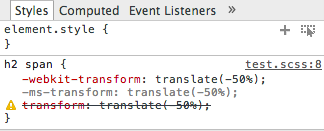
Style tab in chrome shows the scss file Source tab leads to the right source and line

Big thanks to Gerrit and Florian for a nice discussion!

Related Articles