


Hoisting is the process of virtually moving the variable or function definition to the beginning of the scope, usually for variable statement var and function declaration function fun() {...}.
When let (and also const and class, which have similar declaration behavior as let) declarations were introduced by ES2015, many developers including myself were using the hoisting definition to describe how variables are accessed. But after more search on the question, surprisingly for me hoisting is not the correct term to describe the initialization and availability of the let variables.
ES2015 provides a different and improved mechanism for let. It demands stricter variable declaration practices (you can't use before definition) and as result better code quality.
Let's dive into more details about this process.
Sometimes I see a weird practice of variables var varname and functions function funName() {...} declaration in any place in the scope:
// var hoisting
num; // => undefined
var num;
num = 10;
num; // => 10
// function hoisting
getPi; // => function getPi() {...}
getPi(); // => 3.14
function getPi() {
return 3.14;
}
The variable num is accessed before declaration var num, so it is evaluated to undefined.
The function function getPi() {...} is defined at the end of file. However the function can be called before declaration getPi(), as it is hoisted to the top of the scope.
This is the classical hoisting.
As it turns out, the possibility to first use and then declare a variable or function creates confusion. Suppose you scroll a big file and suddenly see an undeclared variable... how the hell it does appear here and where is it defined?
Of course a practiced JavaScript developer won't code this way. But in the thousands of JavaScript GitHub repos is quite possible to deal with such code.
Even looking at the code sample presented above, it is difficult to understand the declaration flow in the code.
Naturally first you declare or describe an unknown term. And only later make phrases with it. let encourages you to follow this approach with variables.
When the engine works with variables, their lifecycle consists of the following phases:
undefined.A variable has unitialized state when it passed the declaration phase, yet didn't reach the initilization.
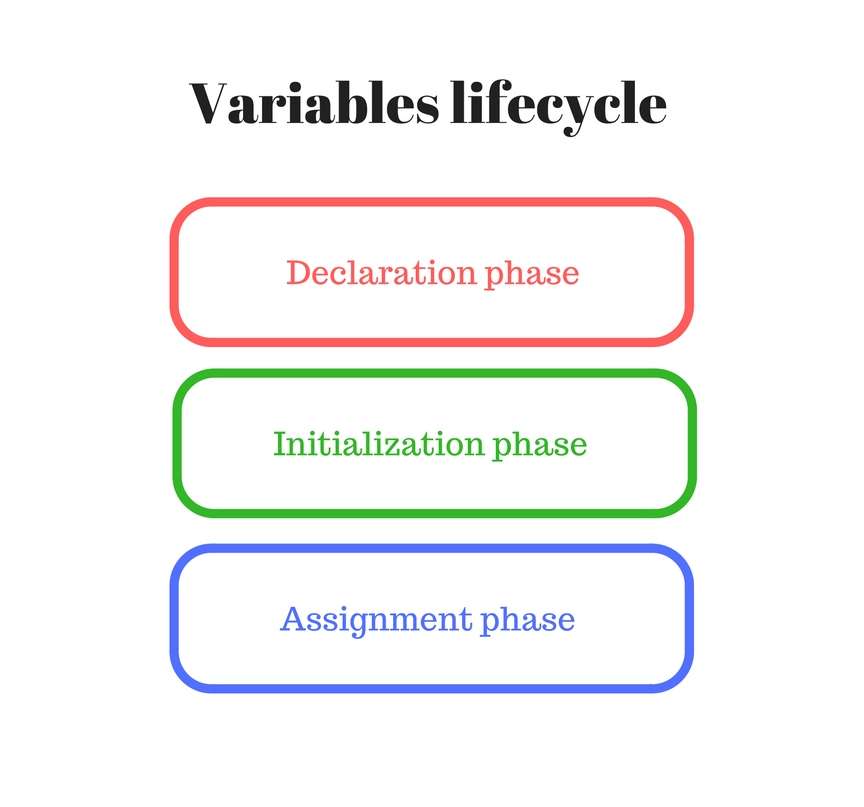
Notice that in terms of variables lifecycle, declaration phase is a different term than generally speaking variable declaration. In simple words, the engine processes the variable declaration in 3 phases: declaration phase, initialization phase and assignment phase.
Being familiar with lifecycle phases, let's use them to describe how the engine handles var variables.
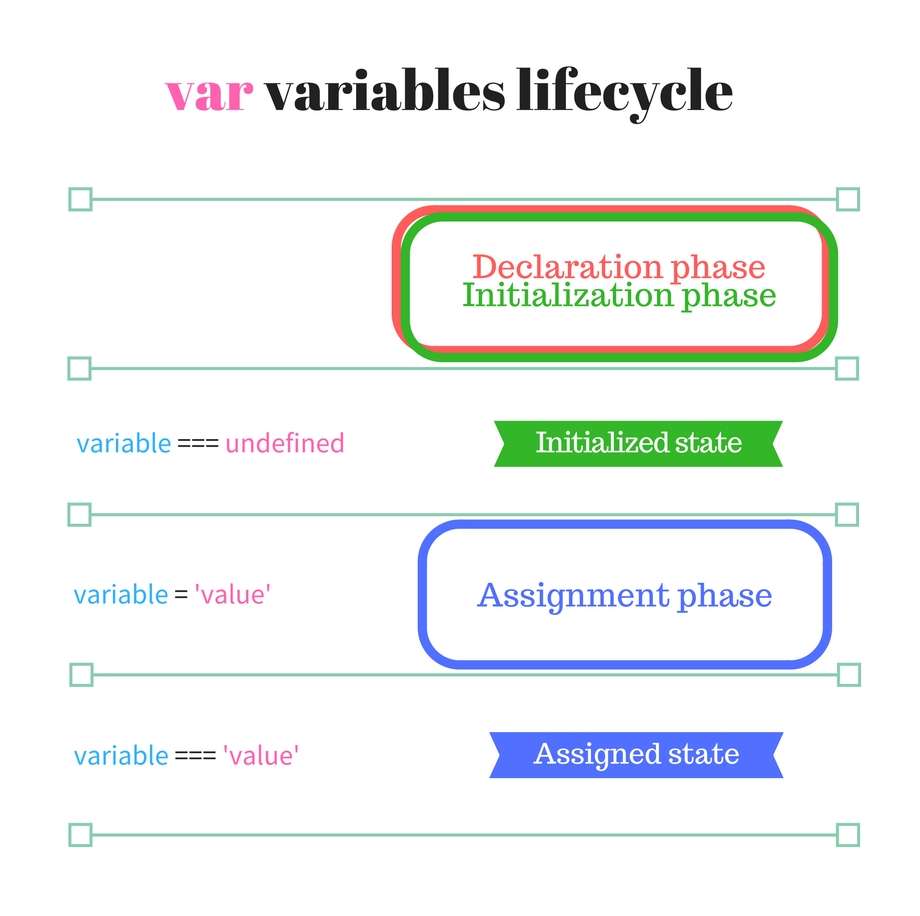
Suppose a scenario when JavaScript encounters a function scope with var variable statement inside. The variable passes the declaration phase and right away the initialization phase at the beginning of the scope, before any statements are executed (step 1).
var variable statement position in the function scope does not influence the declaration and initialization phases.
After declaration and initialization, but before assignment phase, the variable has undefined value and can be used already.
On assignment phase variable = 'value' the variable receives its initial value (step 2).
Strictly hoisting consists in the idea that a variable is declared and initialized at the beginning of the function scope. There is no gap between declaration and initialization phases.
Let's study an example. The following code creates a function scope with a var statement inside:
function multiplyByTen(number) {
console.log(ten); // => undefined
var ten;
ten = 10;
console.log(ten); // => 10
return number * ten;
}
multiplyByTen(4); // => 40
When JavaScript starts executing multipleByTen(4) and enters the function scope, the variable ten passes declaration and initialization steps, before the first statement. So when calling console.log(ten) it is logged undefined.
The statement ten = 10 assigns an initial value. After assignment, the line console.log(ten) logs correctly 10 value.
In case of a function declaration statement function funName() {...} it's even easier.
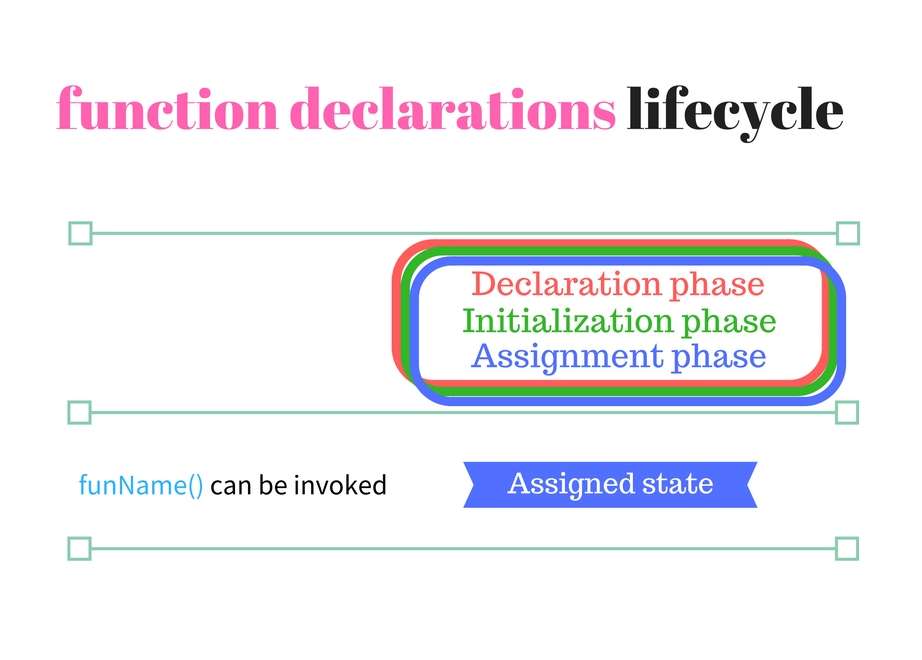
The declaration, initialization and assignment phases happen at once at the beginning of the enclosing function scope (only one step). funName() can be invoked in any place of the scope, not depending on the declaration statement position (it can be even at the end).
The following code sample demonstrates the function hoisting:
function sumArray(array) {
return array.reduce(sum);
function sum(a, b) {
return a + b;
}
}
sumArray([5, 10, 8]); // => 23
When JavaScript executes sumArray([5, 10, 8]), it enters sumArray function scope. Inside this scope, immediately before any statement execution, sum passes all 3 phases: declaration, initialization and assignment.
This way array.reduce(sum) can use sum even before its declaration statement function sum(a, b) {...}.
let variables are processed differently than var. The main distinction is that declaration and initialization phases are split.
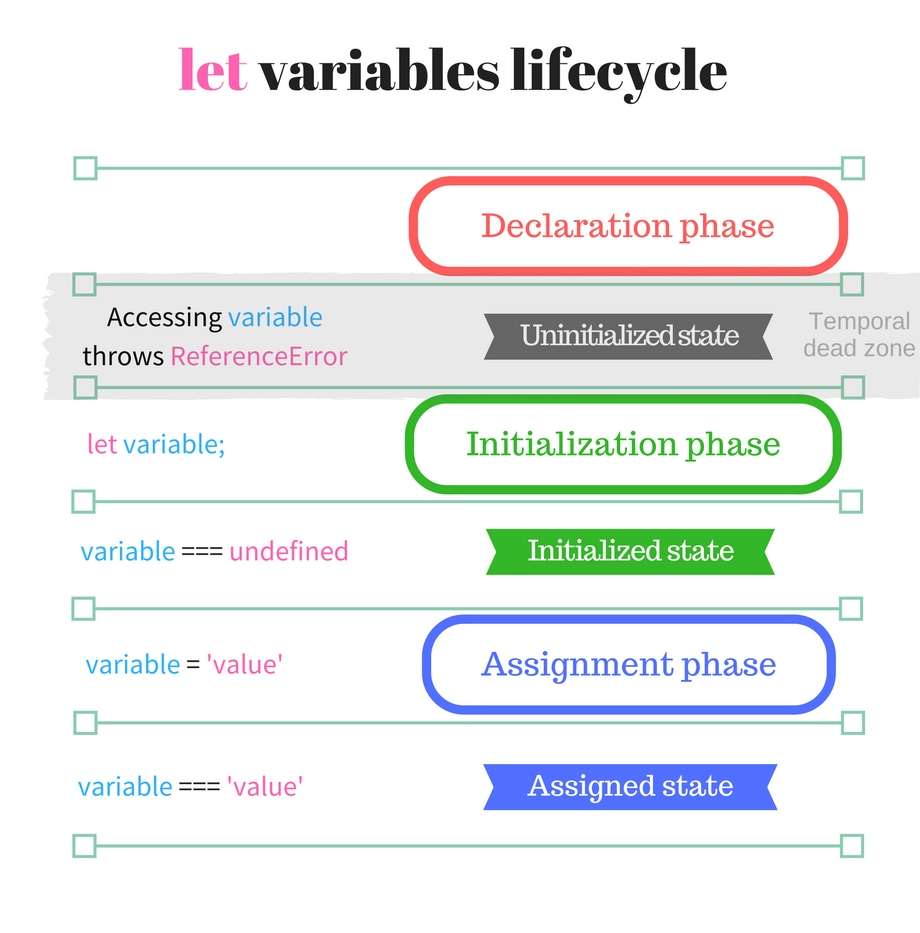
Now let's study a scenario when the interpreter enters a block scope that contains a let variable statement. Immediately the variable passes the declaration phase, registering its name in the scope (step 1).
Then interpreter continues parsing the block statements line by line.
If you try to access variable at this stage, JavaScript will throw ReferenceError: variable is not defined. It happens because the variable state is uninitialized.
variable is in the temporal dead zone.
When interpreter reaches the statement let variable, the initilization phase is passed (step 2). Now the variable state is initialized and accessing it evaluates to undefined.
The variable exits the temporal dead zone.
Later when an assignment statement appears variable = 'value', the assignment phase is passed (step 3).
If JavaScript encounters let variable = 'value', then initialization and assignment happen in a single statement.
Let's follow an example. let variable number is created in a block scope:
let condition = true;
if (condition) {
// console.log(number); // => Throws ReferenceError
let number;
console.log(number); // => undefined
number = 5;
console.log(number); // => 5
}
When JavaScript enters if (condition) {...} block scope, number instantly passes the declaration phase.
Because number has unitialized state and is in a temporal dead zone, an attempt to access the variable throws ReferenceError: number is not defined.
Later the statement let number makes the initialization. Now the variable can be accessed, but its value is undefined.
The assignment statement number = 5 of course makes the assignment phase.
const and class types have the same lifecycle as let, other than the assignment can happen only once.
As mentioned above, hoisting is variable's coupled declaration and initialization at the top of the scope.
let lifecycle however decouples declaration and initialization phases. Decoupling vanishes the hoisting term for let.
The gap between the two phases creates the temporal dead zone, where the variable cannot be accessed.
In a sci-fi style, the collapsed hoisting in let lifecycle creates the temporal dead zone.
The freedom to declare variables using var is error prone.
Based on this lesson, ES2015 introduces let. It uses an improved algorithm to declare variables and additionally is block scoped.
Because the declaration and initialization phases are decoupled, hoisting is not valid for a let variable (including for const and class). Before initialization, the variable is in temporal dead zone and is not accessible.
To keep the variables declaration smooth, these tips are
That's all for today. See you in my next post.
What do you think about variables coding best practices? Feel free to write a comment below!
此内容由惯性聚合(RSS阅读器)自动聚合整理,仅供阅读参考。 原文来自 — 版权归原作者所有。